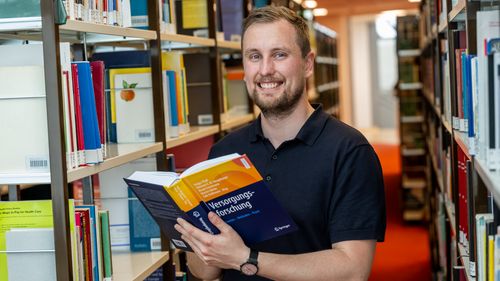

From the “Voluntary Research Year” at the University of Oldenburg to “Jugend forscht”: budding scientist Max Kehrer wins the regional competition.
With his Abitur in the bag – what next? This was the question Max Kehrer from Metzingen in Baden-Württemberg was also asking himself. He achieved excellent Abitur results but couldn’t decide which subject to study at university. Whilst searching online, he stumbled across information about the “Voluntary Scientific Year” (FWJ). “I was immediately excited by the opportunity to get to know research in this way and to work in a scientific environment,” says Kehrer.
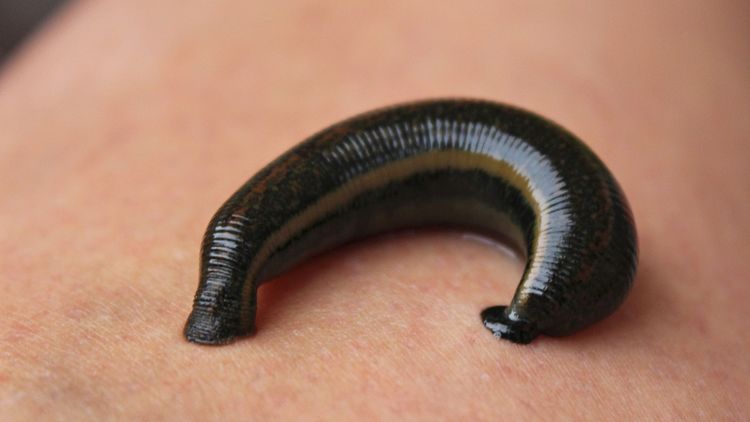
In September 2019, he joined Prof. Dr Jutta Kretzberg’s ‘Computational Neuroscience’ research group at the Department for Neuroscience within the School of Medicine. Here, like other members of the group, he is researching the nervous system of leeches. And he has now achieved a major success: by taking first place in the ‘Jugend forscht 2020’ regional competition in Emden, he has qualified for the state competition.
What do rising temperatures mean for wildlife?
Many people are unaware that young researchers can still take part in the competition even after completing their Abitur, says Kretzberg. The neuroscientist volunteers with the ‘Jugend forscht’ club at the Altes Gymnasium in Oldenburg and suggested that Kehrer take part in the competition. This was a great opportunity for the young researcher, as it allowed him to present his work in the study group as his own project.
Specifically, Kehrer investigated how rising temperatures – such as those caused by climate change – affect the nervous system of leeches. For the scientists in the Kretzberg research group, these animals serve as a model system through which they investigate fundamental mechanisms in nervous systems. Using electrophysiological measurements, Kehrer examined the activity of the leech’s pain receptors at different temperatures. “Based on the results, I developed hypotheses about the processes in the nervous system, which I then tested using computer simulations,” explains the 18-year-old. “We use such simulations to gain a better understanding of how the nervous system functions under different conditions,” explains Kretzberg.
The experiments showed that, whilst the nature of the neural activity changed depending on the temperature, the intensity of the activity did not. “So we were unable to find any clear signs of altered pain perception,” says Kehrer. “Climate change isn’t hurting the leech (yet), but it’s certainly getting on its nerves,” he adds with a laugh.
Kretzberg emphasises that Max Kehrer has raised some good new research questions. Following these insights into everyday research life, the FWJ participant can certainly envisage studying neuroscience – though he hasn’t made up his mind yet.
Successful research
Anyone interested in a “Voluntary Research Year” between 1 September 2020 and 31 August 2021 can still apply. For more information, visit https://uol.de/fwj