
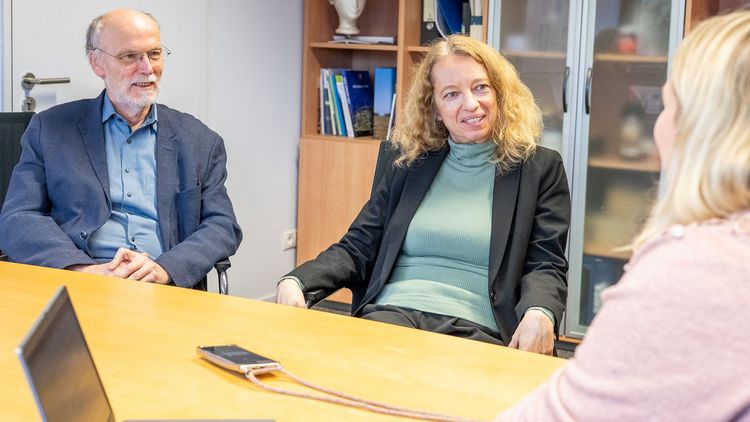

On 1 January, the Hearing4all cluster starts its third funding period - with a new face at the helm. Birger Kollmeier and his successor Christiane Thiel talk about the past and future of the cluster.
Mr Kollmeier, Ms Thiel - you are united by the topic of hearing. What role does hearing play in your everyday lives? Where do you particularly enjoy or consciously listen?
Prof Dr Dr Birger Kollmeier: When making and listening to music, of course. I used to be a more active musician myself, playing guitar, cello and bass guitar and singing - even once with Dieter Bohlen. But that's another story. (laughs) Nowadays, I only make music myself on rare occasions, for example at Christmas. Instead, I usually listen to others at concerts - preferably in The Haus des Hörens, of course, where there is a hall where you can change the acoustics at the touch of a button. The musicians can choose whether they want it to sound like a concert hall or a railway station concourse, for example.
Prof Dr Christiane Thiel: The opposite is true for me. I'm completely unmusical and tend to switch the radio off rather than on. This is perhaps also due to the fact that my family rarely played music: My brother is deaf and my father was a teacher for the deaf. So I was involved with hearing from an early age. The fact that I went into hearing research myself was still more of a coincidence...
Kollmeier:...but an interesting coincidence.
Ms Thiel, in the new funding phase there are once again numerous new perspectives on hearing under the heading "Hearing4all.connects". What are they - and why are they important?
Thiel: Technological progress, especially in the field of artificial intelligence, offers completely new opportunities. For example, when it comes to predicting hearing loss before it occurs. In order to train such systems, we need large amounts of data - and in the same format. That's why we want to develop a large, open audiology database as a first step.
A look at genetics is also promising: using fruit flies that carry human hearing loss genes, we want to look at the molecular basis of hearing and investigate the effects of genetic changes.
Over the next few years, we will also be investigating hearing more closely in the context of social interactions. For example, information on how parents communicate with their hearing-impaired children can provide important insights into language development. We are investigating questions like these.
Mr Kollmeier, hearing research in Oldenburg existed long before the Excellence Strategy. You have a comparison: how has research changed as a result of cluster funding?
Kollmeier: Hearing research has become bigger and bigger over time. I came to the university in 1993. Three years later, we opened the Hearing Centre as a joint institution between the University and the Evangelical Hospital in Oldenburg. Later, together with the Jade University of Applied Sciences, we introduced the degree programme in Hearing Technology and Audiology. Our first application for Cluster of Excellence funding in 2006 set a lot of things in motion within the university - although it was not successful in the end. As a result, we received the necessary funding to strategically prepare for the next round of funding. At the same time, the first Collaborative Research Centre "Active Hearing" was launched. The Fraunhofer Institute for Digital Media Technology (IDMT) set up its Hearing, Speech and Audio Technology division in Oldenburg and we were successful in the next round of the Excellence Initiative in 2012. That was the start of Hearing4all, which made hearing research even bigger, more diverse and in some ways more powerful. We were able to work at full speed on topics that had previously only been dealt with by a small group. And thanks to the cluster, we were able to think research through to the end for the first time, i.e. to the finished product.
What does that mean in concrete terms?
Kollmeier: A good example is the so-called True Loudness method. We have found that people with hearing loss often find their hearing aids far too loud, even though the left and right hearing aids were individually perfectly customised. However, we hear with two ears at the same time - and this led to the effect described, which had not been taken into account at all in the hearing aid fitting until then. This was the result of Dirk Oetting's doctoral thesis. Based on these findings, we were then able to develop a process together with the Hearing Centre, one of our cluster partners, which was launched on the market last year and helps acousticians to fit hearing aids better.
And what impact does the cluster have on the university?
Thiel: Among other things, it contributed to the positive assessment of the model degree programme in human medicine in 2019: the German Council of Science and Humanities highlighted the strong research in neurosensory and hearing research as a "profile-forming feature of university medicine". Hearing4all has also played a role in numerous academic appointments - in that the cluster has attracted hearing researchers in the narrower and broader sense and has also enabled a research infrastructure that is very attractive to scientists from other fields.
Kollmeier: We now have a number of new working groups that are well established. In recent years, we have been able to establish a total of eight new professorships. A significant proportion of the researchers at the university are therefore involved in hearing. The Collaborative Research Centre for Hearing Acoustics is in its second funding phase and hearing researchers are also involved in the Hearable-Centred Assistance Research Training Group. The University of Oldenburg is very well positioned in the field of hearing research, even by global standards. We would never have achieved this without the cluster.
Mrs Thiel, as a researcher you have been part of Hearing4all for a long time. What tasks does the new, additional position as spokesperson entail?
Thiel: It means a lot of organisation - but also dealing with research areas that are not originally my own. As spokesperson, you have to be able to explain what your colleagues are researching and have a good overview. At the same time, I can't always know everything, which is why it's important to me to bring other cluster researchers who represent their respective areas more to the fore in future. We have this team strength and were already able to demonstrate it in our application for the third funding phase. The reviewers explicitly praised this.
Mr Kollmeier, how will your day-to-day work change now that you are retiring from Hearing4all?
Kollmeier: I will still be working at the university for the next four years, but not for the entire duration of the cluster funding programme. That's why I'm no longer involved in Hearing4all as a spokesperson or project leader. In industry, you would probably switch from the Management Board to the Supervisory Board in this situation. We have a similar structure: the centre of excellence for hearing research. This is an organisation of the three universities involved in the cluster, i.e. the Hannover Medical School and the University of Hanover alongside us. In the long term, however, we also want to integrate the University of Göttingen. I am dedicated to setting up this centre of excellence, which is intended to provide a long-term structure for hearing research in Lower Saxony. At present, funding as a cluster of excellence creates a certain structure within which the participants can conduct research together - at least during the funding period. The centre of excellence is intended to consolidate these structures in the long term and sustainably, but also to develop them further.
What have been the greatest successes in the past 13 years of cluster research in Oldenburg?
Kollmeier: Our work has not only improved the fitting of hearing aids. The Oldenburg sentence test, which is available in over 20 languages, is now used in all fitting software for cochlear implants worldwide. This was only possible because our partners in Hanover used the results from Oldenburg and convinced companies that they are the best method for testing speech intelligibility. New algorithms for hearing aids that use artificial intelligence to suppress background noise better than was previously possible with signal processing techniques are also among the promising developments.
Thiel: Basic research has made a substantial contribution to studies on age-related hearing loss in particular. We have also shown, for example, what effects hearing loss has on the brain , i.e. that the proven connection between hearing loss and dementia is not due to a fundamental change in the brain caused by hearing loss - but has other causes that still need to be investigated.
Kollmeier: In recent years, we have also established the triad of hearing research with humans, mice and machines: Hearing tests with humans give us an impression of how various factors affect hearing, experiments with mice allow us to look at the physiology of hearing in detail and with software models we can simulate the hearing process on the computer. All of this provides us with the scientific basis for interpreting and better diagnosing hearing disorders, but also for building better hearing systems.
What role do encounters with people or even those affected play? What do you particularly remember?
Kollmeier: We have a great group of citizen science volunteers who regularly lend us their hearing - 2,000 alone who take part in hearing tests at the hearing centre. I usually meet them at events where my job is to explain to them what we have been able to research with their data. As "System Oldenburg", i.e. with all partners outside the cluster, we are also a point of contact for patients from all over the world who hope to find solutions from us that they could not find elsewhere. However, I am particularly pleased when I meet older people who tell me that they have bought hearing aids because they had previously heard from me that it is important to start early and in both ears. It's great for me to feel the joy of hearing the birds again or gaining something when listening to music.
Thiel: There are also patient advisory boards in the research training groups with whom we work on research topics. I admit that I was a little sceptical at first, but it soon became clear that the members were addressing things that we hadn't even thought of. In one study, for example, we asked about partners and family because we wanted to get an impression of the social environment. The patient advisory board then pointed out that a good network of friends who regularly look after you is at least as important - we hadn't even asked about that before.
Mrs Thiel, what secret recipe from his experience as cluster spokesperson would you like to hear from Birger Kollmeier before you take over the reins?
Thiel: How to find creative solutions within the sometimes rigid rules and guidelines so that good ideas don't fail due to bureaucratic hurdles.
What H4a research success would you like to hear about in the coming years, Mr Kollmeier?
Kollmeier: I would like the hearing aids to be able to suppress background noise so well and always have the right volume that the hearing aid, which I will probably need in a few years' time, will eliminate all complaints.
Interview: Sonja Niemann