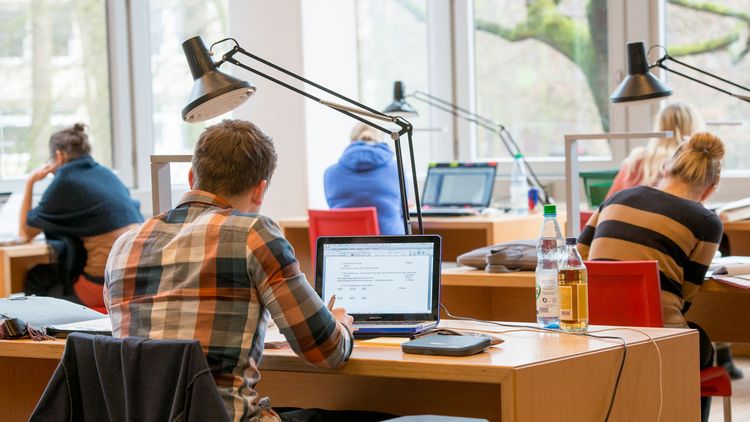

For many students, academic texts present a challenge during their studies. The Lernwerkstatt run by the Central Study Counselling Service – which has been a permanent feature of the university since January – offers support with reading these texts and, above all, with writing their own academic papers.
A blank sheet of paper, an empty page on the screen – the starting point for all texts, whether in academia or elsewhere. That’s how Manuela’s master’s thesis began, too. But it stayed that way for far too long: “I sat there, a blank page in front of me, and after an hour of getting distracted, I still had a blank page,” recalls the 25-year-old. Time slipped by until the library was about to close and it was no longer worth starting to write. She sorted through her collected material again and again “completely haphazardly” – “but that wasn’t productive in the long run,” she says today with a touch of self-deprecating humour.
Manuela is grateful to the Lernwerkstatt at the Central Study Counselling Service (ZSB) for helping her get started with her writing and for having now drafted the first ten pages. During her writing consultation there, she developed an outline “which I’m absolutely delighted with and which I can follow really easily,” says Manuela. “It’s actually quite astonishing,” she adds, almost in disbelief. She also discussed the introduction with Anke Görres before she started writing.
Anke Görres is the head of the ZSB Lernwerkstatt; as its sole member of staff, she essentially embodies the Lernwerkstatt. An organisation that has been a permanent fixture at the university since early 2015, following a decision by the Executive Board. “Writing workshops are now established at most German universities, and certainly in the USA,” explains Görres. From the perspective of the Vice-President for Studies and Teaching, Prof. Dr Gunilla Budde, it has “proved valuable to help students make the transition from gathering ideas and material to producing an academic text – regardless of their subject”.
Demand has risen: compared with 2010, when Görres started in a quarter-time role at the then fledgling Lernwerkstatt, her working hours have tripled. “More and more students are seeking advice on academic writing,” says Anke Görres. The focus is primarily on structural issues, such as organisation and the logic of argumentation. Last year, for instance, Görres coached 150 students in one-to-one sessions, whilst nearly 350 took part in workshops on learning and reading strategies, as well as on presenting and writing. Görres offers office hours on Mondays in her office and on Tuesdays in the library, based on the insight “that a conversation can clarify a great deal – and that it is only through speaking that thought is generated”. When it comes to writing, many students lack such a counterpart.
It was a similar story for Martha. The 28-year-old felt downright ‘overwhelmed’ by the task of integrating the empirical material for her Master’s thesis with the theory, and began to panic. On the advice of a friend, she visited the Lernwerkstatt, hoping “that there would be someone there who could help me sort through my thoughts a bit and structure the process”. She found the experience encouraging and enriching. “Ms Görres may not be at all familiar with the subject matter, but she’s very good at facilitating the transfer of knowledge thanks to her wealth of experience.”
For Görres, the diversity of topics is part of the job. “The range – from education, English and German studies through to economics and ecology – is absolutely fascinating,” she explains. At the same time, she gains an insight into students’ academic journeys. Take Martha, for example, who had hoped in vain for methodology courses during her Master’s degree, and who found that, with the standard practice of writing short presentations – rather than ‘proper’ seminar papers – the theoretical aspect was neglected in retrospect. Or in the case of Anna, who, on a double-subject Bachelor's degree programme in the humanities, reached her final dissertation having written just two seminar papers – and failed.
Görres is particularly surprised “that there are degree programmes in which individual students have not written a single seminar paper before their Bachelor’s degree”. In their efforts to accumulate credits for their degree, some apparently do not – or have not – taken the time to delve into a topic academically. Many have shortcomings when it comes to research and linking reading with the writing process. “Some also lack an awareness of what they are actually doing here, or what scholarship actually is.” She would like to see the “key competence” of writing given appropriate priority for all students right from the start of their studies.
Professor Albrecht Hausmann, a German studies scholar, can only emphasise this point. He regards writing as “part of the academic process of discovery” and as crucial to a successful degree programme. However, the constant pressure of examinations within the Bachelor’s–Master’s system may diminish the learning benefits of seminar papers: Some students lose interest in feedback as soon as they have received their credits. Many are also unsure what academic writing entails, believing that ‘the main thing is to make it complicated’, when in fact the principle should be ‘the main thing is to be reflective’.
Historian Budde observes not only a decline in writing skills but also a reduction in reading literacy amongst students. “Some cannot even name a favourite book; very few read newspapers; many now only get their information online,” she says. “The way information is absorbed has become fragmented.” This is reflected in their writing. She has them practise writing introductions specifically and recommends reading good texts. “We want to give students the sense of achievement that comes from producing their own academic work – the satisfying feeling of putting their thoughts down on paper.”