

To gain an insight into academic work, get to know the university and gain clarity about his choice of degree and career: these were the goals Enno Gronewold set himself when he began his Voluntary Academic Year. Seven months on, he takes stock.
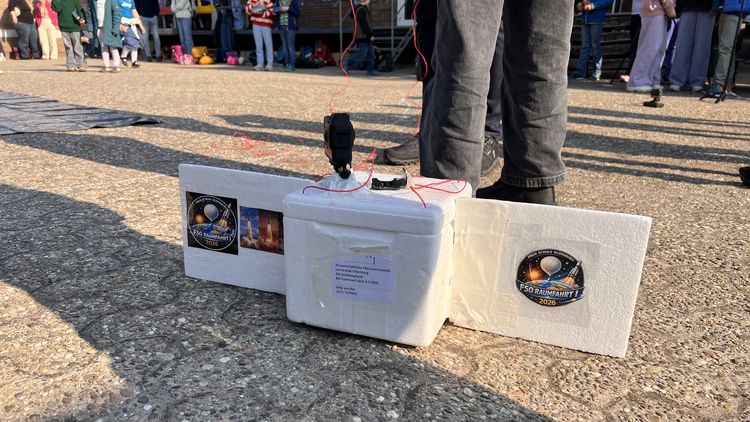
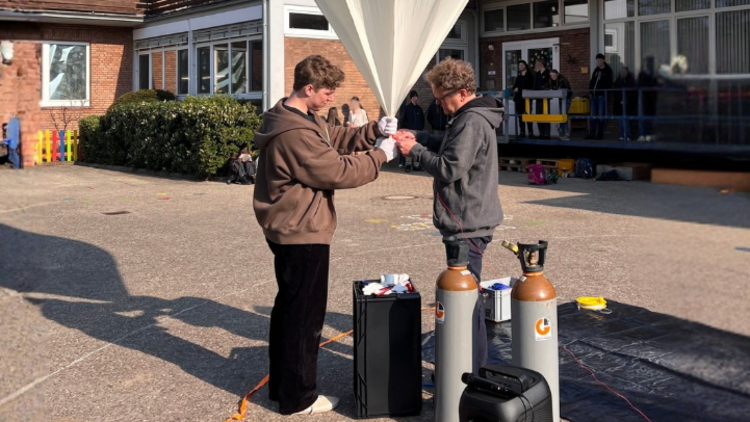
Enno Gronewold strides briskly across the school playground. He’s looking for some new adhesive tape to secure cameras to a white polystyrene box. They need to be windproof – that’s the only way to guarantee impressive shots. “You can never stick them on too firmly,” calls out Björn Poppe, professor and head of the Department of Medical Radiation Physics and Space Environment, from a few metres away. Gronewold is already holding the tape and the box in his hands. “Here, hold this for a moment,” he says to a child. The boy, who then helps to attach the cameras, understands immediately. After all, they have been preparing together for weeks for what needs to be done now. They want to send a weather balloon right to the edge of space.
At the start of his Voluntary Scientific Year (FWJ) at the University of Oldenburg, Gronewold hadn’t expected to be involved in such an exciting schoolyard experiment. “This is one of the highlights I’ll still be remembering for many years to come,” says the 20-year-old.
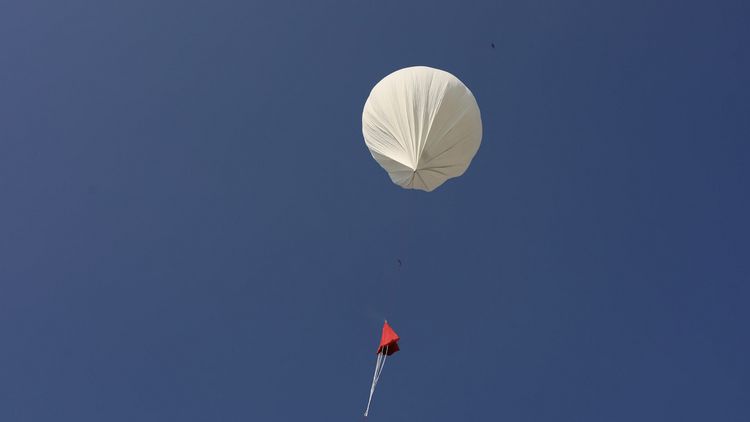
It’s the perfect day for it: mild temperatures and a cloudless sky provide ideal conditions. All the other preparations are also going like clockwork – in the truest sense of the word. A white balloon, reminiscent of a bed sheet, is being filled with helium. Strings and tape prevent the helium from escaping. A red parachute is set to ensure a soft landing later on. Inside the white polystyrene box, which turns out to be a probe, are three cameras, a mobile phone system and a GPS system. As well as the children taking part, there are also lots of onlookers gathered around the balloon. They stream out of the classrooms to witness the balloon flight up close, together with their teachers. Gronewold and Poppe are slightly tense. After all, nobody is to be disappointed today.
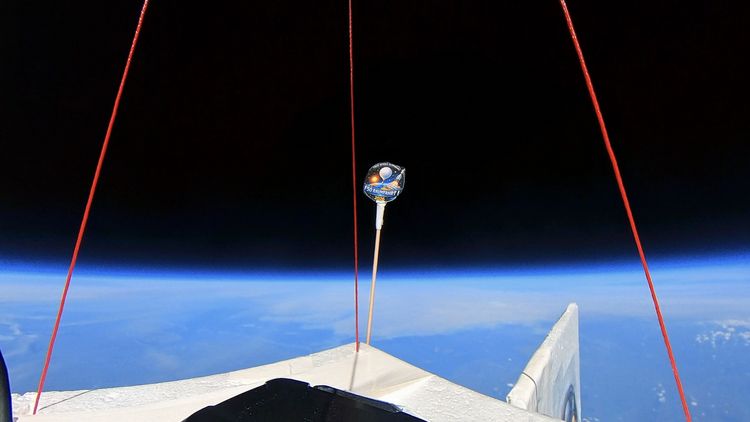
Now things are getting noisy: first the countdown, then cheers. The balloon has taken off successfully. It eventually soars 36 kilometres into the sky before bursting and landing in a tree canopy near Achim. In the process, alongside landscape shots, photos and videos were taken from the edge of space, as the balloon had in fact risen as far as the stratosphere. Mission accomplished!
For the experiment, Gronewold ran an ‘Astro Club’ with Poppe over several months for the primary school pupils at the Freie Schule Oldenburg. The programme focused on teaching the children about space, the atmosphere and the planets. “Everyone enjoyed the balloon flight today. Special activities like this really spark an enthusiasm for science,” says Gronewold. Working with the children once a week was a labour of love for him: “I really enjoyed it. I learnt how to bring research to life for young people.”
A year full of insights
Last year, Enno Gronewold was made aware of the Voluntary Scientific Year at the university through personal contacts. “It came at just the right time for me,” he says. Although he had been interested in physics and mathematics after Abitur, he hadn’t yet wanted to commit to a specific degree programme. The FWJ offers him the opportunity to gain insights into research projects and work processes, as well as to explore study and career options. Accompanying workshops and an English course round off the year. He can also attend lectures, for example in astrophysics. “Now I’m certain that I want to study physics after the FWJ,” he says. “Preferably at the University of Oldenburg.”
His supervisor, Björn Poppe, is delighted. “Enno Gronewold is the first FWJ participant in our department. It’s great that he’s enjoyed his time with us so much.” Gronewold: “I was able to help shape my year right from the start. I hope that future FWJ participants will have similarly wonderful experiences.”