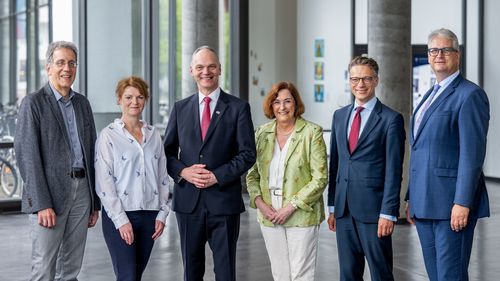


Rethinking education without abandoning the tried and tested: On the initiative of the University of Oldenburg, experts held a discussion at Herrenhausen Palace in Hanover. An interview with the Rector of the University of Siegen and Vice President of the German Rectors' Conference, Prof Dr Holger Burckhart.
QUESTION: New technological developments such as Massive Open Online Courses (MOOCS) and video tutorials are changing university teaching. Do German universities in particular need to rethink education in this context?
BURCKHART: German universities must face up to all social and technological challenges. This includes digitalisation, which relates to administrative university processes as well as research and teaching. In terms of university teaching, digital teaching formats such as MOOCs or video tutorials have potential. This potential lies in the greater flexibility, individualisation and self-organisation of teaching. In addition, the forms of innovative didactics associated with digitalisation and the new formats of collaborative learning can enrich conventional teaching. However, this is not about completely replacing conventional teaching, but rather an intelligent combination of old and new. After all, a prerequisite social interaction such as learning requires a minimum level of personal trust and an interplay of different sensory impressions, which can be guaranteed in particular through face-to-face communication.
QUESTION: How relevant are Humboldt's educational ideals for you?
BURCKHART: Humboldt's educational ideals are still relevant, but they need to be reinterpreted against the backdrop of today's social, economic and technological realities. The connection between education and freedom emphasised by Humboldt is still valid. In the higher education sector, this is reflected both in the freedom of research and teaching, but also in the free choice of educational pathways. For this reason, state regulation, such as an artificial shortage of study places, would not be compatible with Humboldt's educational ideal. Humboldt's thesis that education is a prerequisite for a humane existence is still true. In the context of university teaching, we must therefore not ignore the aspect of students' personal development. However, this does not exclude preparing students as well as possible for their future academic appointments.
QUESTION: Can universities only train active citizens for democratic societies if educational goals are readjusted or at least reconsidered?
BURCKHART: On the one hand, universities must have a high degree of autonomy, especially in relation to the state. On the other hand, however, they cannot and must not close themselves off from their social environment. On the contrary, universities - like other educational institutions - contribute to the development of students' personalities. In addition to the ability to analyse, reflect and make normative assessments, this also includes communicative skills. These are also key prerequisites for active citizens in democratic societies.
QUESTION: With regard to the educational mission of universities, where do you see the greatest challenges for the future?
BURCKHART: Universities have to face up to current challenges. This applies, for example, to internationalisation, individualisation, diversity and inclusion. However, it is important to develop concepts that are compatible with Humboldt's ideal of self-direction in science. Therefore, in close dialogue with the universities, policymakers should only set a framework for overcoming these challenges and leave the concrete design to the universities. The universities' different strategies for specific challenges will also ensure the diversity of the higher education landscape. One thing is clear: Only universities that are diverse and have a division of labour can do justice to the increasingly heterogeneous social and technological developments.
QUESTION: What is your motivation for taking part in the symposium?
BURCKHART: I am looking forward to the discursive exchange on both classic and new educational ideals. It will be interesting to bridge the gap between the ideals and the current educational mission of universities. I will try to contribute my experience as a university lecturer, university director and Vice President of the German Rectors' Conference for Teaching and Studies, Teacher Training and Lifelong Learning. I am also looking forward to hearing the experiences and insights of the other symposium participants. I can certainly "educate myself further", in line with the title of the event.