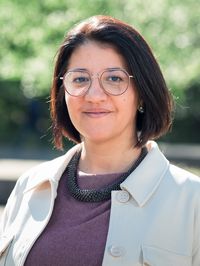
I come from Brazil and did my doctorate in São Paulo in the field of vascular biology. I've been doing research as a cardiologist at the University of Oldenburg for five years, I've been a postdoc at the Department of Internal Medicine since 2020 and head of experimental cardiology since 2024. I now have responsibility for an entire laboratory, for a team, for students.
We use 3D technology to develop so-called bioresorbable tissue scaffolds. Our aim is to use them to accelerate the healing of the endothelium in the coronary arteries after a heart attack. The speciality: The scaffolds are made of polymers, dissolve in the body after a few months and accelerate the recovery of the vessel - in contrast to conventional metal stents, which keep formerly blocked vessels open for several years without medical necessity. I am very interested in the subject and I know how to approach the whole thing scientifically.
However, I didn't know how the academic system in Germany works and how relevant a habilitation is for career advancement, for example. German is not my native language. I also have no training in leading or managing people. The "Progressio" programme has helped me to develop my skills in these areas. It has given me the opportunity to think calmly about how I envisage my academic career. There is little room for such reflection in my regular working life - between experiments, teaching and meetings.
In the workshops, I was able to expand my skills in communication and conflict management. I was able to find out which management style suits me best. My mentor was also very important in this process. I met with her several times over the course of the year and we remain in contact even after the programme has ended. She is objective, but also lets me share personal experiences that have led to her current position. It was very helpful for me to hear from a woman in a managerial position from and in Germany that it is not always easy to get there. I realised that I experience many challenges not only because I come from abroad. Unfortunately, a lot of it also has to do with the fact that I am a woman.
This was also made clear to me in my dialogue with the other mentees. We have similar issues that concern us. The majority, for example, have families and regularly ask themselves: How can I reconcile paid work and career ambitions with household and childcare? How can I get involved in science when it's clear that there won't be a permanent contract for the time being? When I came to Germany in the middle of the coronavirus pandemic, I felt very isolated. In the meantime, I have built up a wide professional network, also thanks to "Progressio".
I can imagine staying in Oldenburg for longer. In São Paulo, a city with around twelve million inhabitants, it took me at least two hours to get from home to work. Everything is much quieter here, with shorter distances and lots of nature. That suits my life as a single mum. I also have the feeling that there are already more women in leading positions in the medical-academic world in Germany than in Brazil. That inspires me.