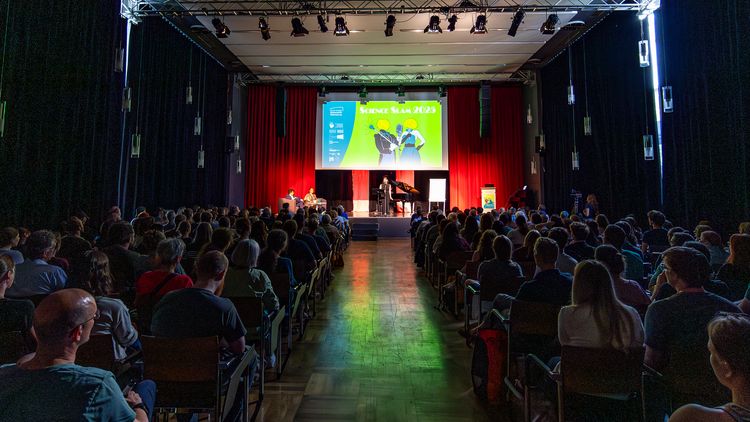


Complex research presented in an accessible and entertaining way: at the Science Slam on 17 June, scientists will take to the stage to present their own work. The audience decides who scores the most points. Anyone wishing to attend can register now.
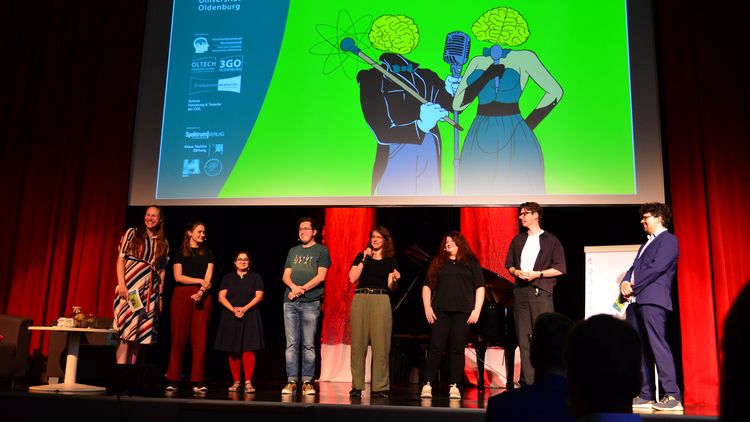
What causes some jellyfish to glow in the water? How do wind turbines communicate with one another – and how does our sense of hearing distinguish between the timbres of musical instruments? Conveying research in an accessible way whilst being creative and humorous: that’s what the Science Slam, hosted by the University of Oldenburg on 17 June, is all about. Five early-career researchers will be taking to the stage.
Spontaneity and PowerPoint karaoke
The ‘slammers’ have ten minutes to present their own projects to the audience in short, entertaining talks. ‘The appeal of a Science Slam lies above all in its dynamism,’ says organiser Dr Nina Gaßmann. “The order of the presentations is decided by drawing lots, and nobody knows in advance how the evening will turn out. It’s like a goody bag from which everyone takes home something lovely.”
A highlight of the supporting programme is ‘PowerPoint Karaoke’. In this, two professors from the University of Oldenburg present each other’s talks – without any preparation and without knowing the topic. “It’s a chance to get to know our lecturers from a completely different angle. That alone makes it worth attending,” Gaßmann continues.
At the end of the evening, the audience votes by applause to decide which slam performance was the most convincing. The winner receives the ‘Golden Brain’ prize, worth 500 euros, sponsored by the University of Oldenburg’s Graduate Academy.
Presentation of the Open Science Prize
As part of the event, the University Society of Oldenburg e.V. (UGO) will also present the Open Science Prize, which comes with a cash prize of 1,000 euros. Since 2023, the UGO has been using this prize to honour projects and initiatives at the University of Oldenburg that actively promote the transparent and publicly accessible communication of research findings. The Science Slam is organised by the Research Centre Neurosensory Science, the Graduate Academy and the Graduate Schools for Social Sciences and Humanities (3GO) and for Natural Sciences, Medicine and Technology (OLTECH).