


In a seminar paper, two students have set out on the trail of an unusual plant collection at the State Museum of Nature and Man - and published their first scientific paper.
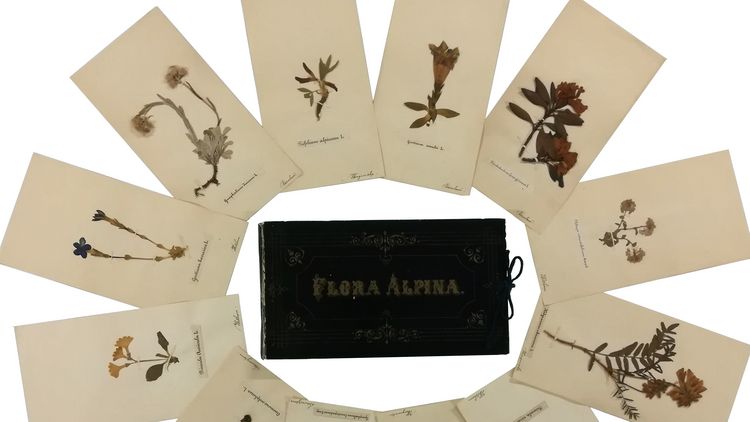
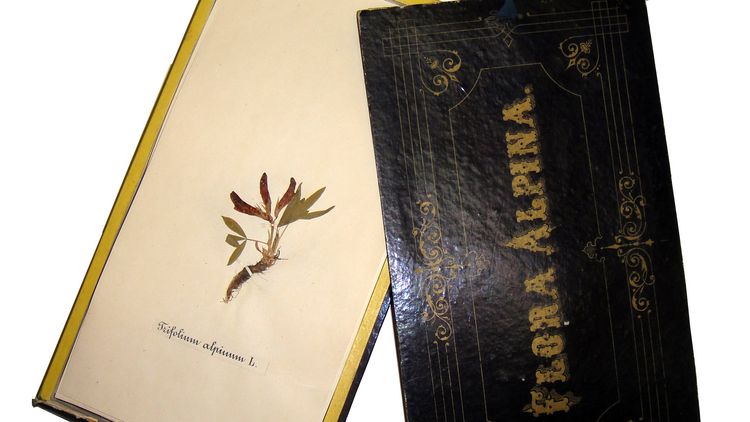
They are only a few centimetres in size, dried and faded - but still recognisable: 25 plants from the Alps, neatly mounted on small sheets of paper and stored in a small box. "I noticed the collection straight away because the plants it contains are so small and it looks different to scientific herbaria," says Dr Maria Will.
The biologist, who researches and teaches at the University's Institute of Biology and Environmental Sciences, discovered the gem - the pages are only about half the size of a handkerchief - during her time as a scientific volunteer at the Oldenburg State Museum of Nature and Man (LMNM). So she didn't have to ponder for long when she was looking for an assignment for a final project that students were to write in the seminar "Learning from things - university collections as teaching and learning objects". The as yet unexplored "Flora Alpina" posed plenty of puzzles: Why was the herbarium so tiny? Who had collected it? And who did it belong to?
"In our seminar, students learn how scientific collections are created and what they are actually good for," explains Will. "But the students also practise how to describe an object scientifically and how it should be stored and preserved. And we ask what different themes we could convey with a particular object," she adds.
Deliberately collecting small specimens?
In the summer of 2018, two candidates were quickly found for the task of taking a closer look at the "Flora Alpina" from these perspectives: Nele Charzinski and Annika Halfter, who are both now studying for a Master's degree in Biology. "Maria got us carried away with her enthusiasm and the question of what is special about the herbarium," says Charzinski.
In order to describe the collection correctly, the students first identified each species it contained using specialised botanical literature. A laborious endeavour: "We only had the dried specimens in our hands," reports Halfter. And these provide far fewer clues as to their origin than a fresh plant, for example because the typical scent is missing or the flower colour is difficult to recognise. However, with the help of digital, high-resolution images that they took themselves, Charzinski and Halfter were finally able to identify almost all the species.
Only then did the students try to find out what the herbarium en miniature was all about. From the young researchers' point of view, there were various possible reasons for this - such as a certain aesthetic or the desire to save material and space. In fact, comparisons with literature data and similar herbaria showed that the specimens in the collection are significantly smaller than the average size of the plants found in the Swiss Alps. "We therefore suspect that someone has deliberately collected particularly small specimens in order to create a kind of aesthetic mini-herbarium - without any particular scientific claim," says Halfter.
Communicating species conservation and the loss of biodiversity
The students and lecturer finally tracked down the age and origin of the collection together. In an internet search, they tracked down three similar herbaria in online antiquarian bookshops and auction houses. They finally estimated that the Oldenburg "Flora Alpina" must be older than 160 years. "The printed labels also suggest that the collection is a souvenir that someone might have brought back from a holiday," adds Charzinski.
The students summarised their findings in a report with the help of their lecturer - and recently published it in the LMNM's museum journal. "It's really something special that the students were able to work so closely with the museum and even write their first publication," says Will. It was only after this work that a small but important detail emerged thanks to another project: the herbarium very probably came from the estate of a Grand Duchess of Oldenburg. In 1877, the museum noted the donation of a "collection of mountain species" in its accession book. "Of course, this makes the small collection even more valuable," emphasises Will.
For the biology lecturer, the students' work has shown the value of historical herbaria: "Many of the species in the "Flora Alpina", such as the Alpine edelweiss, have become rare today," she explains. "The collection also allows us to document and communicate issues such as species conservation and the loss of biodiversity."