
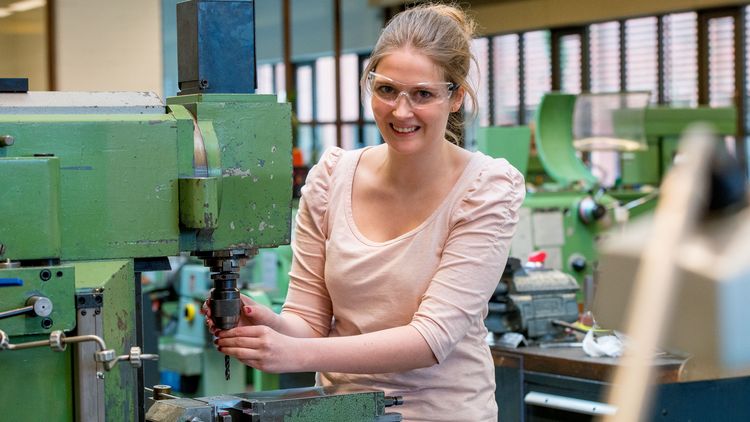

For me, my job is more than just a daily routine – working with metal is a passion. Long before I finished Abitur, I knew I wanted to work with my hands. My father and my sister are interior designers; perhaps that’s where my enthusiasm for craftsmanship comes from. What I particularly like about my apprenticeship as a precision engineer at the University’s Mechanical Workshops is that the work is so varied and diverse. We work with many different materials: stainless steel, aluminium, plastic and brass. They all have very different properties. When you’re working with them, you always have to adapt accordingly.
I help to produce prototypes for research. I’m involved in the entire process: from the engineer’s drawing, through the individual manufacturing processes, right up to the finished workpiece. We don’t produce large quantities; instead, we make what are essentially one-off pieces. In this way, we help scientists gain new insights through their research. It’s all absolutely fascinating!
I’m now in my third year of my apprenticeship and have already worked in many different areas here in the Mechanical Workshops. At the moment I’m in the plastics workshop; before that, I worked on the waterjet cutting machine. I enjoy working with this machine the most. In waterjet cutting, the material is cut by a high-pressure water jet. This jet generates very high pressure on the surface, which is how it cuts the material.
During my apprenticeship, I’m learning to work with great precision. After all, as precision mechanics, we’re working in the thousandth-of-a-millimetre range. For this profession, you need not only a keen interest in the various materials we work with every day, but also a head for numbers. We often use mathematical formulas, for example to work out rotational speeds or to calculate the thermal expansion of materials.
I don’t mind that most of my colleagues are male. There are nine of us precision engineering apprentices in total, three of whom are women. I’ve got my final exam at the end of the year. Perhaps I’ll start a degree course afterwards – but it will definitely have to be related to metalwork.
Written by: Daniela Reile


