

People in Germany are among the seven percent of the world’s population that still lives in a liberal democracy. We all have a part to play in preserving it, political scientist Jan Sauermann writes in his article marking this year’s anniversary of the “Grundgesetz”.
Robert Dahl, one of the most influential democratic theorists of the 20th century, understood democracy as an ideal political system, one that fully implemented the wishes and preferences of all its citizens. In reality, this ideal will probably never be fully achievable. Dahl therefore coined the term “polyarchy” to describe actual modern political systems that come as close as possible to the democratic ideal. However, “polyarchy” never entered popular usage, and as a result the word “democracy” is generally used to refer to both the ideal political system and actually existing political systems.
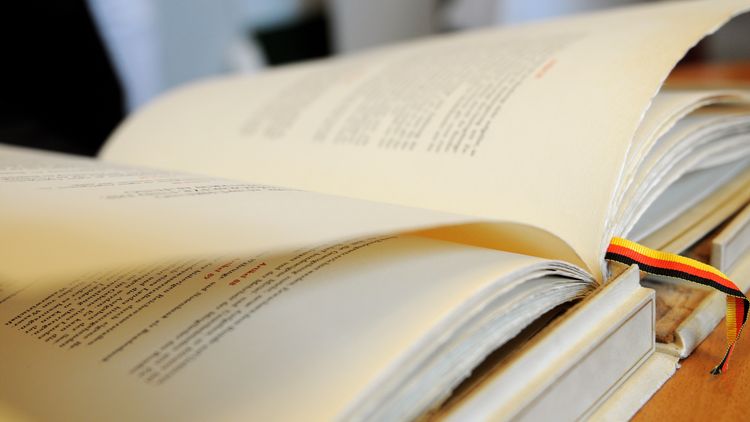
This dual meaning of the concept of democracy should serve as a constant reminder that true democracy always entails a certain degree of imperfection. Winston Churchill put it succinctly when he described democracy as “the worst form of government – except for all the others that have been tried from time to time.” This is especially true as regards our constitution, the “Grundgesetz” (Basic Law), the proclamation of which 77 years ago we are celebrating today. Despite all imperfections, we in Germany have never enjoyed a greater degree of freedom or prosperity than under the liberal democratic order enshrined in our Basic Law.
According to Dahl, a defining feature of polyarchies is the best possible implementation of two dimensions. First, there must be open political competition in free, fair and regularly held elections in which parties or candidates compete with one another for the votes of the electorate. The second dimension is participation, whereby as many citizens as possible are able to engage in the political process. The right to vote and the right to stand for election must therefore apply universally. If these two dimensions are underpinned by an effective separation of powers and protection of minorities, a functioning rule of law and the implementation of civil liberties such as freedom of expression, freedom of the press and freedom of assembly, the system is referred to as a liberal democracy.
Based at the University of Gothenburg, the international research network Varieties of Democracy (V-Dem) compiles an annual report on the state of democracy worldwide. In its 2026 assessment, Germany is classified as one of only 31 stable liberal democracies. Our country thus belongs to the group of nations in which the democratic principle is most fully realised. Unfortunately, this group of countries has shrunk over the last 20 years. Whereas 17 percent of the world’s population still lived in a liberal democracy in 2005, by 2025 that figure had dropped to just 7 percent – the lowest it has been since 1978.
On a global scale, democracy is currently on the defensive, and the three defining characteristics of liberal democracy – competition, participation and the protection of minorities through civil liberties and the rule of law – are increasingly under threat from radical and populist forces, also in Germany.
What can be done to counter this trend? The democracy theorist Samuel Huntington postulated that democratisation occurs in global cycles, or waves. A wave – in other words, a phase of democratisation such as that experienced from the 1970s to the 2000s in almost every region of the world – is quite naturally followed by the regressions of what he called a “reverse wave”. According to this view, the current reverse wave will also end at some point, and another wave of democratisation will ensue.
Personally, I do not believe that democracy is an inevitable and unchangeable natural phenomenon, governed by a cycle of ebb and flow. I believe in the Aristotelian concept of human beings as zoon politikon, or “political beings”, capable of actively shaping the conditions of their coexistence.
Here in Lower Saxony, we will have plenty of opportunities to do this in the coming months. Local elections are scheduled for September, and a new state parliament is due to be elected in autumn 2027. Democracy cannot thrive solely on the basis of people turning out to vote, an act by which we merely consume democracy passively. If we truly want to counter anti-democratic forces, we must participate actively and constructively in shaping our community. In the context of elections this means, for example, getting involved in political parties and being willing to stand for office. Outside of elections we participate by volunteering in groups, associations and other organisations that support our community.
It is understandable that people feel discouraged by the multiple crises of our time. But if a large number of us engage and actively participate, together we can preserve our free and democratic society, even in difficult times. In my view, this is absolutely worth the effort.