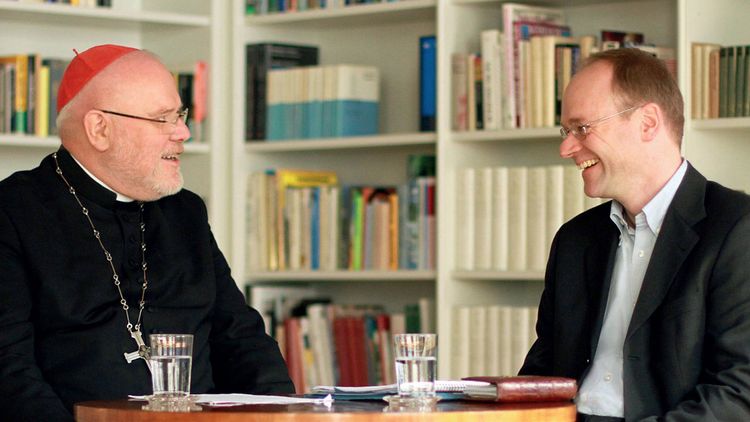

"Faith and Education" is the title of the book by Reinhard Cardinal Marx, Archbishop of Munich and Freising, and the Oldenburg educational scientist Prof Dr Klaus Zierer, which will be published in April. We are publishing an article from it in advance - in which Zierer sheds light on the changing university system.
Looking back, the words of former German President Roman Herzog from 1997 seem visionary: "Let's unleash new forces by breaking bureaucratic shackles," he emphasised at the end of his speech at the Berlin Education Forum, concluding with the words: "Let's set our education system free." Roman Herzog's intention was to modernise the education system, which in future must be characterised by six characteristics: "which is firstly value-oriented and secondly practice-oriented, which is thirdly international and fourthly diverse, which fifthly allows competition and sixthly uses the resource of time sensibly."
Colleges and universities should be organised in a market economy.
In the meantime, the framework conditions in all areas of the education system have changed and most of these demands have (apparently) been stopped. In this context, colleges and universities should be emphasised, as they have had to undergo and still have to undergo profound change. The reason for this is not least the Bologna Process and subsequent reforms. As a result, colleges and universities are to be organised in a market economy and grow into companies: commercialisation, privatisation, profiling and globalisation are key challenges in this context. The higher education system becomes a market and competition becomes a regulator. Following Michel Foucault, one can interpret the associated setting of self-regulation as a new level of governance.
However, current developments show that this market model cannot be easily reconciled with the academic model. For example, it is still unclear how the role of the state should be viewed in this process. Is it limited to its supervisory and control function in the sense of an employer or does it attempt to intervene strategically in the market? Similarly, freedom in research and teaching, as propagated by Wilhelm von Humboldt, is increasingly being pushed back. In endeavouring to attract as much third-party funding as possible, academics must be guided by the rules of the market rather than the rules of the subject. In the same way, Bachelor's and Master's degree programmes regulate teaching in terms of content and organisation. In view of these developments, it is obvious that critical voices are being raised and the idea of academic freedom is being jeopardised: Are colleges and universities more unfree than ever today?
"Excellence Initiative serves a monopoly mechanism."
This calls into question the very idea of the market, as is clear from the example of the Excellence Initiative of the federal and state governments. If this initiative was launched with the aim of forcing competition for the best locations and thus for the best minds and ideas and allocating the corresponding resources on the basis of an unambiguous performance principle, it runs the risk of reducing the competition itself to absurdity. This is because there is no equality of opportunity in this context; instead, the Excellence Initiative serves existing inequalities and thus a monopoly mechanism. This can be seen in the fact that those who already have a lot get even more and those who have little get even less. Robert K. Merton has described this phenomenon as the Matthew effect. In short, the plan to transform the scientific community into a market fails because of the market model itself.
Furthermore, this market has no price mechanism, only a system of indicators that sets standards. These are primarily the amount of certain third-party funding and the number of peer-reviewed articles in journals with a respected impact factor. This brings the aforementioned idea of self-regulation into criticism: its centrepiece is statistics that are not only obtained at a national level, but increasingly at a transnational and supranational level. One example in this context is the OECD and the Bertelsmann Foundation, which use statistics and rankings to influence the further development of the science market.
"Gaming the system": Hands off monographs.
A rule of numbers is emerging, a numerocracy that has the power to become self-fulfilling prophecies: If you want to attract certain third-party funding, you have to adhere to the relevant guidelines and organise your proposals accordingly. If you want to get a lot of articles published in the so-called A journals, you have to publish your research in the smallest possible portions in English and preferably refrain from writing a monograph. James Rieley calls this strategy "gaming the system". However, it is becoming increasingly clear that this standardisation and metrisation is questionable, both in terms of generation and significance: as Richard Münch describes it in his book "Academic Capitalism", there is an over-research of trendy topics with simultaneous under-investment in high-risk research. Originality and diversity in research and teaching are lost.
At this point, it is worth taking a look back at the "founding texts" of the founding fathers of Berlin University in the 19th century, which are often cited in this context as a model that must be adhered to and must not be "sold": Johann Gottlieb Fichte, Friedrich Daniel Ernst Schleiermacher and Wilhelm von Humboldt. In their writings, they all attempted to influence the reorganisation of a university. Three points were at the centre of this discourse.
Freedom of purpose of science, freedom in research and teaching, unity of research and teaching.
Firstly, the autonomy of the university with simultaneous sponsorship by the state: science is seen as a problem that has not yet been fully solved and is therefore always in the process of being researched. For this reason, science must be freed from state and social interests, while at the same time being based on financial security. This must be guaranteed by the state, but the state must not derive any claims to power from this.
Secondly, freedom in research and teaching: The freedom of purpose of science just mentioned implies freedom in research and teaching, which is valid for both teachers and students. Everyone at the university should be able to decide for themselves which subject they devote themselves to using which methods.
And thirdly, the unity of research and teaching: If science is seen as something processual and inconclusive, then research and teaching must be intertwined. Consequently, a hierarchical relationship between students and professors must be replaced by a collegial one.
The idea of academic freedom was never realised.
The presentation of the idea of academic freedom, as it is currently being discussed following Johann Gottlieb Fichte, Friedrich Daniel Ernst Schleiermacher and Wilhelm von Humboldt, must not end without pointing out that it itself was never realised. In this respect, one can also speak of a myth.
With regard to the intention of the reform, the two positions presented - the idea of a science market and the idea of science following Wilhelm von Humboldt - do not seem to differ too much from each other: Both are concerned with knowledge evolution. In view of the analysis and criticism presented, however, it is clear that the paths to this goal are diametrically opposed.
Bologna Process: Teaching degree programmes are particularly affected.
It is obvious that teaching degree programmes are particularly affected by the developments outlined: They allowed for a variety of combinations of subjects and were completed by a State Examination. With the Bologna Process, they are now being converted to competence-oriented, consecutive and polyvalent Bachelor's/Master's degree programmes, which is causing difficulties from an organisational point of view alone, because almost every Federal State is going its own way. It should not be overlooked that in almost all cases teachers are employees or civil servants of a Federal State and for this reason alone the governments feel obliged to intervene in the intended autonomy of the universities.
Professional relevance in teacher training: a loss of academic rigour?
In addition, since this change, the relationship between theory and practice in teacher training has been increasingly discussed and the term "professional relevance" has been used. The core idea here is that prospective teachers should apply what they have learnt at university as early as possible in a professional field, usually in schools - which for critics also means a loss of academic rigour and subsequently raises the question of the place of teacher training. In this respect, the type and number of internships are up for discussion, as are the content and duration of the degree programme. Both are directly related to the so-called second phase.
In addition, universities are endeavouring to use aptitude tests at an early stage to recruit only those people for a teaching career who appear to be up to the associated demands. Whether this can fulfil the demand for lifelong learning, which is also made for the teaching profession, is doubtful - also in view of the complexity of the human being.
Prof. Klaus Zierer's article is the introduction to the chapter "University and teacher training" in the book "Glaube und Bildung: Ein Dialog zwischen Theologie und Erziehungswissenschaft" by Reinhard Marx and Klaus Zierer. The book will be published in April by Verlag Ferdinand Schöningh. ISBN-10: 3506773593, ISBN-13: 978-3506773593, Paperback: 200 pages, 19.90 euros.