Contact

Press & Communication

+49 (0) 441 798-5446

More on the topic

Contact study programme "Intercultural competence in education, counselling and social work "

Contact

Friederike Walther
Institute of Educational Sciences
Tel: 0441-798/4962
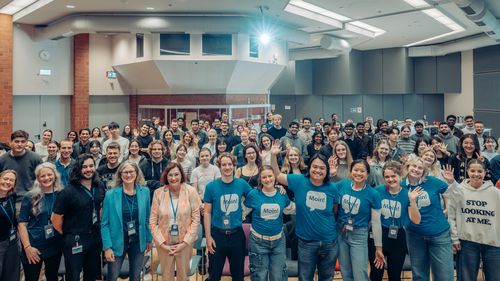
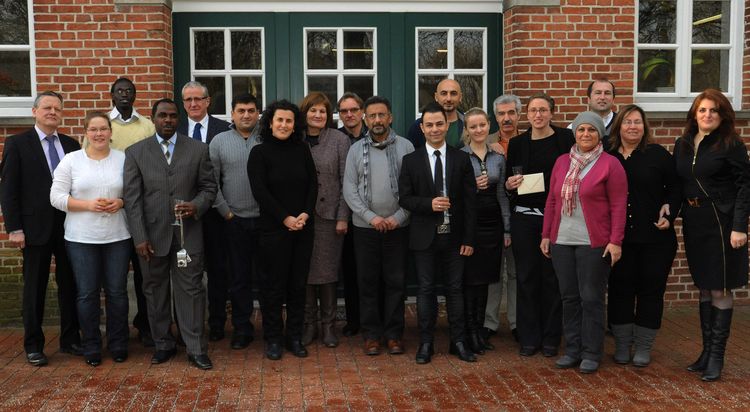
  • The graduates of the contact study programme with Eckhardt Lotze (1st from left), Lower Saxony Ministry for Social Affairs, Women, Family, Health and Integration, Erich Bode (5th from left), Federal Office for Migration and Refugees, Dr Ayça Polat (7th from left), Integration Officer of the City of Oldenburg, Winfried Schulz-Kaempf (9th from left), Coordination Office for Cooperative Migration Work in Lower Saxony, and project staff of the contact study programme "Intercultural Work in Lower Saxony".), Integration Officer of the City of Oldenburg, Winfried Schulz-Kaempf (9th from left), Coordination Office for Cooperative Migration Work in Lower Saxony, and project staff from the contact study programme "Intercultural Competence in Education, Counselling and Social Work".

16 graduates from twelve nations

The university's contact study programme "Intercultural Competence in Education, Counselling and Social Work" is aimed at highly qualified refugees. Recently, 16 graduates of the further education programme were bid farewell. The new programme starts in April.

The university's contact study programme "Intercultural Competence in Education, Counselling and Social Work" is aimed at highly qualified refugees. Recently, 16 graduates of the further education programme were bid farewell. The new programme starts in April.

The graduates come from Pakistan, Iran, Iraq, Syria, Azerbaijan, Rwanda, South Sudan, Afghanistan, Belarus, Ukraine, Turkey and the Congo and have been living in Germany for between two and 18 years. In their home countries, they worked as teachers, pharmacists or university lecturers, for example. Over the past nine months, the training programme has prepared them for work in educational and socio-educational fields. "There are many refugees and people entitled to asylum living in Germany who have already completed a university education in their countries of origin and have gained professional experience in the social sector. This potential is hardly utilised in Germany. The further education programme takes this fact into account and is precisely tailored to the individual participants: It is geared towards previous academic appointments and skills as well as migration biographies," says Prof Dr Rudolf Leiprecht, university lecturer in social pedagogy / racism prevention and head of the project. In this way, participants are prepared precisely for the needs and requirements of the local labour market.

A new round of contact studies will start at the end of April. Anyone interested can register now by contacting Friederike Walther on 0441/798-4962. Admission requirements are a degree or training in a pedagogical, socio-educational or social occupational field as well as good German language skills. The total number of participants is limited to 25. They are selected on the basis of written application documents and a counselling interview. During the further education programme, students acquire skills in areas such as "Approaches and concepts of racism-critical education", "Theories and methods of counselling work" and "Diversity-conscious approaches in social work".

The EU supports the project with funding from the European Refugee Fund (ERF).

This might also be of interest to you:

A snapshot of the workshop: participants are seated at U-shaped tables and are looking at a presentation. The two speakers are pointing at something on the projected image.
Campus Life

How to Pursue an Academic Career in Germany

How does the German research system work, and how can I successfully secure external funding? International researchers at the University of Oldenburg…

more: How to Pursue an Academic Career in Germany
Children stand on a stage and sing, with two violinists in front of them.
University of Oldenburg/ Matthias Knust
Campus Life Culture

"Children's opera can also be in Low German"

Pupils from Oldenburg and a professional orchestra bring "Der Leuchtturm auf den Hummerklippen" to the stage, together with students. A children's…

more: "Children's opera can also be in Low German"
In the background, black space, with the earth below covered by a light blanket of clouds.
Astro-AG
Campus Life

Flying high during a voluntary year

Gaining an insight into academic work, getting to know the university and finding clarity about study and career choices: Enno Gronewold started his…

more: Flying high during a voluntary year
(Changed: 12 May 2026)  Kurz-URL:Shortlink: https://uol.de/p82n101en
Zum Seitananfang scrollen Scroll to the top of the page

This page contains automatically translated content.