

The final of the international Hyperloop competition will take place in California at the end of August. Among those competing to design the fastest vehicle for the transport system of the future is a team of students from the University of Oldenburg and Emden/Leer University of Applied Sciences.
Just recently, the ‘HyperPodX’ team successfully presented its concept for a transport capsule, the Hyperpod, to a panel of experts. In the competition, the students – most of whom are on the international ‘Engineering Physics’ degree programme – are competing against 24 other teams from around the world. The idea behind Hyperloop is to use levitation technology and minimal air resistance to accelerate a kind of train travelling through a tube to speeds of up to 1,200 kilometres per hour – thereby enabling people to be transported as environmentally friendly as possible in the future.
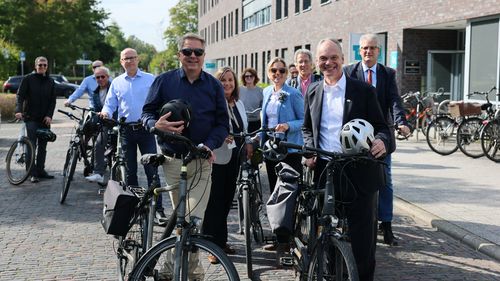
At a meeting at the University of Oldenburg’s Presidential Board on Wednesday, the team and its supervisors, Prof. Dr Walter Neu and Prof. Dr Thomas Schüning, presented their work. There have already been new successes: the group, which originally consisted of 22 students, has grown to 50 members. As the schedule is tight leading up to August, the team has been working almost round the clock for a good week now. This is because the budding engineers now actually have to build their vehicle for the competition – and raise a good 400,000 euros in sponsorship funds. This leaves little time for normal university life, says team member Adrian Rose.
Prof. Dr Martin Holthaus, Vice-President for Research and Transfer at the University of Oldenburg, is clearly impressed by the students’ commitment: The HyperPodX team’s Hyperloop project is an “exciting example of interdisciplinary, practical and future-oriented education”. The team members not only have to familiarise themselves with state-of-the-art technology, but also need to understand the organisational and economic context. “Anyone who has taken part in a project like this whilst studying will be ideally equipped to face the challenges of the future,” emphasises the physicist, who wishes the team the best of luck and every success in the competition in California.
“I am certain that the international team will represent the North-West region appropriately in this academic competition at both the supra-regional and international levels. This competition is a prime example of participatory research and international cooperation,” adds Stephan Albani, a Member of the German Bundestag, who is supporting the project as its patron. The Oldenburg University Society is also providing the young engineers with 1,000 euros to help them secure sponsors and raise awareness of their project.