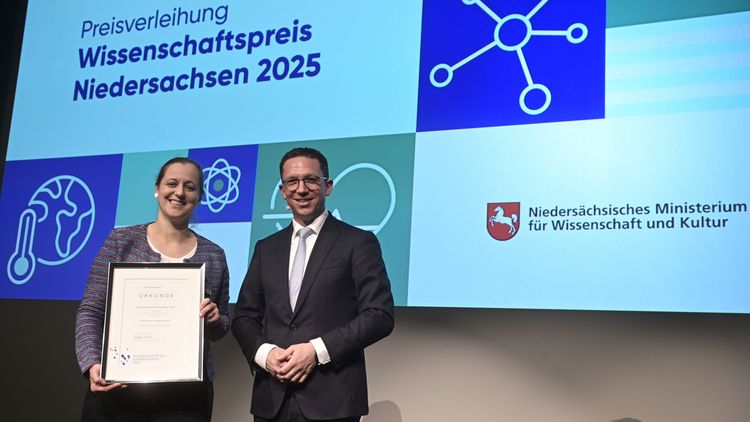


Geoscientist Sinikka Lennartz has been awarded the Lower Saxony Science Prize for Early Career Researchers. She translates microscopic biological and chemical
processes in the marine environment into mathematical equations – and incorporates them into global Earth System Models.
It was by no means a given that Sinikka Lennartz would one day become a marine researcher. "I come from Hesse," she replies with a smile when asked whether she has a special connection to the sea. Hesse is a landlocked state in the middle of Germany, so it was more of a coincidence than anything else that the marine environment became the focus of her research. She applied to work on a three-month project at the renowned Woods Hole Oceanographic Institution in the US when she was still a Master's student in geoecology at the Technische Universität Braunschweig – and got accepted. "I had no idea this was such a famous marine research institute," she recalls. Yet her stay at Woods Hole, on the US east coast, marked a turning point in her career. It was there, in a group led by marine researcher Scott Doney – a leading expert on the role of the oceans in climate change – that she first encountered mathematical modeling of biological processes in the sea.
Lennartz is now a junior professor of biogeochemical ocean modelling at the University of Oldenburg, having won numerous prestigious research awards. This year alone, she received three such awards. Her latest success was receiving the Lower Saxony Science Prize in the "Early Career Researcher" category, which is endowed with 20,000 euros. Earlier this year, she received Germany's top award for early-career researchers, the Heinz Maier-Leibnitz Prize from the German Research Foundation (DFG). This prize, which comes with €200,000 of funding for further research, was awarded to a University of Oldenburg scientist for the first time. Last but not least, she also received the Georg Wüst Prize from the German Society for Marine Research in June.
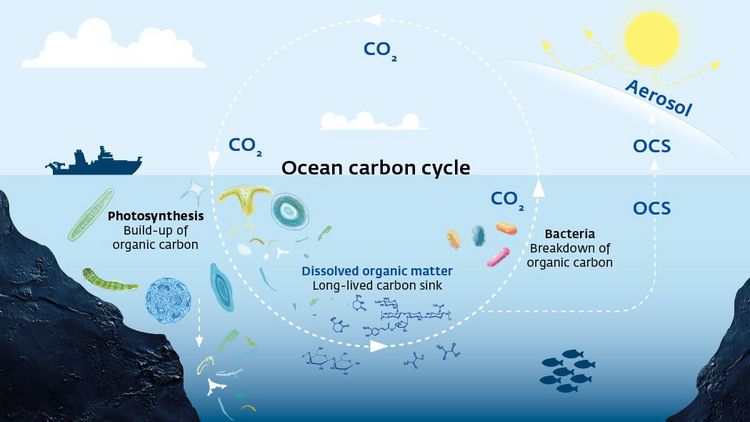
To understand what makes Lennartz's research so important and relevant, it's worth taking a closer look at carbon, the chemical element which in its key compound form, carbon dioxide, is driving global warming. In its multiple chemical forms, carbon is exchanged between living organisms and the abiotic environment in an endless cycle – a highly complex machinery consisting of carbon sources, carbon sinks and intermediate storage sites on which ultimately our planet Earth's temperature depends. Researchers generate simulations of the carbon cycle with all its pathways and deviations to predict how human CO₂ emissions will affect the climate, and then use Earth System Models (ESMs) to predict temperatures and other variables. However, not all the processes in the cycle have been sufficiently studied to be incorporated into global models. For example, one of the largest carbon transfer processes in the ocean, the conversion of organic biomass into inorganic CO₂ – also known as remineralisation – is currently represented with far less precision in ESMs than the reverse process, the build-up of organic substances from CO₂ via photosynthesis. These gaps create uncertainties in climate projections.
Processes at the microscopic level have a global relevance
However, in recent years Lennartz has made significant progress towards understanding and quantifying two little-researched processes by which the ocean affects the climate system. First, she studied the climate-active trace gas carbonyl sulphide and how it is exchanged between the ocean and the atmosphere. Published in 2017, her global model of this process continues to set the standard in the field, and she plans to use it as a starting point for clarifying open questions in a new project with researchers from the US and Israel. Secondly, she is researching carbon compounds in the sea and their bacterial breakdown. "I find it fascinating that these diverse chemical and microbial processes which take place at the microscopic level have such global relevance," she explains.
Lennartz recently demonstrated just how relevant they are in her model of the dynamics of organic carbon compounds dissolved in the sea (also known as DOC). She led an initiative to incorporate DOC into an Earth System Model, resulting in the first model to explicitly represent bacterial DOC degradation while remaining consistent with observational data. Prior to this, global models either aligned with DOC measurements or included bacterial mechanisms, but not both. She then demonstrated that this reservoir, which consists of millions of different substances and forms one of the largest organic carbon reservoirs in the Earth system, reacts far more strongly to environmental changes than previously assumed. According to her calculations, the oceans will probably be able to store more carbon than was thought. "But that won't save us from climate change," she hastens to clarify. On the basis of her predictions, the additional carbon absorbed by the oceans over the next 200 years is equivalent to the amount generated by humans within just three to four years – which highlights the huge impact of human activities on global material cycles. Thanks to her results, degradation processes in the oceans can now be better incorporated into the climate models that feature in the reports of the Intergovernmental Panel on Climate Change.
"Sinikka Lennartz's discovery that dissolved organic carbon does not remain stable over thousands of years, but behaves dynamically, has challenged a paradigm that existed for decades and has revolutionised our understanding of biogeochemical processes in the sea," emphasises Prof. Dr Thorsten Dittmar, the head of the Marine Geochemistry research group in which Lennartz was a postdoc researcher from 2019 to 2021. "Her great strength lies in her unconventional way of questioning established doctrines and tackling unsolved scientific problems."
The Oceans could store more carbon in the future
Lennartz herself sees interdisciplinary dialogue as a key inspiration: "What I enjoy most is working and having discussions with people from many different disciplines – that's when I come up with the best ideas." This is also one of the things she appreciates most about her current research group: new trains of thought to follow and a shared passion for spontaneity. She says she learned how to steer discussions in a productive direction during her time at the Massachusetts Institute of Technology (MIT) in the US – but according to colleagues she was already good at the art of discussion before that. She worked at MIT on a DFG Walter Benjamin Fellowship in 2021 and 2022 before taking up the junior professorship in Oldenburg three years ago.
Curiosity, frustration tolerance and perseverance are other key prerequisites for scientific success, she says: "It's rarely the case that everything works out straight away." Her own career pathway has been enviable so far, including positions at ETH Zurich, the GEOMAR Helmholtz Centre for Ocean Research Kiel and MIT. She has also started a family and now has two children, one seven years old and one eighteen months. But there have been times when not everything has gone to plan: last year, despite a positive assessment, a research proposal for a large collaborative project under her co-leadership was rejected – to her great disappointment. "That was quite a setback," she admits. "I was really keen on that project. We had a great team for tackling the question of carbon storage in dissolved organic compounds from different angles." She even had fun writing the proposal – a task many researchers find unpleasant. "Thinking about the next important steps to get closer to solving long-standing research questions, and how to put those ideas into practice – it was all very exciting," she says.
But her enthusiasm for solving the mysteries of marine material cycles is as keen as ever. As a member of the Cluster of Excellence "The Ocean Floor", which is based at the Universities of Oldenburg and Bremen, she will now turn her attention to other exciting questions. Lennartz, who at 37 is among the youngest on the team, is among its leading scientists. One of the fifteen doctoral candidate positions to be filled in the cluster from the beginning of 2026 will be in her research group. The focus here will be on carbon in its particle form rather than the degradation of dissolved organic carbon in the sea.
Lennartz already has her sights on certain data sets that she can tap into to learn more about the fate of carbon in the sea. Thanks to new technologies, scientists now have access to far more data about marine microbiological processes. "This is a treasure trove that cannot be ignored," Lennartz stresses. An entirely new picture of the geographic distribution of different microbes and the functions they perform will emerge, she says. Her aim is to use it to provide an even more comprehensive description of the dynamics of carbon degradation in her Earth System Model.
This article will soon be published in printed form in the university's research magazine EINBLICKE.