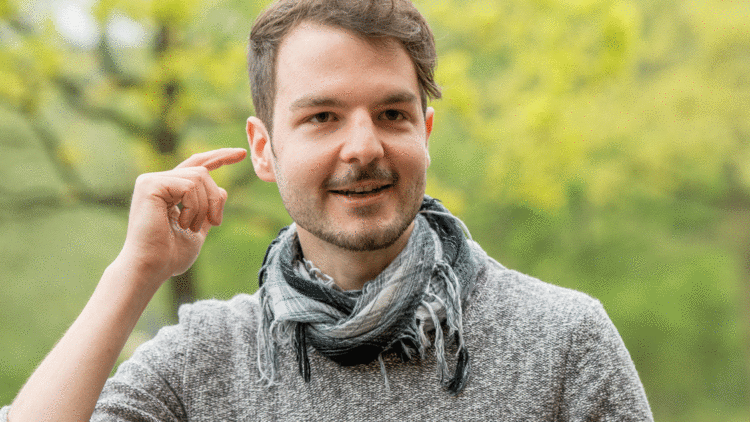

From Oldenburg to Harvard: Stefan Raufer, a Master’s student in Hearing Technology and Audiology, is moving to a prestigious US doctoral programme this autumn. In this interview, the 25-year-old talks about his unusual career path, the many facets of hearing research and what he loves about Oldenburg.
QUESTION: Mr Raufer, in September you’ll be starting a postgraduate programme at the elite universities of Harvard and the Massachusetts Institute of Technology (MIT). A career in science wasn’t exactly on the cards for you, was it?
RAUFER: My career path has generally taken a slightly different course, that’s true. After finishing secondary school, I first did an apprenticeship as an electronics technician before going on to complete my vocational A-levels. In my leaving class at the time – a class made up entirely of boys – virtually everyone wanted to stay in Bavaria and study electrical engineering or mechanical engineering – except me. I thought that wasn’t the right thing for me; there had to be something cooler, something a bit more interdisciplinary. Perhaps acoustics seemed an obvious choice because I’m a musician and was already playing in a band back then. And so you start researching and poring over course guides. But when I found the subject of Hearing Technology and Audiology in Oldenburg, it was clear. That’s when it just clicked. Because the subject isn’t limited to technical lectures, but also covers the medical side.
QUESTION: What interests you most about hearing research?
RAUFER: My area of interest has done a complete 180-degree turn since I started my degree. When I began, I thought that after seven semesters I’d return to a car manufacturer as an acoustics engineer. But during my studies, the lectures on medicine and physiology were also very interesting. So, over the course of five years, my focus has shifted from purely technical aspects – such as loudspeaker design – towards a more medical orientation. I’d still like to continue working in a technical capacity, but closer to people, and more directly on the organ of hearing.
QUESTION: What unanswered questions do you aim to address in your Master’s thesis?
RAUFER: The aim of my Master’s thesis is to better describe the process of hearing itself. We use a microphone in the ear canal to record sounds emitted by the inner ear. The aim is to use this method to describe the vibrational behaviour of the inner ear. To put it simply, you can imagine that we perceive high-pitched sounds at the entrance and low-pitched sounds further inside the cochlea. However, exactly how this frequency tuning works in the inner ear is still unclear.
QUESTION: What attracted you to the joint postgraduate programme at Harvard and MIT?
RAUFER: Just as Oldenburg is the centre of hearing research in Germany, where a wide range of disciplines in this field converge, so too is Boston in the USA, where a great many research groups and universities are associated with the programme. The big advantage of the programme, in my view, is that it’s structured over five years, the last three of which constitute the actual PhD. During the first two years, you can get your bearings, work in different laboratories – perhaps with one professor on this topic and another on that one. And during those two years, you can find a topic you’re really passionate about. Whether that ends up being the mechanics of the inner ear for me, or the mechanics of the middle ear – or who knows, perhaps I’ll end up in speech production or neuropsychology… you have another opportunity to explore the various fields at your own pace.
QUESTION: The SHBT programme only accepts seven or eight new doctoral candidates each year. What is the application procedure like?
RAUFER: First of all, it’s a standard online application with a personal statement and three letters of recommendation from professors. This was followed by an invitation to interviews in Boston: an interview with a different professor every half hour throughout the day. Personally, I had eleven interviews with researchers from a wide range of disciplines – genetics, speech production and speech pathologies, neuropsychology, the mechanics of hearing… and my final interview was with the founder of the laboratory in Boston, who launched the programme in the 1990s. It was a veritable marathon of interviews; afterwards, I simply couldn’t manage anything else. But it was good to have seen the place and got to know the professors and students, so as to work out whether I could envisage moving there. After all, you’d have to build a completely new circle of friends and a new life there.
QUESTION: What would you like to take with you from Oldenburg, or rather, what are you taking away from your time here?
RAUFER: An incredible amount. I’m certainly feeling a bit wistful; I’ve simply felt right at home here from day one. It’s good to know that hearing research won’t stand still here in Oldenburg either, that we’ll definitely maintain contact and can come back from time to time, whether for a conference or other meetings… Well, I’ve really come to love Oldenburg and the people here over the years. And I’ll miss drinking tea. Over the past five years, I’ve definitely become a tea drinker.
More on the topic
Research group "Physiology and Modelling of Auditory Perception"Harvard-MIT graduate programme "Speech and Hearing Bioscience and Technology (SHBT)"