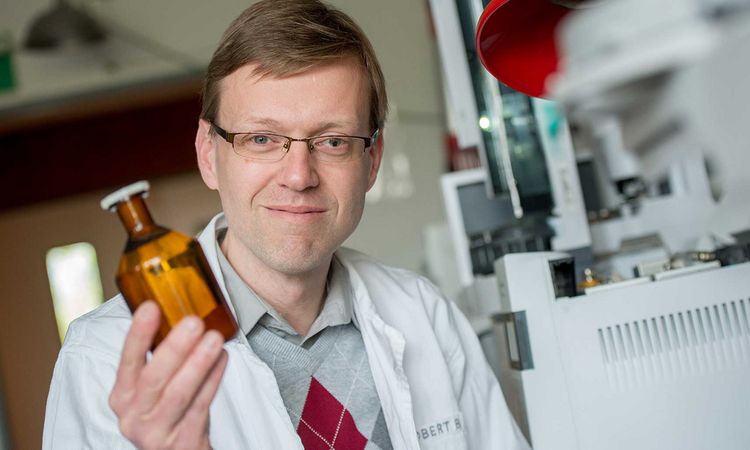

The European Research Council (ERC) is the institution through which the European Union supports outstanding scientists with unconventional approaches. One such scientist is Dr Oliver Wurl: the marine scientist has been awarded a ‘Starting Grant’ worth 1.48 million euros for early-career researchers.
Wurl’s project, which he plans to carry out at the University of Oldenburg, focuses on the ocean’s surface: The role they play in the ocean’s absorption of CO₂, how microbes colonise them, which pollutants accumulate there and how they influence both the food chain and the climate – these are the key areas of his research.
Successfully securing funding in the highly competitive EU Excellence Programme is an outstanding achievement, said the Acting Vice-Chancellor, Prof. Dr Katharina Al-Shamery. “Oliver Wurl will establish one of the first research groups worldwide to focus on the chemical and biological processes at the ocean’s surface. The fact that he has made the Institute of Chemistry and Biology (ICBM) his base demonstrates the excellent opportunities he has found for his basic research at the University of Oldenburg.”
“With the various research groups at the ICBM, I can pursue my research into the ocean surface in an interdisciplinary manner. The working conditions here are excellent, and the ICBM’s location in Wilhelmshaven, with its direct access to the North Sea, offers ideal conditions for my fieldwork,” said Wurl, explaining his decision.
The world’s oceans absorb almost a third of the carbon dioxide produced by humans. They are therefore at the centre of the global CO₂ cycle. Wurl’s research group will focus on this cycle. “Carbon dioxide forms weak acids when combined with water. The first signs of ocean acidification are already apparent – with significant implications for sensitive ecosystems. It is therefore important to gain a better understanding of the process by which the ocean absorbs CO₂,” says Wurl, explaining his research project.
In earlier studies, the scientist had already demonstrated that the oceans are largely covered by wafer-thin surface films. Organic compounds originating from microbial life in the sea enrich these films. “The films form a low-turbulence boundary layer which not only slows down gas exchange between the oceans and the atmosphere, but also provides microbes with opportunities to colonise the nutrient-rich films,” says Wurl. Furthermore, some microbes absorb CO₂, whilst others break down organic compounds into energy and CO₂, thereby influencing the carbon dioxide cycle. “These highly complex processes at the ocean’s surface are not taken into account in current computer models used to predict CO₂ trends. Yet these processes are extremely important, for example, in obtaining more precise information on climate change,” says Wurl.
As a first step, Wurl now plans to collaborate with the ICBM Marine Sensors working group, led by Prof. Dr Oliver Zielinski. Together, they aim to develop a novel research catamaran – one that can not only take samples from the sea surface but also scan it using the latest sensor technology.
About the author:
Oliver Wurl, born in 1972, studied environmental engineering at Hamburg University of Applied Sciences and subsequently worked for four years in research and industry. In 2006, he obtained his PhD from the National University of Singapore with a thesis on the distribution and cycles of organic pollutants in the marine environment of South-East Asia. From 2008 to 2012, he undertook research stays at the Institute of Ocean Science of the Canadian government’s Department of Fisheries and Oceans and at Old Dominion University in Norfolk, USA. In Canada, he investigated the global distribution of surface films on the ocean. Wurl then moved to the Leibniz Institute for Baltic Sea Research in Warnemünde with a grant from the German Research Foundation (DFG).
More on the topic
Institute of Chemistry and Biology of the Marine Environment
Contact
Dr Oliver Wurl
Institute of Chemistry and Biology of the Marine Environment
Tel: 04421-778 580 11