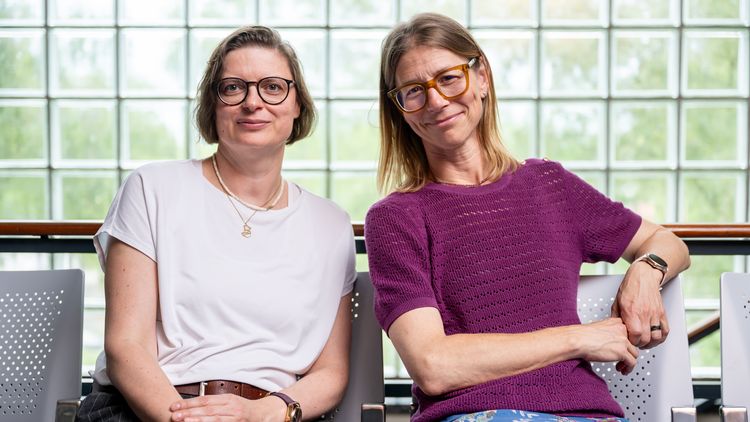

How does the reintroduction of border controls affect the attitudes of people in border regions? Hannah Arendt Fellow Marije Michel from Groningen is investigating this together with Juliana Goschler, a German studies scholar from Oldenburg.
Anyone who crosses the border between two countries sometimes takes away a special memory – even if it is simply because nothing out of the ordinary happened. Marije Michel has just such a story to tell: “A few years ago, my passport was stolen in Italy,” reports the professor of second language acquisition at the University of Groningen. “What was remarkable was that I didn’t have to show the replacement document I’d been given at all during the entire journey back through Switzerland and Germany to the Netherlands.” The episode made her realise what a special privilege it is to be able to travel freely within Europe.
Juliana Goschler, a professor of German as a Foreign Language / German as a Second Language at the Institute for German Studies, also has a vivid memory of crossing a border without any hindrance. Around 1990, shortly after the fall of the Berlin Wall, the linguist – who grew up in the GDR – travelled to the Netherlands with her family. “It was the first time I’d ever experienced a border where there was simply nothing – no barriers, no checks,” she says, still impressed by the memory today.
Since then, borders within the EU have regained their significance. Germany has introduced border controls with all its neighbouring countries. This is certainly a far-reaching measure – but how does it influence the attitudes of people in the German-Dutch border region towards each other’s languages? And how does it affect their attitudes towards one another and towards democratic values? These are the questions driving Michel and Goschler in their current research project, ‘Bridges and Borders of Democracy’. The Groningen-based language education specialist has been awarded one of ten Hannah Arendt Fellowships from the Lower Saxony Ministry of Science and the Volkswagen Foundation. The programme facilitates visiting stays of up to six months at research institutions in Lower Saxony. The overarching theme of all projects this year is democracy.
Foreign languages open up new perspectives
Michel’s application grew out of the close co-operation between the Universities of Oldenburg and Groningen, for which there are naturally many points of connection in the field of linguistics. Both she and Goschler train prospective German teachers. Every semester – now for the tenth time – students from both universities take part in a cross-border virtual exchange. In their research, they do not limit themselves to language teaching methodology, but also examine the social significance of foreign languages, language learning and an interest in foreign cultures. This is also the case in the current project. “After 40 years of free travel in some cases, border controls are certainly having a major impact, particularly on people in border regions,” says Michel. Their hypothesis: “The sense of closeness to the neighbouring country is being lost – and this may well undermine understanding of the fundamental European principles on which our democracy is based.”
For her, it is clear that learning foreign languages is essential for developing a deeper understanding of people of other nationalities. “Anyone who engages with a foreign language and culture gains new perspectives, including on their own language and culture, and becomes open to different viewpoints – this also strengthens democratic attitudes,” emphasises Michel. Her own life story reflects this open-minded attitude: having grown up multilingual in Switzerland, the Dutch national has already worked in the UK and Germany during her academic career. As well as Dutch, German and English, she also speaks Italian, French and Swiss German. In Groningen, she is responsible for all language acquisition courses within the ‘European Languages and Cultures’ degree programme, in which a total of eight European languages are taught alongside their respective cultures and politics.
Media reports highlight many minor annoyances in everyday life
To gain an initial sense of the impact border controls are having on people in the region as part of their Hannah Arendt research project, Michel and Goschler first carried out a media analysis. According to the initial findings, two consequences in particular feature prominently in media coverage in both Germany and the Netherlands: traffic disruption and economic disadvantages, such as shopping or filling up with petrol across the border having become more difficult. Apparently, the checks cause many minor annoyances in everyday life for people in the region. “The media, however, hardly mention the great benefit that Europe brings,” says Goschler. Furthermore, very few reports addressed whether the border controls prevent “irregular migration” – which is officially cited as the justification for the measure.
From a linguistic point of view, it is interesting to note that these reports could lead to the consolidation of phrases such as ‘traffic jam at the German border’ or ‘German’ in conjunction with ‘police check’ – and possibly shape the image that Dutch people have of Germany in a rather negative way.
For the next phase of the study, the researchers are looking for people who regularly commute between Germany and the Netherlands to ask them about their attitudes and experiences. One exciting idea they are currently discussing is: what if they were to collect and analyse stories of border experiences? Might these accounts reveal how relations between Germany and the Netherlands have developed over recent decades? Goschler: “Perhaps we’ll then also hear from younger people what it’s like to have been checked at a border for the first time.”