
“How can it be that I meet up with my best friends just to punch them in the face?” Nils Baratella is a PhD student on the “Selbst-Bildungen” research training group. His topic: boxing. Ines Weber, on the other hand, is studying bishops. A portrait.
By Mark Brüggemann
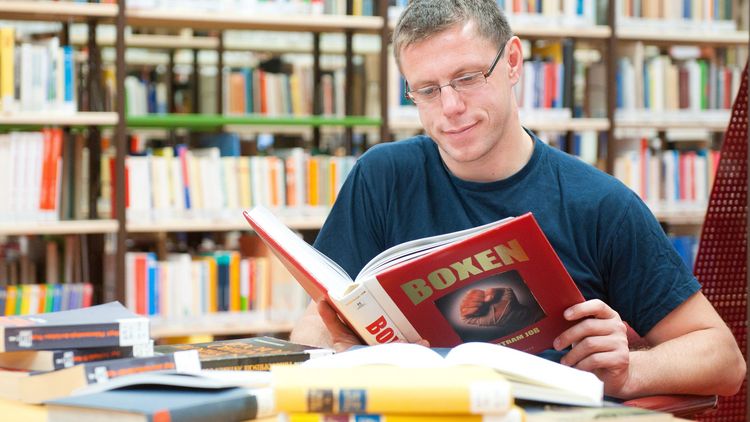
Nils Baratella came up with the topic for his doctoral thesis one day whilst thinking about his hobby: boxing. He has been stepping into the ring more or less regularly for ten years. “How on earth can it be that I meet up with my best friends every evening just to punch them in the face?” Baratella asked himself. For himself, the then philosophy student at the Free University of Berlin quickly found an answer: “I also enjoy the intellectual exchange with people who give me something to challenge.” According to Baratella, boxing also offers this kind of open engagement: “It’s not just about knocking the other person out. Boxing matches are also a form of physical engagement in which you learn more about a person than you would through language alone.”
Combat as a Narrative of Modernity
What does the sport of boxing reveal about modern societies’ understanding of violence and the body – and how has this understanding developed? These research questions have occupied Baratella ever since he was accepted as a doctoral candidate into the Research Training Group ‘Self-Formations’ in 2010. How does his doctoral project fit into the overarching theme of subjectivisations? “There is a philosophical strand in modernity according to which the subject and its existence are understood as a struggle,” explains Baratella, referring to the theories of Hegel, Nietzsche and Foucault. ‘In a sense, one can understand this struggle as the narrative of modernity.’ This also includes the subject’s struggle against itself – represented in the ring as the overcoming of one’s own body, displayed half-naked, following decisive blows.
According to Baratella, the boxing ring is a social space of exception, and the fight is a performance that prototypically grapples with violence on behalf of the society in question. “With its ethos of fair play and masculinity, boxing provided a social ideal for how conflicts should be resolved in the modern era,” he says. This was not always the case: In the earliest modern boxing matches, there was no limit on the number of rounds – the opponents simply punched each other in the face until one went down. Even as late as the 1920s, boxers who had been knocked down were allowed to be struck again immediately after getting back to their feet. “Increasing regulation has given the sport its specific aesthetic and, at the same time, changed boxing’s view of humanity,” explains Baratella. “It was no longer a case of doing whatever it took to defeat the other man.”
According to Baratella, from the 1920s to the 1970s, boxing was one of the prominent arenas in which society grappled with violence and combat. Legendary fights, such as those between Muhammad Ali and the recently deceased Joe Frazier, remain present in the collective memory even decades later. “Today, however, boxing no longer plays such a central role in European and North American culture – unlike, for example, in Mexico and South America,” notes Baratella. In Europe, other sports are becoming increasingly important. However, even at the height of boxing’s popularity, the sport was regarded as a marginal social phenomenon – wrongly so, as Baratella argues, drawing on Foucault: “Looking from the margins, one learns more about society than when one is at the centre.””
Nils Baratella’s thesis supervisors are the Oldenburg philosopher Prof. Dr Johann Kreuzer and Prof. Dr Gunter Gebauer from the Free University of Berlin. The doctoral candidate continues to use his stays in Berlin to train at a boxing club on Potsdamer Straße. “It’s all about having fun,” says Baratella; “I also do a bit of sparring now and then when someone from the boxing club is preparing for a competition.” Baratella does not have any role models for his own fighting style, but he does have boxers whom he particularly admires: “Johann Trollmann, a member of the Sinti community, was an impressive figure.” Having become German light-heavyweight champion in 1933, Trollmann was racially vilified by the media, which had been brought into line with Nazi ideology, and was murdered at Neuengamme concentration camp in 1944. Apart from Trollmann, Baratella is particularly impressed by boxing legend Rocky Marciano: “I like the classic story of the son of an Italian immigrant who boxes his way to the top.”
“No sports” – at least for bishops
Sport also plays a role in Ines Weber’s doctoral project on subjectification – albeit rather marginally. “Sometimes superior, sometimes inferior,” he was described in a medieval chronicle about the Archbishop of Trier, Balduin of Luxembourg, who held the office from 1307 to 1354. He was reportedly “the most cheerful companion when leaping, light-footed when running; he threw the stone further than the others and surpassed them in physical strength”. Is this a description of a sprightly elderly gentleman taking his sports badge test? Not at all. The passage quoted from the *Gestis Baldewini* (‘The Deeds of Balduin’) provides an insight into the early years of Balduin’s tenure, having been appointed Archbishop at the age of just 21. Baldwin’s enthusiasm for ‘sport’ did not seem entirely compatible with his ecclesiastical office. According to the chronicler, the archbishop would preface such a pastime with the phrase: ‘Let us hang the episcopal dignity on the wall!’
Ines Weber found the quotation from the *Gestis Baldewini* so interesting that, inspired by it, she developed a doctoral project for the Research Training Group in collaboration with the historian Prof. Dr Rudolf Holbach. ‘A Comparative Study of the (Self-)Education of Late Medieval Bishops in the Holy Roman Empire’ is the working title of her doctoral thesis. “As well as Balduin, I want to look at several other bishops from the period between around 1250 and 1550,” says Weber, who is part of the research training group’s new class of students. “How did each individual ‘educate themselves’ into their office and then embody it?” is the central research question of the 26-year-old, who completed her Master’s degree in European History in Oldenburg. According to Weber, the ‘self-formation’ of late medieval bishops encompasses a wide range of aspects: education and religious background, social networks, dress and lifestyle, interests and activities. What qualities did the bishops bring to the role? What is compatible with the dignity of their office, and what is not? To whom are they compared in the chronicles? Weber’s work aims to answer these and other questions.
Ecclesiastical head and secular ruler
Ines Weber sees a particular appeal in her dissertation topic in identifying structural differences across the bishoprics of the Holy Roman Empire: “There were dioceses in which the local nobility held a strong position, but also those in which the free townspeople played the decisive role.” Consequently, very different expectations were placed on the office of bishop, to which he had to respond. The bishops also operated within a very particular ‘area of tension’, as they were both the ecclesiastical head of the diocese and secular rulers. The expectations of ‘society’ and those of the bishop himself regarding his office did not always coincide: Hinrich Biscop (1315–1381), the son of a Hamburg merchant, for example, pursued the episcopal office ruthlessly and tenaciously until it was finally granted to him in 1370. Fraud and corruption were just as much a part of his understanding of the office as a lavish lifestyle at the diocese’s expense – much to the displeasure of those around him.
Even whilst she was a student, Weber specialised in medieval history; the subject of her Master’s thesis was monastic houses in medieval Friesland. Dr Antje Sander, director of the Jever Castle Museum, found the thesis so well-researched that she commissioned Weber to design a permanent exhibition on the medieval St John’s Chapel in Bokelesch (municipality of Saterland). With this three-year postgraduate scholarship, the East Frisian from Wiesmoor is now moving from exhibition practice back into academia. “The programme at the research college is truly promising: on the one hand, you take part in subject-specific colloquia, but you’re also supported when it comes to interdisciplinary questions,” says Weber, looking forward to the exchange with her fellow researchers and academic supervisors.