
The Smart House Oldenburg will host the opening of the self-organised exhibition "HOW WE KNOW - Interfaces between research and everyday life" on 11 May. Pieces from the university's collections are placed in an unusual context.
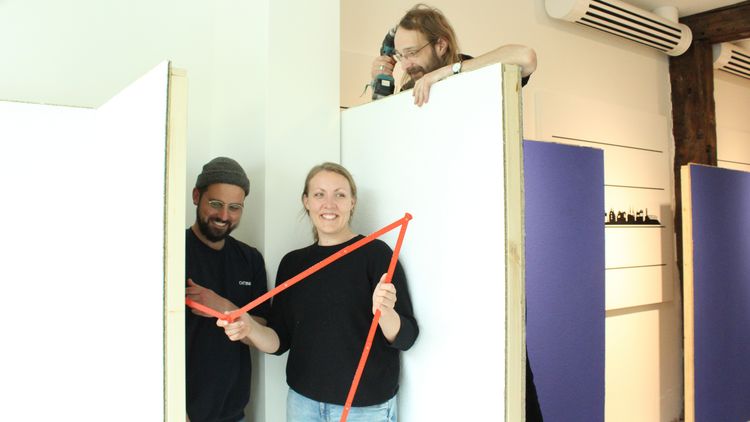
Lilac-coloured pieces of wood are stacked in a driveway, and people are busy painting under white plastic pavilions. Ten students from the Oldenburg Master's degree programme "Museum & Exhibition" are dedicated to their project - as evidenced by the many patches of paint on their clothes. The time has finally come on Saturday: their exhibition "HOW WE KNOW - Interfaces between research and everyday life" will open. And there is still time to make the last items.
The students want to thematise the connection between knowledge and everyday life. Their questions: Where do we get our everyday knowledge from? What knowledge do we receive, pass on or lose during our lives? How do the media, people and fashions sensitise or manipulate us today and in the past? To get to the bottom of this, visitors to the exhibition are invited to take a tour through a staged flat. There they encounter socially relevant themes that are linked to objects from the university collections and specially designed pieces of furniture. From body perception to media consumption and gender images to genetic manipulation. In the bedroom, for example, the focus is on "(dis)clothing", reveals student Julia-Louise Bokermann: "We have set up a full-length mirror here. The question we pose directly to the viewer is: 'How do you (dis)dress yourself?" Other questions in the exhibition arise more from the object or spatial texts. Bokermann goes on to say that visitors to the exhibition can use post-its to contribute their own opinions, comments, associations or even their own questions and answers.
"Placed directly in people's everyday lives"
Putting together an exhibition yourself is an integral part of the degree programme, which is based at the Institute of Material Culture. Students are completely free to choose their own topics. "There was only one requirement: the university's collection had to be included," explains Alexander Duschek, who is also part of the project team. "But what we really wanted was to take the knowledge that was previously presented in an academic context - the supposed ivory tower - and stage it beyond the campus. That's why we placed the collection items directly in people's everyday lives, namely in their homes," continues Duschek. In the living room there are shellac records from the university library's collection, in the bedroom clothes from the collection of everyday textile culture. In the bathroom, everything revolves around the central theme of "Body Feelings", illustrated by items from various collections: from menstrual pants to an anatomical pelvic floor model. The exhibition is accompanied by guided tours, various workshops and a pub quiz.
Unexpected challenges
The students have been working on the exhibition for a year now. In the process, they were faced with many unexpected challenges. "None of us had any experience with financing exhibitions, for example," explains Duschek. The Master's students organised themselves into small teams in order to divide up all the tasks among themselves as sensibly as possible - from project coordination to location scouting. Julia-Louise Bokermann took on the public relations work together with a fellow student. An experience she would not want to miss. "I can well imagine working in marketing or public relations at a museum later on. Preferably in an art museum."
Well prepared for professional life
The previous knowledge that students on the "Museum and Exhibition" Master's programme bring with them is very different in some cases. Duschek already has a Master's degree in history, while Bokemann previously studied art history. They are united by their desire for practical experience. "The project is a very good opportunity to gain the experience you will need later in your professional life," says Duschek. Despite a few hurdles, both are optimistic that all the furniture will be finished by the start of the exhibition. "This is a highlight of the whole project for me: actually seeing how the months of planning are finally taking shape," says Bokermann happily.
The exhibition "HOW WE KNOW - Interfaces between research and everyday life" can be seen from 11 to 31 May at The Smart House Oldenburg (Schloßplatz 16, 26122 Oldenburg).