
New method for ultrashort electron pulses

New method for ultrashort electron pulses
Ultra-fast nano-optics: New method for ultra-short electron pulses discovered
Oldenburg. Another success for the Oldenburg nano researchers: physicists led by Dr Petra Groß from the "Ultrafast Nanooptics" working group at the Institute of Physics have published an article in the renowned journal "Nano Letters", the research results of which could contribute to the development of a new type of electron microscope.
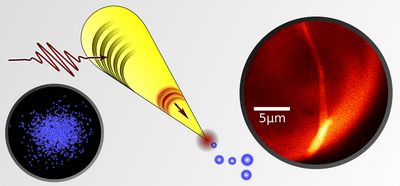
Electron microscopes make it possible to image the smallest nanostructures with such high spatial resolution that individual atoms can be "seen". This allows a variety of new insights into the functioning of a wide range of organic and inorganic materials. However, such microscopes usually only provide static images, a kind of still life of the nanostructure. Of greater interest to science would be a tool that can generate videos with atomic resolution, so to speak - in other words, visualise the movement of electrons and atoms responsible for the function. This requires special time-resolved electron microscopes.
The first models of such devices are now commercially available. However, they are not yet able to visualise the movements at an atomic level. The reason: similar to classical photography, the "shutter speed" cannot be chosen short enough to visualise these ultra-fast and complex processes. However, the Oldenburg scientists have now taken another important step towards a microscope with an ultra-short exposure time. Groß and her team are demonstrating a new method for generating short electron flashes. "In previous experiments, the electron flashes were generated by directly illuminating an atomically sharp metal tip with short laser pulses and triggering the electrons from the metal using Einstein's photoelectric effect," explains Groß. The scientists published their first ground-breaking results on this method two years ago in the scientific journal "Nature Photonics". However, the method has a disadvantage: "For our novel electron microscope, we would like to bring the sample to be analysed as close as possible to the tip. However, this is not possible with illuminated tips, as the intense laser would otherwise also illuminate the sample. The distances are simply too small and can no longer be controlled," reports Groß.
The Oldenburg physicists have now found an elegant solution to this problem. The researchers do not illuminate the end of the tip directly, but a nanostructured grating coupler that they have attached to the side of the tip. Its illumination generates light waves that run along the tip and continue to contract spatially. "At the very end of the tip, a nano-light spot with a size of just 10 nanometres is created," says doctoral candidate Jan Vogelsang, who played a key role in the experiments. "Here - very similar to a lightning rod - the strength of the light field is so great that electrons are knocked out of the tip. Our measurements have shown that this type of electron generation works better than the classic variant. We didn't expect that," says a delighted Vogelsang. The research group was able to prove that even in the first experiments, 50 times more electrons were generated than with the original method.
The scientists now have a free-standing electron source at their disposal, which they have already incorporated into the first microscopy setups. "We have had the source patented. It is not only suitable for time-resolved electron microscopy, but could also be an important step towards improving the time resolution of scanning tunnelling microscopes, another important tool in nanotechnology," summarises Groß.
In further experiments, the scientists now want to try to directly detect the duration of the electron pulses of around ten femtoseconds, which would significantly improve the time resolution in electron microscopy.
Publication:
Vogelsang, J., Robin, J., Nagy, B.J., Dombi, P., Rosenkranz, D., Schiek, M., Groß, P., and Lienau, C. (2015). Ultrafast Electron Emission from a Sharp Metal Nanotaper Driven by Adiabatic Nanofocusing of Surface Plasmons. Nano Lett (2015). doi:10.1021/acs.nanolett.5b01513
[10.07.15]