
2022
2022
- Seven amateur astronomy associations from Papenburg, Leer, Aurich, Wilhelmshaven, Bremerhaven and Oldenburg as well as the three universities in the region have joined forces to form an astronomy network, the ANWE (Astronomy Network Weser-Ems).
The aim is to promote STEM education in the context of astronomy. Members of the Institute of Physics are Prof Dr Jutta Kunz-Drolshagen (Field Theory working group), Prof Dr Björn Poppe (Medical Radiation Physics working group and deputy ANWE coordinator). The working group Didactics of Physics and Science Communication (Prof Dr Michael Komorek) is also a partner in the network. Further information can be found in the press release from the University of Oldenburg and on the ANWE homepage with details of the members.
- Researches from Oldenburg, Würzburg, Wroclaw and Bologna, have found - for the first time - excitons in an atomically thin topological insulator: Bismuthene!
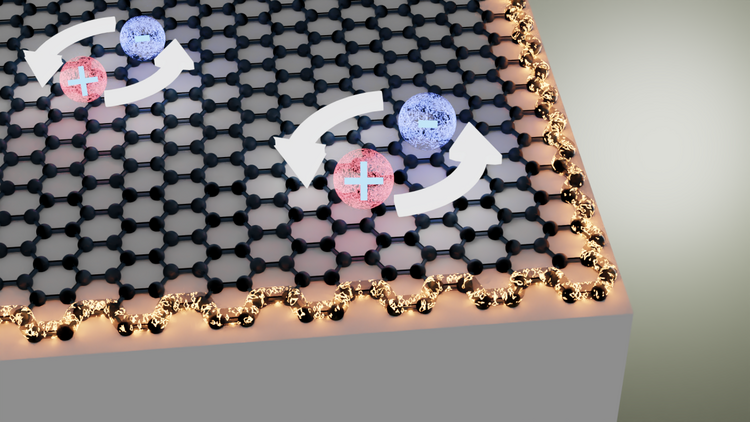 The image was created by Pawel Holewa
Further information can be found here: : https://www.nature.com/articles/s41467-022-33822-8 - Kick-off meeting of the joint project DyNano!
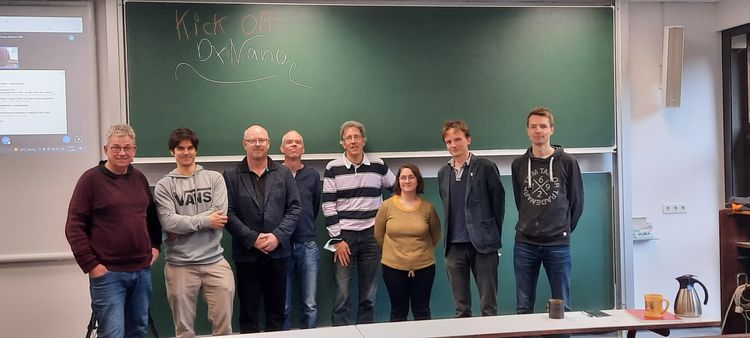
On 11 October 2022, the kick-off meeting of the joint project DyNano (Dynamics on the Nanoscale) took place in Oldenburg. In the DyNano network, which is funded by the state of Lower Saxony with approx. 2.4 million euros, scientists from IfP and IfC are conducting research in 9 joint sub-projects. - Dr Annika Ott was honoured for her doctoral thesis in theoretical physics entitled"Thermal radiation and heat transfer in non-reciprocal and topological many-body systems" (supervisor: PD Dr Svend-Age Biehs, Condensed Matter Theory Group) as an outstanding graduate in the field of doctoral studies. Link: www.presse.uni-oldenburg.de/mit/2022/111.html
- Strong coupling in a microcavity transforms atomically thin semiconductor
In a recent paper, scientists from the Institute of Physics (Quantum Materials Group) and CENAD, together with their collaborators from Iceland, Jena, Würzburg, Tempe and Tsukuba, were able to prove for the first time that a material with a dark ground state (an atomically thin WSe₂ layer) in a microcavity fundamentally rearranges its electronic states by coupling to optical resonances so that it exhibits characteristics of a bright semiconductor. The work was recently published in the journal 'Nature Communications':
Shan, H., Iorsh, I., Han, B. et al. Brightening of a dark monolayer semiconductor via strong light-matter coupling in a cavity. Nat Commun 13, 3001 (2022). https://doi.org/10.1038/s41467-022-30645-5
- Large Main Telescope of the Oldenburg Observatory (GHOST)
On 2 March, the University Observatory's robotic telescope, together with other telescopes worldwide, was responsible for the discovery of the approx. 170 m large near-Earth asteroid "2022 EX". With a minimum distance to the Earth of 2.8 million kilometres or about 7 lunar distances, this asteroid is classified as potentially dangerous. However, according to current measurements, it is not expected to collide with the Earth.Further information: wp.uni-oldenburg.de/asf/ghost-discovers-new-near-earth-object-2022-ex/
Contact
Prof. Dr rer. nat. habil. Björn Poppe, - New states in 2D materials
A team of Oldenburg physicists from the Quantum Materials Group and Würzburg researchers led by Prof. T. Brixner have identified and quantified a triple coupling between exciton, photon and phonon in two-dimensional materials. This hybrid state could be of particular interest for opto-mechanical applications of the materials.
D. Li et al, "Hybridised exciton-photon-phonon states in a transition-metal-dichalcogenide van-der-Waals heterostructure microcavity", Physical Review Letters (2022).Contact
Prof. Dr. Christian Schneider, AG Quantenmaterialien, University of Oldenburg, T +49 441 798 3116,
Prof. Dr. Tobias Brixner, Chair of Physical Chemistry I, University of Würzburg, T +49 931 31-86330,