
How turbulence arises
How turbulence arises
How turbulence arises
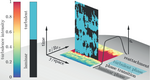
Oldenburg physicists test 30-year-old theory in an experiment
Oldenburg. Describing turbulence mathematically is one of the great unsolved problems in physics. Even how they arise has not yet been conclusively clarified. A team of scientists led by Oldenburg physicist Prof Dr Joachim Peinke and Osnabrück mathematician Dr Pedro G. Lind has now succeeded in experimentally understanding how turbulence arises on a wing profile. The findings could help to further optimise the rotor blades of wind turbines, for example. The scientists recently published their findings in the journal Physical Review X.
Turbulence is the term used to describe a flow that is characterised by disorder. In contrast, there are smooth, so-called laminar flows. The exact point at which a laminar flow changes into a turbulent flow can be determined by the Reynolds number. This physical parameter describes the ratio of turbulence-generating factors and smoothing frictional forces acting on the object being flowed around. However, the transition from laminar to turbulent flow does not always take place abruptly. In fact, there is often a kind of transition zone in which laminar and turbulent flow exist simultaneously. The initially sporadic turbulence becomes more and more frequent - until it exceeds a critical point and develops into complete turbulence.
As early as 1986, the French turbulence and chaos researcher Yves Pomeau theorised that turbulence arises according to the model of so-called direct percolation. Percolation theory describes how complex, interconnected structures - known as clusters - emerge from what were originally localised events. Random spreading plays an important role here. For example, a percolation model can be used to describe how epidemics spread from individual people to an entire region.
After Pomeau's theory had been ignored for many years, scientists have been able to verify it experimentally in recent years with fluid flows in pipelines. The Oldenburg wind energy experts have now tested the theory for the first time with regard to its practical application for aerodynamic problems: Using modern optical measurement methods, the scientists were able to record the flow along a blade in the wind tunnel with high temporal and spatial resolution. The data analysis showed that the results of the experiment could be clearly assigned to the theoretical model of direct percolation. "With this work, we have provided the first experimental evidence that percolation models have practical relevance for the aerodynamics of wings," says Dominik Traphan, doctoral candidate in Peinke's team and first author of the study. This means that the point at which the laminar flow changes to turbulence can now be precisely determined.
"The results of our basic research are highly relevant for the development of rotor blade profiles," says Peinke. This is because if the air flow on the blade becomes turbulent, a so-called laminar separation bubble is created - and forces act on the blade that contribute to the fatigue of the material over time. "Based on the new findings, previous engineering models can be adapted and wind turbines further optimised, for example," says Lind, summarising the potential applications.
"Aerodynamics and Percolation: Unfolding Laminar Separation Bubble on Airfoils" by Dominik Traphan, Tom T. B. Wester, Gerd Gülker, Joachim Peinke and Pedro G. Lind (2018) in Physical Review X, Volume 8, Number 2, Page 021015.
Weblinks
Contact
Prof Dr Joachim Peinke, Phone: 0441/798-5050, Email: peinke@uol.de