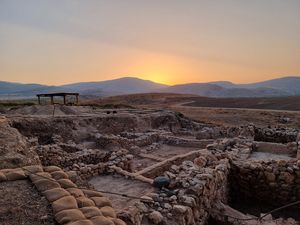
Resettlement of Ruins and Memories in the Making



Associated researchers
- Dr. Kishiya Hidaka (Persian and Hellenistic literature of the Hebrew Bible and its environment)
- Prof. Dr.-Ing. Dr. h.c. Thomas Luhmann (Photogrammetry and Geovisualisation, Jade University of Applied Sciences)
- Prof Dr Michael Sommer (Ancient History, UOL)
- Prof. Dr Dagmar Freist (Early Modern History and Digital Cultural Heritage Research)
- Project association with the digital cultural heritage projects at the UOL: Price Papers, DiViAS and ProSaDi.
The project in the press
mdr Wissen report: Hazor: German researchers want to shed light on the origins of the people of Israel (7.4.2024).
An ancient megacity in upheaval. Research project looks at the settlement history of the Iron Age metropolis of Hazor in Israel (2 April 2024).
Oldenburg theology professor Hensel is co-director of Israel's currently largest archaeological excavation. Special excursion to Hazor: 20 students also take part in excavation of ancient megacity (17 July 2023).
Resettlement of Ruins and Memories in the Making
A Case Study on Hazor and the Shaping of Early Israelite Identities during the Iron Age
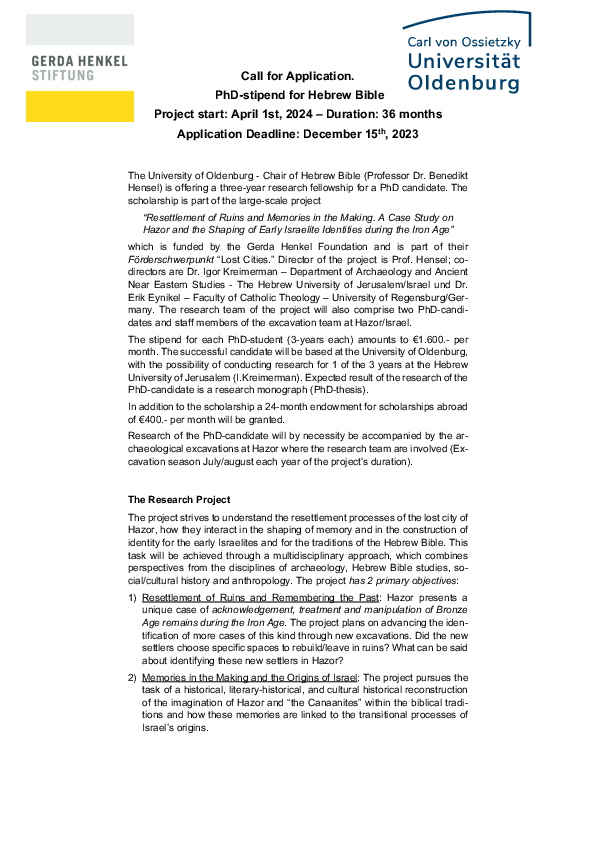
Research project 2024–2027 within the Gerda Henkel Foundation’s “Lost Cities” funding priority
Project team
project leader:
- Prof. Dr Benedikt Hensel – Chair of the Hebrew Bible – University of Oldenburg, Germany
Project partners:
- Dr Erik Eynikel – Faculty of Catholic Theology – University of Regensburg, Germany
- Dr Igor Kreimerman – Department of Archaeology and Ancient Near Eastern Studies – The Hebrew University of Jerusalem, Israel
Project coordinator – Project office
Two postdoctoral positions:
- Sub-project: ‘Archaeology of Hazor’: Dr Nitsan Shalom (University of Oldenburg)
- Sub-project ‘The Hebrew Bible, memories in the making and the origins of Israel’: Dr Yair Segev (University of Oldenburg)
The Aims of the Project
Within this recent and crucial debate, the ‘Resettlement of Ruins and Memories in the Making’ project aims to understand the processes of resettlement of the lost city of Hazor in relation to the shaping of memory and the construction of identity concerning the early origins of Israel and its significant literary traditions, which later became the Hebrew Bible. This objective will be achieved
- through the lens of the megapolis of Hazor, whose complex settlement history of de- and re-urbanisation—as one of the largest former megacities of the Southern Levant in antiquity—spans the entire period covered by this project.
- by integrating these detailed observations into a general and much-needed overarching picture of cultural and ethnic continuities, discontinuities, and Late Bronze Age/Iron Age I–II transitions in the Southern Levant.
This task can only be achieved through the unique multidisciplinary approach adopted for this project, which will combine perspectives from the disciplines of archaeology, social and cultural history, anthropology, and Hebrew Bible studies. The project has two primary objectives, leading to the two areas of research described in the following section:
- “Resettlement of Ruins and Remembering the Past” (Archaeology; Nitsan Shalom): Hazor presents a unique case of acknowledgement, treatment and manipulation of Bronze Age remains during the Iron Age. The project aims to identify further cases of this kind through new excavations. Did the new settlers have prior knowledge of the destroyed buildings? Did they choose specific spaces to rebuild or leave in ruins? What can be said about the (cultural or ethnic) identity of these new settlers in Hazor?
- “Memories in the Making and the Origins of Israel” (Hebrew Bible Studies and Cultural History; Kishiya Hidaka): The project aims to undertake a historical, literary-historical and cultural-historical reconstruction of the imagination of Hazor and the Canaanites within biblical traditions, and to examine how these memories are linked to the transitional processes of the origins of Israel – or rather, the ‘memories of Israel’ as an early tribal culture.
Each area of research will, by necessity, be accompanied by the archaeological excavations at Hazor in which the Principal Investigator and the research team are involved.
‘Resettlement of Ruins/Gerda Henkel Project’ Research Unit since 2024: EABS Annual Meeting Research Unit ‘The Origins of Israel: Perspectives from Archaeology and Biblical Studies’
Chairs: Benedikt Hensel (Carl von Ossietzky University of Oldenburg), Kishiya Hidaka (Carl von Ossietzky University of Oldenburg)
The question of the ‘origins of Israel’ (which should be addressed in the plural) in the land and the formation of ‘Israelite’ identity requires an interdisciplinary approach involving scholars from a range of disciplines, including biblical studies, the history of ancient Israel, cultural history, socio-political history, and the archaeology of the southern Levant.
Modern archaeological research has revealed views that diverge significantly from the account in biblical narrative literature, which states that the origin of Israel came about through the conquest of the land – a view presented particularly in the so-called Deuteronomistic History (e.g., the Book of Joshua).
However, this discrepancy sheds new light on the question of the ‘origins of Israel’. Why do the major biblical traditions present the origin of Israel as the conquest of land, rather than the peaceful settlement of the ‘Israelite’ population within the land? How can we interpret the socio-political and historical situation from the Late Bronze Age to the early Iron Age II – for example, the retreat of the Egyptian Empire’s power from the Levant, and the destruction and abandonment of major urban sites in the Levant – in relation to the formation of Israelite identities? This research unit aims to investigate the origins of Israel and the formation of Israelite identity from multiple perspectives using diverse methodological approaches as a collaborative scholarly endeavour.
Related project: ‘Hazor Digital’ (Principal Investigator: Benedikt Hensel)
In archaeology, digital methods have been tried and tested extensively for years and are already established in some areas – including geoinformation systems, databases, digital photography, digital 3D documentation and 3D scanning, virtual reconstructions, retrodigitisation of older analogue documentation (diaries, plans, drawings), as well as statistics, machine learning, artificial intelligence and agent-based simulations. At the same time, these methods are often organised as stand-alone solutions in archaeological projects: they address individual aspects (plan, profile, artefact, find inventory, image data, analysis), are tailored to specific methods and are only integrated to a limited extent as part of an overarching fieldwork process. The Oldenburg-based research project ‘Hazor Digital’ addresses precisely this issue and focuses on two central aspects of digital field archaeology: 1. A data information system – a (field) archaeological processing pipeline – and 2. AI-supported, (partially) automated analysis of field archaeological findings and artefacts within the data information system and the pipeline (see the project website).
The Oldenburg research project ‘Hazor Digital’ will continue its work in 2026, testing key components of an integrated digital excavation practice directly in the field. The focus is on state-of-the-art surveying techniques, daily georeferenced 3D recording of the sections currently being worked on (including ‘next-day’ orthomosaics for documentation), geovisualisation, and AI-supported analysis methods – in particular, automatic image segmentation, wall and stone recognition. In 2026, the work will initially concentrate exclusively on the Upper Town and, within that area, on sites yielding finds from the Iron Age I–II (M22, M4, M68, M69). In collaboration with specialists from Jade University (IAPG) and the Digital Technologies in Heritage Conservation programme (University of Bamberg), various methods (static and mobile scanners, photogrammetry, smartphone workflows) will be systematically compared and further developedinto a high-performance processing pipelinethat integrates documentation and analysis within a single data management system.
Publications (selection)
- Hensel, Benedikt/Kreimerman, Igor, “New Excavations in the Megapolis of Hazor: Descending into the Settlement Layers of Ancient Israel,” in: Welt und Umwelt der Bibel 1 (2024), 62–65.
- Hensel, Benedikt, ‘From Hero to Zero? The Bronze Age–Iron I Transition at Hazor: Resettlement of Ruins and Memories in the Making’, in: Zimmermann, M. (ed.), Abandoned Cities – Resilience in Perceptions and Interpretations, 2026, 49–62.
- Kreimerman, Igor / Eynikel, Erik / Hensel, Benedikt / Lhoyer, Bénédicte / Sandhaus, Débora, “Tel Hazor 2023: Preliminary Report”, Zeitschrift des Deutschen Palästina-Vereins 141/1 (2025). [peer-reviewed]
- Shalom, Nitsan / Sandhaus, Débora / Cimadevilla, Manuel / Hensel, Benedikt / Eynikel, Erik / Kreimerman, Igor, ‘Between Function and Meaning: The Reuse of Bronze Age Elements in Iron Age Hazor’, Levant (in press; accepted 06/2026). [peer-reviewed]
- Hensel, Benedikt. ‘Spatial Turn: Biblical Archaeology and Regional Studies.’ In Handbook of Bible and Cultural Studies, edited by S. Hübenthal and B. Collinet. London: T&T Clark / Bloomsbury. Forthcoming (submitted to the publisher).
- Hidaka, Kishiya, “The Curse of Canaan (Genesis 9:18–29) as a Post-Priestly Composition: A Literary and Tradition-Historical Reassessment,” Zeitschrift für die alttestamentliche Wissenschaft 137 (2025): 467–482.
- Hidaka, Kishiya, ‘The Theme of Canaan in the Priestly Tradition’, Vetus Testamentum. (accepted)
- Hidaka, Kishiya, “Joshua 11 as a Secondary Expansion of the Conquest Narrative: A Literary-Historical Analysis,” Zeitschrift für die alttestamentliche Wissenschaft 138 (2026). DOI: 10.1515/zaw-2026-3002.
- Hidaka, Kishiya, “The Promise of the Land and Israel’s History in Genesis 15,” in Moritz F. Adam, Lida Panov, and Florian Oepping (eds.), Genesis und Exodus. Proceedings of the Symposium on the 60th Birthday of Konrad Schmid (BZAW), Berlin: De Gruyter. (accepted)
- Hidaka, Kishiya, “Canaan in Joshua: The Literary Development of the Concept of the Land and Its Former Inhabitants,” Vetus Testamentum. (submitted)
- Hidaka, Kishiya, “The Decentred Israel of Judges 3–12: Benjamin/Ephraim, the Saviour Cycle, and Post-Monarchic Tribal Imagination,” in JiSeong James Kwon (ed.), How Did Benjamite and Judean Memories Shape the Stories of David and Saul? Contested Narratives of David and Saul (provisional title). (submitted).
- Y. Segev, “The Other Face of Moses: Reconsidering the Place and Image of Moses in the Deuteronomistic Tradition”, Religions (accepted for publication)
- I. Kreimerman and Y. Segev, “The Absolute Destruction of Cities in Archaeological Findings and its Relation to the Practice of Ban (Ḫerem) in Biblical and Ancient Near Eastern Sources” (submitted)
- I. Kreimerman, Y. Segev, B. Hensel, “Hazael’s Grand Empire? A Recent View from Tel Hazor” (in progress; biblical section completed).
Theses / MA Theses (completed)
- “Joshua 11, Judges 4 and Hazor: Literary Findings and Archaeological Evidence” (Lennart F. Frost, University of Oldenburg; supervisor: Benedikt Hensel)