
Hazor Excavations Project


What the press says:
- An in-depth feature on the Hazor excavation by the Oldenburg archaeology chair on the main page of the UOL.de website.
- Report on the Hazor excavation in UNI Info (October 2023 issue) and an interview with excavation director Benedikt Hensel, as well as Maryam Matta and Sophie Dierks
- UOL press release dated 18 July 2023
- Report on the excavation and the 2023 Summer School in MoX (18 July 2023)


Hazor Excavations Project
Israel’s largest archaeological excavation: a major international and interdisciplinary project
Dr Igor Kreimerman, The Hebrew University of Jerusalem, Israel (Director)
Prof. Dr Benedikt Hensel, University of Oldenburg (Co-Director)

(Fig.: Iron Age citadel and cult site at Hazor; in the foreground, a cult site (‘Bamah’) dating from the 11th century BC (copyright: Wikimedia Commons, free use)
Professor Dr Benedikt Hensel is conducting excavations at Hazor in Israel. Since 2023, he has been Co-Director of the large-scale excavation at Israel’s largest Bronze Age megacity, working there in collaboration with the Hebrew University of Jerusalem and the Director of Excavations, Dr Igor Kreimerman.
The associated project, ‘Resettlement of Ruins and Memories in the Making: A Case Study on Hazor and the Shaping of Early Israelite Identities during the Iron Age’, which he leads jointly with Dr Igor Kreimerman (Jerusalem), aims to investigate the processes of de- and re-urbanisation of the megacity of Hazor during the transition from the Late Bronze Age to the Early Iron Age, examining their interplay with the formation of a culture of remembrance and the construction of identity in ‘early Israel’, as well as within the Hebrew Bible. This task is approached through a multidisciplinary approach that combines perspectives from the disciplines of archaeology, Old Testament studies, social and cultural history, and cultural anthropology.
‘Hazor Digital’: Hazor Season 2025
The Oldenburg team led by Benedikt Hensel is currently developing digital recording and analysis methods to drive forward the digital transformation processes which, as a result of the so-called Digital Revolution, enable the indexing, recording, digitisation, storage, organisation and analysis of aspects relating to the materiality of excavations, artefacts and written records. From 2025, these methods will be tested on site as part of the Oldenburg project ‘Hazor Digital’.
These include state-of-the-art surveying techniques, 3D digitisation and visualisation (multispectral), geovisualisation, spatial AI and AI-assisted analysis methods. Specialists from Jade University’s Institute for Applied Photogrammetry and Geoinformatics (IAPG) are involved in the project.
The excavations for the 2025 season will take place from 3 to 22 August 2025. We cordially invite you to an information evening on 19 December at 6.30 pm at ‘Villa Geistreich’, Oldenburg, or online via: meeting.uol.de/rooms/qub-zix-bor-ezt/join.
Hazor Excavation Season 2023

(Staff photo: Director, Co-Director, Area Supervisors, Assistants and the Management Team – Hazor Excavation 2023)

(The team of students from Oldenburg – Hazor Excavation 2023)

March 2026

Axel Springer Foundation supports the Intercultural Summer School Israel 2026 of the Professorship of Old Testament and Biblical Archaeology
The Axel Springer Foundation (Berlin) is supporting the Intercultural Summer School Israel 2026 of the Professorship of Old Testament and Biblical Archaeology with a substantial grant, which will directly benefit the participating students. We are very pleased about this recognition and would like to thank the foundation for its generous support. The Summer School will take place in Israel from 2 to 23 August 2026 and will combine the educational excavation in Hazor with intercultural and interreligious encounter formats as well as scientifically guided excursions. Further information on the Summer School can be found here.
02-23 August 2026

Intercultural Summer School Israel and teaching excavation in Hazor (02-23 August 2026)
Prof Dr Benedikt Hensel is running a three-week summer school in Israel with a team of 30 students and researchers from Oldenburg. The focus is on training intercultural and interreligious skills at the centre: Israel will be explored as a polyphonic cultural and religious space in the past and present - through excursions, encounter formats and scientifically guided tours of ancient sites that complement the educational excavation in Hazor. Discussions are planned with representatives of Judaism, Christianity and Islam as well as insights into smaller communities (including Samaritans and Druze). A visit to Yad Vashem is a fixed part of the programme. The Summer School combines academic research, historical depth and lived dialogue practice - as an intensive teaching and experience format on site.
3 November 2023

In another time
The university website reports in an extensive article on the excavation of the Old Testament Chair in Hazor and the associated summer school and the related research projects of Benedikt Hensel - including his textbook on the "Archaeology of the Southern Levant". Click here for the article.
October 2023

UNI Info report and interview about the 2023 Hazor excavation of the Old Testament Chair
In the October-December 2023 issue, the UNI Info newspaper reports on the excavation of the Old Testament Chair Oldenburg in Hazor! In addition to excavation director Benedikt Hensel, our Hiwis Maryam Matta and Sophie Dierks are also interviewed.
Click here for the online edition of the journal.
New major Oldenburg project of the Old Testament Chair: Israel's largest excavation under the co-direction of Prof. Hensel (press release from 18 July 2023)
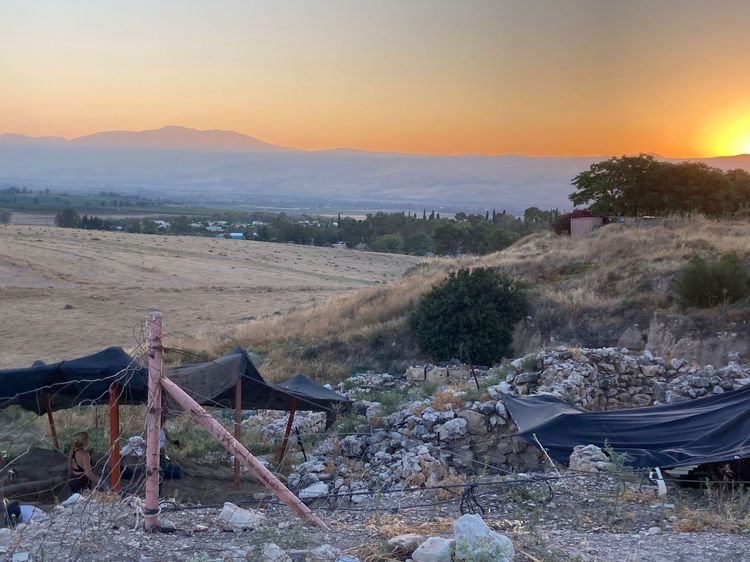

Excavation of the ancient megacity of Hazor under Oldenburg project management
Oldenburg theology professor and Old Testament scholar Benedikt Hensel is co-director of Israel's currently largest archaeological excavation in the ancient megacity of Hazor (Israel), for which he is responsible together with his Israeli project partner, excavation director Dr Igor Kreimerman from the Hebrew University of Jerusalem. Hazor has been a United Nations World Heritage Site since 2005. Twenty students from School IV are also taking part and will get to know the historic land and multicultural modern Israel on excursions at a summer school organised by Hensel in parallel. The ancient megacity of Hazor is also the subject of Hensel's current research as well as several dissertation and habilitation projects under his supervision. For further information see here.
Hazor: Canaanite Metropolis - Israelite City

Expanded edition of A. Ben -Tor, Hazor, Canaanite Metropolis, Israelite City, published in 2016. Ben -Tor, Hazor, Canaanite Metropolis, Israelite City, published in 2016. It presents recent finds and new insights that have emerged since the publication of the previous edition. Buy it online at here.