
GRK Neuromodulation (GRK 2783)
GRK Neuromodulation (GRK 2783)
P4 Sensor-based tracking of upper limb use in domestic environments
Motivation & Goals
This project is part of the Research Training Group "Neuromodulation of Motor and Cognitive Function in Brain Health and disease" (GRK 2783): https://uol.de/neuromodulation
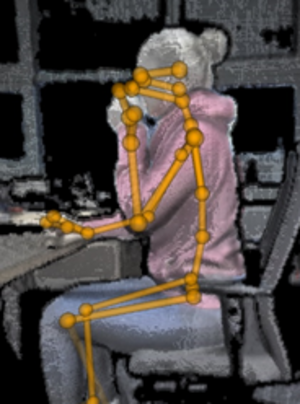
About 50% of stroke survivors experience impairments in activities of daily living (ADLs). ADLs are an important outcome criterion for interventions aimed at improving upper limb function, although commonly used assessment tools regularly fail to show significant improvements. Therefore, Project 4 of the Research Training Group aims to use body-worn inertial measurement units (IMUs) and depth imaging cameras to both detect changes in arm movements when performing ADLs and to classify different ADLs in stroke patients.
Approach
In order to pursue the objectives, two studies will be conducted in the project:
In the first study, IMU data as well as colour and depth images of stroke patients will be recorded before, during and after neurofeedback training. This will include activities of daily living, such as drinking or making a sandwich. The data is recorded both in a laboratory environment at the university and at the patients' homes. The arm movements of the stroke patients are then extracted from this data and changes over the training time are examined.
In the second study, IMU and camera data will also be recorded from healthy individuals and stroke patients in a simulated home environment. The subjects will be asked to perform simple arm movements, natural arm movements according to a standardised procedure and completely natural arm movements. These data will then be used to classify ADLs. Furthermore, it will be assessed how the quality of the movements is reflected in the data and the classification results.
Publications
Büker, L., Hellmers, S. and Hein, A. (2025). A Pre-Study on Tremor Classification During Activities of Daily Living. In Proceedings of the 18th International Joint Conference on Biomedical Engineering Systems and Technologies – HEALTHINF; ISBN 978-989-758-731-3; ISSN 2184-4305, SciTePress, pages 805–812. DOI: 10.5220/0013307400003911