
Latest news
Latest news
Here you will find current information on calls for tenders, events and other offers relating to equal opportunities.
Current research on gender-sensitive medicine
Lecture series
As part of a student initiative, we are organising a public lecture series on gender-sensitive medicine during the 2025/26 winter semester, in collaboration with Kritische Mediziner:innen.
We firmly believe that gender-sensitive medicine has so far received too little attention in medical education and practice. Through our lecture series, we aim to highlight the latest scientific findings, connect interested parties and jointly create spaces for exchange and discussion.
Thanks to the support of the Gender and Diversity Management team at School VI, the Department for Human Medicine and the FemRef at the University of Oldenburg, as well as the Smart House Oldenburg, the City of Oldenburg’s Gender Equality Office and the Marburger Bund of Lower Saxony, we have been able to put together an exciting programme to which we would like to cordially invite you.
Please note: Continuing professional development credits are awarded to doctors.
Our lecture series is aimed in particular at students on medical-related degree programmes, teaching staff and medical professionals, but is open to anyone interested.
Following each lecture, there will be time for questions, discussions and an opportunity to chat over snacks and drinks.
You can also find the latest information and announcements on Instagram at https://www.instagram.com/kritmeds.ol/
Should you have any queries or suggestions, please do not hesitate to contact us:
We look forward to some fascinating talks and discussions and would like to thank our supporters!
The organising team for the lecture series
Belana Attallah, Gesine Buurman, Merit Henkel, Ella Mönning
Programme:
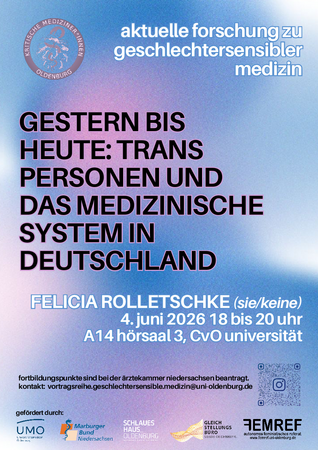
4 June 2026, 6–8 pm, University of Oldenburg, A14, Lecture Theatre 3
From yesterday to today: trans people and the medical system in Germany
Felicia Rolletschke (she/no)
A hundred years ago, Germany was home to one of the most progressive centres for research into trans people: the Institute for Sexual Science. In the 1980s, Germany then began sterilising trans people on a massive scale. Supported and underpinned by the medical system, this continued until 2011. What happened? Where did medicine go wrong? How has research into trans people developed over the decades?
---
Past events:
25 February 2026, 5–7 pm, The Smart House Oldenburg
Gender-sensitive medicine in medical studies – fundamentals, perspectives and practical examples
Dr Laura Wortmann (doctor and researcher in the field of gender-sensitive medicine) (she/her)
The lecture will be streamed online: https://meeting.uol.de/rooms/n38-pp5-tdb-9cv/join
Gender-sensitive medicine examines how gender affects health, illness and healthcare, and helps to improve medical care for all genders. Nevertheless, it has so far been inadequately integrated into medical training in Germany. The lecture provides an overview of fundamental concepts, curricular approaches and practical examples drawn from her own teaching at the OWL School of Medicine in Bielefeld. Dr Wortmann will explain how gender sensitivity can be established as a central component of modern medical education and how it prepares students for a nuanced, patient-centred practice.
CANCELLED: 11 February 2026, 5–7.00 pm, BIS Hall, University of Oldenburg (Haarentor campus)
Transformative technologies: implementing intersectional justice in digital health
Dr Tereza Hendl (philosopher and bioethicist) (she/her)
28 January 2026, 5–7 pm, BIS Hall, University of Oldenburg (Haarentor campus)
Pain and Prejudice: Why pain is not gender-neutral
Stefanie Beinert (doctoral candidate and research assistant, Department of Health Economics) (she/her)
The lecture will be streamed online: https://meeting.uol.de/rooms/coq-yek-qce-yke/join
In healthcare, pain is still largely understood through a biomedical lens that takes only limited account of social and cultural factors. However, pain is deeply embedded in social, cultural and gender-specific contexts. Numerous studies show that women, people of colour (PoC), people with a migrant background, and trans*, inter* and non-binary people experiencing pain are less likely to be taken seriously, receive diagnoses later, and are more frequently labelled as having psychosomatic conditions or treated inappropriately than cisgender male patients. Pain is therefore not only a medical issue, but also one relevant to power dynamics and discrimination.
Why is pain in women more frequently interpreted as ‘emotional’? Why are men more likely to undergo invasive diagnostic procedures, whilst women are more likely to be prescribed sedatives? What role do gender norms, stereotypes and implicit biases play in everyday clinical practice? And how do these mechanisms affect diagnosis, the progression of chronic pain, adherence to treatment and inequalities in care?
The lecture examines pain from a gender- and diversity-sensitive perspective and demonstrates how structural assumptions and bias systematically shape the perception, assessment and treatment of pain. The aim is to raise awareness of gender bias in pain medicine, to contextualise key mechanisms and to identify starting points for fairer, evidence-based and patient-centred pain care.
25 November 2025, 5–7.00 pm, V03 0-C002 University of Oldenburg (Haarentor campus)
Care and needs of trans*, inter* and non-binary people in gynaecology and obstetrics
Taleo Stüwe (doctor and medical consultant) (he/him)
There is evidence that queer people receive poorer care within the healthcare system than non-queer people. In particular, access to gender-specific medical services remains severely restricted for trans*, inter* and non-binary (TIN*) people. They face structural discrimination, as well as a lack of knowledge and sensitivity among healthcare professionals.
Can trans* women breastfeed? What does a professional approach to the birth of an inter* baby look like? How can non-binary people be treated sensitively in a gynaecological practice? What needs to change to ensure that pregnant trans* men receive good care?
This talk will address these and other questions. The aim is to reduce uncertainty when dealing with TIN* people, as well as to raise awareness of the current state of care and the needs of genderqueer patients. Terminology will be clarified and the significance of the healthcare system for the lived experiences of TIN* people will be highlighted. The focus will be on the experiences, the current state of care and the areas for improvement for TIN* people in gynaecology and obstetrics.
5 November 2025, 5–7.00 pm, BIS Hall, University of Oldenburg (Haarentor campus)
The Anatomy of Patriarchy – How Textbooks Marginalise Female Sexuality
A gender-critical perspective on the representation of female sexual anatomy and physiology in medical education
It is often said that anatomy is a self-contained subject. For centuries, the human body has been dissected, prepared and drawn. It is hard to imagine that any structure could have been overlooked. And yet there is one organ whose structure and function are strikingly under-represented and inaccurately depicted in medical textbooks: the bulbo-clitoral organ. How can this be explained? How is the female external genitalia otherwise depicted? And how do current anatomical and physiological textbooks address gender, sexuality and normality? We aim to shed light on these questions in this lecture, taking an interdisciplinary look at the history of science, philosophy, cultural studies and sexology.
After all, it is part of rigorous scientific practice to question where academic knowledge comes from and what shapes it. As future medical professionals, this ultimately also concerns the provision of appropriate – that is, informed – treatment for our patients.
Marianne Hamm (sex educator, sex and gender studies scholar) (she/her) and Lucia Christians (medical student) (she/her)
---
Apply now: Individual coaching for female scientists and physicians eligible for appointment
Have you qualified for a professorship? Are you already actively applying for advertised professorships or are you planning to do so soon?
We would like to support you in your career development and in your appointment procedure. You can now register for a free individual coaching session with the German Association of University Professors and Lecturers (DHV).
The DHV is the largest interdisciplinary, higher education policy and scientific association in Europe. In addition to other services, the DHV offers seminars, counselling and coaching. The DHV counselling team has many years of proven experience in career and appointment coaching for academics, with extensive expertise in higher education and civil service law and knowledge of medical appointment procedures in particular.
According to the DHV, in addition to teaching the legal framework of an appointment procedure, the coaching focuses on the professional development of an optimal concept and strategy as well as preparatory negotiation training. Further information can be found on the DHV website.
DHV: "The aim of individual coaching is to prepare you comprehensively in terms of content and tactics so that you can successfully master the increasingly complex situation of academic appointments and, if necessary, lead negotiations with great confidence."
In brief:
- Who: Scientists* and doctors* with a habilitation (or habilitation-equivalent qualification) who have a contractual connection to the University of Oldenburg and are in an appointment procedure or who are applying for a professorship in the near future.
- What: One intensive coaching session of two hours each at the DHV (face-to-face or online). If required, a further hour can be requested
- Costs: Free of charge for faculty members
- Deadline: 29.11.2024
Note: If the number of registrations exceeds the available places, we reserve the right to draw lots for participation in the programme.
The following proposal must be submitted:
Further equality measures can be found here.
DFG publication: Avoiding bias in scientific judgement processes
"No person should be prevented or excluded from a scientific career because of factors unrelated to science."
DFG publishes film and concrete recommendations for avoiding bias in scientific judgement processes.
Further information on the DFG website.
From 01.11.2023: Change of first name and gender details for trans*, inter* and non-binary persons
From 1 November 2023, all trans*, inter* and non-binary members and relatives of the UOL will be able to apply to change their official first name(s) and gender details to match their identity in the leading IT systems with external effect (e.g. employment contract, email address, enrolment certificate, etc.).
The application is available to students in Stud.IP from 1 November 2023 under Study details -> Change personal details.
Students can find FAQs at: https://uol.de/studium/studierendenstatus/namensaenderung
Employees should contact the person responsible for them in Division 1.
You can find the relevant guidelines here.