Latest news
Latest news
Exhibition: Pamphlet Literature
19th-century fair prints. 11 September – 24 October 2026 (Oldenburg State Library)
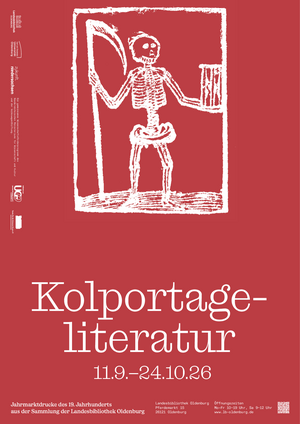
A forgotten form of popular literature is being brought back to life: the exhibition ‘Kolportage Literature’ at the Oldenburg State Library showcases 19th-century fairground prints recounting gruesome crimes, terrible disasters or tragic love stories.
At the opening on 10 September at 7.00 pm, curator PD Dr Christian Schmitt will introduce the theme, and actor Jens Ochlast will read from the fairground pamphlets. A catalogue accompanying the exhibition is being published by Isensee Verlag.
Further information is available on the Oldenburg State Library’s website.
Workshop: Nazi ‘Euthanasia’ in Literature and Film: On the Media Representation of Disability since 2000
23 June 2026, 6.00–8.00 pm (Unikino GEGENLICHT at UNIKUM Oldenburg, Stage 1)
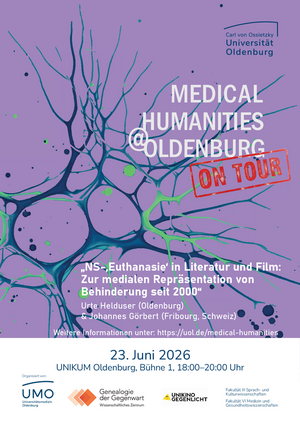
Since the turn of the millennium, the history of ‘euthanasia’ under National Socialism has increasingly entered the public consciousness and become a central part of remembrance culture. This growing public awareness is evident in the increased attention paid to the remembrance work carried out by memorial sites in places such as Hadamar, Bernburg, Grafeneck, Hartheim and – not least – Wehnen near Oldenburg. The topic of Nazi ‘euthanasia’ is also increasingly encountered in cultural and media discourse: in literature, the visual arts and audiovisual media. The media culture of remembrance is also linked to historical and current discourses on disability and debates on medical ethics, such as those concerning prenatal or pre-implantation genetic diagnosis and euthanasia. In this workshop, we therefore wish to explore this literary and media engagement with Nazi ‘euthanasia’ from the perspective of Cultural Disability Studies. To this end, we would like to present excerpts from selected films, plays and novels on the subject and discuss them together: How are these media forms of remembrance linked to understandings of disability? What images are conveyed here? What emotional effects do cinematic portrayals of victims’ stories aim to achieve? How do fictional forms of remembrance in literature and film contribute to the historical reappraisal of Nazi biopolitics?
Speakers:
Johannes Görbert (University of Fribourg, Switzerland) is a literary scholar specialising in Literary Disability Studies and Medical Humanities. He is co-director of the DFG network “Inclusive Philology”.
Urte Helduser is Professor of Modern German Literature at the University of Oldenburg and conducts research on literature and biopolitics.
New publication: Idyll and gender. Transformations of pastoral poetry in the 18th century
Edited by Kristin Eichhorn and Christian Schmitt (=Das achtzehnte Jahrhundert 49/2, 2025)
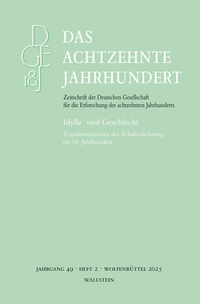
The articles in this special issue explore the question of the relationship between 'idyll' and 'gender' in exemplary contexts. The 18th century appears to be a transitional period in two respects. According to the starting point, this period not only saw the transformation of early modern pastoral poetry into a bourgeois idyll, as has been described by many researchers, but this genre-historical transformation also went hand in hand with the transformation of gender orders and thus the way in which pastoral texts and idylls construct gender(s) and desire also changed over the course of the 18th century. If the history of the genre can be read as a tense interplay between the confirmation of established and the opening up of alternative conceptions of gender and desire, the question arises as to how 18th-century pastoral poetry can be categorised in this respect.
New publication: Yearbook of the Society for Children's and Youth Literature Research
Theme issue: Uncanny. Edited by Thomas Boyken et al. (Vol. 9, 2025)
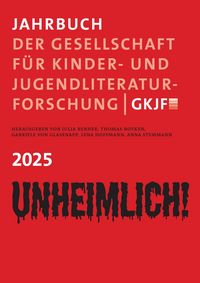
This year's yearbook of the Gesellschaft für Kinder- und Jugendliteraturforschung is dedicated to the uncanny in all its breadth and diversity and shows how it is negotiated and developed in various media - from radio plays, novels and comics to films and computer games. The contributions address the topic from various theoretical as well as object-orientated perspectives, often with reference to Sigmund Freud's reflections.
With contributions by Sabrina Dunja Schneider and others.
The yearbook is available as Open Access here.
New publication: Adalbert Stifter: Abdias
Afterword and notes by Christian Schmitt (Stuttgart: Reclam 2025)
Abdias lives as a proud, successful trader in an African desert town, but then everything is taken from him: He falls ill, robbers plunder his house and his wife dies in childbirth. He emigrates to Europe with his daughter Ditha, who receives all his care. But happiness does not return. Stifter's literary breakthrough came in 1842 with the story Abdias.
New publication: Figures of diagnostics
Edited by Till Huber and Sabine Kyora (Boston/Berlin: De Gruyter 2025)
This volume of essays explores the question of the link between medical knowledge and aesthetic procedures, focussing on the narrative of diagnosis as a connection between medical, literary and social discourse. The starting point of the volume is the hypothesis that literary texts from around 1800 to the present day develop 'diagnostic modes of writing' and thus establish diagnosis as a narrative typical of modernity. When analysing figures of diagnostics, the first step is to look within the text for literary figures who diagnose or who are given a diagnosis. Doctors, patients and diagnostic situations depicted in literary texts since the mid-19th century will be analysed. In this context, the link between medical and literary diagnostics also raises the question of rhetorical figures: for literary procedures can be analysed as 'diagnostic modes of writing' independently of the actors involved. This means that literary texts not only adopt subjects related to medicine, but also aestheticise the course of illnesses and thus subordinate them to a literary principle. In this way, they can attempt to override medical logic. Finally, writer-doctors and writers as actors within the narrative must also be analysed. At least for the doctors among them, clinical training as diagnosticians is important.
With contributions by Urte Helduser, Ella M. Karnatz, Thomas Boyken, Sabine Kyora and others.
Interview: Christian Baron "A man of his class"
The writer Christian Baron in dialogue with students
On 24 June 2020, the author Christian Baron visited the University of Oldenburg at the invitation of the Institute for German Studies and the Office for University and Trade Union Co-operation. He spoke to students about his autobiography "A Man of His Class", which was published in 2020.
Baron's book, which is about growing up as a working-class child with an alcoholic and violent father in Kaiserslautern in the 1990s, was on the Spiegel bestseller list. The resulting TV feature film (directed by Marc Brummund in 2024) was awarded the 2025 German Television Prize as "Best Television Film of the Year".
In the video, Christian Baron talks about his career, his work as a journalist and writer, the genesis of the book and his literary process. The interview was conducted by Bachelor students of the seminar "Social Origin and Literature" under the direction of Prof Dr Urte Helduser.