Prof Dr Thomas Boyken
Prof Dr Thomas Boyken

Curriculum Vitae
| since 1 July 2023 | Professorship in Children’s and Young Adult Literature at the Institute for German Studies, University of Oldenburg |
| 1 October 2019–30 June 2023 | Junior Professorship in Children’s and Young Adult Literature at the Institute for German Studies, University of Oldenburg |
| 1 April 2014 – 31 March 2019 | Junior Lecturer in Modern German Literature at the Department of German Studies, Eberhard Karls University of Tübingen |
| 1 February 2013–31 May 2013 | Visiting Lecturer at Nicolaus Copernicus University, Toruń |
| 22 December 2012 | PhD with a thesis on representations of masculinity in the dramatic works of Friedrich Schiller |
| 1 October 2011–31 March 2014 | Teaching staff for special tasks at the Institute for German Studies, University of Oldenburg (specialising in modern German literary studies) |
| 1 October 2009 – 30 September 2011 | Teaching staff for special tasks at the Institute for German Studies, University of Oldenburg (specialising in media studies) |
| 1 January 2009 – 31 September 2009 | Research assistant at the Institute for German Studies, University of Oldenburg |
| 1 January 2007–31 December 2008 | Research assistant in the Centre for Studies and Teaching at the University of Oldenburg |
| 2001–2006 | Degree: German Studies and Sports Science at the University of Oldenburg |
Research
Research focuses
- Children’s and Young Adult Literature from the 18th to the 21st Century
- Theatre theory
- Narratology
- Theory of mediality
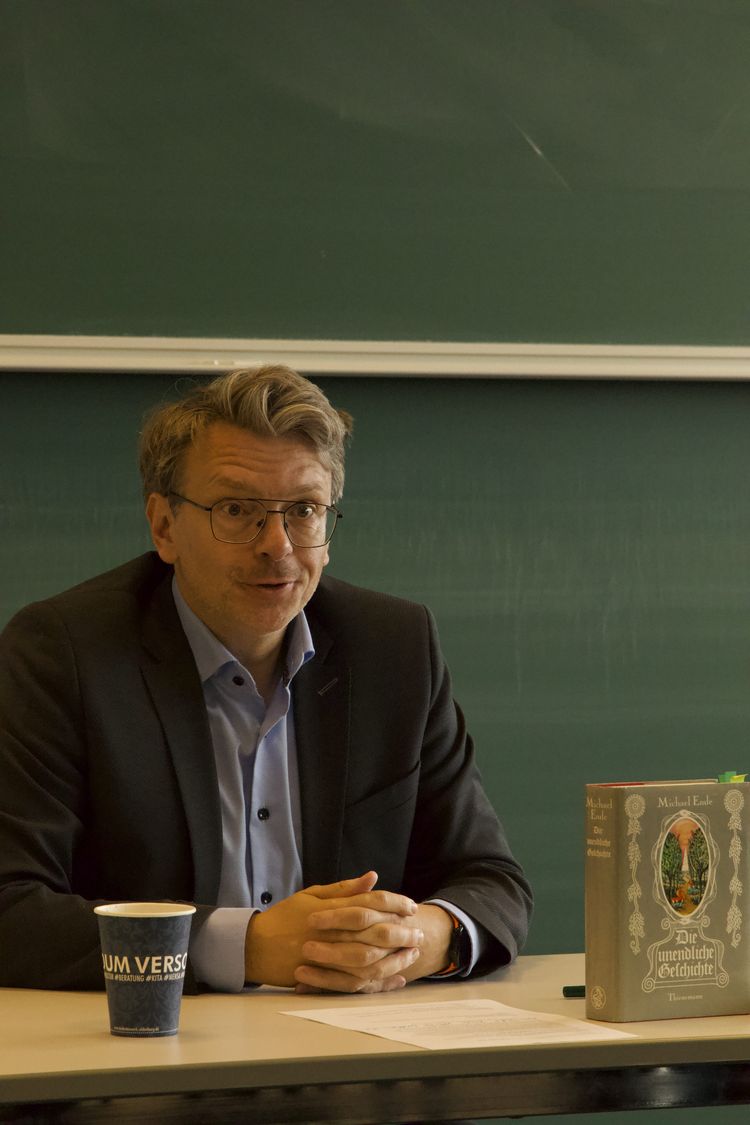
- Michael Ende
Ongoing externally funded projects
- The Post-War Period and the Middle Ages. Children’s and Young Adult Literature (1945–1970), funded by the DFG
- Online commentary on Michael Ende’s *The Neverending Story*, funded by the DFG
Conferences and workshops
- Recorded Heritage. Spaces of Cultural Interference in Eastern Europe in Comics (international workshop, organised jointly with Dr Silke Pasewalck (BKGE) and Prof. Dr Gudrun Heidemann (University of Łódź), 7–8 November 2024)
- Media Reflections and Reflexive Mediality. Children’s and Young Adult Literature in the Context of Media Competition (international workshop, in co-operation with the Hanse-Wissenschaftskolleg, 22–23 February 2024)
- Authorship in Children’s and Young Adult Literature. Historical and Contemporary Practices and Images (international conference, in co-operation with the Swiss Institute for Children’s and Young Adult Media, 16–17 November 2023)
- Research into Children’s and Young Adult Literature: A Methodological Review (workshop, in co-operation with Prof. Dr Maren Conrad and Prof. Dr Tobias Kurwinkel, 26–27 January 2023)
- Michael Ende: Poetics and Positions (international conference, in co-operation with the German Literature Archive in Marbach, 24–26 March 2022).
- Philosophical Questions Reflected in Children’s and Young Adult Literature. Perspectives on the Teaching of Literature and Philosophy. Symposium organised by the Oldenburg Research Centre for Children’s and Young Adult Literature (OlFoKi) (conference, jointly with Prof. Dr Jörn Brüggemann, Prof. Dr Christa Runtenberg and Dr Kerstin Gregor-Gehrmann, 22–24 November 2021).
- “Of Speech and Craft: Oral and Written Narrative in Children’s and Young Adult Literature”(international conference, in collaboration with Dr Anna Stemmann, Oldenburg, 30 June–2 July 2021)
- International conference “Medial Poetologies” (together with Dr Simon Aeberhard, in co-operation with Forum eikones, University of Basel, 11–13 October 2018)
- Summer School “The Return of the Real? New Realism and Contemporary Literature” (in collaboration with Dr Astrid Dröse and Dr Mario Gotterbarm, Eberhard Karls University of Tübingen, 9–11 May 2018)
- “From the Tower to the Classroom: Hölderlin in Schools” (in collaboration with Dr Astrid Dröse and Dr Gabriele Wacker, Hölderlin Tower, Tübingen, 8 July 2017)
- “Reading and/or Looking: Ambiguity in bimodal narrative texts” (in collaboration with Prof. Frauke Berndt and Dr Sebastian Meixner, Bayreuth German Studies Conference, 25 September 2016–28 June 2016)
- German Studies Seminar (in co-operation with the Tübingen Regional Council, Eberhard Karls University of Tübingen, 3 December 2015, 22 January 2016 and 14 February 2017)
- Organisation of the lecture series: “Perspectives: German Language Teaching Methodology” (Eberhard Karls University of Tübingen, winter semester 2014/15)
- Workshop with Terry Eagleton: “Nietzsche, Marx and Tragedy” (in collaboration with Prof. Frauke Berndt, Prof. Dorothee Kimmich and Prof. Jörg Robert, Eberhard Karls University of Tübingen, 30 April–7 May 2014)
- “New Perspectives on Rolf Dieter Brinkmann: Places – Heroes – Bodies” (in collaboration with Ina Cappelmann and Uwe Schwagmeier, University of Oldenburg, 12–14 June 2009)
Publications
Books
Monographs
- Thomas Boyken: The Mediality of Narrative. The Rediscovery of the Book in the Novel. Göttingen: Wallstein 2020.
- Thomas Boyken and Nikolas Immer: Post-War Poetry. Poetry and Poetics between 1945 and 1960. Tübingen: utb [Narr Francke Attempto] 2020.
- Thomas Boyken: ‘So I Will Give You a Manly Example’. Imaginations of Masculinity in the Dramatic Works of Friedrich Schiller. Würzburg: Königshausen & Neumann 2014.
- Thomas Boyken and Jan Traphan: ‘When I Come Across a Solution, the Text Is Over’. A workshop discussion with Antje Ràvic Strubel. Oldenburg: Frühwerk 2008.
Anthologies
- Thomas Boyken and Thomas Scholz (eds.): Michael Ende. Poetics and Positions. Berlin: Metzler 2023.
- Thomas Boyken, Jörn Brüggemann and Kerstin Gregor-Gehrmann (eds.): Philosophical Questions as Reflected in Children’s and Young Adult Literature. Dresden and Munich: Thelem 2023.
- Thomas Boyken and Anna Stemmann (eds.): Of the Spoken Word and Craft. Oral and Written Narrative in Children’s and Young Adult Literature. Berlin: Metzler 2022.
- Thomas Boyken and Nikolas Immer (eds.): Textures of the Wound. Constellations of Post-War German-Language Poetry. Würzburg: Königshausen & Neumann 2016.
- Thomas Boyken, Ina Cappelmann and Uwe Schwagmeier (eds.): New Perspectives on Rolf Dieter Brinkmann: Places – Heroes – Bodies. Munich: Fink 2010.
Editions
- Maria Lypp: Simplicity as a Category of Children’s Literature (1984). Taking into account the unpublished version of 1980. Edited by Thomas Boyken and Hans-Heino Ewers in collaboration with Lucas Lypp. Weinheim 2025.
Essays
Afterword. In: James Krüss: Today All the Stars Are Dancing. Stories and Poems for the Christmas Season. Edited by Ulrike Schuldes. With an afterword by Thomas Boyken. Stuttgart 2026, pp. 113–124.
‘For Young People’. Form and Function of Subtitles in Children’s and Young Adult Literature (1800–1900). In: *Kodex*. Yearbook of the International Society for Book Studies 13 (2024/2025): Title Practices. Actors – Formats – Stories. Edited by David-Christopher Assmann and Raul Calzoni. Wiesbaden: Harrassowitz 2026, pp. 101–118.
“It is a dreadful habit of yours to always write poetry about poetry”. The barrel organ as a poetological motif in Krüss’s poetry. In: Petra Josting (ed.): Poetry for Children, Young People and Others. From the 18th Century to the Present Day (kjl&m, class 78, 2nd half of 2026), pp. 34–41.
A poetics of written storytelling? The ‘bookishness’ and ‘work politics’ in Michael Ende’s writing. In: Ute Dettmar, Lena Hoffmann and Christine Lötscher (eds.): Ways of Writing. Authorship, Writing Practices and Formats in the Field of Children’s and Young Adult Media. With contributions by Pauline Gaspard and Jesper Rusterholz. Berlin 2026, pp. 101–116.
Over His Dead Body. Depictions of Suicide in German-Language Young Adult Literature: The Case of Anne Freytag’s *Nicht weg und nicht da* (2018) and Tobias Elsäßer’s *Für Niemand* (2011). In: Ella Margaretha Karnatz, Misa Fujiwara, Federica La Manna, Waltraud Maierhofer (eds.): Narratives of Mental Health Crises. Depression, Suicide and Trauma in German-Language Literature since 2000. Bielefeld 2026, pp. 25–41.
The Power and Powerlessness of Narrative. Forms of Self-Reflexivity in Preußler’s *The Flight into Egypt*. The Royal Bohemian Section (1978). In: Julia Benner and Petra Josting (eds.): Between Nostalgia and Innovation. The Literary Work of Otfried Preußler. Berlin 2025, pp. 35–68.
‘Prosa Nova’: Medial and narrative representational techniques in literary autopathographies, using the example of David Wagner’s Life (2013). In: Till Huber and Sabine Kyora (eds.): Figures of Diagnosis. Berlin and Boston 2025, pp. 267–186.
Cornelia Funke’s Reckless. Stone Flesh : A Comparison of Editions (2010, 2020). In: Tobias Kurwinkel, Philipp Schmerzheim and Anke Vogel (eds.): Cornelia Funke Intermedially. Würzburg 2025, pp. 43–62.
Research into Children’s and Young Adult Literature [in collaboration with Gina Weinkauff]. In: Yearbook for International German Studies. In association with the International Association for German Studies. 56 (2024), Issue 2, pp. 267–308.
- Research into Children’s and Young Adult Literature (in collaboration with Gina Weinkauff). In: Yearbook for International German Studies 55 (2023), No. 1, pp. 273–276.
- Action Systems and Symbolic Systems. Reflections on heuristic added value within research into children’s and young adult literature. In: Yearbook of the Society for Research into Children’s and Young Adult Literature (2023), pp. 118–129. [https://ojs.ub.uni-frankfurt.de/gkjf/index.php/jahrbuch/issue/view/8/8]
- Syncretic Poetics. Play in the Works of Michael Ende. In: Michael Ende. Poetics and Positions. Berlin 2023, pp. 43–59.
- Michael Ende: The Genesis of a Field of Research (co-authored with Thomas Scholz). In: Michael Ende. Poetics and Positions. Berlin 2023, pp. 1–12.
- Eccentric Narrative. Nils Mohl’s *Kasse 43*. In: Karin Vach (ed.): *Nils Mohl*. Munich 2023, pp. 119–134.
- ‘Came, came. / Came a word’. Decontextualisation and recontextualisation of Paul Celan’s ‘Engführung’ in Cornelia Funke’s ‘Inkheart’. In: Bernd Auerochs, Frederike Felicitas Günther, Markus May, Anne Fleig and Susanne Zepp-Zwirner (eds.) *Celan Perspectives 2022*. Heidelberg 2023, pp. 11–19.
- ‘Dedicated to Berlin’. Berlin as a poetological cipher in Wolfdietrich Schnurre’s ‘Als Vaters Bart noch rot war’. In: Ute Dettmar, Andre Kagelmann and Ingrid Tomkowiak (eds.): *Urban! Urban Cultures in Children’s and Young Adult Media*. Berlin 2023, pp. 17–31.
- Language and Writing in Children’s and Young Adult Literature. In: Literary Grammar. How Literary Studies and Linguistics Can Benefit from One Another, ed. by Nanna Fuhrhop, Niklas Reinken and Niklas Schreiber. Heidelberg: Winter 2023, pp. 41–55.
- History as Family History. Realistic Narrative in Ursula Wölfel’s *Ein Haus für alle* (1991). In: Ursula Wölfel (1922–2014). Commemorative volume marking the author’s 100th birthday, ed. by Hans-Heino Ewers. Baltmannsweiler: Schneider Hohengehren 2023, pp. 147–163.
- ‘Hmm, hmm! – Tell me, what do you think?’ The Socratic dialogue in children’s and young adult literature of the Enlightenment. In: Philosophy as Reflected in Children’s and Young Adult Literature, ed. by Thomas Boyken, Jörn Brüggemann and Kerstin Gregor-Gehrmann. Dresden and Munich: Thelem 2023, pp. 219–233.
- On the Relationship between Philosophy and Children’s and Young Adult Literature (co-authored with Jörn Brüggemann and Kerstin Gregor-Gehrmann). In: Philosophy as Reflected in Children’s and Young Adult Literature, ed. by the same authors. Dresden and Munich: Thelem 2023, pp. 7–14.
- As published. Literary-theoretical reflections on written storytelling. In: Of Speech and Craft: Oral and Written Storytelling in Children’s and Young Adult Literature, ed. by Thomas Boyken and Anna Stemmann. Stuttgart: Metzler 2022, pp. 39–54.
- Oral Tradition and Craft? Theoretical and conceptual reflections on the relationship between orality(ies) and written language(s) in children’s and young adult literature [in collaboration with Anna Stemmann]. In: Of the Oral and the Craft. Oral and Written Narrative in Children’s and Young Adult Literature, ed. by Thomas Boyken and Anna Stemmann. Berlin: Metzler 2022, pp. 1–17.
- Breaches of media conventions? Narratological and poetological reflections. In: Children’s and Young Adult Literature Today. Theoretical Reflections and Content- and Theme-Based Approaches to Contemporary Children’s and Young Adult Literature, ed. by Carsten Gansel, Anna Kaufmann, Monika Hernik and Ewelina Kamińska-Ossowska. Göttingen: Vandenhoeck & Ruprecht 2022, pp. 59–79.
- A literary ‘universal motif’? The book motif in German-language children’s and young adult literature, illustrated by Michael Ende’s *The Neverending Story* (1979) and Cornelia Funke’s *Inkheart* (2003). In: Narrative Aesthetics and Didactics of Motifs in Children’s and Young Adult Media. On Literary Outsiders, the Vampire on the Silver Screen and Death in the Comic Book, ed. by Tobias Kurwinkel and Stefanie Jakobi. Tübingen: Narr 2022, 123–140.
- Poles in the Field of Post-War Literature. Popularity and Continuity: The Case of Werner Bergengruen. In: Benn Forum. Contributions to Literary Modernism 7 (2021), pp. 63–80.
- Cotta’s Playing Card Almanac as a Conversation Game. With a brief ‘Poetics of the Playing Card Almanac’. In: Yearbook of the German Schiller Society 65 (2021), 91–113.
- An ‘Exercise in Practical Criticism’. Humour and Social Criticism in the Children’s Picture Books by Marc-Uwe Kling and Astrid Henn. In: Literature in the Classroom. Texts of Contemporary Literature for Schools 22 (2021). Issue 1, pp. 21–37. [Reprinted in: What’s There Left to Laugh About? Humour in Texts and Media of Contemporary Culture from a Literary Didactic Perspective, ed. by Nicola König and Jan Standke. Trier: WVT 2023, pp. 75–90.]
- Media Simulations in the Works of Joachim Heinrich Campe and Michael Ende. Literary-theoretical and literary-historical reflections on the significance of ‘bookishness’ in narrative children’s and young adult literature. In: *Spiegel der Letteren*. Journal of Dutch Literary History and Literary Studies 63 (2021), Issue 1, pp. 39–62.
- ‘The path led through the neighbour’s garden’. The garden in Storm’s poetry. In: Schriften der Theodor-Storm-Gesellschaft 69 (2020), pp. 26–40.
- At the Limits of Representation? Tenses in the Subtext and Possible Consequences for Dramatic Theory. In: Drama & Theatre. Festschrift for Bernhard Greiner on the occasion of his 75th birthday, ed. by Eckart Goebel and Max Röhl. Tübingen: Stauffenburg 2020, pp. 43–58.
- ‘That was quite a shot! People will still be talking about it in times to come’. Some reflections on the subtext in the apple-shooting scene from Schiller’s *Wilhelm Tell*. In: *Schiller’s Theatre Practice*, ed. by Peter-André Alt and Marcel Lepper. Berlin and New York 2019, pp. 214–230.
- The stage directions in a play for reading. Speaker identification and humour in Kleist’s *Der zerbrochne Krug*. In: *Zeitschrift für Literaturwissenschaft und Linguistik*. Special Issue 48 (2018), Issue 3, pp. 463–480.
- ‘Kooooonzentrieren – Ruuuuuuu-u-huig sein’. * * Printed orality in contemporary German-language novels (*Die 13½ Leben des Käpt’n Blaubär*, *Der Fuchs*, *Die Trunkene Fahrt*). In: *Textgerede*. Interferences between Orality and Writing in German-Language Literature at the Turn of the Millennium, ed. by David-Christopher Assmann and Nicola Menzel. Munich: Fink 2018, pp. 61–76.
- Experiments in Form? On the Function of Typography in Contemporary German-Language Novels, using Jan Brandt’s *Gegen die Welt* (2011) as an example. In: On the History of Printing and Intermediality in Early Modern Drama Prints, ed. by Dirk Niefanger and Alexander Weber. Münster: LIT 2018, pp. 11–34.
- On the ‘Heroes of Antiquity’ in Schiller’s early plays: experiences of discrepancy and models of action. In: Schiller’s Concepts of Time, ed. by Dirk Oschmann and Helmut Hühn. Hanover: Wehrhahn 2018, pp. 35–55.
- On Academic Relationships. An Attempt to Classify Current Developments within German Language Teaching from a Literary Perspective. In: ‘Strange Sisters in Dialogue: Interdisciplinary Research in German Language Teaching’, ed. by Iris Winkler and Frederike Schmidt. Frankfurt am Main et al.: Peter Lang 2016, pp. 23–42.
- Between Commentary and Emotion. Schiller’s Concept of the Chorus and its Realisation. In: Chorus Figures. Interdisciplinary Contributions, ed. by Julia Bodenburg, Katharina Grabbe and Nicole Haitzinger. Freiburg im Breisgau: Rombach 2016, pp. 51–66.
- The Intrigue as the Dramaturgical Centre of Laube’s Plays. In: Heinrich Laube. Essays to Mark the 125th Anniversary of his Death. A German-Polish Colloquium, ed. by Marek Halub. Heidelberg: Winter 2016, pp. 139–155.
- The Poem as a Revenant. The Verbalisation and Aestheticisation of Trauma in Karl Krolow’s Early Poems. In: Textures of the Wound. Constellations of Post-War German-Language Poetry, ed. by Thomas Boyken and Nikolas Immer. Würzburg: Königshausen & Neumann 2016, pp. 145–163.
- Poetry and Trauma. Traces of Pain in Post-War German-Language Poetry (co-authored with Nikolas Immer). In: Textures of the Wound. Constellations of German-Language Post-War Poetry, ed. by Thomas Boyken and Nikolas Immer. Würzburg: Königshausen & Neumann 2016, pp. 7–29.
- Twilight, Intoxication and Dreams. Vision and its Function in E.T.A. Hoffmann’s Stories. In: ‘The Folly of the Eye’. Illusions and Visual Epistemology in the 18th Century, ed. by Evelyn Dueck and Nathalie Vuillemin. Heidelberg: Winter 2016, pp. 187–200.
- Functional potentials of complex narrative situations in recent television series. In: *Quality TV. The narrative playground of the 21st century?!*, ed. by Jonas Nesselhauf and Markus Schleich. Münster: LIT 2014, pp. 51–64.
- Performative and narrative dimensions of masculinity in films set in antiquity, using *300* (2007) as an example. In: Gender in Antiquity, ed. by Friederike Krippner and Anna Heinze. Munich: Fink 2014, pp. 327–347.
- The account of ‘the impassioned deed’. On the function of the narratives in Schiller’s *Don Carlos*. In: *Jahrbuch der Deutschen Schillergesellschaft* 57 (2013), pp. 105–121.
- ‘Ah, what a hero’s heart you have broken!’ Insights into Kleist’s fragile heroic figures. In: Figures of Knowledge in Heinrich von Kleist, ed. by Yixu Lu, Anthony Stephens, Alison Lewis and Wilhelm Voßkamp. Freiburg im Breisgau: Rombach 2012, pp. 289–302.
- ‘The man’s heart pounds against his ribs’. Representations of masculinity in Schiller’s poetry. In: Schiller’s Poetry. Contributions from the Weimar Schiller Society, ed. by Nikolas Immer and Silke Henke. Weimar 2012, pp. 57–80.
- The Night of Love and the Murder. Transpositions in Kleist’s *Der Zweikampf*. In: *Kleist. Relektüren*, ed. by Branka Schaller-Fornoff and Roger Fornoff. Dresden: Thelem 2010, pp. 184–212.
- ‘Of course, I have a good excuse, I’m part gay’– On the construction of masculinity in *The Life Aquatic with Steve Zissou*. In: *This is an Adventure. The Director Wes Anderson*, ed. by Christian Vittrup. Kiel: Ludwig 2010, pp. 25–43.
- “The outlines were lost in it; the bodies seemed to have softened”. Representations of the body in Rolf Dieter Brinkmann’s early prose. In: New Perspectives on Rolf Dieter Brinkmann: Places – Heroes – Bodies, ed. by Thomas Boyken, Ina Cappelmann and Uwe Schwagmeier. Munich: Fink 2010, pp. 109–123.
- Introduction (in collaboration with Ina Cappelmann and Uwe Schwagmeier). In: New Perspectives on Rolf Dieter Brinkmann: Places – Heroes – Bodies, ed. by Thomas Boyken, Ina Cappelmann and Uwe Schwagmeier. Munich: Fink 2010, pp. 9–18.
- ‘And Carlo Moor in particular / I took as my model’. Schiller’s dramas as reflected in Heine’s poetry. In: Heine-Jahrbuch 48 (2009), pp. 72–89.
- On “the fact that heroes are lonely / when the light comes on”. On imaginings of masculinity in the poetic work of Rolf Dieter Brinkmann. In: Pop and Masculinity. Two Phenomena in Precarious Interaction?, ed. by Katja Kauer. Berlin: Frank & Timme 2008, pp. 51–70.
Handbook and encyclopaedia articles
- Exemplary Analyses: Political Speeches in Schiller. In: Handbook of Political Rhetoric, ed. by Armin Burkhardt. Berlin and Boston: De Gruyter 2019, pp. 929–954.
- Simple Thoughts on My Death. In: Rolf Dieter Brinkmann. His Poems: Individual Interpretations, ed. by Jan Röhnert and Gunter Geduldig. Berlin and Boston: De Gruyter 2012, pp. 46–53.
- Without a Pension. In: Rolf Dieter Brinkmann. His Poems: Individual Interpretations, ed. by Jan Röhnert and Gunter Geduldig. Berlin and Boston: De Gruyter 2012, pp. 187–198.
- ‘The White Bedsheet Is in Front of the Window’. In: Rolf Dieter Brinkmann. His Poems: Individual Interpretations, ed. by Jan Röhnert and Gunter Geduldig. Berlin and Boston: De Gruyter 2012, pp. 332–340.
Reviews
- Kristin Börjesson and Jörg Meibauer (eds.): Pragmatic Acquisition and Children’s Literature. Tübingen: Narr Francke Attempto 2021. In: Yearbook of the Society for Research into Children’s and Young Adult Literature (2022) [online: ojs.ub.uni-frankfurt.de/gkjf/index.php/jahrbuch/issue/view/7/7]
- Nicola Gess and Mireille Schnyder (eds.): The Wondering Child. Cultural Imaginaries of Childhood. Paderborn: Brill/Wilhelm Fink 2021. In: Yearbook of the Society for Research into Children’s and Young Adult Literature (2022) [online: https://ojs.ub.uni-frankfurt.de/gkjf/index.php/jahrbuch/issue/view/7/7]
- Hans-Heino Ewers (ed.): Michael Ende. On the Relevance of a Classic of International Standing. Berlin et al. 2020. In: Yearbook of the Society for Research into Children’s and Young Adult Literature (2021) [online: ojs.ub.uni-frankfurt.de/gkjf/index.php/jahrbuch/issue/view/ 6/5].
- Tobias Kurwinkel and Philipp Schmerheim (eds.): Handbook of Children’s and Young Adult Literature. Stuttgart and Weimar 2020. In: Yearbook of the Society for Research into Children’s and Young Adult Literature (2021) [online: https://ojs.ub.uni-frankfurt.de/gkjf/index.php/jahrbuch/issue/view/6/5].
- Julia Freytag, Inge Stephan and Hans-Gerd Winter (eds.): Lenz Handbook. Berlin 2017. In: Information Resources for Libraries (IFB). Digital review journal for libraries and academia http://www.informationsmittel-fuer-bibliotheken.de/showfile.php?id=8775
- Wassiliou, Nikoletta: Schiller’s Philosophical Justification of the Poetics of Drama. A Contribution to the Critical Relationship between Literature and Philosophy. In: Germanistik 58 (2017). Issue 3–4 (No. 5063).
- Baumgartner, Stephan: Conquerors of the World. The ‘Great Man’ in Drama, 1820–1850. In: Germanistik 57 (2016), Issue 1 (No. 783).
- Literature, 1800–1830. In: *The Year’s Work in Modern Language Studies*, ed. by Stephan Parkinson, Graeme Dunphy, David Gillespie, Olivia Santovetti, Paul Scott, Owen Thomas. Vol. 75. Cambridge: MHRA 2015, pp. 445–454 (co-authored with Regina Schmid).
- Literature, 1800–1830. In: The Year’s Work in Modern Language Studies, ed. by Stephan Parkinson, Graeme Dunphy, David Gillespie, Olivia Santovetti, Paul Scott, Owen Thomas. Vol. 74. Cambridge: MHRA 2014, pp. 331–339.
- The Relationship between Discourse on War and Romanticism. Martina Lüke writes on depictions of war in Romantic texts (Martina Lüke: Words as Weapons. War and Romanticism. Göttingen: Vandenhoeck & Ruprecht 2013). [https://literaturkritik.de/id/18206]
- Every drama has a beginning. Claude Haas and Andrea Polaschegg have edited an anthology on the ‘use of drama’ (Claude Haas and Andrea Polaschegg (eds.): The Use of Drama. Dramatic Beginnings, Poetics of Scholarship and Genre Politics. Freiburg im Breisgau: Rombach 2012). [https://literaturkritik.de/id/17119]
- A ‘reflective figure of modern ambivalence’? Renate Stauf’s defence of Heinrich Heine’s modernity (Renate Stauf: Heinrich Heine. Poems and Prose. Berlin: Erich Schmidt 2010). [https://literaturkritik.de/id/14769]
Essays
- Of Monkeys and Humans. In: ‘Words That Are Simple Are Beautiful’. Poems by Paul Maar, ed. by Claudia Pecher, Nils Mohl and Maximilian Mihatsch. Munich 2023, pp. 18–21.
- ‘Ach – Ach’. Artificial Humans in Literature. In: *Bunsen-Magazin*. Journal of the German Bunsen Society for Physical Chemistry 4 (2022), pp. 157–159.
- Do werewolves exist? In: Ask Away! Questions for Science. Oldenburg 2020, p. 31.
- The Reality of Literature. Why the Criticism of Robert Menasse and Takis Würger Is, After All, Justified (co-authored with Mario Gotterbarm) [https://literaturkritik.de/the-reality-of-literature-why-the-criticism-of-robert-menasse-and-takis-wuerger-is-in-fact-justified,25514.html]
Series / Journals
- Since 2024: Co-editor of the Yearbook of the Society for Children’s and Young Adult Literature
- since 2021: Editor of the series published by the Research Centre for Children’s and Young Adult Literature (open access) at the University of Oldenburg Press (UOLP)
Lectures
4 July 2026
‘The Lighthouse on the Hummer Cliffs’. Literary Policy and Digital Edition [Conference ‘100 Years of James Krüss: Narratives and Perspectives on the Work and Author in the Context of History, Language and the Arts’ from 3–4 July 2026 at the International Youth Library and LMU Munich]
11 June 2026
Project presentation: Online commentary on Michael Ende’s *The Neverending Story* [Workshop: Tübingen Forum for Text and Editorial Studies (EdiKo) from 11–12 June 2026 at the Eberhard Karls University of Tübingen]
6 May 2026
The Middle Ages in post-war and children’s literature [Lecture as part of the series of lectures ‘The Middle Ages and Children’s Literature’ at the Universities of Halle/Wittenberg and Goethe University Frankfurt am Main]
13 March 2026
Project presentation: ‘Online commentary on Michael Ende’s *The Neverending Story*’ [Workshop: Digital Humanities and Research into Children’s and Young Adult Literature at Goethe University Frankfurt am Main, 12–13 March 2026]
24 October 2025
On the Margins. Conceptions of Youth in the Series “Die Discounter” [Conference: Life Like in the Movies. (Current) Trends in Children’s and Young Adult Film at the University of Hamburg, 22–25 October 2025]
9 October 2025
“I write for the child in all of us”. The motif of the stranger child in Michael Ende’s works [Interdisciplinary conference: The Stranger Child at the International Youth Library, Munich, and LMU Munich, 8–10 October 2025]
25 September 2025
“Might there be something new in these letters?” Youth in Lavater’s “Fraternal Letters to Various Young Men” (1782) [Conference: ‘Strong Men, Dreamers and Marginal Existences’ at Friedrich Schiller University, Jena, 24–26 September 2025]
26 June 2025
Play: Fiction, Poetics, Children’s and Young Adult Literature. On the heuristic added value of a figure of thought [37th Annual Conference of the Society for Children’s and Young Adult Literature, 26–28 June 2025 in Königswinter]
20 March 2025
‘For the common man and the young’. Form and Function of Subtitles in Children’s and Young Adult Literature (1800–1900) [International Conference ‘Title Practices: Actors – Formats – Stories’ at the University of Bergamo, 19–21 March 2025]
5 November 2024
Research into children’s and young adult literature at the University of Oldenburg. The invention of the Oldenburg Children’s and Young Adult Book Fair, born of the spirit of the university [Grand opening of the exhibition ‘50 Years of KIBUM: History – Present – Future’ on 25 November 2024]
5 June 2024
The Book as Vanishing Point. Michael Ende’s Poetics of Written Narrative [Literary Studies Colloquium at the University of Leipzig on 5 June 2024]
15 May 2024
Literature between ‘Art’ and ‘Education’? Challenges in Children’s and Young Adult Literature Research [Inaugural lecture at University of Oldenburg]
30 April 2024
The Post-War Period and the Middle Ages. Children’s and Young Adult Literature (1945–1970) [Colloquium on Literary Studies at Bielefeld University on 30 April 2024]
24 February 2024
Michael Ende: A Poetics of Written Narrative) [Workshop: The Materiality of Texts at the Georg-August University of Göttingen, 23–24 February 2024]
22 February 2024
Markedness and Convention. Reflections on the Significance of Materiality in the Development of ‘Fictional Awareness’ [International Workshop: Media Reflection and Reflexive Mediality. Children’s and Young Adult Literature in the Context of Media Competition at the Hansewissenschaftskolleg Delmenhorst, 22–23 February 2024]
7 February 2024
‘We will tell a story together that does not yet exist and that nobody knows.’ Practices of authorship in action in *Otfried Preußler lädt ein* (1970) [Series of lectures ‘Otfried Preußler – New Perspectives on a Bestselling Author’, organised by Dr Andrea Weinmann at Goethe University Frankfurt am Main]
17 November 2023
“Together, we will tell a story that does not yet exist and that nobody knows.” Practices of Authorship in Action in ‘Otfried Preußler Invites You’ (1970) [Authorship in Children’s and Young Adult Literature, 16–17 November 2023 at the University of Oldenburg]
26 October 2023
Refined Masculinity. Education and Reading in Hölderlin’s ‘Hyperion’ [Literature as ‘an organon of history’. Colloquium to mark the 70th birthday of Prof. Dr Heinrich Kaulen, 26–27 October 2023 at Phillips University, Marburg]
6 October 2023
No postmodern game! Forms of self-reflection in Preußler’s *The Flight into Egypt. The Royal Bohemian Part’ (1978) [‘I am a storyteller.’ International academic conference to mark the 100th birthday of Otfried Preußler, 4–6 October 2023 at Humboldt University, Berlin]
10 June 2023
A Poetics of Written Narrative. The Nature of the Book and the Politics of the Work in Michael Ende [Annual Conference of the Society for Research into Children’s and Young Adult Literature, 8–10 June 2023 in Königswinter]
6 June 2023
The Post-War Period and the Middle Ages. Children’s and Young Adult Literature (1945–1970) [Colloquium on Literary Didactics at the University of Cologne on 6 June 2023]
24 May 2023
Breaches of convention? Michael Ende’s poetics of written storytelling [Literary Studies Colloquium at the University of Duisburg-Essen]
21 March 2023
Written Narrative in Children’s and Young Adult Literature. Conceptual Reflections Using the Example of Michael Ende’s *The Neverending Story* [Research Colloquium led by Prof. Dr Nina Janich at the Technical University of Darmstadt]
7 February 2023
The Post-War Period and the Middle Ages. Children’s and Young Adult Literature (1945–1970) [Research Colloquium led by Prof. Dr Jörg Robert at the Eberhard Karls University of Tübingen on 7 February 2023]
27 September 2022
Ambiguities from a praxeological perspective. On a central concept in children’s and young adult literature research [27th German Conference of German Studies, 25–27 September 2022 at the University of Paderborn]
12 September 2022
Are dinosaurs a childhood phase? What dinosaurs tell us in literature [11th Academic Soirée of the Oldenburg University Society]
7 July 2022
Provenance in children’s and young adult literature. Intertextual networks and ‘parasitic appropriation’ using the example of Cornelia Funke’s *Inkheart* [Workshop ‘Literature (Studies) and Provenance’ organised by the Provenance Research Group within the Marbach-Weimar-Wolfenbüttel research network, 7–8 July 2022 at the German Literature Archive in Marbach]
28 April 2022
: ‘Adventure at Sea?’ The Deep Sea in Children’s and Young Adult Literature and Pop Culture [‘Everything Flows: Water Worlds in Children’s and Young Adult Literature from a Historical, Literary and Artistic Perspective’ at the Schlefenhaus (Volkach), at the invitation of the German Academy for Children’s and Young Adult Literature]
26 March 2022
Michael Ende’s syncretic poetics [International conference ‘Michael Ende: Poetics and Positions’ at the German Literature Archive in Marbach]
24 November 2021
“Hm, hm! – Tell me, what do you think?” The Socratic dialogue in children’s and young adult literature of the Enlightenment [Symposium “Philosophical Questions as Reflected in Children’s and Young Adult Literature: Perspectives on the Teaching of Literature and Philosophy” at the University of Oldenburg from 22–24 November 2021]
1 October 2021
Proximity and Distance. Schiller’s ‘On the Use of the Chorus in Tragedy’. [Invitation from Prof. Michael Multhammer, workshop organised by SFB 1472 ‘Transformations of the Popular’: ‘The Limits of the Aesthetic in Schiller: The Popular and the Vulgar’ from 30 September to 1 October 2021]
8 September 2021
‘Prosa Nova’. Autobiographical writings and the possibilities of narrating illness [Figures of Diagnosis. International conference at the University of Oldenburg from 8–9 September 2021]
5 June 2021
‘Dedicated to Berlin’. The city of Berlin as a poetological cipher in the texts of Wolfdietrich Schnurre [Urban! Urban Cultures in Children’s and Young People’s Media. 33rd Annual Conference of the Society for Research into Children’s and Young People’s Literature 2021, 3–5 June 2021]
29 January 2020
The Child in the Garden. On Storm’s Poetry [Invitation from the Oldenburg Library Society]
15 January 2020
Narrated Mediality. The ‘Book-like’ Quality of Contemporary German-Language Novels [Invitation from the Institute for German Studies at Friedrich Schiller University, Jena; lecture as part of the Institute’s colloquium]
24 October 2019
The Artificial Sea. Imaginations of the Sea and the Oceanographer Jacques-Yves Cousteau in *The Life Aquatic with Steve Zizou* (2004) and *L’Odyssée* (2016) [Screening the Sea. Audiovisual Media and the Sea, Christian-Albrechts University of Kiel, 23–25 October 2019]
7 September 2019
‘The path led through a neighbour’s garden’. The garden in Storm’s poems. [Storm’s Poetry. Annual Conference of the Theodor Storm Society, Husum, 6–8 September 2019]
7 December 2018
At the limits of representability? Striking secondary texts in Schiller’s plays [Tübingen Colloquium in honour of Bernhard Greiner, Eberhard Karls University of Tübingen, 6–7 December 2018]
5 October 2018
Constellations of German-language poems after 1945 (Krolow, Kaléko, Bergengruen) [International Literaturstraße Symposium 2018. ‘Weltminute’ and ‘Konstellation’ – The Construction of Literary Epochs in an Intercultural Comparison, Eberhard Karls University of Tübingen, 3–6 October 2018]
11 October 2018
Introduction: Medial Poetologies of Literature [International Conference ‘Medial Poetologies of Literature’ at the University of Basel in co-operation with Forum eikones, 11–13 October 2018]
12 June 2018
‘Fictionalised Experience Report’. Narratives and media-based possibilities of storytelling in the contemporary novel (David Wagner: *Leben*) [Literary text and the medical-scientific context. Workshop organised by the Institute for the History of Medicine and Science Studies and the Buddenbrookhaus Lübeck from 12–13 June 2018]
23 February 2018
On the materiality of the Morgenblatt [ Cotta’s journal poetics. Research and cataloguing between global history and the digital revolution at the German Literature Archive in Marbach, 22–23 February 2018]
8 July 2017
Hölderlin’s *Hyperion* in German lessons [From the Tower to the Classroom. Hölderlin at School. Workshop at the Hölderlin Tower on 8 July 2017]
30 June 2017
“That was quite a shot! People will still be talking about it in the farthest reaches of time.” On the stage directions in the apple-shooting scene from Schiller’s *Wilhelm Tell* [ Schiller’s Theatre Practice. Conference of the German Schiller Society at the German Literature Archive in Marbach, 29–30 June 2017]
9 June 2017
Writing, graphics and typography in the novel. On current developments in the contemporary German-language novel [A Comparison of Writing and Visual Elements. Annual Conference of the German Society for General and Comparative Literature, 6–9 June 2017 at Ruhr University Bochum]
30 March 2017
Specialised subject-specific teacher training in teacher education. Do literary studies seminars need to be structured differently? [Perspectives and views of lecturers and students on specialised subject-specific teacher training. Conference at Dresden University of Technology from 30–31 March 2017]
10 March 2017
“Kooooo-centring – being Ruuuuuu-u-huig”. Typographical orality in contemporary German-language novels, using the example of Nis-Momme Stockmann’s *Der Fuchs* (2016) [Textgerede. Interferences between orality and written language in German-language literature at the turn of the millennium. Conference at Goethe University, Frankfurt am Main, 9–11 March 2017]
26 November 2016
“He pours a drink” – “He drinks”. On the subtext in Kleist’s comedies, using *Der zerbrochne Krug* as an example [ It’s All About the Subtext! Stage Directions in Drama. International workshop at the Eberhard Karls University of Tübingen, 25–26 November 2016]
7 November 2016
Reading about ‘great men’. Ancient heroes in Schiller’s early dramas [Classical Romanticism. Schiller’s image of Italy. Conference at Villa Vigoni, 7–10 November 2016]
25–28 September 2016
Panel: Reading and/or Watching: Ambiguity in Bimodal Narrative Texts (in collaboration with Prof. Dr Frauke Berndt (Zurich) and Sebastian Meixner (Zurich)) [25th Germanists’ Conference 2016 in Bayreuth]
18 June 2016
Mediality and materiality in the contemporary German-language novel, using the example of Clemens J. Setz’s *Indigo* (2012) [Literature in the Face of Media Competition: Media Transpositions 1800–1900–2000. Conference at Heinrich Heine University Düsseldorf, 16–18 June 2016]
10 June 2016
On the ‘Heroes of Antiquity’ in Schiller’s plays. Role models, experiences of discrepancy, ‘correct’ action. [Schiller’s Concepts of Time. University of Leipzig, 9–11 June 2016]
3 December 2015
Recent narratological approaches. The potential of Genette’s narrative theory for German language teaching? [Study day on German teacher training on 3 December 2015 in Tübingen]
26 November 2015
The functional potential of typography in the novel, using Jan Brandt’s *Gegen die Welt* (2011) as an example [On the printing history and intermediality of early modern dramatic prints. Workshop on the DFG project ‘Reading Drama in the Early Modern Period (1500–1730)’ at the Herzog August Library in Wolfenbüttel, 26–27 November 2015]
24 November 2015
The poem as a ‘flying suitcase’. Karl Krolow’s early poetry between the aesthetics of autonomy and an anchoring in reality [Aesthetics and Ideology 1945. Conference at the Federal Institute for Culture and History of the Germans of Eastern Europe (Oldenburg) from 23–25 November 2015]
7 November 2015
Quality Slapstick? Recent developments in German-language television series (in collaboration with Michael Vauth) [Quality TV 3.0: In Search of the Third Golden Age of Television. Conference at Saarbrücken University, 6–7 November 2015]
8 October 2015
Introduction to *Danton’s Death* followed by a workshop on Georg Büchner [Störck Grammar School, Bad Saulgau]
7 October 2015
Experiments with form? On the function of typography in contemporary German-language novels, using Jan Brandt’s *Gegen die Welt* (2011) as an example. [Literary Form. History and Culture of Aesthetic Modelling. International conference at the University of Münster from 5–7 October 2015]
20 November 2014
Between Effect and Reflection. Schiller’s Concept of the Chorus and its Realisation [Choral Figures: Voice, Affect, Collective. New Perspectives on an Intermedial Figure. Conference at the University of Münster from 20–22 November 2014]
7 November 2014
Twilight, Intoxication and Dreams. Vision and its function in E.T.A. Hoffmann’s stories [‘The Folly of the Eyes’. Illusions and visual epistemology in the 18th century. Conference at the University of Neuchâtel, 6–8 November 2014]
22 September 2014
The plot as the dramaturgical centre of Heinrich Laube’s plays [Heinrich Laube (1806–1884): Era – Work – Impact. International academic conference marking the 130th anniversary of Heinrich Laube’s death. University of Wrocław, 21–24 September 2014]
18 October 2013
On Puppets and Humans. The Concept of Humanity in the Works of Georg Büchner [Büchner Weekend at the Oldenburg State Theatre]
30 September 2013
Functional potentials of complex narrative situations in recent US television series [Quality Television: The narrative playground of the 21st century?! Conference at the University of Saarbrücken from 30 September to 1 October 2013]
18 June 2013
“Why do I shrink back so from this piercing point?” On the dramatic demise of Schiller’s stage characters [Invitation from the Goethe Society, Oldenburg]
23 April 2013
“Take heart, bear it like a man!” On masculinity(ies) in Schiller’s *Wilhelm Tell* [ Invitation from the Association of Friends and Patrons of the Oldenburg State Library / Regional Association of the Lower Saxony Library Society e.V.; Oldenburg State Library]
18 October 2012
‘The call of the impassioned deed’. Narratives and their functions in Schiller’s *Don Carlos* [ International postgraduate conference at Nicolaus Copernicus University, Toruń, 17–19 October 2012]
15 June 2012
‘So I will give you a manly example’. Imaginations of Masculinity in Friedrich Schiller’s Dramatic Works [Interdisciplinary Colloquium for (Post-)Doctoral Students, 14–15 June 2012, at the Centre for Postcolonial and Gender Studies, University of Trier]
5 November 2011
“The man’s heart pounds against his ribs”. Representations of masculinity in Schiller’s poetry [Schiller Days in Weimar 2011. Academic lectures on the topic: Schiller’s poetry; at the invitation of the Weimar Schiller Society]
25 June 2011
Representations of Antiquity. Gender and the Body in Contemporary Film [Gender in Antiquity. Early-career conference of the Research Training Group within Collaborative Research Centre 644 ‘Transformations of Antiquity’ at Humboldt University, Berlin, 23–25 June 2011]
27 May 2011
Representations of Masculinity in the Dramatic Works of Friedrich Schiller [International PhD conference at the University of Oldenburg in co-operation with the University of Toruń, 27–28 May 2011]
20 February 2011
‘Ah, what a hero’s heart you have broken!’ The construction of heroes and reader knowledge in Kleist’s stories and plays [Figures of Knowledge in Heinrich von Kleist. University of Sydney (in collaboration with the Heinrich von Kleist Society). 16–20 February 2011]
13 June 2009
Constructions of the body in Rolf Dieter Brinkmann’s early prose [New Perspectives on Rolf Dieter Brinkmann: Places – Heroes – Bodies. University of Oldenburg. 12–14 June 2009]
6 December 2008
“And Carlo Moor in particular / I took as my model.” Schiller’s plays as reflected in Heine’s poetry [11th Forum on Young Heine Research in Düsseldorf, organised by the Heinrich Heine Society]
3 July 2008
The Construction of Masculinity in the Work of Rolf Dieter Brinkmann [Pop and Masculinity. Two Cultural Phenomena in a Precarious Interplay? Otto von Guericke University Magdeburg. 2–4 July 2008]
Functions
| since 2025 | Director of the Institute for German Studies at the University of Oldenburg |
| since 2024 | Member of the Lower Saxony Literature Commission |
| since 2024 | Co-editor of the Yearbook of the Society for Children's and Youth Literature Research |
| 2022-2025 | Scientific Advisory Board of the Yearbook of the Society for Children's and Youth Literature Research (GKJF) |
| 2022-2024 | Advisory board of the Lower Saxony Literature Commission |
| since 2021 | Member of the German Academy for Children's and Young Adult Literature Volkach |
| 2020-2025 | Jury member of the Friedrich Hölderlin Prize of the City of Bad Homburg |
| since 2020 | Director of the Oldenburg Research Centre for Children's and Young Adult Literature (OlFoKi) |
| since 2020 | Board member of the Oldenburg Research Centre for Children's and Young Adult Literature (OlFoKi) |
| since 2018 | Scientific advisory board of the Hölderlin Society (Tübingen) |
| 2014-2019 | Board of the German Seminar at the Eberhard Karls University of Tübingen |
Courses
Lectures
Winter term 2026 / 2027
