

"Hennynk de Han" (Bremen 1732)
"Hennynk de Han" (Bremen 1732)
First edition of Kaspar Friedrich Renner's "Hennynk de Han" (Bremen 1732) - An Oldenburg student project
Thees Becker, Joschka von Lienen, Theresia Remmert, Lena Sassen, Jan-Ludwig Schlachter, Kea-Marie Wolters and Doreen Brandt
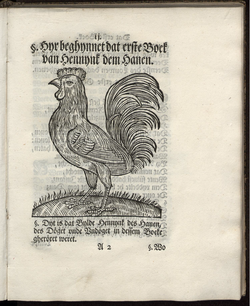
At the University of Oldenburg, a group of German Studies students is currently working with Prof. Dr Doreen Brandt on a critical edition of the Low German animal epic *Hennynk de Han*, which was printed in Bremen in 1732. Preliminary discussions regarding this project took place as part of a Master’s seminar during the summer semester of 2023.
Not only does the title of the work, ‘Hennynk de Han’, and the layout of the print recall the Middle Low German animal epic ‘Reynke de Vos’, which was printed in Lübeck in 1498. The alleged editor, Franz Henrich Sparre – who is mentioned in a preface at the beginning of some printed copies – also describes the work therein as an imitation of ‘Reynke’, which he claims to have come across in an old 16th-century manuscript. However, scholars in the late 18th and early 19th centuries recognised that the editor’s name was a pseudonym for the Bremen town bailiff Kaspar Friedrich Renner (1692–1772). At the same time, it was he who had composed the animal epic in the style of ‘Reynke’.
The Middle Low German animal epic ‘Reynke de Vos’ occupies a prominent place in the history of Low German literature. This is evident, amongst other things, in its widespread reception through reprints and translations well into the 18th century, even though the shift in the written language from Low German to High German, which began in the 16th century, led to a significant decline in Low German literature. The ‘Hennynk’ must also be included in the history of the reception of ‘Reynke’.
To date, there has been little extensive consideration of the ‘Hennynk’ in academic research. The prevailing view here was that the ‘Hennynk de Han’, in both form and content, was a deliberate imitation of ‘Reynke de Vos’. Not only was the work thus denied its independence, but, in the view of 20th-century research, its literary quality also fell short of that of ‘Reynke de Vos’, which is why studies of it have mostly remained superficial and generalised. Consequently, analyses of the work that emphasise its literary-historical and poetic originality have, to date, been few and far between (Lesser 1936; Bellmann 1977; Brandt 2021).
One reason for the research situation outlined above is likely to be the fact that, to this day, no modern scholarly edition of the work exists. This is where the edition project comes in, aiming to contribute to more in-depth studies of this work, which has received little attention to date. The edition is also intended to encourage a consideration of ‘Hennynk’s’ emergence amidst a less productive phase of Low German literature between 1650 and 1800, in such a way that the specific circumstances of his work’s creation are likewise brought to light. The project thus also fills a gap in the history of Low German literature and research.
The plan is to produce a text edition featuring a translation into Modern High German and extensive commentary.