
School and classroom visits on five continents
School and classroom visits on five continents
Since 1975, I have accepted invitations to lecture and training trips on all five continents and have used every trip to observe lessons in the visiting country. I have taught in Switzerland and Austria, the Netherlands, France, Denmark and Finland, Greenland, Russia (Yaroslavl), Ukraine (Kiev), Turkey (Istanbul), Israel, Brazil (Santos and Salvador da Bahia), Bolivia (St. Cruz, La Paz and El Alto) and Paraguay. Cruz, La Paz and El Alto) and in Paraguay (Filadelfia), in the USA (Washington/DC and Tuczon/Arizona), in San Salvador (City) and Guatemala (City), in Egypt (Cairo) and Ghana (Alavanyo), in China (on a total of eight trips to a dozen schools) and in Japan (in Kumamoto) and in 2005 also in New Zealand (on Stewart Island). The world map shows the places I visited:

I took a thick notebook with me on each of these trips and kept a diary. These diaries are the basis for my report.
German schools abroad: Many of my trips were at the invitation of a German school abroad or school abroad: e.g. in Paris, in Kiev (three times), in Istanbul, in La Paz/Bolivia, in Santa Cruz/Bolivia, in Asuncion/Paraguay, in San Salvador, in Guatemala City, in Washington/DC.
The overall impression on five continents was more positive than negative. A lot has been set in motion in kindergartens, pre-schools and schools around the world! And there is no return to barracks-style education, but almost everywhere there are trends towards respectful interaction, more individualisation of learning processes and more pupil participation - even if frontal teaching still dominates in most cases.
As a scientist, I ask myself whether I am too naive in my assessment of the global situation of schools and teacher training institutions. That may be the case. We have to assume that in most cases we have visited model schools and have been shown what our academic hosts and the school administrators involved consider to be "good teaching". However, I have also visited schools in Denmark, Yaroslavl (north of Moscow) and New Zealand "just like that" and observed lessons that were not organised for visitors. This brings me to my initial hypothesis.
I will now provide a summarised overview, not following a systematic approach, but rather the chronology of my training and visiting trips.
(1) Israel (1999) - Inclusion and a high level of internal differentiation
I am a member of a delegation of Oldenburg school headmasters visiting the district of Mateh Asher in the north of Israel, right on the Lebanese border. We are visiting half a dozen different kibbutz schools. They were under considerable pressure in 1999, and probably still are today, because the socialist idea of the kibbutz is slowly crumbling. One of the consequences: Kibbutz members are trying to set up flagship schools to which pupils* are sent from the surrounding area in return for school fees. Here are a few impressions:
Regba School: The pupils - guided by their teachers, of course - have built their own school museum with an ecological and archaeological focus, to which school classes travel by bus from far and wide. A dozen specially trained guides lead us through the museum in English. The pupils are visibly proud of the experiments they have devised and the exhibits they have procured themselves.

Elementary School "Ma'ayanot" in Kibbutz Cabri: The school has a sophisticated individualisation concept and works inclusively.


A large area in the schoolyard is reserved for a "scrapyard" where pupils can climb, do handicrafts and play. We ask ourselves: Why can't this be done in Germany? Our Israeli host Arnon Rafaely says: "German school law is a via dolorosa!"
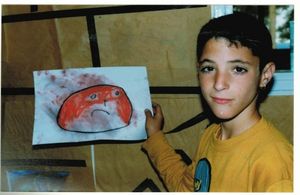
Over the past few days, all of the pupils have been working intensively on the upcoming Holocaust Memorial Day and have created expressive sculptures: a concentration camp watchtower, a cell with barbed wire. A mentally handicapped child paints the picture on the right and is proud of it.
Ha Shalom" High School ("Peace School"): This is an Arab school for Palestinians and Arabs who have an Israeli passport. We are greeted by half a dozen young girls who perform a dance for us.

The lessons we were shown consisted of strictly teacher-centred frontal teaching.
The headmaster's pride and joy is a newly equipped computer lab. It is used for direct instruction. The teacher spends most of the time working at the only computer at the front. The pupils watch.

An initial interim conclusion: Nowhere else have I encountered such marked differences in teaching methods and in the level of self-regulated learning aimed for as I have at these two schools, which are situated just 8 km apart and have reasonably comparable facilities and financial resources. From this I conclude:
Thesis: A society’s socio-cultural mission statements are reflected in teaching practice – even when the framework conditions (funding and administrative requirements) are comparable.
In the evening, the headteacher invites us to his home. He has had a mutton slaughtered especially for us, which tastes absolutely delicious.
(2) Bolivia (2001) – Teaching in one of the world’s poorest countries
Together with Volker Wendt (Oldenburg), I visit the special needs teacher Barbara Heiß, who was one of my PhD students in Oldenburg at the time and who is working in Bolivia on school-based inclusion projects with indigenous communities; she had arranged an invitation from the German School in La Paz.
Professional development at the German School in La Paz: a dozen separate buildings spread across a large campus with plenty of trees, paths, sports facilities and so on, at an altitude of 3,700 metres. The composition of the pupil body is similar to that of a large German comprehensive school offering the Abitur. Four-fifths of the teaching staff are Bolivian.
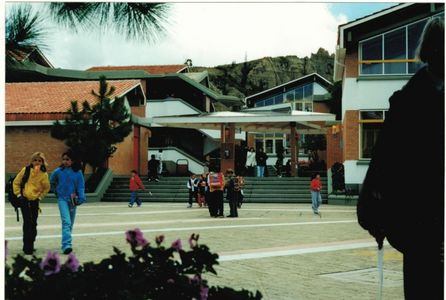
The headteacher asks me to offer a workshop on the topic of "educational neglect" in addition to the all-day training programme (on the topics of "teaching quality" and "diversity of methods"). The reason: more and more pupils of German descent are losing all respect for teachers and police officers.[1]
I speak to the head of the kindergarten at the German school. She has a Diplom in psychology from the USA. She is totally fit and, during the discussions on our training day, she puts many secondary school teachers "in her pocket" with her clever suggestions.
Visit to the primaria "Mariscal Braun" in El Alto: Barbara Heiß, Volker Wendt and I visit a UNESCO school in El Alto at an altitude of 4100 metres (above La Paz), which offers free education for the former "underdogs" of Bolivian society, the Quechua Indians.[2]
In the eighth grade, we attend an advanced course.

The pupils tell us what career aspirations they have. Many want to become doctors, pilots and lawyers. But the chances of this happening are zero given the level of qualification they can achieve.
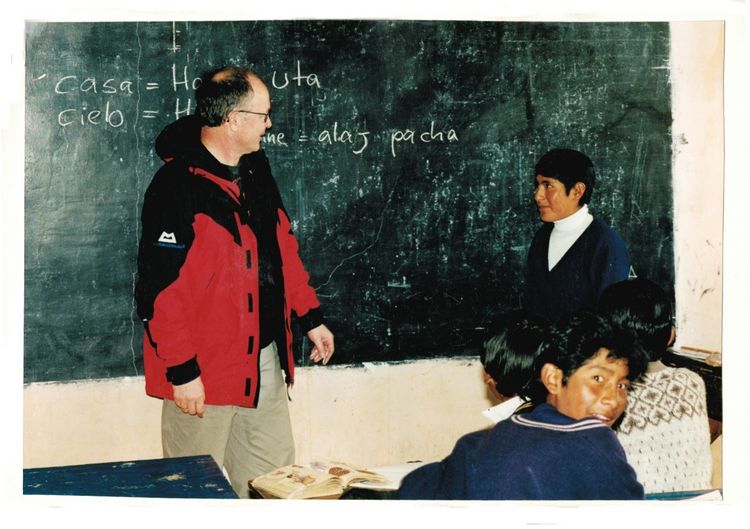
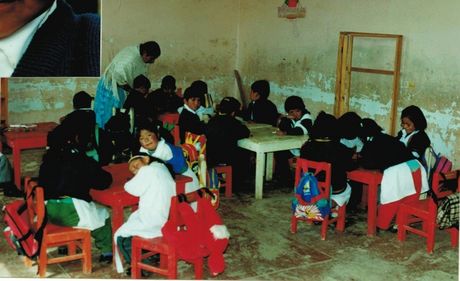
Pre-classes: The school has several pre-classes. The children are dressed in thick clothes because of the outside temperatures, but are in good spirits. The pre-class room could do with a new coat of paint, but everything is clean and tidy. There are very few work materials and learning aids. The tone of voice is very friendly everywhere. During the breaks, the young children cling to the nursery and primary school teachers like burrs.
Teachers' salaries: Barbara Heiß introduces me to a good personal acquaintance - a Quechua woman. She is a teacher at the Primaria. She had a baby a week ago and seven days later she is already back at school. I ask her why she has returned to work so quickly. Her answer: "If I don't work, it will be deducted from my salary. And I simply can't afford that. My whole family lives off my wages."
"Bolivia is over-aided"? There are many representatives of national and international development aid projects in Bolivia. Also in the school sector. We visited a superbly equipped school in La Paz run by Bavarian Catholic nuns. But all this aid also causes problems. Barbara Heiß's husband, a development aid worker who has stopped receiving alimentation from Germany and founded an agricultural cooperative with indigenous people, explains to us: "Bolivia is over-aided! The national and local decision-makers don't even start working if they haven't first found a sponsor from Europe or the USA. That paralyses all initiative."
A second interim conclusion: what our Bolivian colleagues are achieving under the poorest of conditions is more than impressive and deserves all our respect! We live in indescribable luxury in Germany. It is then much easier to create the framework conditions for open lessons with a high degree of self-regulation and extensive use of media!
(3) New Zealand (2005) - successful integration
My twin brother and I, my sister-in-law and my wife take a private trip "down under". On Stewart Island (at the southernmost tip of the South Island - only Antarctica comes after that! - we visit a small village school with 17 pupils and discover state-of-the-art departmental teaching in a class with years 0 to 7.

In New Zealand, every child who turns five on that day becomes of school age. This inevitably forces the dedicated and truly capable teacher to implement a high level of internal differentiation. She makes the most of the mixed-age classes and has set up a well-functioning system of student helpers. Every now and then, a mother pops in and hands out fruit and vegetables to all the children. (Why can’t we do that in Germany?) The school is at risk of closing because it is becoming too small. That is why the teacher is delighted to have heard that three or four women are expecting.
We are particularly impressed by how well the Māori children from the village have been integrated. The little girl in the photo is the one who calls the shots in her class. Even the older pupils in her class of pupils do as she says.

(4) Greenland (2008) - The lost generation
Back in 1985, Ingmar Egede, the Inuit and then director of the Greenland Teachers' College, invited us to visit him and his college during his visit to the University of Oldenburg. He promised to take us on a seal hunt in a kayak. In 2008, the Inuit Dorthe Korneliussen[3] is the director. She repeats the invitation and asks me to do further training with Inuit students and Danish lecturers on my book "What is good teaching?" published in Danish. If you look out of the window of the seminar room onto the water, you can see large glaciers slowly drifting by:
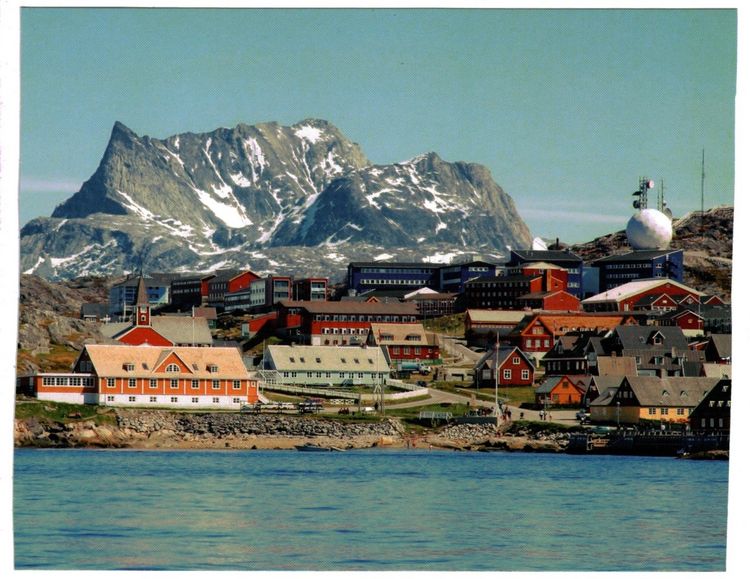
In 1979, Greenland (with a population of just 55,000) was granted domestic self-government by the mother country Denmark. One of the first decisions taken by the new government concerned language regulations in schools: From now on, only the most important Inuit language was to be taught, which was already very difficult because there are almost a dozen different Inuit languages that are not understood by each other. After 7 years, the language experiment was cancelled because the Inuit pupils were now only learning a little Danish and no English at all. As a result, they could not even access the internet. Since then, these cohorts have been referred to as the "lost generation".
My interim conclusion: in the globalised world community, it is impossible to avoid the "lingua franca" of English without suffering massive disadvantages. The Chinese have also realised this. Every pupil here learns English from primary school onwards.
(5) Paraguay (2013) - Lessons with the Mennonites of German origin
The Mennonites, founded 500 years ago in Zurich as a reformed revivalist movement, were on the run for 450 years because they strictly refused any military service. In Paraguay, they found a new home by special decree in the north of the country (in the Gran Chaco, a shrub desert almost as large as Germany, with little water and a lot of salty soil). Today they live from cattle farming and peanut cultivation. And for the second time in their history, they are doing well economically.[4]
The local Mennonite congregations are also the school authorities. Once a year, they decide how much salary the teachers will receive. As there is a shortage of money, a third of the teachers have taken to raising their own livestock. This often earns them twice as much money as the teaching profession.
Teaching is largely, but not always, at a high didactic level. This is also helped by the fact that the teacher training institute ensures that all student teachers do an internship at a German school. The trained teachers also maintain close contact with Germany, as well as with the large Mennonite communities in Canada.
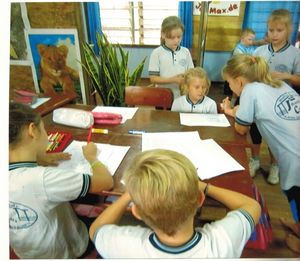
Primary school lessons: Domenika Eitzen, our host, teaches in class 2 at Johann Cornies Elementary School.[5]
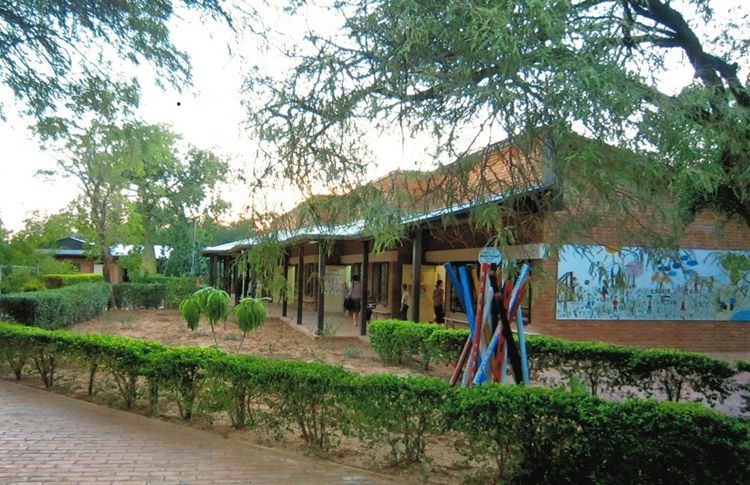
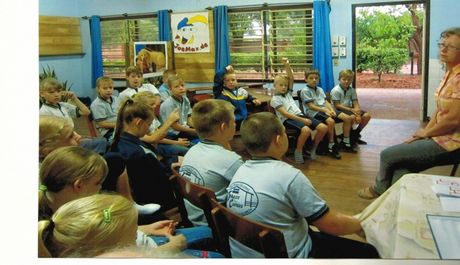
The lessons are taught entirely in German because all the pupils come from the Mennonite community, where High German and Low German are spoken. The standard of teaching is very high. After 15 months of lessons, almost all of them were able to read, write and do maths in the designated number range. There is a great deal of internal differentiation, e.g. through weekly lesson plans and station-based learning.
Inclusion: A girl in Year 2 has fallen silent. She sits in her seat while the other girls stand next to and behind her. She hasn't spoken a single word at school for a year - but at home there are no such absences. This clinical picture is therefore referred to as selective mutism ("selective muteness"). A second boy has (mild) autism, which is not recognised as a disorder by his ambitious mother. Both children are well integrated socially, partly because the girls look after them lovingly.
Teacher training institute: The Mennonite colonies in the Gran Chaco have set up a small teacher training institute with 50 students. The former director, Jakob Warkentin, completed his doctorate under Wolfgang Klafki.

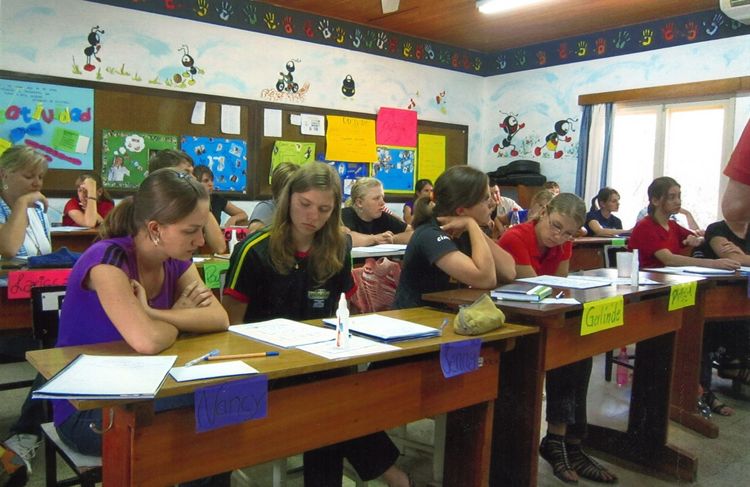
My interim conclusion: where there is a lively pedagogical exchange, "open lessons" are more likely to be practised and there is a higher level of individualisation of learning.
(6) Ghana (2013) - A lesson in respect
At the invitation of the Evangelical Presbyterian Church of Ghana, my wife and I visit the church university in Ho for a week and take part in a training programme with the professors on the subject of "Teaching Methods":
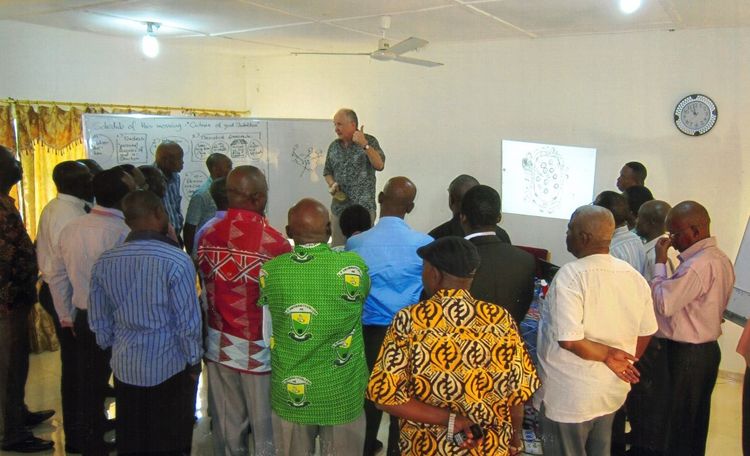
After our visit to Ho, we carry on to the Vocational Institute in Alavanyo – a large vocational Institute that receives significant support from the EKD (Evangelical Church in Germany).
A dedicated headteacher who is very student-focused. Many dedicated, warm-hearted lecturers, but also a surprise:
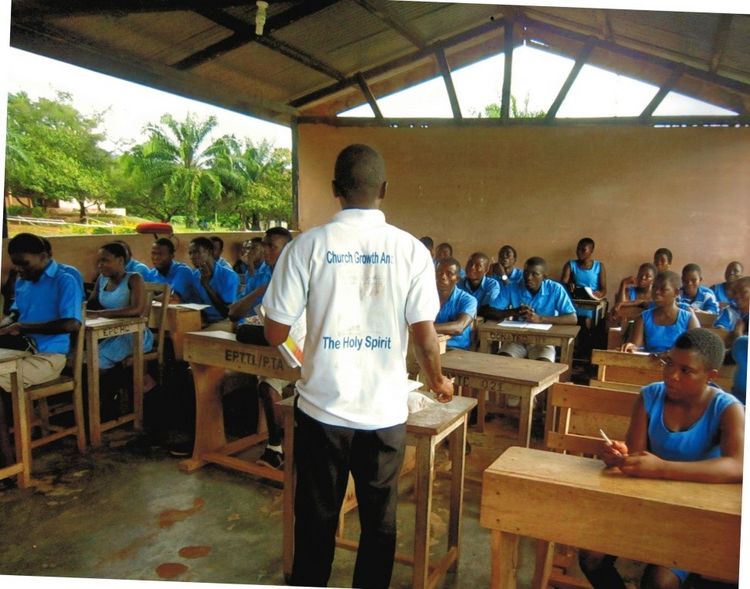
English lesson - with a stick in my hand: I arrive in the English classroom twenty minutes after the start of the lesson, as announced. An 18-year-old pupil is kneeling on the floor. I am irritated and ask my host why. His answer: "That's a young English teacher. He still has to earn respect." The sugar cane stick lying on his desk, which he repeatedly picks up, fits in with this.
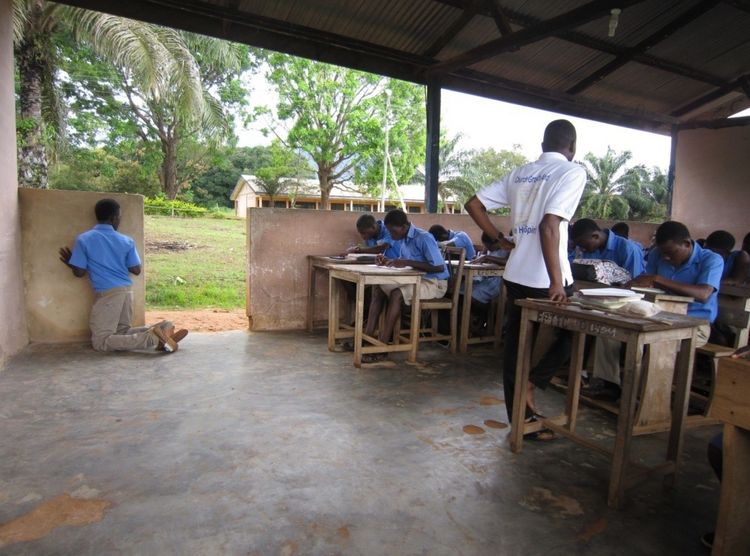
It should be noted that corporal punishment was officially abolished by decree in Ghana 25 years ago. Seven years later, it was admitted again because teaching had more or less collapsed in many school classes.
But we should not become arrogant! In Germany, corporal punishment was only banned in the 1960s. During my first school placement in East Frisia in 1962, it had just been abolished by the newly appointed teacher and the pupils, who had previously been taught by the teacher with the nickname "spanking fisherman", had a hard time realising that not being spanked did not mean that they had done everything right.
I was impressed bythe fee for the two-day training course in Alavanyo: it consisted of a large bunch of plantains and a bucket full of palm oil seeds.
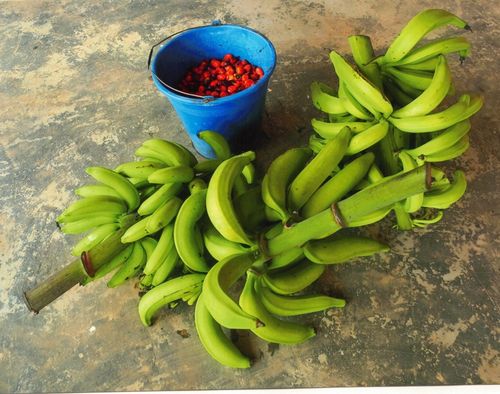
My conclusion: Respect is a key pedagogical concept that is universally recognised (Sennett 2004). It lays the foundation for a working partnership between lecturers and pupils. – However, what exactly this entails is interpreted very differently depending on the level of socio-cultural development.
(7) China (206–2019) – Moving away from stereotypes
I have now visited a good dozen Chinese nurseries and schools and observed many lessons. Teaching is significantly more teacher-centred than in Germany – but it is of a high academic and pedagogical standard.[6]
The ‘Kindergarten’ at East China Normal University in Shanghai. It is situated on the university campus. Around 500 children attend it. There is a carefully formulated curriculum. In addition, there are specialist rooms for science lessons, for project work and for calligraphy. The children are lively and cheerful as they get on with their activities.
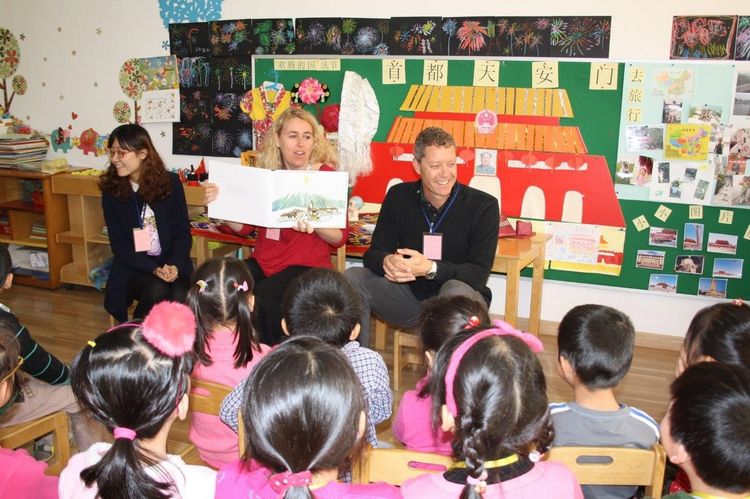
A lesson in the kindergarten: My former doctoral student Catherine Walter-Lager (a Zurich educator who has now become a professor of elementary education at the University of Graz) has travelled with me. She does a movement exercise with the Chinese children. And then she tells a picture story about a Swiss children's book. She speaks Schwyz German. This is translated into English by Manfred Pfiffner and into Chinese by Ma Yuan, a doctoral student at Humboldt University in Berlin. I am impressed by how professionally Catherine goes about her work. You can see in a minute that teacher training can be "revitalised" at any time.
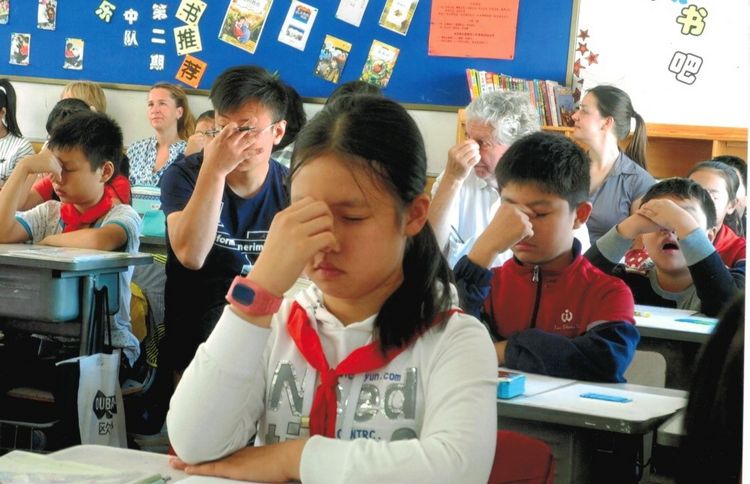
Lessons in a primary school in Fenhu (near Shanghai): The pupils do a little concentration exercise during the maths lesson and rub their noses and close their eyes.
Inclusion at a primary school in Shanghai: In 2016, we visited Tian Primary School in Shanghai. The school operates on an inclusive basis and is proud of this. It is supported by the Shanghai local authority and by academics. We observe a maths lesson in Year 5, which includes a child with severe autism named Tong Tong. His verbal communication is very limited, at the level of a two-year-old. Tong Tong has just learnt to use the word ‘I’ correctly. However, he is very good at maths and plays the piano superbly.[7] The two girls sitting to the right and left of him are actively supporting him. In the follow-up discussion, I ask: “How many children with special educational needs are there in this class?” The answer: “Just one, Tong Tong!” The next question: “How did Tong Tong end up at this school?” The answer: “His parents are rich. They paid a great deal for it.”
My interim conclusion: It is not only between rich and poor nations that there is a lack of educational equity (see Bolivia). Even within individual nations, things are often unfair. In China, however, this is the subject of heated debate, particularly with regard to the lack of educational equity between urban and rural children (see Ye Xuping 2017).
Sixth-form lessons in Ma’Anshan: In September 2019, I observed a lesson on the topic ‘Should students wear school uniforms?’ in an 11th-class English class at Ma’Anshan High School No. 2 in the city of Ma’Anshan, Anhui Province (west of Shanghai). The school has 3,000 pupils in classes 10 to 12 and 230 teachers. School uniforms are compulsory from Monday to Thursday; on Fridays, pupils are free to choose. The lesson was prepared by the teaching staff.

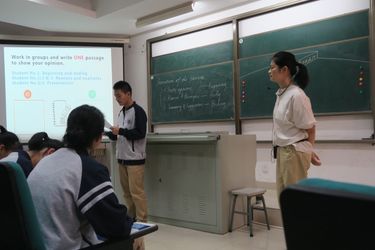
Sixty pupils are sitting in a screening room.[8] Two pupils are not wearing their school uniforms, even though it is a Wednesday. The young teacher, Ms Ji Ke, speaks perfect English. She wears a microphone so that she can be heard even in the back rows. The tasks are given verbally, but are also displayed on the whiteboard. The lesson begins with a round of whispering to get a feel for the topic. Afterwards, groups of three or four are formed, who are tasked with clarifying their answer to the controversial question and then setting it out in writing in three points. The teacher walks round and looks at the interim results.
Thirty minutes into the lesson, the discussion begins. The group spokespersons are called to the front one by one. They present their group’s opinion in fluent English. The teacher notes on the board whether they have voted for or against the proposal. She also specifically calls forward groups that are against the proposal. However, due to time constraints, not all groups can present; only eight are able to do so. In the end, there are six ‘for’ and two ‘against’ votes. One ‘for’ vote: “We should wear uniforms to show respect for our school.” A second ‘for’ vote: “Rich parents can afford expensive clothes. And that’s not good for the classroom atmosphere.” A ‘against’ voice: “We all have different personalities. Having our own clothes makes us happier.” The teacher gives a closing statement summarising the results and praises the pupils.
My interim conclusion: It is not only between rich and poor nations that there is a lack of educational equity (see Bolivia). Inequality also exists within individual nations. In China, this is the subject of heated debate amongst educationalists, particularly with regard to rural-urban disparities (see Ye Xuping 2017). I have not come across any discussions regarding the unequal treatment of the Uyghurs.
(8) Summary
I shall summarise my wide-ranging observations on everyday school life across five continents into a few generalised conclusions:
(1) The similarities in teaching practice across different nations and on all continents are far greater than the differences.
(2) Lecture-style teaching dominates worldwide – including in Europe.
(3) Open-class teaching with a high degree of internal differentiation and a significant element of self-regulation is rather rare. I have observed it in kibbutz schools in Israel, at a small island school in New Zealand, as well as amongst the German-descended Mennonites in Paraguay and in a primary school in China. We do not have exact figures, but the proportion of open-classroom teaching is likely to be between 0 and 2 per cent worldwide and does not exceed 10 per cent in any single country.
(4) The framework conditions for teaching vary greatly. Compared with countries such as Bolivia, El Salvador or Ghana, we in Europe enjoy great material wealth. This makes it easier to create the pedagogical and methodological conditions necessary for open-classroom teaching (small class sizes, flexible use of space, use of media, whiteboards, etc.). However, the example of Israel shows that sufficient resources alone are not enough. Teachers and the education authorities must also develop a mental openness towards these significantly more demanding teaching concepts.
(5) In some countries, such as New Zealand, mixed-age and inclusive teaching takes place ‘against their will’, either because declining pupil numbers force schools to adopt form-based teaching or because there are no special schools.
(6) With a few exceptions, teachers and pupils treated one another with respect in the schools I visited. However, the understanding of respect varies greatly. In countries such as China and Japan, the respect due to the teacher is instilled through family socialisation even before children start school, so that it can be taken for granted in the classroom without any problems. This is not the case in countries such as Ghana and Bolivia.
(7) English is becoming established as the first foreign language worldwide. Where attempts were made to use educational autonomy to implement English lessons at the same time (e.g. in Greenland in 1979), this experiment was soon abandoned.
(8) School buildings are similar worldwide, as are the schoolyards, corridors and classroom layouts. Very often, classrooms are arranged in a ‘bus-shaped’ seating plan or, at most, a U-shape. Kibbutz schools in Israel and wealthy private schools, such as the German schools in La Paz, Bolivia; San Salvador; and Washington, DC, can afford a campus system comprising numerous individual buildings, specialist classrooms, a canteen, etc.
(9) State curriculum guidelines exist everywhere, though they are implemented in different ways. In Brazil, Paraguay and Bolivia, many headteachers assume that ‘paper is patient’, meaning that nothing has to be implemented exactly as prescribed. In China and Germany, at least, efforts are made to take the guidelines seriously. However, the ‘law of recontextualisation’ of administrative guidelines, as formulated by Helmut Fend (2006), evidently applies worldwide, even though the Chinese headteachers I interviewed – unlike those in Brazil – stated that they adhere strictly to the guidelines.
(10) The development of teaching towards greater pupil participation is significantly easier to achieve in rich countries than in poor ones.
Many of the schools I visited were German schools abroad with a rather privileged status. However, they are quite clearly important and successful cultural ambassadors in their host countries. Germany has around 141 such schools, Switzerland 18, and Austria 8. They are building national educational networks. They contribute to teacher training and assist local schools with the German Language Diploma (DSD) or the International Baccalaureate. Working at German schools abroad is not all plain sailing. School boards, often made up of large landowners of German descent, can make life difficult for the headteacher. The levels of corruption and crime in many countries mean one must always be mindful of one’s own safety. The COVID-19 pandemic has plunged some of these schools – almost all of which charge school fees to pay their staff – into extreme hardship. Some have been forced to close.
In several countries, I have experienced conditions bordering on civil war: in San Salvador, in Guatemala and in a province in Ghana. On the day I arrived at the German School in San Salvador (2015) – a Sunday – a new, tragic record was set: 51 murders in a single day in the country’s capital. The background: two major gangs are fighting over protection money zones, drug trafficking and so on, and have been at war with each other for decades.
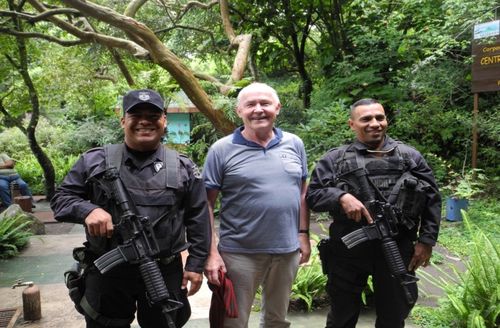
The photo (2015) from San Salvador is staged. I engaged the two military police officers in a conversation in 2015 when they had to keep an eye on US Americans at a tourist hotspot.
My conclusion: schools based on the European model have triumphed worldwide - and not only in those parts of the world where European colonial powers held sway from the 18th to the 20th century, but also in Arab countries and in Central and South America. Christel Adick (1992; 2003; 2017) has analysed these processes, asked about the causes and has good news to report overall. For example, the number of children who not only go to school by law, but actually go to school, has multiplied. The number of illiterate people has been falling for decades. But there is still a lot to do.
The greatest challenge of all is to distribute the world's wealth fairly!
Then it will also be easier to develop a school landscape that teachers in many nations can only dream of.
Literature:
Adick, Christel (1992). The universalisation of the modern school. Paderborn: Schöningh.
Adick, Christel (2003): Global trends in worldwide school development: Empirical findings and theoretical explanations. In: Journal for Educational Science, 6th Vol. H. 2/2016, pp. 173-187.
Adick, Christel (2017): International education transfer in the name of diplomacy: The foreign cultural and educational policy of the Federal Republic of Germany. In: Journal for Pedagogy. Vol. 63, H. 3, pp. 341-361.
Fend, Helmut (2006): New theory of the school. Wiesbaden: VS Verlag für Sozialwissenschaften.
Ye, Xuping (2017). A comparative study on the understanding of teaching quality in Chinese and German didactic textbooks. Oldenburg: BIS-Verlag.
Status: July 2022


[1] The school board of the German school, which had been voted out of office a few years earlier, had compromised itself because two or three members had known that the SS officer and "Butcher of Lyon" Klaus Barbie had gone into hiding in the neighbourhood.
[2] In the meantime, the president of Bolivia is himself a Quechua - and the situation of the indigenous people has improved a little.
[3] The European names were given to them by the missionaries. Things are different today.
[4] The first time they did well was at the end of the 19th century, when they settled in southern Russia and became very successful farmers, craftsmen and small industrialists - until they were discredited in the course of the Russian October Revolution and persecuted and largely murdered under Stalin.
[5] Named after a successful reformer of the Russian Mennonite communities at the end of the 19th century.
[6] It must be borne in mind that Chinese teachers offer a great deal of individual support outside the classroom with an average workload of 15 hours.
[7] He won second prize for his piano playing at the annual Shanghai school competition for disabled pupils .
[8] The high school is a so-called key school that organises a lot of teacher training in its environment. That is why there is an extra room for demonstration lessons - with padded rows of chairs and without the possibility of creating a circle of chairs.