

Our escape story 1945
Our escape story 1945

A conversation between siblings: It was conducted by Berend Meyer, Dierk Meyer and Hilbert Meyer, with Elke (Dierk's wife) and Christa (Hilbert's wife) listening and asking questions. The interview took place on 15 December 2020 at Kastanienallee 40 in Oldenburg. It was recorded on tape and then transcribed.
This text has three parts:
(1) An INTRODUCTION: Preliminary remarks on the course of the escape, written by Hilbert.
(2) The CONVERSATION between the three siblings Berend, Dierk and Hilbert - unfortunately without Meinert, who died in November 2018.
(3) An APPENDIX with eleven family documents on the war and post-war period from the Meyer archive set up by Meinert.
The text had just been completed when Vladimir Putin began his war against Ukraine. Some memories of the escape are now oppressively topical. On the other hand, our escape was rather "harmless" compared to the dramatic escape stories of other families, as Argula Töllner remarked on the phone.
PART 1: Introduction
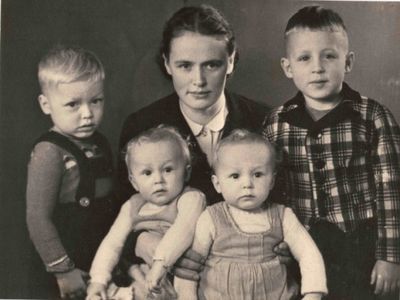
Photo from page 1: From 1938 to February 1945, the Meyer family lived at Büchnerstrasse 14 A in Lauenburg (Pomerania). The small town lies 75 kilometres west of Gdansk and is now called Lebork. We were: Erna Meyer (7 July 1912 to 29 August 2000), Friedrich Meyer (5 November 1904-10 November 1974), the four children Berend (born 14 January 1938), Dierk (born 6 October 1939) and the twins Meinert and Hilbert (2 October 1941). The photo on page 1 that most of you readers of this text will recognise is a so-called "Führer photo". It was taken sometime in 1943 by a professional photographer in Lauenburg at state expense to send to soldiers fighting at the front in order to keep up their morale. Berend is five years old in the photo, Dierk is three and a half and the twins are one and a half. Meinert and Hilbert are easy to tell apart with a trick:
- Meinert's skull is shaped like the pointed triangle in the capital letter "M".
- Hilbert's skull is not pointed, but runs in two parallel lines like the capital letter "H".
Now you should be able to work out who is who.
Meinert's preliminary work: This script is based on our twin brother Meinert's thorough research into the family history of 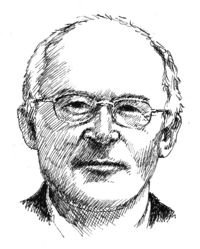 , supplemented by internet research by Hilbert's daughter Tale into her father Friedel Meyer's Nazi career.[1] For his retirement ceremony at the University of Hamburg in 2006, Meinert had prepared a manuscript of over 100 pages, supplemented with many photos and archive material, which he later intended to expand into a family chronicle, but which never materialised:
- Meinert Meyer: Meine Familiengeschichte und ich aus der Perspektive der Bildungsgangforschung. Revised version on 2 October 2011, his 70th birthday.
The original documents can be found in over 30 "family history" folders in Meinert's study in Münster[2] The results of his research can be found in a long document on his and Hilbert's computer and certainly also on the PCs of Meinert's children.
Why Lauenburg? Friedrich Meyer, called Friedel, came from Wilhelmshaven, Erna from Delmenhorst. Friedel had been appointed a lecturer at the teacher training college in Lauenburg (Pomerania) in 1938.[3] He had previously been a teacher in Ammerland and Friesland, including in Elisabethfehn, Ellens, Heidkrug, Schönemoor, Ocholt, Mansie, Aschhausen and for a long time in Gießelhorst. However, from 1933 he studied for a doctorate in Bonn under the well-known philosopher Erich Rothacker[4] and successfully completed it in 1936 ("with honours"). As a result, he had acquired the qualifications for a lecturer position. At that time, however, you could not apply for a professorship yourself. You had to wait until you were called (or not). Friedel wanted to become a school teacher at the University of Teacher Education in Oldenburg. This came to nothing because the educational scientist Theodor Wilhelm (later Kiel University), who became famous after the war, was preferred. Then came the offer for the University of Lauenburg, which he gladly accepted. Erna and Friedel therefore moved with Berend, then barely a year old, from the flat "Unter den Eichen" in Bad Zwischenahn to Büchnerstraße 14 A in the small Pomeranian town of Lauenburg.[5]
Navy: Just over a year after starting his service on 1 April 1938, Friedel was drafted into the navy on 25 August 1939. He was  then deployed throughout the war as a naval officer in his home town of Wilhelmshaven, finally from 21 January 1945 as adjutant to the station commander, Captain Mulsow. It is probable, but not documented anywhere, that he was involved in the site commander's negotiations to surrender the town without a fight (with British and Polish units).
Paternal grandparents: Georg and Wilhelmine Meyer; bombed out in Wilhelmshaven and also on the run - Uncle Georg-Heinz: Wilhelmshaven, as a central naval base  , was threatened by British air raids from the beginning of the Second World War. That is why our grandparents Georg Friedrich Meyer (1.10.74-12.2.1945)[6] and Wilhelmine Meyer (15.1.1877-1970), known as Mimi, moved into our flat in Lauenburg. They lived in our parents' bedroom, Erna slept on the sofa in the living room. Living together with the parents-in-law was difficult because Wilhelmine did little instead of helping and was always very demanding of her daughter-in-law Erna - even when Erna had severe pneumonia in 1943, from which she only recovered slowly.
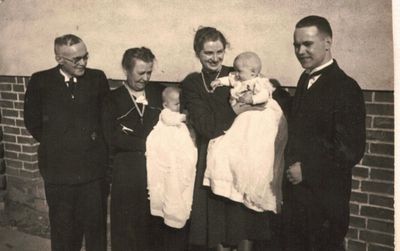 Georg-Heinz, Friedel's youngest brother, our uncle, was a member of the Confessing Church, so certainly not a supporter of National Socialism. He had studied theology as a scholarship holder of the German Study Foundation and had then renounced the privilege of not having to serve in the military as a pastor. In the photo, taken on Meinert and Hilbert's baptism day, 16 April 1942, in front of the door of the Büchnerstrasse flat in Lauenburg. From left to right: Grandpa Georg, Grandma Wilhelmine with one twin, a woman we don't know with the other twin, Uncle Georg-Heinz, theologian and front-line soldier, who used his leave to baptise Meinert and Hilbert.[7] Grandpa Georg had suffered a stroke in 1944. He then died on the last leg of the escape on 12 February 45 in Bremen's main railway station. An emergency hospital had been set up there. Berend talks about this further down in our interview.
Maternal grandparents: Hubertine Günther, née Böhm (1887 - 1955), remarried to Heinrich Einemann after the death of our grandfather Ernst in the First World War. The photo shows Hubertine as a young woman (ca. 1910).
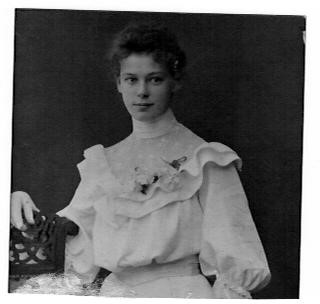
From the first marriage came the two daughters Erna and Irene, from the second the twins Ursel and Inge.
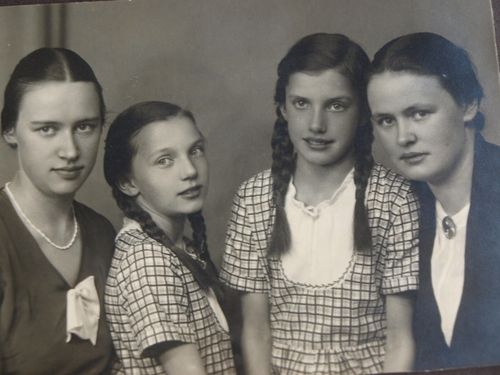
Hubertine's flat in Parkstraße in Delmenhorst was the first stop on our escape.
Request to flee: The telegram that Friedel Meyer sent to Erna on 28 January 1945 has been preserved. In it, he urges her and the family to flee:
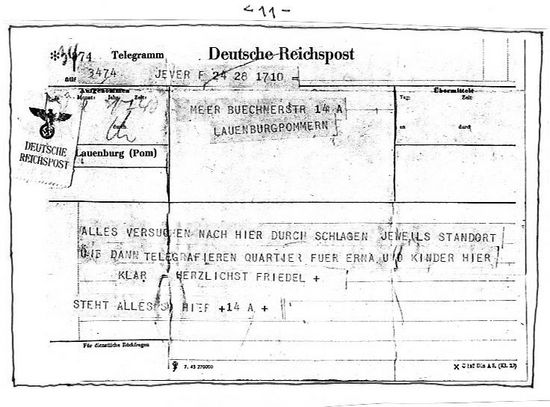
"TRY EVERYTHING TO GET THROUGH HERE. EACH LOCATION. THE (?) THEN TELEGRAPH ACCOMMODATION FOR ERNA AND CHILDREN HERE EVERYTHING IS CLEAR IN THE LETTER - SINCERELY FRIEDEL."
The letter mentioned in the telegram has not survived, presumably we were already on the run by then. We spent one of the last days before the Russian troops arrived in Lauenburg[8] for the escape. The Soviet army had already begun the "Vistula-Oder Operation" on 12 January 45. The German troops were encircled there in the "Battle of East Prussia". On 26 January, the Red Army reached the old Hanseatic city of Elbing at the mouth of the Vistula into the Baltic Sea. It was only 136 kilometres from Elbing via Danzig to Lauenburg. Friedel's telegram was therefore more than overdue!
Start and end of the escape: Erna did not state the exact date of the start of the escape anywhere.[9] But it must have been on one of the first days of February, probably the 2nd, maybe the 3rd or 4th. In any case, we arrived in Delmenhorst on the evening of 10 February.
Escape route: On the first two days we were picked up by two military lorries that were on their way back from the Baltic seaside resort of Leba to Peenemünde on the island of Rügen.
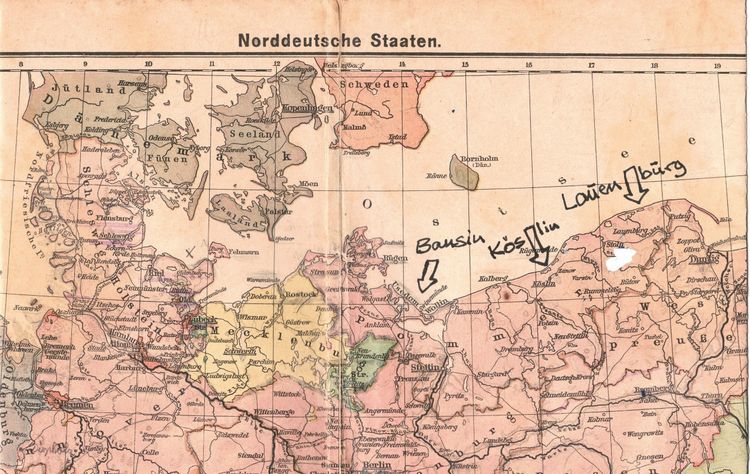
Friedel Meyer had organised the lorry transport from Wilhelmshaven. According to Erna's reports to us children in the 1950s and 1960s, the lorries had to bring material for Wernher von Braun to Peenemünde. The individual stops, reconstructed from scanty notes:
- With the military lorry from Lauenburg to Köslin (the first overnight stay).
- From Köslin with the same lorry to the seaside resort of Bansin on the island of Usedom (second overnight stay), where we were dropped off near the railway station. (The photo from 2013.) We were not allowed to travel any further on the lorry because the northern half of Usedom was a restricted military area due to the missile testing station - and that's where the military lorries had to go. The Hornig text (page 130) describes in detail how, on arriving in Bansin at night, it was still possible to find accommodation - despite Erna's fears about the lack of an evacuation permit, which the Nazi functionary in Lauenburg had refused Erna days before - only to flee herself the next day.
- From Bansin onwards by train[10] via Bremen to Delmenhorst to Erna's parents' house at Parkstraße 8.[11] It is unclear how long the railway part of the escape took. Berend speaks of an overnight stay in a railway station building, Dierk of a journey on a goods train and an overnight stay in a brickworks. In any case, the family arrived in Delmenhorst late in the evening on 10 February.
In APPENDIX No. 2 you will find a transcript of a telex conversation that our Aunt Inge, Erna's sister, had with Friedel's office on the "Rosenhügel" on 11 February 1945.[12] in Wilhelmshaven. Friedel was not directly available. This is how the telegraph text came about:
"erna arrived safely in delmenhorst yesterday with the children. parents had to stay in bremen because father is very unwell."
- From Delmenhorst onwards to Drielakermoor near Oldenburg. There they stayed with Willi and Irene Brunken. Irene was Erna's younger sister.
- From Drielakermoor - presumably in March 45 - on to Westerstede: first to the flat of Erna's aunt Anni (sister of Erna's mother Hubertine Einemann and wife of the master painter Schmidt).[13]
- From Westerstede a few days or weeks later to the farmer Grote in the village of Gießelhorst, 3 kilometres from Westerstede. The farmer's children had had lessons with father when he was a teacher in Gießelhorst. We were therefore warmly welcomed, sat at the farmer's family's table and, as Erna reports in the Hornig text, were lavishly fed. However, the only incident of war occurred there - tank fire in the last days of the war.
- From early summer or summer 1945: Schützenhaus Westerstede. From Gießelhorst, they went to the refugee centre in Westerstede, the Schützenhaus, in June or July.[14] The house belonged to the Westerstede Shooting Club until the end of the war. It was dissolved as a Nazi organisation. And the shooting club house, including its extensive shooting ranges, was set up as emergency accommodation for refugee families. We lived there until 1951.[15] An ideal living environment for us children: a large meadow right in front of the house, the swimming pool right behind the house, right next to it a small wood where we learnt to climb into the trees. In APPENDIX No. 5 you will find a letter that Erna wrote to Friedel in the British POW camp in Esterwegen (Civil Internment Camp No. 101) on 22 January 1946. It's a great letter in which she describes our living conditions in the Schützenhaus.
From Lauenburg to the first longer stop in Drielakermoor, the escape took 7 to 9 days.
Repetition - travelling the escape route: In 2013, Dierk, Meinert, Hilbert, Christa and Dörte [16] travelled the escape route again in Dierk's motorhome - from Oldenburg to Greifswald, then south of the island of Usedom near Swinemünde (Swinoujscie) across the Oder, on past Kolberg to Köslin, Stolp and then in a south-easterly direction to Lebork/Lauenburg.
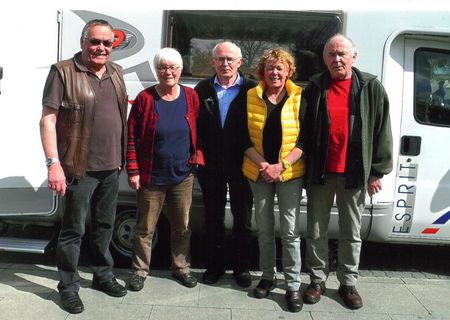
We visited all the places of our childhood in Lauenburg: Büchnerstrasse, where we spent the first years of our lives, the hospital where Dierk, Meinert and Hilbert were born, the former teacher training college where Friedel had worked (now a vocational school again) and the now Catholic, then Protestant church where Dierk, Meinert and Hilbert were baptised. In Lauenburg, we were even greeted by the mayor because Dörte had a Polish acquaintance who had arranged the meeting. The mayor then took us on a short tour of parts of the town centre.

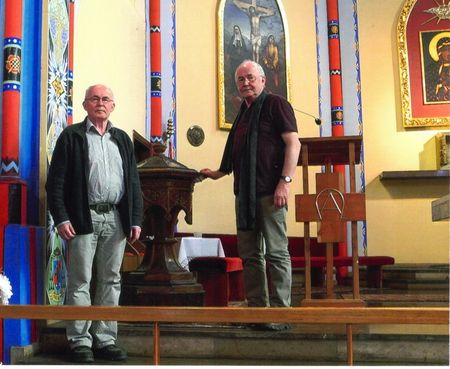
PART 2: Our conversation about the escape
Now the exciting question: What memories do Berend, Dierk and Hilbert have of the escape and the first 5 post-war years in the Schützenhaus in Westerstede in December 2020?[17]
Hilbert: A week ago, a full-page report by and about Argula Töllner appeared in the Nordwestzeitung newspaper. We knew her because she had rented us the first Oldenburg flat at Würzburger Straße 13 in 1975. Argula Töllner had come to Oldenburg in 1946 with a group of refugees from Silesia. She received a very unfriendly welcome. This prompted Christa to ask the three of us: "How do you three remember the escape and the immediate post-war period?"
I'll start with myself. I still have four very brief but clear images of the escape in my mind's eye.[18] The first image: I'm sitting on the back of an open lorry. Opposite me is a sheepdog on the lorry. He's always jumping up on the wall to the driver's cab.
Berend : Yes, that's half right, but it wasn't one - there were two sheepdogs on the lorry bed and not just one, but two lorries.
Hilbert: It may well have been two sheepdogs. That's the way it is with memory.
Dierk: I can't remember a sheepdog.
Berend: It was in the back of the lorry. 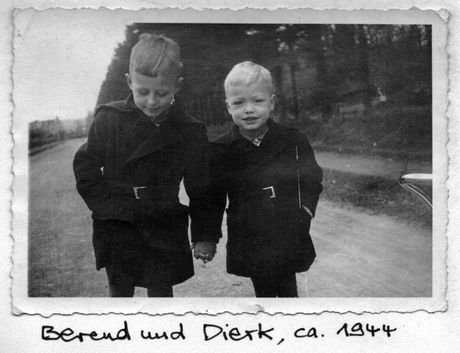
Dierk: That's right. Berend and I sat at the front with the soldiers.
Hilbert: How old were we then?
Berend: Just 7
Hilbert: At the end of January 45?
Berend: Yes, 14 January was my birthday.
Hilbert: OK, and Dirk, how old were you?
Dierk: I was 5 years and 4 months.
Hilbert: So Meinert and I were 3 years and 4 months.
Dierk: And our mum was 32! (The photo on the bottom right is from 1943.)
 Berend: I feel the same as you, Hilbert. I don't remember the escape as a complete film, but only individual images, which are perhaps not always in the right chronological order. Well, it started before the actual escape, because there were four rucksacks in the hallway of our flat. I still have that in my mind's eye. 4 rucksacks for the 4 of us boys. The adults probably had suitcases or another larger rucksack, I can't remember. And they were supposed to contain a bag of biscuits and a bag of rock candy, which was very tempting. But we all knew that we weren't allowed to go in there.(laughs) I just thought to myself: What's going to happen to the rock candy now?
Hilbert: Erna's report in the Hornig book also mentions these rucksacks. Erna sewed them for us from a piece of parachute silk she had left over.[19]
Dierk:... with wise foresight! 
Hilbert: Surely these rucksacks no longer exist?
Berend: No, no, definitely not! And one of the rucksacks, namely Dierk's, also had a small pee pot on it.
Dierk: The most important piece of equipment, especially on the train afterwards - in the goods wagon we were travelling in.
Berend: And then our mum had also sewn 4 dog leashes, each with a little loaf on it, with a long leash, so that she could hold all 4 children with one hand or tie us to a lamppost if necessary.
Hilbert: And you're sure that there were four leashes? I remember Erna saying that she had made these leashes for Meinert and me.
Dirk:... so that she could keep the little ones under control!
Berend: Yes, that could be right. I was just about to say that I can't remember them ever being used. At least not on the run. But later on, we used to play horse-drawn carriage, horse and cart with these lines in the shooting lodge.
Hilbert: I can still remember these horse and cart games, but of course I don't remember them being played with the lines from the escape.
Berend: Back to the start of the escape: it started at some point. I remember that when we came out of the flat, we had to turn right down the street to get to the crossroads. There were two military lorries there. I always thought it was a bigger convoy, because Dad had always said it was a bigger transport, but it was probably just two lorries.
Dierk: Plus a trailer! Everyone had a trailer on the back.
Berend: And that's where we got in, although I can't remember Grandma Mimi and Grandpa Georg at all. They must have travelled with us too. I spent the whole time sitting in the driver's cab between two soldiers in uniform and found it all terribly exciting.
Dierk : Yes, of course, they were wearing uniforms.
Berend: I think we spent two days in those lorries. The whole thing was actually relatively undramatic.
Elke: What kind of lorries were they?
Hilbert: Military lorries!
Christa: Why? How did you come to this?
Dierk: Father must have organised it from Wilhelmshaven. They were lorries that drove back from Leba via Lauenburg to take things important to the war effort, supposedly for Wernher von Braun's V2 rockets, to Peenemünde in the restricted area![20] Until then, we were only allowed to ride along.
Berend: I remember it like that too. Erna told me several times after the war that Friedel had organised it from Wilhelmshaven. He knew the leading officer in Leba and told him: "If you're travelling through Lauenburg, take my Erna and her four boys with you!" And then he would have done the same.[21] Of course, it was a certain advantage that our father ...
Elke:... quite a luxury, I would say!
Berend: Yes, luck or what should we call it?
Elke: And that was at a normal time of day?
Berend: I mean, it would have been early in the morning.
Dirk: Yes, it was in bright light, at least when we set off.
Köslin
Dierk: We arrived in Köslin in the dark, where we spent the night in this house.
Berend: It was a villa!
Dierk: Bachmann or whatever the owner's name was!
Hilbert : Maybe his name was Wachsmann?
Dierk: That's right. We did some research for our trip to Lauenburg in 2013 and found out that it was the house of the sister of Gerhard Wachsmann, who later worked in Oldenburg. If I remember correctly, she had married a teacher who taught at the elite school in Köslin Napola[22] taught there. There were only a few of them: one in Köslin, two in Potsdam and a few more. But the Wachsmanns were long gone. And the one soldier probably knew that the house was empty and that's why, as I understand it, we were able to stay there overnight.
Hilbert: The name Wachsmann is well known in Oldenburg because the brother-in-law of the teacher's wife from Köslin was employed here in Oldenburg at the Oldenburger Landesbank (OLB) and then became managing director. He was very involved in the founding of the university in the 1960s and was also Chair of the University Society. In his memory, the Gerhard Wachsmann Prize was established to honour outstanding doctorates. It is still awarded to young academics today.
Berend: Yes, I can still remember the first stop in Köslin, this empty house. And that Grandma Mimi complained that the beds only had these red ticking sheets. They weren't covered.
Hilbert: Of course, that applies one hundred per cent to Grandma Wilhelmine!
Dierk: I can still remember Grandma's complaint that it was uncomfortable for her to climb into these beds and sleep there.
Bernd (ironically): It's not proper either!
Dierk: It wasn't proper for Grandma!
Hilbert : She should have thought better about her husband who had a stroke! She essentially left that to our mum!
Berend: Something completely different: I remember that right at the beginning of the escape in the lorry, a group of prisoners suddenly came towards us. They were supposed to have been Russian prisoners.[23]
Dierk: I remember that too. I can still see the picture right in front of me. There were - how many people were there? - 30, maybe 40, and then with soldiers. But they were travelling in the opposite direction to us. And we drove past them.
Hilbert: I have another question. I still have a second picture of the escape in my mind's eye, where I'm lying in a bed and it was getting dark and there was a wooden boarding with fluorescent knotholes - I remember that exactly. Do you remember anything about that? Was that in Köslin? But that could also have been one of the next overnight stays, e.g. in Bansin.
Berend: No, I don't remember anything like that.
Dierk: And then - now I remember - we had to take the lorries across the Oder to Usedom on the ferry. And then Stukas flew in again or something similar, it got hectic and then it almost got to the point where the trailer or our whole vehicle fell into the water. So, the ferry had already set off and the car wasn't even fully on board yet. I remember that. I can't say how much of that is just a story or whether I actually remember it.
--------------------------------------------------------------------------------------------------------------------
Before the escape
Berend: I'll slip in something that goes back to the time 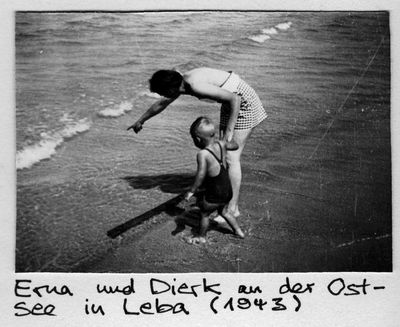 before we fled. I remember that we travelled to Leba on the Baltic Sea from time to time and went swimming there.[24]
Hilbert: And I remember going to the railway station with an older man by the hand - and that could only have been Grandpa Georg. And there was a ramp and there were shot stags or deer lying on the ramp. So that's the oldest picture I still have in my mind's eye. It must have been in autumn 1944 - I was three years old then.
Dierk: Yes, I must have been on those walks with Grandad too. We went to the railway station with Grandad. There were deer, but they were already lying on the trolley. Grandad had to go for a walk with us, probably to recover from his stroke. So we went to the railway station and had a look. The deer were then loaded onto the train and sent to Berlin for 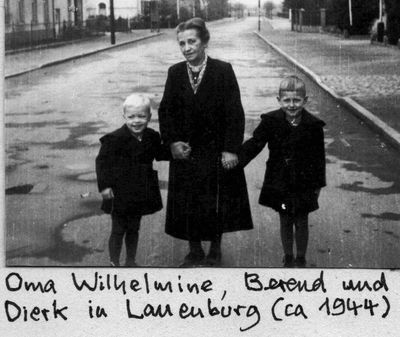 catering to the high-society people, I suppose.
Berend: I can think of another point about the time before the escape: I would normally have started school in Lauenburg in autumn '44. But refugees had been accommodated in the school shortly before that.[25] And somehow - I don't know why - I went to school either alone or with mum Erna.
Dierk: I was there too! It was all covered with straw. That's where the refugees lay.
Berend: And that's why school never started for me.
By train from Bansin to Bremen and Delmenhorst
Hilbert : So, back to the escape story!
Berend: Well, I actually remember relatively little for the rest of the journey. I can still remember two scenes, that we once spent the night in a waiting room, on the floor with blankets or something. But I can't remember where that was. The other scene: I can still remember one time when we were on the train and when the train left, there was a little girl and she started crying. And then it turned out that the girl's mother had got off the train to try to get something to eat somewhere. And she hadn't come back in time. Then there was a lot of drama: what now? But I can't remember how that was resolved.
The next stop I remember was in Bremen, at the main railway station. I remember that we were somewhere up there on a gallery and could look down. And you could look into a medical room where Grandpa Georg was lying. I can't remember whether he had already died or not.
Dierk : There's only one place like that at Bremen Central Station where you can look into the concourse: from platform 1, where the Rossmann shop is now.
Berend : And then I know that we travelled on to Delmenhorst by train and in Delmenhorst in the evening in the dark in front of our grandma Einemann's front door[26] in the dark. Parkstraße 8, I think it was, and there were some stairs leading up to it.
Dierk : Yes, that was Grandma Einemann's house!
Hilbert: So the escape was first by lorry from Lauenburg via Köslin to Bansin on Usedom, and then we had to get off the lorry there?
Dierk: Yes, that was in Bansin! From there we travelled on by train.
Hilbert: You say it was a goods wagon?
Dierk: Yes, I remember that.
Berend: No, I can't remember that!
Dierk: Yes, I can remember that it was a goods wagon.[27] The door was slightly ajar and there was a big wooden box in front of it, turned upside down like a table. So that no child would fall out. And then, if I remember rightly, my pee pot was also important, there in the goods train. I had it on my rucksack.
Hilbert: Why not Berend, the eldest?
Dierk: I don't know, I have no idea.
Berend: Dirk was more reliable!
Hilbert: That's a hierarchy problem.
Berend: Yes, actually it is.
Dierk: But we also spent the night somewhere in a brickworks once. Can you remember that?
Berend: Yes! There weren't that many overnight stays.
Dierk: They were cabins partitioned off with slatted frames. I can't remember any more than that.
Berend: What kept going through my mind later and where I asked myself whether or not it was somehow typically German in a positive sense was that - in all these chaotic conditions at the railway stations - there was always some kind of auxiliary service, winter relief service, Red Cross or BDM girls somewhere. There was always someone there who could help somehow; that you could always get something somewhere.[28] That's why this one mother had run off somewhere, because she thought she could organise something.
Hilbert: Erna reports in the Hornig book that there was another woman in our travelling group. She doesn't give her name, she wasn't related to us, the man was from Oldenburg and ran a hotel in Lauenburg. Do you remember that?
Berend: I can't remember this woman at all. I only read about her in Erna's report.
Dierk : Yes, the woman must have existed. According to Meinert, father signed some kind of affidavit for this woman.
Berend: How many nights must it have been from Bansin until we got to Delmenhorst? Five? Five to six?
Hilbert: I reckon it was six, maybe seven days. It didn't happen that quickly under the conditions at the end of the war! The trains had to keep stopping at railway stations.
-----------------------------------------------------------------------------------------------------------------
Grandpa Georg Meyer and Grandma Mimi
Berend: Grandpa Georg died at the railway station in Bremen. What happened next? He was buried in Wilhelmshaven, wasn't he?
Dierk: Yes, at the naval cemetery.
Hilbert : Meinert researched that. He died in Bremen on 12 February 1945, probably in the emergency hospital at the railway station. Father Meyer then applied for special permission to transport the coffin from Bremen to Wilhelmshaven.[29]
Bernd: So during the war?
Hilbert: Yes, during the war a special permit was required to transport a body. Friedel organised a car for this. As adjutant to the site commander in Wilhelmshaven, that must have been relatively easy for him.
I remember taking the bus with Meinert and Grandma Meyer to the naval cemetery a few times during our school holidays. And then she showed us this big memorial where there were lots of oak leaves on the memorial for the sailors from the First World War who died in the Battle of the Skagerrak. A whole row of oak leaves with names had been broken off and I always thought: Oh, that's not fair.
Berend : I remember I always had to go to the cemetery when I was in Wilhelmshaben with Grandma. I can remember having to go there on my own once.
Hilbert: To tend the grave?
Berend: More to look at the grave to see if anything needed fixing.
From Delmenhorst via Oldenburg to Drielakermoor
Dierk : I think we only stayed at Grandma Einemann's for one night. There was no room at all. It was a very small flat, we came there with 4 boys, mum ... that's 5, and Grandma Meyer was also there. Where was Grandma Einemann supposed to leave them all? So we went from there to Aunt Irene's[30] .(The photo of Erna and Irene was taken around 1922).
Hilbert: She lived in the teacher's flat at Drielakermoor school.[31]
Berend: That was a big flat. But I remember that they had a very ordinary outhouse there.[32]
Hilbert: I have no memory of the refugee centre in Drielakermoor. I only know that later, when we were twelve or thirteen years old, Meinert and I repeatedly went to Tweelbäke by bike during the autumn holidays and spent our holidays there.
Hilbert : Were we in Drielakermoor for a few days or longer?
Berend: No, we were there a whole lot longer!
Hilbert: Irene's husband was called Willi Brunken. Like our father, he probably had difficulties with denazification after the war in order to get back into the teaching profession. But he succeeded and became head teacher at the school in Tweelbäke in 1948 and stayed there until he retired.[33] I remember Uncle Willi and Aunt Irene coming to our house in Würzburger Straße for Tale Meyer's christening in 1976. A really friendly old gentleman!
Berend: Willi's first wife died back in the 1930s! And there were already 6 children!
Dierk: No, 4 children! Rieke, Hermann, Renke and a fourth.
Hilbert: Renke Brunken told us how our aunt Irene's marriage to Wilhelm Brunken came about: when Willi's first wife died in 1936, Erna Günther stepped into the breach shortly before her wedding to Friedel Meyer (in October 1936) and looked after Willi's four children for several months. Friedel was well known in the Brunken household because he worked for a time as a young teacher at the Elisabethfehn-Ost school, where Willi was headmaster from 1927 to 1934. This is how contact with Erna's sister Irene came about a while later.[34]
Dierk : Then the two boys Ernst and Brunke were born! They are or were about the same age as us.
Christa: We still have regular contact with Renke. Renke and his wife were in the Oldenburg Ansgari church choir with me. Ernst died a few years ago, but Brunke is still alive.
Hilbert : My first memory of Oldenburg (which could only have been at the main railway station) is that there was a military train with Allied soldiers on the platform. And suddenly one of the soldiers called out to us twins, Meinert and me, from the carriage window and we were given a bar of chocolate. The first piece of chocolate I can remember! And afterwards Erna or someone else must have told me: They were Canadian soldiers. Since then, Canada has been at the top of my country ranking(laughs).
Berend: I remember that there was also a lot of Polish military in Oldenburg. At the end of the war, they formed a fifth occupying force alongside the Allies. And they took Wilhelmshaven together with the British.
Hilbert: Yes, I read in the newspaper that they even wanted to establish a Free Republic of Poland in Emsland because they didn't want to subordinate themselves to the communist government in Warsaw, but wanted to set up an enclave in Germany for the Polish government in exile, which still existed in London. That's why they had the idea that the Emsland would become a nucleus that would later liberate the whole of Poland from communism.
Berend: And when the Emsland enclave was dissolved, it was reported that the many Polish nationals did not want to return to Poland under any circumstances. They probably went to the USA or Canada.
-----------------------------------------------------------------------------------------------------------------
From Drielakermoor to Westerstede and from there to Gießelhorst - tank fire
Hilbert : Right, so we were in Tweelbäke for a few weeks and then we went on to Aunt Anni's in Westerstede. She lived with her husband, the master painter, in Poststraße. And later, when she became a widow, she built a house diagonally opposite ours on Melmenkamp. Her son was the painter Schmidt-Westerstede, who later became well-known locally and regionally. And her granddaughter still lives in this house with her husband Manfred Hylla.
Berend : Yes, and from Poststraße you went to the Schützenhaus?
Dierk: No, not straight away. After Aunt Anni, we first went to Gießelhorst[35] at Grandma Grote's farm. But there must have been German soldiers on the farm even before the Canadians arrived, who were billeted there briefly on their retreat.
Hilbert: Yes, they all retreated in the direction of Wilhelmshaven.
Dierk: The German soldiers were billeted with ponies at Grotes. The ponies were in the cowshed and we weren't allowed to walk in front of them because they were a bit snappy. But of course we did. And then they had me on the back of my neck, which is where horses like to nibble. In the old stables, which had really big boxes, the soldiers had a big grey horse. It wasn't a pony. That's why I remember so clearly that when we came to Grotes, the German soldiers were there first. The Canadians came later.
Berend: That's right. I remember that now. In Gießelhorst, we sometimes camped in the cellar.
Hilbert : Father Meyer had been a teacher in Ammerland before he went to Lauenburg, first in Gießelhorst around 1933. During the denazification process in 1946/47, he explained that he had joined the NSDAP in 1933 because the farmers had told him that if you were a teacher here in the village, then you had to join the party.[36] In any case, father had good old contacts there and that's why he put us up in Gießelhorst for a while after we fled - still during the Nazi era.
Berend: And then I can remember the only really dangerous situation on the whole escape.
Hilbert: Tell me about it!
Berend: It was at Grotes, we were standing in the kitchen and looking out of the window. There were some bushes and suddenly a tank, probably a Canadian one, came round the corner. That was the first enemy tank I'd ever seen, and we were standing at the window looking out. And then all of a sudden there was a flash and the tank fired. It didn't hit our window, though, but the barn about 10 metres away. A cow was so badly injured that it had to be slaughtered. There was meat for weeks. And I remember that Dierk then ate so much meat that he couldn't see another piece of meat for a long time.
One thought afterwards was whether the tank had fired because Erna, who was in the kitchen with him, was wearing such a green uniform-like jacket that the Canadian sitting in the tank thought it might be a soldier, so he had to react quickly. They mustn't think twice. He just saw something green in the window back there and thought it might be the Wehrmacht, so he fired a shot, but thank God it didn't hit us, it missed us by 10 metres. Otherwise we wouldn't be sitting here today.
Hilbert: I don't remember seeing a tank. Not even a shot. But I do remember that it was suddenly forbidden for us children to go behind the barn. A calf was being slaughtered there. That can only have been the same situation - the calf I remember was the cow in your report.
Bernd: Yes, that must have been the incident. Maybe the cow didn't look so good after the shot.
Hilbert : I don't remember the name Grote at all, but I do remember the name Röseler.
Dierk: That was someone else. Röselers lived right in the village of Gießelhorst. We often stayed with them after the war. It was an old farmhouse with a riding stable. But it was torn down a long time ago.
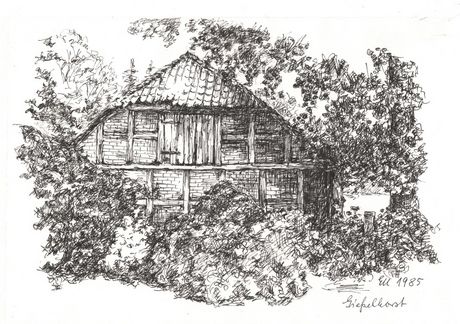
1985: Erna draws the barn behind Röseler's farmhouse (the picture is in Hilbert's possession)
Hilbert: Erna was often at Röseler's, as she writes in the Hornig report, to glean corn.[37]
Berend: Yes, I can also remember Röseler, father and son. But we were only there for a very short time.
-----------------------------------------------------------------------------------------------------------
Schützenhaus Westerstede
Dirk: And then we came to the Schützenhaus.
Berend : We were there for quite a long time - until 1950.[38] Then we moved into the larger ground floor flat at Schillerstraße 1 in Westerstede.
Hilbert: When exactly did we move into the Schützenhaus?
Dierk: That must have been in July or August '45, I guess.
Berend : Erna always told us a story: In the Schützenhaus, we four boys each had our own bed for the first time. We had to climb the narrow, sloping wooden stairs to the floor of the house. On the first night, Meinert or Hilbert came down and said: "Mum, come to bed with me. It's so airy here."
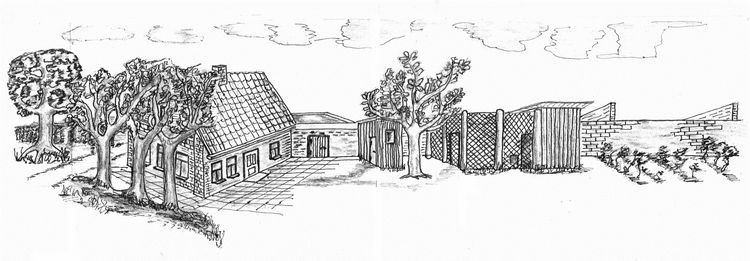
The Schützenhaus, drawn from memory by Dierk in 2022; on the left the house with extension, the outhouse in the centre, the chicken coop, rabbit hutch and vegetable garden to the right, followed by the shooting range behind the wall
Hilbert: I still remember the flat very well. There were three large chestnut trees at the front. The main entrance door was in the centre of the side front. And on the right, attached to the main building, was an extension with its own door, from which you could also enter the flat; we almost only went in there; there was a washbasin for washing our hands. There was no bathroom in this house. The toilet was an outhouse outside the house. Every now and then a farmer would come with a slurry tanker to empty the pit. We didn't live in the whole Schützenhaus, just one half or two thirds of it. There were only very thin cardboard walls to separate us from the other refugee families, who were also accommodated in the house and the annex. We poked a hole in them with our fingers and could then look into the other people's flat. But the attic was only for the Meyer family.
Hilbert: There was a big cooker in the kitchen - pretty much exactly like the one Dörte now has in her flat in Gristede.[39] The cooker was always nice and warm in winter. In spring, Erna bought a dozen chicks for the henhouse. They were first put in a cardboard box, which was placed next to the stove so that the chicks were nice and warm. They were fed with a finely chopped boiled egg. (I remember that I would have preferred to eat that myself).
Berend : In summer, we were almost always outside in the Schützenhaus.
Hilbert: In winter, the four of us were occasionally taken to the gasworks near the church. There was a lot of hot water there. We were then put into a large bath tub and scrubbed down vigorously.
Berend : In the particularly harsh winter of '45, food was very scarce. I remember being surprised that Erna voluntarily gave a few potatoes to a family who lived in the house diagonally opposite Schützenplatz because they had even less than we did. I thought to myself, 'Gosh, we should have kept them ourselves. There were often turnips without potatoes!
Hilbert: I also remember this food shortage: there were three potatoes on Sundays and two on weekdays. Meinert writes: four potatoes on Sundays, three on weekdays! Both were probably correct. In any case, we were often really hungry.
I still have vivid memories of this large garden. There were strawberries, potatoes, turnips, savoy cabbage, kohlrabi, roots, leeks and beans ... and beanstalks. Mum grew tomatoes on the wall of the shooting range for a while. The sun shone on them. And in the autumn, Friedel and Erna planted a large windrow. A hollow in the garden field, maybe 40 cm deep, into which the potatoes, turnips and roots went. Then they put a thick layer of straw on top and a layer of soil on top of that - so that the potatoes and vegetables wouldn't freeze to death in the freezing temperatures. Then, from December onwards, the hay was gradually emptied.
Berend:... And then my father also grew tobacco! He was a non-smoker. But he could easily exchange the dried tobacco for other foodstuffs.
Dierk: So there was a lot of self-sufficiency.
--------------------------------------------------------------------------------------------------------------
Father Meyer returns from being a prisoner of war
Berend: When was father Meyer released from Esterwegen? Was that in '46?
Hilbert : Meinert dug it all up from the documents in the navy box. On 27 May 1945, he received an order for interrogation in Wilhelmshaven, at that time still an officer in the navy. He was arrested immediately afterwards and interned in Civil Internment Camp No. 101 in Esterwegen. Before it was used as a prison camp for naval officers, this was the Nazi concentration camp Esterwegen, where Carl von Ossietzky was also imprisoned and mistreated. On 25 February 1946, Friedel was released from Esterwegen after eight months and then turned up at the Schützenhaus.[40]
Berend: I can still remember when father came back. I had the feeling that Erna was really excited. But we thought it was a bit strange: a strange young man came in, lean and slim, and he had a small military bag with something to eat in it, but I can't remember what.
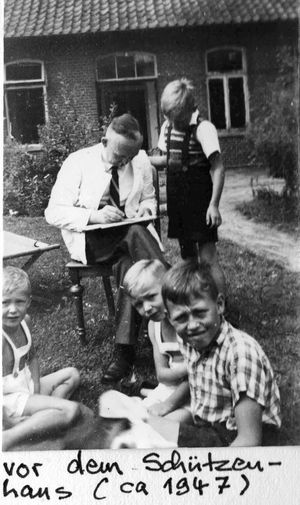 Hilbert : Do you remember that so clearly?
Berend: Yes! I was already 8 years old. I remember it was a sunny day and then it was suddenly there.
Hilbert : Had you been waiting for him to finally arrive, or was that not an issue at all?
Dierk : No, I can't remember any such feeling.
Berend: There wasn't much talk about it either.
Hilbert : My first precise memory of Father Meyer is that Meinert and I, or I alone, had opened the fire damper on the kitchen cooker and burning coals of eggs had fallen onto the wooden floor. Instead of telling him, we just ran away. By then, Erna had already scolded us severely. And then Father Meyer came home from work in the evening and we were not only severely reprimanded, but also spanked. So that we wouldn't do that again. And we didn't do it again!
Berend: Yes, actually, did Dad actually take action like that? I can't remember that happening to me or Dierk. We were probably both better behaved(laughs).
Hilbert: Erna wrote in a letter to Friedel as a prisoner of war that the twins "couldn't be kept down".[41]
Berend: And then there was Anna.
Dierk: I remember that the four of us often really annoyed Anna.
Hilbert: Yes, we did!
Berend: There were a few tears because she just couldn't cope with us four cheeky boys. She had no relatives and nothing and was happy to at least have a job with us.
Hilbert: She had a crippled finger on one hand. And she always said: "When you're out of the house, I'll put three crosses behind you!" I only read later that in the Catholic Church this is a small version of exorcism.
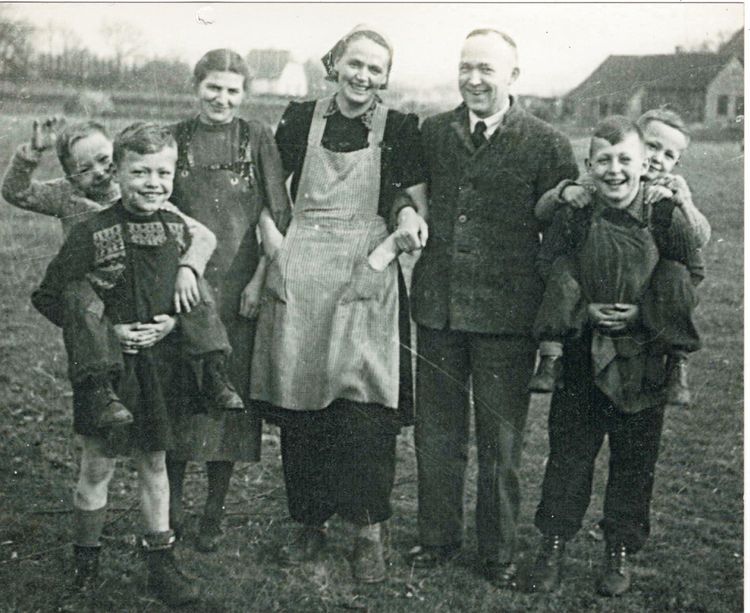
In the photo, which was taken around 1947, Anna is to the left of Erna, with the two houses on the other side of the Schützenplatz in the background. (By the way: Who is Meinert, who is Hilbert? Easy to recognise with the help of page 2).
------------------------------------------------------------------------------------------------------------
Heating, looking after siblings and cutting peat
Dierk: I remember that we stood around a round stove, like a burning witch, and then looked into the fire. It was really nice and warm. And then I remember that one evening Erna wasn't there and I don't think Dad was either. They were probably invited somewhere to visit and we were on our own and I think you twins caused a lot of stress and we didn't know what to do with you. I just remember that Erna came back at some point and then everything was fine again.
Hilbert : We initially heated the stoves with peat, and later also with briquettes. Once in autumn, a farmer came with a horse and cart and brought the peat. It was tipped in front of the house. And we children then had to stack it up the wall in the extension.
Dierk : I remember that we used to cycle into the moor somewhere and ring the freshly cut peat so that the sods could air out and dry.
Hilbert: So Friedel cut his own peat, which we burnt in the winter?
Dierk : I don't know if he could cut it himself, but we at least had to wrestle it and, eh ...
Hilbert : Egg charcoal was far too expensive. And that's why peat and briquettes were common. And I remember my father telling me that he used to cut peat even before the war and then occasionally killed an adder in the moor with a spade or cut it in two.[42]
Berend: I mean that our father also used to go hamstering with a rucksack, sell something or go shopping.
Dierk : Everyone did that. We had to get something to eat from somewhere.
-----------------------------------------------------------------------------------------------------------------
Chickens, rabbits and shooting ranges
Hilbert : We had a chicken coop and rabbits.
Dirk: Right ...
Berend: ... quite a lot, two kinds.
Dierk: One kind of white laying hens, Lisa or whatever her name was.
Berend: Yes, a white Leghorn variety and brown Rhodeländer. Rhodelanders were meat chickens and the white ones laid more eggs.
Hilbert : I remember, but that could also have been Erna's retrospective report, that you, Dierk, were mainly responsible for the rabbits. You were very fond of them and were always very sad when they were slaughtered. You wouldn't have eaten any of them. That speaks volumes for your tender soul, doesn't it?
Dierk: Yes, of course! When my rabbits are killed, you don't like to eat them either!
Elke: Who slaughtered the chickens and rabbits?
Dierk: Erna or Friedel, I think it was mostly Erna.
Elke: Yes, that's how it was with us too. My father did that.
Hilbert: We children had to feed the chickens. There was a big sack in the shed with chicken feed in it. And to this day, I still tell people that there were uncoiled dried crabs in the feed. I don't think anyone wanted to eat them back then. It wasn't the luxury stuff it is today. Then I remember that we always had to go out to collect chickweed for the chickens so that they could get fresh greens.

Photo circa 1948: Dierk with Angora rabbit, Hilbert with normal rabbit, then Meinert and Berend on the shooting range
Berend : The Schützenbusch was right next to the Schützenhaus. I remember playing a lot of Indian games there. And on the shooting range, which was directly attached to the shooting house, there was also a very narrow wall, just one brick wide, and you could walk on it.
Hilbert : You could learn to balance there.
Berend : We weren't allowed to do that, but we did it anyway.
Dierk: And then there were the cross walls across the top of the shooting ranges. They were probably a metre higher than the others.
Hilbert : That was even more exciting, climbing up there and balancing without falling down the 3 metres.
Dierk: And then there was the little wood. We called it 'the Schützenbusch'. We often walked through it. There was a row of birch trees in front, followed by beech and fir trees. We also played cops and robbers there. I remember that there were several large hazelnut trees at the back left of the forest, some of which had tipped over at an angle or had grown at the same angle. They were great for swinging in. That's why we called the three trees our monkey swing. In autumn, we also picked mushrooms there, mainly chestnuts, sometimes a porcini or birch mushroom.
-----------------------------------------------------------------------------------------------------------------
Swimming pool and learning to swim
Berend : A special attraction at the Schützenhaus was the swimming pool, which we also used in '45. It consisted of two pools: the small pool, which we also called the pee pool, and the large pool, which was also suitable for competitions. In winter, the old photographer Sander, the father of our bookseller Ulla Sander, came in all weathers. Even when there was a thick layer of ice on the water, he would chop a hole in the ice with an axe and then bathe in the cold water.
Hilbert : Did you already know how to swim?
Berend: Not yet in 1945, of course. But we all learnt straight away from lifeguard Janßen. Erna rightly said that we should all learn to swim straight away because otherwise it would have been too dangerous with the freely accessible swimming pool.
Hilbert : I still remember the swimming lessons we twins had with lifeguard Janßen: he stood with his left foot on the starting block for the 50-metre course and with his right foot, half retracted, on the 1-metre board. And with his right foot he stepped on the line hanging down from the 1-metre board. We were given one of those canvas loungers, a line was tied to the back and then we wobbled around in the water under the 1-metre board and had to do the swimming movements. He also taught us how to jump from the 1 and 3 metre boards. And he always said: "Squeeze your arse cheeks together" to get the right posture.
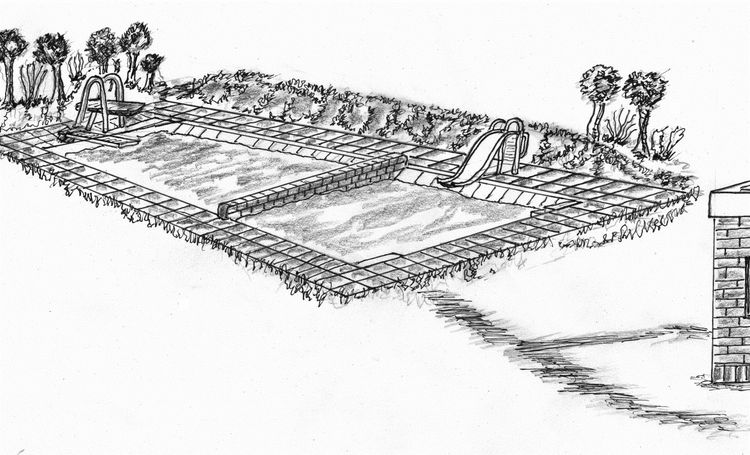
The swimming pool, sketched from memory by Dierk 2022.
Hilbert: I remember lifeguard Janßen putting this swimming lesson bib on us twins when we couldn't swim yet but wanted to jump off the 3-metre board. We were then on his long line, climbed up onto the 3-metre board and then jumped down. For me, it was always the most fun when we dived deep down and Mr Janßen pulled us up again from the depths by the line. Then the water flowed so beautifully past our backs. And then we got our free swimming licence pretty quickly. At least I remember that we twins could already swim when we started school. So we must have got our swimming licence in 1947 at the age of six.
Dierk : There's another story Erna told me: When you twins were able to swim well, probably in 48 or 49, the first of you two went up onto the 3-metre diving board, jumped down and had just disappeared into the water when he was already back on top of the board. A woman was completely dismayed at the speed with which the boy was back up. She was standing at the edge of the pool and said later, according to Erna: "How did he do it so quickly? He's only just jumped into the water and now he's already back up on the board!"
Berend : We practically grew up in the swimming centre.
Dierk : Erna had the biggest problems keeping us out of the water so that we didn't sit in the pool from morning till night. At some point, we would come home again, often frozen blue.
 Berend : The water was pretty dirty by today's standards. There was no filter system. The small pool at the front was paved, but the large pool was only lined with stone slabs at the edges. The pool itself was bare sand. And the small pool was called the pee pool for a reason.
Hilbert: There was a fountain in the large pool at the back left by the diving boards. I often dived down the two and a half or three metres and stuck my arm in the spring. The water was much colder. I can still feel the jet of water.
Berend: When the swimming pool had to be cleaned, once or twice a year, the municipal workers would come with a diesel engine and pump out the water. It was then channelled into the Süderbäke, just 30 metres away. The water also came from there when the two pools had to be refilled.
Dierk: They had such an old engine. The pump was connected to it. The engine was the size of a tractor or lorry and stood on thick wooden planks. To start the engine, they used some kind of ignition cartridges or something similar. These were first inserted into each cylinder and then ignited to start the engine. And when it was running, it made a marvellous noise.
When the water was almost completely pumped out, the eels emerged. The workers always wanted them for themselves, we didn't get any of them. They always had a bucket next to them, where the eel would go when they caught one.
Hilbert : The swimming pool was the highlight for us throughout our time at the Schützenhaus. And when a new swimming pool was built on Hössen, our activities just shifted. But we were already living on Melmenkamp by then. We were always there in the summer from May until the final swim in September. We were all members of the swimming club.
---------------------------------------------------------------------------------------------------------
Schützenfest and fair on the Schützenplatz
Hilbert: Then there were the shooting festivals! I remember them well. All the marksmen would come together in uniform on the market square and then march "paramilitary" with the marksmen's association brass band to the shooting range to determine the marksman's king in a shooting competition. Father Meyer also became a member at some point. The marksmen had told him: "If you're already living in our clubhouse, you have to become a member too." But he was careful not to hit the target too well at the shooting competition because he definitely didn't want to become king.
Dierk: On the shooting ground there was a chain carousel, a swing boat, lots of stalls, and also a stall with broken sugar and ehh ..."
Hilbert: Peppermint schnapps!
Dierk: Yes, peppermint schnapps, or whatever it was called. There was also a wagon from my father's relatives from Bremen, the Herings. One of them made the peppermint schnapps. I often watched how the slabs were moulded. That was great fun for us.
Hilbert: We also visited him once in Bremen-Neustadt. The Herings had a patisserie there and they served delicious cakes.
----------------------------------------------------------------------------------------------------
Circus on the Schützenplatz, Sinti and Roma
Dierk: The circus came to the Schützenplatz at least once a year.
Berend: Yes, that was always a special highlight. The circus people lived in their caravans and they weren't particularly well equipped. There were a lot of women from these caravans who often sat at Erna's sewing machine and who were in our house and could do a bit of work: sewing or washing or cooking or something like that. Erna was always pretty generous when someone came from one of the caravans.
Hilbert: I remember that when the circus was on, the Schützenplatz was cordoned off - including this path between the two beech hedges from the main road to our house ..."
Dierk: That was the black path. It was cordoned off when the circus was performing. Only we were allowed in because we lived there. That was always a privilege.
Berend: When the circus was there, we naturally saw everything from morning to night: how the tent was set up, how people walked around, what they did outside the performances. And we even got to talk to one or two of them. And, as I said, I have a few women in mind who were sitting at the sewing machine in the Schützenhaus.
Hilbert: I still remember the clang-clang of the heavy iron hammers when the huge steel posts were hammered in to anchor the masts to the ground. There were always two workers taking it in turns to hammer the steel post and drive it into the ground. Three or four for each of the four masts, i.e. 12 or 16 in total. Then the poles anchored in the ground were pulled up with long ropes and then the tent was erected around them.
Dierk: Yes, the anchors were practically like tent pegs, except that they were cavemen.
Berend: Of course, they weren't the biggest circuses that performed on the Schützenplatz. But they all had the ring in the centre, from where the rows of seats went up at an angle. There was this traditional entrance and, of course, a ringmaster. Up next to or above the entrance was the band. So it was still playing live. And then came the usual programme with horses and some trained animals, acrobats and clowns.
Hilbert: During the interval, the cage was set up for the lions and other things.
Berend: Oh right, of course I can still remember the predator act: several predators in a cage on the Schützenplatz. When there was no show, we always watched them in detail.
Hilbert: They didn't have good conditions. Lions, tigers, panthers, they always stayed in their trailers and every now and then they were given a bone with leftover meat. The only time they had a run was when they came into the ring for the show.
Hilbert: I remember that Sinti and Roma were billeted at the Schützenhof a few times. We still called them gypsies back then. We didn't know any other word.
Berend: The police also came round once and sent them away or chased them away, I can't remember why.
Hilbert: I can still remember a jeep with British soldiers arriving and parking on the Schützenplatz next to the gypsy caravans. There were one or two rifles lying open in the back of the jeep. The soldiers negotiated with the gypsies. Erna told us afterwards that the gypsies had been in the pub near the district court, drank firewater and hadn't paid! I then thought about it: What is firewater? I hadn't heard that word before.
Berend: We never had any close contact with the Sinti or Roma, but we didn't bite them off either. Erna was always liberal towards them, just like everyone else.
---------------------------------------------------------------------------------------------------------------
Sibling dispute?
Berend: I've often wondered about that: Did we four boys actually argue a lot? I can't remember it at all.
Dierk: No, I don't remember either.
Hilbert: Well, I remember exactly, and I was probably 7 or 8 years old at the time, that Meinert and I climbed to the top of the 3 metre high slide at the edge of the small pool in the swimming pool and got into a big fight - I can't remember what about, maybe about who got to slide down first. We had a real fight until one of us had a nosebleed. Then we thought: That's probably enough. Then one of us slid down, the other climbed down the ladder and that was the end of the argument.
Berend: But I really don't remember the four of us arguing in the house. Funny, isn't it? Do you just repress that?
Hilbert: Maybe Meinert and I were more argumentative, but not towards you. Erna had already written from Lauenburg that the two of us were very active twins who got up to a lot.
Berend: So it was just you two who were the troublemakers?
Hilbert: There's a speciality of us twins that Erna reported: When we were both put on the pot, we would always try to tip the pot over each other. But I don't remember any arguments with you two older ones.
Dierk: Me neither.
Hilbert : You, Berend, were the oldest and much bigger and stronger. So it was clear that people would think twice before picking a fight with you.
 Berend: One more thing: we always had these wooden plugs that we used to build towers, churches or houses. They were really flat things, they always had 3 teeth or 5 or so. We had a huge box full of them. We could build endless things with them. That's why it always went off without a fight.
--------------------------------------------------------------------------------------
School
Hilbert: When did you start school, Berend?"
Berend: I mean, in '45, in May. I should have started school in Lauenburg.
Dierk: I was probably there as soon as I moved into the Schützenhaus.[43]
Hilbert: You were two classes above me and we twins started school in '48. So the age gap is right.
Dierk: Yes, back then the school year started at Easter!
Berend: I still remember the old school building, the Brakenhoff School on the market square, right next to the church. It was demolished in the 80s or 90s. It wasn't called Brakenhoffschule either, but simply Volksschule. With my teacher Mrs Tie or Tieje ...

Hilbert: Her name was Mrs Thiede. She limped a bit, could that be?
Berend: She had a walking stick. Maybe polio or something?
Hilbert: She was considered strict. When she was supervising during the break, I got out of her way.
Berend : I didn't realise that. I was always relatively well-behaved and unobtrusive at school anyway and had few problems with the teachers. I only know that there was Mrs Thiede, but I don't remember her in a positive or negative way.
Hilbert: Headmaster, was that Mr Stamer, who lived in Schillerstraße? Or was he just one of the teachers? I still remember Mr Fittje very well. I had local history lessons with him in year four. He gave great lessons, including lots of exploratory walks. Once he took us to the moor.
Berend : At some point, Mr Finke became headmaster, didn't he?
Hilbert: Yes, but Mr Finke became headmaster much later. Dörte still had him as her first class teacher when she started school in 1959. He was the one who wrote the memorable quote on Dörte's report card: "The school events did not meet with Dörte's undivided interest." (And someone like that became headmistress 40 years later!)
Dierk : Father Meyer was also a teacher at our school. I remember that well. I also had lessons with him. If I remember correctly, it was about the post office. Father drew a picture of the post office counter on the blackboard. Primitive, but I was fascinated by how well he could do it. The postwoman sat behind the counter and we then came to the front of the counter and had to say what we wanted.
Hilbert : This is the first time I've heard that my father drew anything! Drawing was always my mum's thing. I also remember Berend's comments in his report card, issued by his own father.
Berend: Yes, I sometimes felt I was treated unfairly because my father probably attached great importance to not giving the impression that he favoured me.
Hilbert : But that was at secondary school?[44]
Berend: Yes, that must have been in year 5 or 6. He was my class teacher and he once gave me a slap in the face, not very hard, but still a bit more severe, because of something, I can't remember what it was. He probably wanted to show that his son was treated according to the same rules as everyone else.
Hilbert: Dierk, do you remember who your class teacher was?
Dierk: That was Miss Keller. She lived in what is now called the Neue Pastorei.
Hilbert: Meinert and I started school at Easter 1948. I had Mrs Jodlauch from first to third grade. She had considerable problems coping with the large class. There must have been about 40 of us. I still remember the very first day of school at Easter 1948. We were ushered in and given a place on the wooden bench. There were no other ceremonies. We couldn't afford a school bag either. Someone called Meyer sat three or four benches in front of me and he peed in his trousers. Then everything was wet and Mrs Jodlauch sent him home. He didn't come back, and it wasn't until a year later that he started the next first class. That's when I learnt that you're not allowed to pee in your trousers at school (laughs) - it's too dangerous.
I also remember the way to school, which we did from the beginning without mum's company: through the black road to the Bundesstraße 75. Opposite was Böhlje's tree nursery. Then over the Süderbäken bridge, then the railway barrier. Every now and then it was down when we arrived. But it was always very exciting to look at the various steam locomotives. Then we continued along Wilhelm-Geiler-Straße. On the left was Oetken's inn. Further up Peterstraße. Just before the market square was the pharmacy on the right. Then past St Peter's Church, which was simply called the church at the time, turn right to the school, which was also simply called a primary school and not Brakenhoffschule. Every now and then we had to bring a peat sod with us in winter so that the caretaker could heat the large stove in the classroom.
I was given a leather satchel with a slate blackboard and a wooden pencil case, as well as a tin can with a wire handle, into which we put the so-called school lunch (buttermilk soup, sultana porridge, rice pudding or gruel) during the break.[45] was filled into them. 50 years later, I saw just such a satchel at a flea market. I bought it immediately.
I suffered when learning to write because, as a left-hander, I had to write with my right hand. Nobody at school ever talked to me about it. Mrs Jodlauch obviously didn't even notice when she did her big swinging exercises for the letters at the front, which we then had to copy. I had very poor handwriting for a very long time - I was forced to write on the right. It wasn't until shortly after puberty that I made a conscious decision to learn to write accurately. Meinert's handwriting was always much better.
Berend: Was Meinert also left-handed?
Hilbert: No, he was right-handed. I now know that this is actually always the case with identical twins. If one is left-handed, then the other is almost always right-handed.
Berend: And in August 1950, shortly before we moved out of the Schützenhaus and into Schillerstraße, our sister Detje was born.
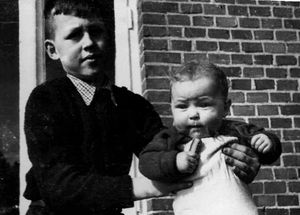
Hilbert: I still remember Aunt Anni laughing at me because I hadn't realised until the birth that mother Erna's belly was getting bigger and bigger.
So, I think we've now covered the most important points from the escape and the first five years in Westerstede. At some point it will be the turn of the next 10 years.
PART 3: APPENDIX
This APPENDIX contains a small selection of documents from the Meyer Archive compiled by Meinert. The originals are all kept in the ‘Navy box’ in Meinert’s study or in one of the 30 Leitz files on family history in Münster. Apart from Document Zero, therefore, these are essentially documents relating to Father Meyer’s time in the navy, his captivity as a prisoner of war and his return to professional life. There are very few documents from this period relating to Erna.
Following the occupation of Wilhelmshaven by British and Polish troops on 27 May 1945, Friedel Meyer was arrested as a naval officer, taken to the former Esterwegen concentration camp and released on 26 February 1946. At the Esterwegen internment camp (Internment Camp No. 101), investigations were carried out to determine whether Friedel had ‘skeletons in the cupboard’. This took some time because he had joined the NSDAP as early as 1 May 1933, had taken on various other party-related roles, and had also been appointed a Nazi command officer by the garrison commander Wulchow in Wilhelmshaven in September 1944.
The exact dates of his capture, release and denazification:
- 27 May 1945 Order for interrogation; arrest in Wilhelmshaven and internment at Civil Internment Camp No. 101 in Esterwegen
- 25 February 1946: Release from Esterwegen, Level IV
- 7 April 1946: Application for reinstatement in the teaching profession
- 24 October 1947 (Denazification) classification notice: Level IV
- 3 November 1948 Denazification, Level V (following an appeal against Level IV)
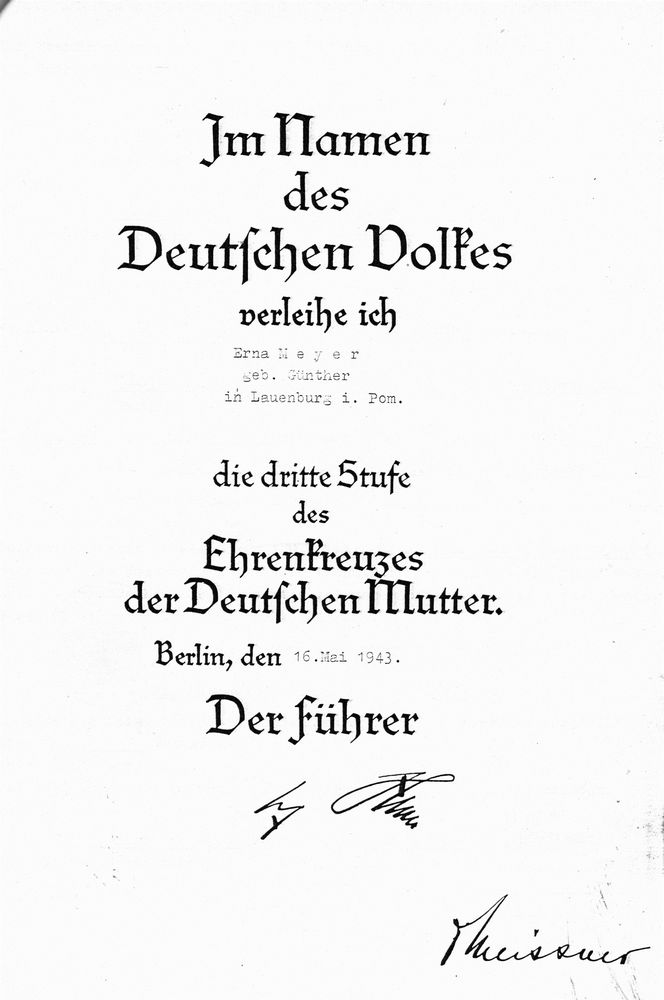
Document 0: Certificate for the ‘Mutterkreuz’ awardedto Erna Meyer in May 1943, bearing a stamped signature of Hitler.
Document 1: Transcript of a telegram from Aunt Inge in Delmenhorst to the Naval Telecommunications Department at Rosenhügel in Wilhelmshaven: information regarding the arrival of the refugee family
Presumably on 10 or 11 February 1945, Inge, Erna’s youngest sister and Hilbert’s godmother, attempted to telephone the ‘Rosenhügel’, the headquarters of the Wilhelmshaven base commander. At that time, Father Meyer was the base commander’s adjutant.
Inge was unable to make a phone call, but she did send a lengthy telegram. The most important message has already been quoted above: Erna had arrived in Delmenhorst with her four children. Her father-in-law, our grandad, remained in the emergency hospital in Bremen, completely exhausted; grandad was probably there too. One or two days later, on 12 February 1945, Georg would die.
The original telegram was presumably sent from Focke Achgelis of Delmenhorst, who is mentioned in the document (as he had a telegraph machine), and was then taken by Inge. (We do not know who this person was.) The document comes from Meinert’s naval box. As it is very faded, Hilbert has retyped it here, but spelling mistakes have been left as they were:
hello is anyone at the fs? + Yes, someone’s here at the fs + is the navy there? + yes, the navy is here + n
Would you do me a big favour? + Yes, who’s this? You really ought to introduce yourself so we know who we’re actually dealing with + Focke Achgelis, Delmenhorst + And what’s your rank?
Do you know Mr Oberlt Meyer, ext. 40806? + No, he hasn’t introduced himself to me yet + Could you perhaps pass on a message to him? It’s very urgent. And I can’t get through on the phone at the moment. + Yes, I can do that for you, although I still don’t know who’s there. + Do you need to know? I don’t know who’s there either. Are you at a loss for words? + The person the line is registered to isn’t available either. Could you perhaps get Oberlt Meyer on the line, or is that not allowed? + No, that’s not possible – access is prohibited +
But I can pass the message on to them now, and will you please pass it on? Tel 40806. Yes, have you already told her what I’m supposed to pass on to him? +
Erna arrived safely in Delmenhorst with the children yesterday evening. The parents had to stay in Bremen because Dad is very unwell. Erna is going back to Bremen today and will try to bring them here today.
……………Inge, FS no. O24 849 ++
So that’s all; thank you very much in advance + yes, do stay in touch via the app and let’s see if I can pass anything on to you + yes, of course – so please pass on my thanks to Lt Laeszt; he’s sorted everything out and everything’s fine; he’ll ring tomorrow + dks.7
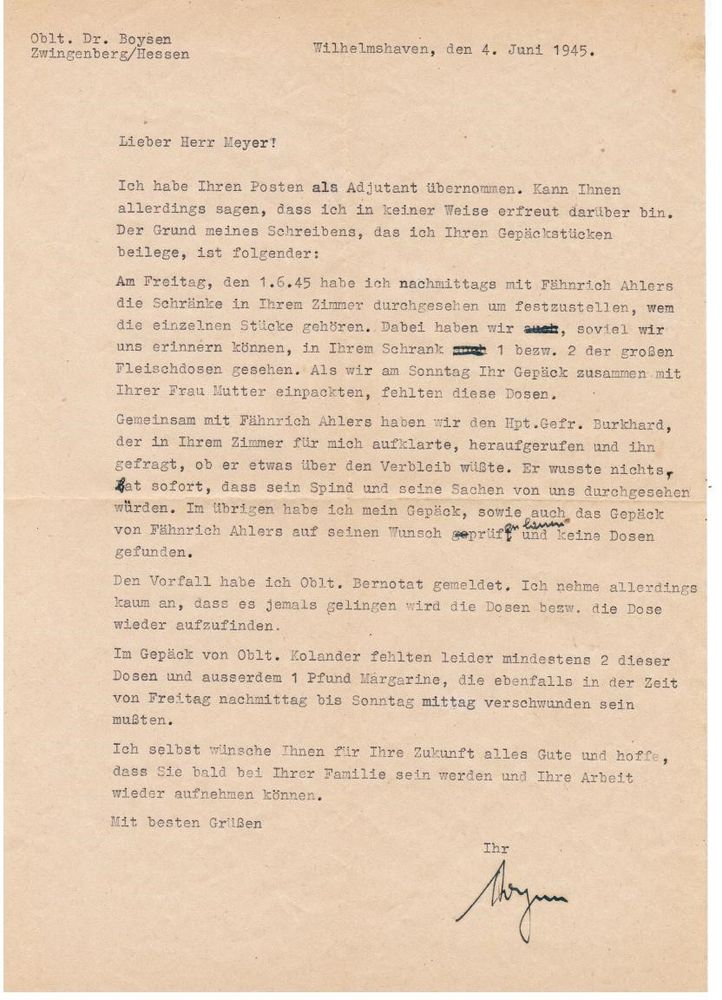
Document 2: Rather curious: in June ’45, two tins of meat were stolen from Friedel’s locker at the naval base in Wilhelmshaven
Friedel is a prisoner of war, but still a First Lieutenant. That’s why he still has a locker in Wilhelmshaven on the Rosenhügel. Someone has stolen something from it. And then – one month after the unconditional surrender – German administrative thoroughness is still at work within the military, just as has always been the custom in Prussia. Father’s successor as adjutant at the WHV garrison headquarters writes in June ’45, one month after the surrender:
Document 3: Certificate confirming the duration of military service (up to 5 November 1945), issued in March 1946 by the still-existing Kriegsmarine
Until 5 November 1945, Friedel was still, quite officially, a first lieutenant in the Kriegsmarine. Only then was he discharged. This is curious, given that Germany had already surrendered in May 1945 and that the Army and the Luftwaffe had been disbanded immediately. The reason for the delay: the British Military Government needed an administrative structure that was still reasonably intact. The city and local authorities were classified as heavily tainted by the Nazis (and rightly so!). The Kriegsmarine appeared more trustworthy. That is why it remained in office until March 1946. The certificate issued on 4 March 1946 dates his discharge as 5 November 1945 – which was, in fact, Friedel’s birthday.

Document 4: Postcard from Friedel Meyer to Erna from the Esterwegen prisoner-of-war camp, dated 31 December 1945
The basis for this letter, in which the sender was only permitted to state that he was still alive, was presumably the so-called Hague Convention on Land Warfare.
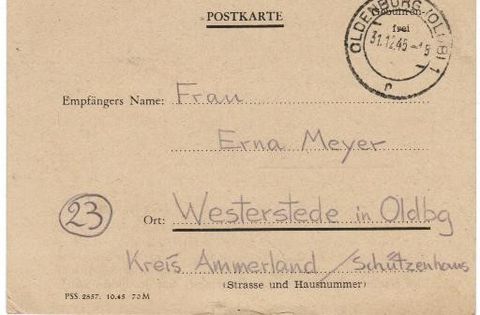
… and the reverse side:
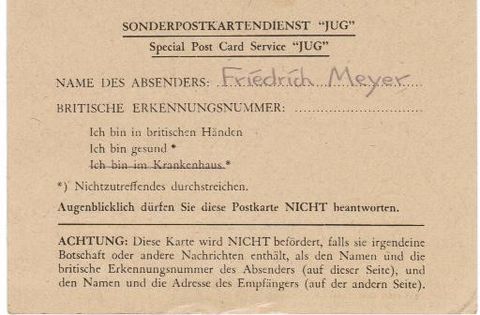
Document 5: Letter from Erna to Friedel at the Esterwegen prisoner-of-war camp, dated 22 January 1946
The original letter was quite obviously brought to Westerstede by Friedel following his release in February ’46. It is also clear from the content of the letter that Father was not yet familiar with the new flat in the Schützenhaus. As he was arrested on 27 May ’45, we can conclude that we moved into the Schützenhaus in June or July ’45. First, the envelope – the stamp has fallen off.

Friedel was held as a prisoner of war for longer than Erna and he himself had hoped. Erna later told us: ‘He was there longer because they were looking for a naval first lieutenant named Meyer who had skeletons in his cupboard.’ But I (HM) suspect it was more likely due to Friedel’s early membership of the NSDAP and his involuntary appointment as a Nazi commanding officer under the garrison commander WHV in September 1944. The letter is in Meinert’s archive, but is very faded. Here is the version produced by Meinert and retyped by me:
Westerstede, 22 January 1946
My dear Friedel!
I’ll have another go at writing you a letter. How are you getting on? I hope you’re always well. I’m always delighted when I hear good news again. Today I had a visitor from Hollwege. A while ago I was in Nord-Moslesfehn and heard all sorts of stories. The demobilisation went well and smoothly. There’s great joy everywhere that they’re back home. (…)
We’re all well. The children are healthy and full of life. They’re enjoying the ice at the lido. They have their own sledge and are out all day. The twins, in particular, are a handful. They’re turning into proper little lads now. Today they slid down the slide with great enthusiasm and landed on the ice. I wasn’t so keen on the torn trousers. The older ones are attending school diligently. Berend has reached the next year group. Miss Thiede is his teacher at the moment. Before that it was Mrs Grundmann, but she’s off sick now. Dierk is in a class taught by a teacher from the East. He doesn’t find the ABCs difficult either.
Mum was here over Christmas and New Year. She’s doing well, all things considered. She’s always delighted when she gets the chance to visit the children. The train service to W’haven is good, after all. So she can come and see us. If only it weren’t for the cold. The grandmothers are very afraid of that. And it certainly is cold here. We’ve had a stove for the past 14 days – from Buchholz in W’haven. It warms the kitchen up enough for us to sit in there. It does use a lot of wood, mind you. But the woods are right on our doorstep. The parlour isn’t getting warm at the moment. Nor is the storeroom. We all huddle together and sleep soundly and cosily. We live here in very ‘idyllic’ surroundings. Everything’s lovely, inside and out. Just a bit primitive in some respects. We have to fetch water and sort out little bits and bobs like that. But I’ve got my own little kingdom, and we’re all very comfortable here. The furniture has all been borrowed or given to us. When we moved in, there was no way of getting Mum’s furniture over here. Now there’s no room for it here. It’s still at Rüdebusch’s. We’re waiting for your instructions. It’ll be fine there until then.
Everyone’s still at home in Delmenhorst. Unfortunately, things aren’t working out with Ursel[46] and Gustl. We saw it coming, of course. I feel sorry for them all. They send their regards. The Brunkens too. Willi came home very soon. He’s been discharged. But they’re still living at the school. Willi was in hospital over Christmas. He’d been hit by a car. He’s recovered now. Hermann has recently been admitted to the Stenum Sanatorium. T.B. We feel sorry for the poor lad. He’ll probably have to stay there for one and a half to two years to make a full recovery.
Also from Grotelüschens[47] warm regards. He’s a supply teacher in Etzhorn. Mrs Grotelüschen gives Latin lessons so they can keep their flat. I myself am not doing anything of the sort yet. I can still get by on my money for a while. Of course, I haven’t had any extra income since May.[48] Mum receives a pension, which is enough for her to live on comfortably.
From Mrs Bertha Ramsauer[49] she asks me to pass on her regards. She has asked that one of our first visits after your discharge be to her.
From Preetz[50] . There’s been another letter from Hans. He was in the military hospital. He’s back on a special diet now. He’s doing well, though. Still no word from Georg-Heinz. I wonder when?[51]
Well, that’s enough for today. We’re always thinking of you. And you know full well that I don’t let things get me down easily. And one day this time apart will be over and we’ll start afresh together.
Lots of love and kisses from the boys,
Your Erna

What an impressive letter! That was Erna for you! Yet she was certainly much more distanced from the Nazi regime than her father, even during the Nazi era. But she doesn’t reproach him in the slightest; instead, she gets on with things.
Document 6: ‘Persil voucher’ for Friedel Meyer from the district pastor in Chemnitz Westerstede
Pastor Chemnitz’s judgement certainly carried weight with the denazification authorities, as he had been one of the leading figures of the Confessing Church throughout the entire Nazi era.
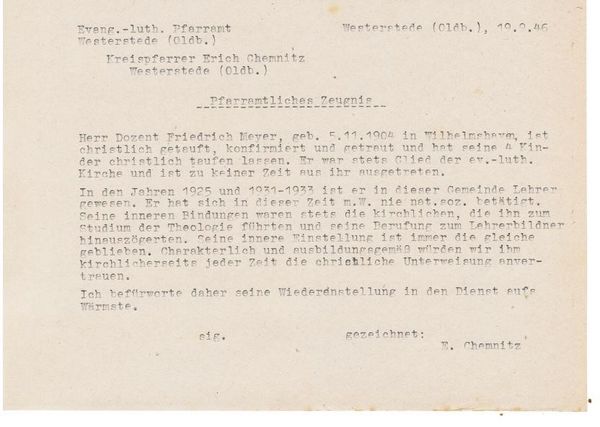
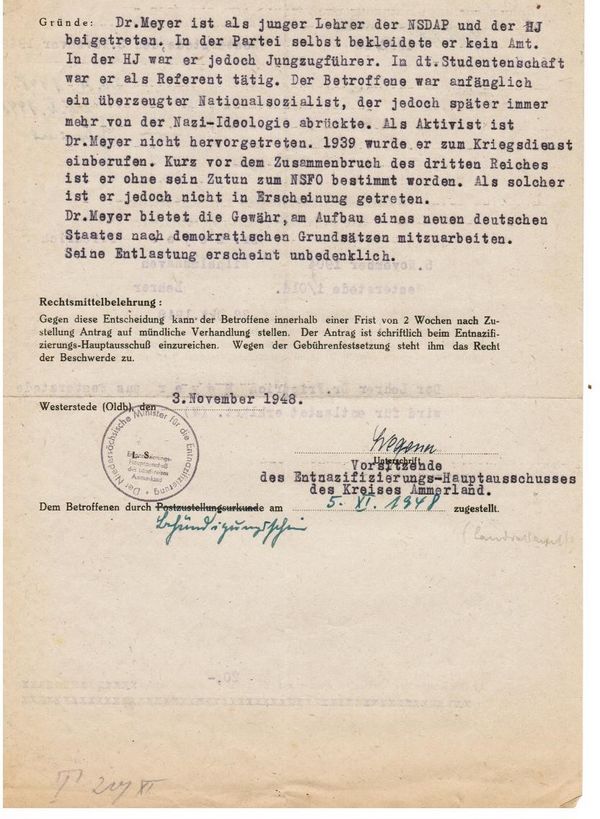
Document 7: Final denazification certificate for Friedrich Meyer, Level V
The reasons are given on the reverse. Initially, Friedel had been denazified at Level IV: this meant ‘minor involvement’. But it was only this Level V that made it possible for Friedel to reapply for a post in the teaching profession. He then, however – despite his Nazi past – very quickly rose through the ranks in the Oldenburg school system.
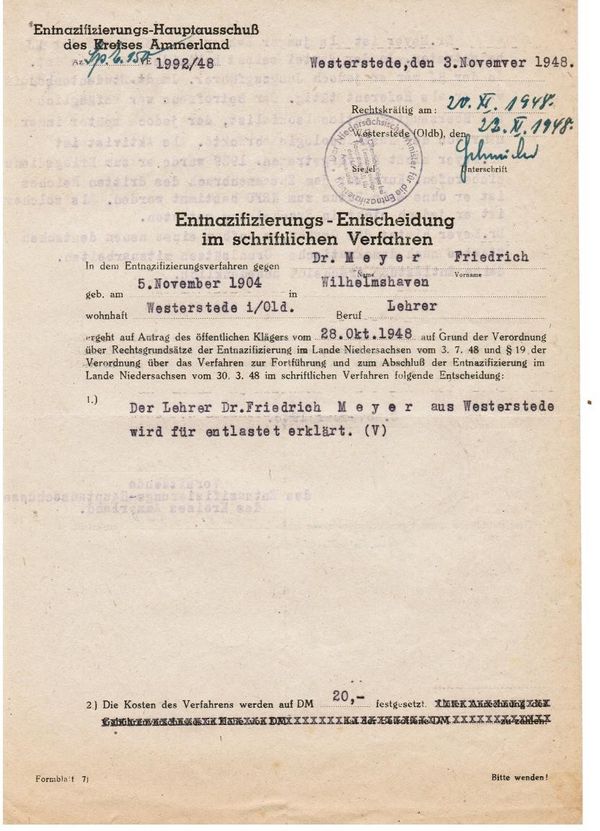
Document 8: Professional reintegration: back as a teacher in Gießelhorst (June 1947)
On 7 April 1946, Friedel applied for reinstatement. On 24 June 1946, he asked the Ammerland school board for permission to give private tuition. It was not until the summer of 1947 that he was assigned the teaching post in Gießelhorst by the authorities. His denazification proceedings were still ongoing at that time. This is probably why he was only ‘assigned’ the post.
The document is signed by Senior School Inspector Stukenberg. He had been dismissed by the Nazis from his post in the Oldenburg school authority and reinstated by the British Military Administration after the liberation. Father knew Stukenberg well. In 1933, he had advised him to embark on doctoral studies. Incidentally, Stukenberg lived on Kastanienallee in Oldenburg, on the opposite side of the street from us.

Document 9: Offer of a school inspector’s post in Delmenhorst (July 1949)
Nothing came of it. Friedel was much more interested in becoming a school inspector in the city of Oldenburg or in the Ammerland region. However, he did not secure the school inspector post in Oldenburg, presumably because the Ministry of Education and Cultural Affairs in Hanover did not approve the proposal submitted by the Oldenburg district government.
Document 10: Appointment as school inspector in Ammerland with effect from 1 January 1950

Document 11: Friedrich Meyer’s biography from a post-war book
In 1995, Alexander Hesse published a painstaking 828-page work entitled ‘The Professors and Lecturers of the Prussian Pedagogical Academies (1926–1933) and Teacher Training Colleges (1933–1941)’ with German Studies Verlag in Weinheim :
Hesse writes: The assumption that the ‘classical’ educators, who were ousted by the Nazis in 1933, were rehabilitated after 1945 and took up professorships, whilst ‘Hitler’s educators’ deservedly faded into obscurity, is incorrect: There is a high degree of continuity amongst teaching staff in West Germany. (This is evidenced by Father Meyer’s career after 1945.)
On pages 509–10 of this volume is the biography of Friedel Meyer:
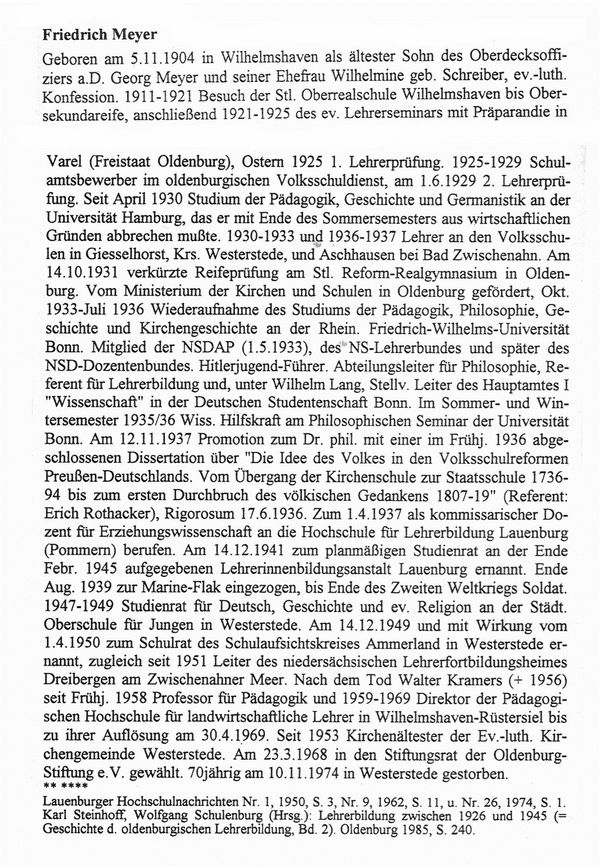
[1] The digitally available texts "Biografische Notizen zu meinem Großvater Friedrich Meyer: Militärische Laufbahn" and "Biografische Notizen zu meinem Großvater Friedrich Meyer: Parteiämter und Nationalsozialistischer Führungsoffizier" were written by Tale Meyer. (Friedel Meyer was appointed to this position in September 1944. There are no more detailed documents on the circumstances. In a letter from Friedel's military superior in favour of his appointment, the only reason given was that he had "pedagogical skills").
[2] Father Meyer had a medium-sized wooden box on the Melmenkamp, which is now in the possession of the Meyer-Münster family. Meinert's son Claas has declared that he wants to take over the care of the Meyer family history as soon as he has found a little time for it - presumably after his retirement. The box contained many important documents, including hundreds of letters and postcards that Grandpa Georg had sent to his fiancée Wilhelmine from Japan and China shortly before and after the turn of the century in 1900. The documents from the post-war period shown in the APPENDIX were also included.
[3] As a "borderland university", the university was to take on a mission determined by Nazi ideology to Germanise the eastern territories. As the first college of the university had completely fallen out, there was a considerable exchange of staff, in which lecturers who - like Father Meyer - were not prepared to leave the church were also given a chance. Father's certificate of appointment can be found in Hilbert's picture folder in the cellar. The certificate was originally signed by Göring, because he was Prime Minister of Prussia, and also bears Hitler's name, which is almost certainly stamped.
[4] Politically, this was a philosopher and anthropologist who was clearly right-wing in 1933 and later became somewhat more distanced. His Nazi past did not prevent the world-famous philosopher Jürgen Habermas from obtaining his doctorate.
[5] The street still exists today; we visited and looked at the Büchnerstrasse terraced house, but didn't dare ring the doorbell at number 14a.
[6 ] A nice coincidence: Grandpa Georg's great-great-grandson Theo Kasper also had his birthday on 1 October!
[7] Georg Heinz's baptismal sermon has been preserved and scanned into Meinert's files.
[8] I (HM) have not found any dates on the Internet as to which day the Red Army occupied Lauenburg.
[9] There is a chapter on Erna Meyer in the book Drei Frauen im 20. Jahrhundert (Three Women in the 20th Century ), printed in Westerstede, about cultural prizewinners of the town of Westerstede: Rolf Hornig (1998): Three women in the 20th century. Westerstede (Rolf Dieter Plois Druckerei, pages 109-156). Hilbert has kept three copies of this book for interested grandchildren, nieces or nephews, which is very beautiful in the passages for which Erna is responsible and slightly blurred in the passages for which Hornig is responsible).
[10] We do not know the exact route of the railway. Given the chaotic conditions in the last weeks of the war, it may have been criss-crossed.
[11] The terraced house is located in the city centre just behind the market square, two stone's throws away from the house that Christa's nephew and godchild Lars Konukiewitz had just bought in Moltkestraße.
[12] The Rosenhügel was the command centre of the Reichsmarine in Wilhelmshaven, disguised as a farm. The building still exists today. Meinert and Hilbert visited the site in 2015 together with the director responsible for the history of the city of Wilhelmshaven.
[13] Detailed descriptions of the reception in Aunt Ann's flat in Erna's Hornig report.
[14] We have found nothing about the exact date of moving in.
[15] In 1951 we moved into a slightly larger flat at Schillerstraße 1 in Westerstede - the first time in 7 years that we had a flat with a bathroom. In 1954, the house at Melmenkamp 21 was built.
[16] Berend was unable to travel because he had to look after his wife Hanna, who was seriously ill.
[17] Recorded on 15 December 2020 in Oldenburg at Kastanienallee 40, transcribed by Gesa's employee at the Bremen regional court, edited by Hilbert February 2022.
[18] I (HM) once asked a neurologist whether it is conceivable to reliably store such early memories. His answer: Yes! The brain is developed to this level at around the age of 3.
[19] His father Friedel Meyer was active in the gliding club at the teacher training college in Lauenburg.
[20] Wikipedia clarifies: 'The Peenemünde experimental facilities were the largest military research centre in Europe from 1936 to 1945.
[21] Erna's Hornig report states that the soldiers were grumpy about the large group of refugees because there were already several more refugees on the lorry.
[22] Abbreviation for National Political Education Centre
[23] This is confirmed by Erna in the Hornig text on p. 128. Erna told us many years after the war that her brother-in-law Georg-Heinz had already told her in 1942 during a furlough in Lauenburg (presumably the baptism in April 1942), without giving details: "Bad things are happening in the East."
[24] Leba is 20 kilometres north of Lauenburg on the Baltic Sea. As small children, we used to go swimming there with mum Erna, sometimes with dad too. In 2013, Meinert and Hilbert jumped into the waves briefly for purely nostalgic reasons, albeit at Easter. It was freezing cold.
[25] Erna also reports on this in Hornig's book: 'The first East Prussian refugees fleeing from the Soviet army, which was already very close, were billeted in the schools.
[26] Erna's mother was called Hubertine Einemann - to distinguish her from Friedel's mother Wilhelmine.
[27] Surely both are right! There was certainly no through train to Bremen.
[28] The great willingness of strangers to help during the escape, e.g. in Bansin, is described in detail in Erna's Hornig report.
[29] This authorisation can be found in Meinert's archive.
[30] Erna's younger sister from Grandma Hubertine's first marriage, married, then widowed Günther.
[31] Note by Renke Brunken (2022): "This is the Paul Maar School today."
[32] Renke's note: "You lived in the three rooms on the upper floor."
[33] Renke clarifies: "In 1948, our father was allowed to work as a teacher again - initially on Brüderstraße in Oldenburg, but we continued to live in Drielakermoor. In 1951, he became head teacher at the Tweelbäke A school (now the Borchersweg Educational and Therapeutic Centre). We moved into the teacher's flat there, where you twins visited us, even with an outhouse. Our parents didn't have their first house with a toilet until 1960 on Ostweg in Oldenburg.
[34] Renke Brunken: "I have a dim recollection that our father worked temporarily at a school in Delmenhorst - I can't prove it."
[35] a small village, 3 kilometres north of Westerstede
[36] This is also stated in the denazification certificate in the ANNEX.
[37] After the harvest, farmers in the post-war period let people (often refugees) into their fields to collect everything that had not been picked up by the harvesters.
[38] Erna wrote in 1992 that we were there until 1951.
[39] In document 5 in the APPENDIX, Erna describes how she got this cooker - a gift from Mrs Buchholz, widow of Grandpa Georg's naval colleague.
[40] For Erna's 80th birthday on 7 July 1992, Meinert produced a 15-page script with Erna's memoirs for the birthday party in the Krömerei. In it, Erna reports: "Father came to us in March 46. He first worked for farmers in Gießelhorst (mainly cutting peat) and I went to dig potatoes. Marvellous! Uncle Georg Schmidt also gave us the opportunity to help with the peat at Strenge in Ocholt. In return, we were given half a cartload of peat. Father then stood in for the teacher in Gießelhorst until the job holder came home. He then went to the secondary school in Westerstede and worked there for two years. After that he became a school inspector." (Hilbert's note: Father's release from captivity as a prisoner of war was in February, not March 1946).
[41] The letter is document 5 in the APPENDIX.
[42] Erna writes in the Hornig report that peat cutting was Friedel's first job after his release from captivity.
[43] In Document 5, Erna wrote on 27 January 46 that Berend and Dierk both went to school and studied well.
[44] It was not until 1959 or 60 that the Westerstede secondary school was renamed a grammar school.
[45] A measure launched in 1947 by the American and British authorities to alleviate the catastrophic nutritional situation of many children and young people in the post-war period.
[46] This refers to Erna's younger sister, mother of our cousin Wolfgang.
[47] This refers to Willi and Renate Grotelüschen, friends of the family. Willi became the geography teacher at the PH Oldenburg. Prelle was a reform pedagogue known beyond the Oldenburg region.
[48] Why no money was added is not exactly clear today. I suspect that father Meyer received no money at all because of the pending denazification proceedings and the end of his lecturing activities in Lauenburg.
[49] Bertha Ramsauer (1884-1947) was also a well-known reform pedagogue in the Oldenburg region and founder of the Husbäke adult education centre, where Erna had been a "student". Bertha is the sister of Lenchen Ramsauer, who was a professor of religious education at the Oldenburg University of Teacher Education until around 1980. Their uncle was the famous Marburg theologian Rudolf Bultmann, who had campaigned for the demythologisation of the New Testament. The great- or great-great-grandfather of the two, Johannes Ramsauer, was a teacher trained by Pestalozzi in Switzerland, who was then employed by the Grand Duke of Oldenburg to educate his daughters. Father Meyer was Chair of the Bertha Ramsauer Foundation for a long time; later Berend was also on the board. You can read all about Bertha in: Dora Hornbüssel (1961): Bertha Ramsauer. Advocate of the soul. Oldenburg: Self-published by the Adult Education Centre Foundation.
[50] This refers to the town of Preetz in Schleswig-Holstein. Friedel Meyer's younger brother Hans lived there.
[51] This refers to father's second and youngest brother (who baptised the twins - see above). He was killed on the Eastern Front near Minsk during the retreat of German troops. The fighting was so fierce that the fallen could no longer be buried. For years, Grandma Wilhelmine clung to the idea that he might have been taken prisoner of war and could return.