
Satisfying work in collapsing new buildings
Satisfying work in collapsing new buildings
An autobiographical report

2009, in Lecture Theatre 1 at the University of Oldenburg
August 2022
Contents
1. Family home
1.1 Birth and flight
1.2 My mother
1.3 My father
2. Childhood and School
2.1 Twins
2.2 Childhood and adolescence
2.3 School and Abitur
2.4 Choosing a career
3. First degree and teaching career
3.1 Bethel University of Theology
3.2 Oldenburg University of Education
3.3 First teaching qualification
3.4 Primary school teacher in Ammerland
3.5 Second teaching qualification
4. Doctoral studies and work on the teacher training college pilot scheme
4.1 Just in time – studies at the Free University of Berlin (West)
4.2 Westphalian Wilhelms University of Münster – Magister Artium
4.3 My supervisor, Herwig Blankertz
4.4 Doctorate
4.5 Chaotic teaching arrangements
4.6 The ‘Kolleg’ school pilot scheme in North Rhine-Westphalia
5. Marriage – four children – golden wedding anniversary
6. University lecturer at Carl von Ossietzky University
6.1 A professorship in Oldenburg – What more could you want!?
6.2 Taking up the post and equipping the chair
6.3 Pilot scheme for single-phase teacher training (ELAB)
6.4 Project-based study
6.5 Key areas of academic research and teaching
6.6 Supervision of teaching placements
6.7 Dean's Office
6.8 Doctoral supervisors
6.9 Doctoral Travel Programme
6.10 Examination duties
6.11 University Representative for Examination Matters
7. Co-operations
7.1 Centre for Educational Practice
7.2 School Reform Unit
7.3 Teacher Training Research Workshop
7.4 Oldenburg Team Research – BLK Pilot Scheme
7.5 GDR Contacts and Reunification
7.6 Research Training Group on Didactic Reconstruction
7.7 Lecturer Training for IG Metall
7.8 Master’s programme in School Management at the University of Kiel
7.9 LABORSCHUL Advisory Board
7.10 CORNELSEN Advisory Board
8. Publications
8.1 Liaison with Cornelsen Publishers
8.2 Long-running bestsellers
8.3 By-catch
8.4 Drawings
9. Sixtieth birthday in 2001 and retirement in 2009
Conclusion and Addendum
First of all: I have spent almost my entire working life with Einstürzende Neubauten[1] :
- No sooner had I become an employee of the North Rhine-Westphalian-Westphalia to help set up the North Rhine-Westphalia ‘Kollegschule’ pilot scheme, when this scheme was scuppered by the then state government of North Rhine-Westphalia – due to a veto by the co-governing FDP – in its most crucial element, namely the merger of the upper secondary school and vocational school. We academics protested against this, but to no avail.
- No sooner had I been appointed to a professorship at the University of Oldenburg in 1975 and committed myself to playing an active part in setting up the pilot scheme for single-phase teacher training than this pilot scheme was scrapped by the newly elected CDU state government in 1976.
- No sooner had I, as the then Dean of Faculty 1 in 1989, utilised my long-standing contacts with Lothar Klingberg (Potsdam) and Edgar Rausch (Leipzig) to establish a cooperation agreement with the Clara Zetkin University of Education in Leipzig, the GDR was dissolved and, shortly afterwards, the Leipzig University of Education was also wound up.
- No sooner had we, following the discontinuation of the ‘single-phase’ pilot scheme at the University of Oldenburg, had we switched teaching operations to the (still reasonably sensible) two-phase examination regulations, the Bachelor’s/Master’s model was introduced as part of the Bologna Process, and everything we had built up was thrown into disarray once again.[2]
That’s life: and for me, this has meant that, over time, I’ve got used to not putting too much heart and soul into the organisational structure of my own workplace and to focusing more on finding meaning in my own work, even under adverse conditions. My colleague from Oldenburg, Astrid Kaiser, remarked 20 years ago that this was an apolitical stance. I would therefore like to clarify my position: I still consider the debate over the correct organisational form of teacher training to be indispensable, and I remain a staunch advocate of the concept of single-phase teacher training, which incorporates early practical placements. But for me, the failure of large-scale projects is no reason to sulk or even to scale back my efforts. Particularly in adverse circumstances, it is all the more important in day-to-day teaching for university lecturers to act as role models, to show students in concrete terms how to teach well, and to support them in developing a humane approach to teaching. This is what I have strived to do in my courses. More on this in section 6!
Text history: The first version of this text was written in 2006 at the request of my long-retired Oldenburg colleague Bernhard Möller for a collection of essays containing autobiographical texts by Oldenburg educational scientists.[3] This earlier version has now been expanded to four times its original length and supplemented with numerous photographs and drawings. Hence the new subtitle: ‘An autobiographical account’.
Intentions: This text is not intended as a contribution to establishing a position within educational science, let alone to the development of theory. I have attempted to do that elsewhere.[4] Despite its subtitle, the text is not an autobiography, but rather something of a report on 58 years of professional activity to date, initially at Ocholt Primary School (in the Oldenburg region), then at the Free University of Berlin and the Westphalian Wilhelms University in Münster, and from 1975 to the present day at the University of Oldenburg. The text also contains some rather personal background information on my professional career, which I am publishing here for the first time. It would have no place in a textbook!
Reliability of memory: I am writing this report from memory. I have only occasionally consulted old records and documents to check dates and names. Errors may arise when proceeding in this way. As a former history student, I am aware of this from analyses of oral history. I ask for your understanding.
Photos and scans: I have incorporated many drawings, photos, extracts from guest books and so on into the text to bring the descriptions to life. If anyone recognises themselves, I would ask them retrospectively for what is nowadays known in the publishing industry as a model release.
A touch of narcissism: A certain degree of self-centredness is almost inevitable in a personal account of this kind. One is particularly keen to write about people who are well-known within one’s own discipline, and then basks in the fact of having had dealings with them. The many small, pleasant and sometimes irritating experiences on the fringes of a long professional life are then overlooked, partly because I have often long since forgotten them. I ask for your understanding! Nevertheless, when this text was finished, I was astonished – indeed, I was downright startled – at just how vast the number of kind and cooperative people was, and still is, with whom I have worked over the course of 57 years in my profession.[5]
Oldenburg,
1 August 2022

1. Family home
1.1 Birth and Flight
I was born on 2 October 1941 in Lauenburg, Pomerania, the fourth of six children.  I am the twin of my brother Meinert Meyer, born ten minutes after him. Our mother explained to us how to tell us apart: Meinert’s face tapers slightly at the top (like the point of the capital letter M), whilst Hilbert’s face is straight across (like the capital letter H).
My parents were from the region of Oldenburg (my father from Wilhelmshaven, my mother from Delmenhorst). So, rather by chance, I was born in the far north-east of what was then Germany. It was only 35 years ago, when I first read a biography of the Polish-Jewish educator Janusz Korczak and looked on a map to see where Treblinka[6] was, that I realised with horror just how close to the extermination camps we had lived back then. My mother told us that she had heard from her brother-in-law Georg-Heinz (a theology student; at the time a soldier near Minsk, missing in Russia since 1944) that ‘terrible things are happening in the East’. But her brother-in-law hadn’t given her any further details.
In early February 1945 – my father was stationed in Wilhelmshaven as a naval lieutenant – my mother fled westwards with her four children, who had been born by then (two older brothers, Berend and Dierk, my twin brother Meinert and myself) and my grandparents to the West to escape the advancing Soviet Army. A detailed account can be found in the ‘Our Escape Story’ file on the website.
My mother wrote down just how exhausting and perilous the escape was for all of us.[7] We twins were tied to two long leather straps so that we wouldn’t get lost in the crush of the train compartments. However, we were never in mortal danger and obviously felt well looked after. To this day, however, I still dream from time to time that I am on a train and have lost my travelling companions or my luggage, or that I am running around the station and cannot find the right platform. Most of the time, the train does not stop where it is supposed to, or it does not arrive at all.
1.2 My mother
My mother, Erna Meyer (née Günther), was born in 1912 in Delmenhorst (west of Bremen). She died in Westerstede in 2000. Our mother was the eldest of four sisters. Her father, Ernst Günther, was a teacher in the Düsternort district of Delmenhorst. He was a keen gymnast and singer. He published a songbook, which ended up with my brother Meinert in Münster. He died in 1918 during the First World War, when my mother was six years old, on the front line in France (near Verdun).
My father, Friedrich Meyer, was responsible for the family’s external affairs. Our mother was in charge of the household – at least during those years when I, as a teenager and young adult, was able to perceive this consciously. We children would go to our mother first with all our problems and wishes, and we would discuss which of them should be passed on to our father – that’s how we learnt to act with a degree of diplomacy.
Our mother took her Abitur at the Delmenhorst Oberrealschule. She had actually wanted to study medicine, but between the two world wars that was unthinkable for her family for financial reasons. She was certainly what we would call today a strong woman. 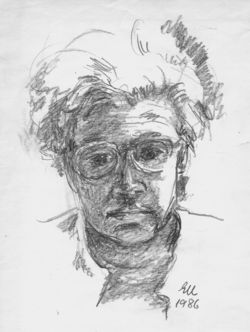 She was repeatedly asked by friends and relatives to help resolve difficult situations. All her siblings, and I too, held her in high esteem and respect, whilst various conflicts were played out with our father.
Throughout her life, Erna regretted not having had any vocational training of her own. To every young woman who came to stay with us, she would say: ‘… but you must definitely do some vocational training!’
Painting: Our mother had been an enthusiastic amateur painter since childhood and achieved a great deal in this field. Here are two examples: a self-portrait from 1986 and a watercolour from 1981 depicting a snow-covered path in Thalenbusch in our home town of Westerstede. We all vied for Erna’s paintings, which she generously gave away.

When Erna celebrated her 80th birthday on 7 July 1992 and was already in a wheelchair due to osteoporosis, the six of us children gathered all the Erna paintings we’d been given by her, or simply ‘borrowed’, and organised a private exhibition at the Westerstede Evangelical Church. We then combined Erna’s paintings with the watercolours produced by us, her children and grandchildren (13 in total), oil paintings by our brother Meinert, etchings by Dierk, horse drawings by our sister Dörte, silver jewellery by our granddaughter Eltje, and model ships built by Hilbert from Danish driftwood (Section 5).


Three photos from this exhibition: on the left, my brother Meinert with two of his own oil paintings; in the middle, Erna, being pushed along by her grandson Berend; on the right, a ‘New Year’s Eve rocket’ made by our son Tiedo himself, which was then set off to round off the celebrations.
Erna used to draw us children time and again; on one occasion she even modelled my brother Dierk’s head in clay. Here is a drawing by Hilbert from 1948. I was 7 years old at the time. 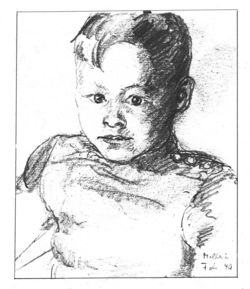
It was certainly down to our mother’s talent for drawing and painting that I – like all the other five Meyer children – always enjoyed drawing myself, even though I never got very far with it (see section 8.4). Our mother simply took away our fear of putting something down on paper.
1.3 My father
My father, Friedrich Georg Meyer, known as Friedel, was born in Wilhelmshaven in 1904, the eldest of three children. He died in Westerstede in 1974.
My paternal grandfather was Georg Meyer, the illegitimate son of the merchant Georg Orth[8] from Apen near Westerstede. He began his career as a sailor on a torpedo boat stationed in Wilhelmshaven, on which he travelled as far as China – to the German colony of Tsingtau (now Qingdao) – and to Hiroshima in Japan during the Boxer Rebellion of 1897–98. After a few years, he was promoted to the rank of ‘deck officer’ (a position between sailors and officers). He married my grandmother Wilhelmine, née Schreiber, from the village of Barnstorf, who lived with us in our house in Westerstede until she was 92. At the end of the First World War, the Imperial German Navy was disbanded and my grandfather was discharged. After that, he couldn’t find any more work, so he took early retirement. When the air raids on the city of Wilhelmshaven became increasingly intense during the Second World War, my grandparents Georg and Wilhelmine moved to join us in Lauenburg, Pomerania.
Seminary training and doctorate: My father was the first in his family to be sent to the Oberrealschule in Wilhelmshaven, but he then failed a year[9] and transferred to the teacher-training college in Varel near Oldenburg.[10] After graduating, he became a primary school teacher at several schools in the Ammerland district. He then went on to complete a degree in educational science in Bonn in two attempts. (His teacher training college qualification was recognised as equivalent to a university entrance qualification.) In 1936, he was awarded his doctorate by Erich Rothacker (1881–1965) – a well-known philosopher who had initially welcomed National Socialism but then, according to his own account, went into ‘internal exile’. After the liberation from fascism, Jürgen Habermas, amongst others, completed his doctoral thesis under Rothacker. I have read my father’s doctoral thesis and was then rather relieved to find that the text on Georg Kerschensteiner’s didactics – at least in my view – contains no overtly Nazi passages.
Nazi: According to his personnel file, my father had been a member of the NSDAP since 1933; however, apart from the admittedly serious role of Nazi leadership officer six months before the end of fascism (see below), he never held any post within the party. He never spoke to us about it. We didn’t ask either, but we were, of course, familiar with the photos showing him wearing the NSDAP party badge from the family photo album. My father’s younger brother, Georg-Heinz, a scholarship holder of the German National Academic Foundation, was an active member of the Confessing Church. My father never told us whether they had argued.
PH Lauenburg/Pomerania: My parents married in 1936. In 1938, my father was appointed as a lecturer at the ‘Grenzlandhochschule’ teacher-training college in Lauenburg/Pomerania, to which the young family moved with my eldest brother, Berend, who had just been born.  The newly founded Lauenburg College was established by the National Socialists specifically for the ideological development and control of the ‘Eastern Territories’. The first cohort of lecturers – all staunch Nazis – had become so divided after just a few years that they threatened one another at gunpoint during a staff meeting. As a result, the Reich Minister of Education, Bernhard Rust, decided to replace a significant proportion of the staff.
- On the right in the photograph from 1942: my father, my older brothers Berend and Dierk, and the twins. (Who’s who?)
This second group of lecturers – not entirely, but at least somewhat ‘de-ideologised’ – included, amongst others, Wolfgang Sucker (1905–1968) as a teacher of religious education, the future Delmenhorst music teacher Werner Figur, and also my father as a lecturer in school pedagogy.[11]
Soldier: Shortly after his appointment as a lecturer in Lauenburg, he was called up for military service in 1939; in keeping with family tradition, my father served in the Navy in Wilhelmshaven. He rose to the rank of lieutenant. During the last two years of the war, he served as adjutant to the base commander of the Kriegsmarine in Wilhelmshaven. There, in September 1944, he was appointed a Nazi leadership officer.[12] From this, one can conclude that he was still a self-confessed Nazi at that time. When the war ended, my father became a prisoner of war of the British occupying forces and was interned in the former Esterwegen concentration camp (where Carl von Ossietzky had been tortured a few years earlier). In 1946, he returned from captivity. It was then, when I was five years old, that I first became consciously aware of him.
Post-war career: After ‘denazification’[13] my father initially became a secondary school teacher at Westerstede Grammar School (without having passed either the first or second grammar school teaching examinations), then, in 1950, as a school inspector for the Ammerland district, and in 1956 as a professor of school pedagogy at the College of Education for Agricultural Teachers in Wilhelmshaven. He was thus one of the many who were able to pursue a career in West Germany despite having been a member of the NSDAP in the past. He subsequently worked credibly to establish democratic structures in my home town of Westerstede, for example as chair of the parents’ council at the grammar school, and as a member of the parish council and the synod of the Evangelical Lutheran Church in Oldenburg.
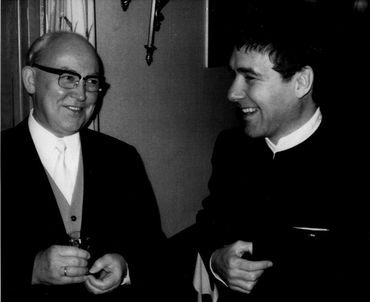
Friedel Meyer and Herwig Blankertz (at my wedding reception in 1969)
Teacher Training College for Agricultural Teachers: The Wilhelmshaven Teacher Training College for Agricultural Teachers was dissolved in 1973/74, and my father’s post – he had by then become the principal – was transferred in the Lower Saxony state budget to the staffing plan of the University of Oldenburg, which was in the process of being established. And it was precisely this post in ‘School Pedagogy’ that I held from 1975 to 2009. When I applied for the post in Oldenburg, I was still unaware of this coincidence. It would have been embarrassing for me, too. After all, there are no hereditary positions at universities. But when the offer came through, my father – who was already seriously ill with cancer at the time – told me that he had made this discovery. It was not until a dozen years later that I first told others about this coincidence.
A preliminary conclusion: I come from a middle-class, academic family; unfortunately, my father did not maintain sufficient distance from the Nazi dictatorship. My mother was more sceptical, but she was a strong woman who brought up us eight children very well. The fact that my father was a university lecturer, I believe, made my career planning easier: a PhD was not something unattainable for me. With the right amount of hard work, it seemed ‘doable’. And I had no undue respect for the title of professor! At least, my supervisor, Herwig Blankertz, told me later that it was precisely because of this entirely natural and never obsequious way I treated him that he enjoyed working with me.

1949: Erna draws Hilbert (aged seven and a half)
2. Childhood and school
2.1 Twins
As I mentioned at the outset, I have an identical twin brother, Meinert Meyer (1941–2018), who – what a coincidence – also became a professor of school pedagogy and, after holding his first professorship in Halle (Saale), taught at the Department of Educational Science at the University of Hamburg.

1943 – Mother Erna, Berend, Dierk and the twins
When we were still children, being twins rather bothered us. Meinert liked to point out that he was 10 minutes older than me. I then told him something about Jacob and Esau (or at least intended to tell him). Our teachers – with one or two exceptions – couldn’t tell us apart. That’s why, at secondary school, we only ever received different grades in those subjects where written work was assessed. We were in the same class right up until our Abitur. We went on every school trip and every holiday together. We had to share many birthday presents, which I felt was unfair compared to my older siblings, who didn’t have to share. That’s why we were both glad when, after our Abitur, we could finally go our separate ways.
Similarity: As children, we twins looked extremely alike. Our mother never had any problems – not even when the nurses in Lauenburg swapped our name tags two days after we were born to test whether she would notice. But my father sometimes had trouble telling us apart when we were a little further away. He’d then call out, “Meinert/Hilbert, come here!”
Mix-ups: Once we’d gone our separate ways and then bumped into each other again professionally fifteen years later, we really enjoyed our twin status. In 1975, my brother took over my job at Herwig Blankertz’s ‘Wissenschaftliche Begleitung Kollegschule’ in Münster – for years afterwards, we kept meeting people who hadn’t noticed the change in personnel. Whenever my brother was approached by a colleague who mistook him for me, he used to say: “I don’t know you. But I know your problem.” And vice versa: when my close friend Jürgen Lüthje, then President of the University of Hamburg and formerly Chancellor of the University of Oldenburg, met my brother Meinert on the Intercity, he asked: “Is it you – or is it you?”
In Banff and Canada at the same time? In December 1979, I had to step in at short notice for the Vice-Chancellor of our university, Friedel Busch, and had the pleasure of joining Detlef Spindler, Uli Steinbrink and Klaus Winter, to undertake a business trip to the Rocky Mountains, to the Canadian spa town of Banff, where the Norwegian Per Dalin was organising an international conference on teacher training. My sole task was to give a 15-minute talk on the Oldenburg single-phase teacher training programme. The decision was made at such short notice that I could no longer cancel my next lecture (on the topic of ‘Pupil-centred lesson planning’). So my brother stepped in, put on my clothes and marched into the Oldenburg lecture theatre without revealing his identity, even though, as he told me afterwards, he would have loved to have inserted the comment here and there in the lecture text I’d prepared: ‘My brother is wrong here!’ Apart from my youngest sister, who was studying in Oldenburg at the time, and four or five students who knew I had a twin brother, nobody noticed the ruse. My brother had actually intended to reveal the truth at the end of the session. But he didn’t get round to it, because after 90 minutes all the students left the lecture theatre so abruptly that he was unable to carry out his plan. Even years later, I was still being asked whether it was really true that I’d sent a stand-in to that session. A week later, a female student came up to me and said that I’d struck her as rather odd right from the start and she’d wondered whether I’d been having marital problems. There was a student sitting in the lecture who was a member of the far-right NPD. He liked to ask questions and was a bit of a nuisance. We hadn’t warned my brother about this risk. So, to the surprise of the other students, he answered his question – which came up in that session too – in a very measured manner.
Hamburg: Conversely, I stood in for my brother when he was Dean at the University of Hamburg in 1996 and had to organise the graduation ceremony for teacher training students. I was on a research semester and had a flexible schedule. So, before the event began, my brother hid behind the scenes; I opened the ceremony with a speech about the expectations of the teaching profession, and at a pre-arranged signal, my brother joined me and we concluded the presentation as a dialogue.
We do not feel that being twins has left us with a lack of self-confidence.[14] The opposite seems more likely to us. We were simply very much alike, even if there were the odd competitive little game right up to the end; however, it was not Meinert who suffered from this, but at most his wife Christel, because – having grown up as an only child – she found these little games very exhausting.
In 2017, my brother was diagnosed with a brain tumour and died from it at the end of 2018.
2.2 Childhood and youth
From the age of 3 to 19, I lived in the village of Westerstede in the Ammerland district, initially in a shooting club house that had been made available for refugees— 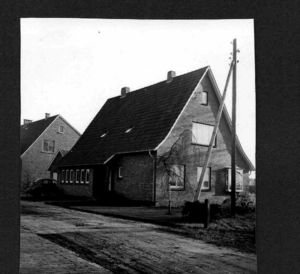 —and then, from 1954, in a small house on the outskirts of Westerstede that had been newly built with a refugee loan: Melmenkamp 21. We twins had our room right at the top under the eaves – not really a room at all, but a shed with sloping walls and a bed frame with a mattress on the floor. I got my first room of my own in 1962 when I was a student.
Ten ‘children’: we were a large household. In addition to the three older brothers already mentioned, two younger sisters, Detje and Dörte, were born in Westerstede in 1950 and 1953. In addition to these five siblings, two foster children lived with our family, who were about the same age as me: Hans-Wilhelm Meyer and Dieter Siemen. 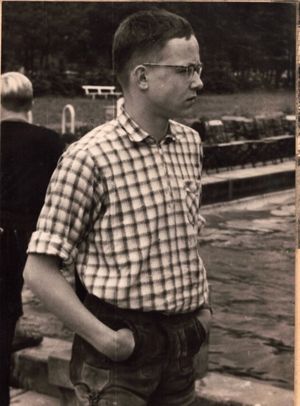 Furthermore, my grandmother Wilhelmine Meyer lived with us throughout my entire childhood. Instead of lending a hand in the large household, she constantly had my mother wait on her; she liked to nag and made life difficult for her daughter-in-law. Later, I put it this way: “There were 10 of us children at home – Grandma counted as two because she was such a pain.”
- Photo on the right: Hilbert aged fifteen at the swimming pool
Swimming pool: The public swimming pool played a major role in our lives as children during the summer. Meinert and I had already started learning to swim at the age of four and had earned our ‘Freischwimmer’ badge by the time we were five. My parents thought this was important because we lived right next to a swimming pool that had no fence, so there was a risk that non-swimmers might drown whilst playing. The twin brothers’ speciality was high diving. We managed to master the Auerbach somersault. I could also dive 50 to 60 metres without any trouble. As a teenager, I would often swim 500 metres (10 lengths) or 1,000 metres (20 lengths) in a row in the large pool at the ‘ ’ Westerstede swimming pool. As primary school children, we used to enjoy jumping from the 10-metre tower at the Marinebad with our grandmother, who was still living in Wilhelmshaven at the time. We hadn’t even asked her beforehand, just to be on the safe side, whether we were allowed to do so.
Open house: We had an ‘open house’ at , 21 Melmenkamp, Westerstede. Lots of friends and schoolmates came and went as they pleased. In particular, the secondary school pupils taking driving lessons often stayed over at our place when they couldn’t get home after evening school events. That was another reason why we didn’t lock our front door. Someone might turn up in the evening looking for a place to sleep – and then we wouldn’t have to wake everyone up. Almost every year we had guests from abroad – pupils from England orFrance who attended lessons with us. During the holidays we would then pay return visits. For example, I stayed three times with a family in Strasbourg who, as I only learnt on my second visit, had been active in the Resistance against the Nazi dictatorship before 1945.
Travel: My parents never went on holiday – neither with us eight children nor on their own. They simply didn’t have enough money for that. But there were alternatives. In Year 8, Meinert and I went on a fantastic cycling trip through Holland with the Protestant youth group from the Westerstede parish and Pastor Hans von Seggern, and in Year 10 we went on a trip to Dover, London and Cardiff (Wales). From Year 10 onwards, I often hitchhiked across the whole of Europe with my twin brother during the summer holidays and even whilst I was a student: to the Netherlands, France, Switzerland and as far as Greece. I felt as though I were in the realm of freedom and enjoyed every one of those trips.[15]
2.3 School and Abitur
From 1948 to 1952, I attended Years 1 to 4 at Westerstede Primary School (later renamed Brakenhoff School), and from 1952 to 1961, Years 5 to 13 at Westerstede Secondary School (later renamed Westerstede Grammar School). Back then, there were still entrance examinations for secondary school. At the end of the exam week, the examiners informed my parents that it would make more sense to let the twins wait another year – they were not yet ready for a Gymnasium. My parents, however, did not follow this advice. Our grades, however, were not particularly good throughout our school years. In lower secondary school, I received the so-called ‘blue letter’ twice, warning that I was ‘at risk of failing to progress to the next year’. On the Abitur, I only achieved a ‘very good’ in PE, whilst in maths and Latin I got a 4 minus. Apart from my PE grade, I received ‘very good’ grades for the first time at the end of my teacher training.
My teachers: they annoyed me more than they impressed me. Their teaching methods and approaches were, in many respects, a thing of the past. But I only realised that once I was studying to become a teacher myself. The younger teachers[16] made more of an effort, but even back then they had a hard time keeping us in line. In our Year 11 school reports, under ‘Comments’ for the twins, it said the same thing for both: ‘Tends to be undisciplined in class’. My mother then asked what this meant. The reply: ‘The twins make active contributions, but they chatter in the middle of lessons and don’t stick to the agreed rules.’
I had just one teacher whom I respected wholeheartedly, even though I got poor grades in his lessons: Senior Teacher Hennig, who taught Latin and History. It was only much later that I learnt that, before the Second World War, he had studied under Theodor Litt in Leipzig, where he was actually due to become an assistant, but was then prevented from doing so by the events of the war and was also unable to complete his doctorate under him.
Polit-AG: Together with a few classmates (they were all boys), we set up a ‘Polit-AG’ and – for the first time at the school – looked into the town’s Nazi history and the fate of the Jews who had lived in Westerstede between 1933 and 1945. This work was one of the reasons why I joined the GEW and the SPD immediately after my first exams. I have remained a member of the GEW to this day. I left the SPD during the student protests – or, to be more precise, I stopped paying my membership fees. I rejoined in 1982. Since then, I have held two SPD membership cards.
Hobbies: When I was in Years 6 and 7, I was given a ‘Chemistry’ experiment kit from Kosmos. It fascinated me. My favourite thing was experimenting with potassium permanganate, because it was great for making oxyhydrogen gas.
I had an aquarium. I used to buy guppies, swordtails and angelfish for it in Oldenburg. Every now and then I’d head to one of the ponds in the neighbourhood to catch water fleas as live feed using a net. Or I’d cycle to ‘Möhlenbült’, a pond 4 km away that had been dug out 100 years ago for the construction of the railway line from Ocholt to Westerstede. There I’d catch a newt, a caddisfly or a stickleback, complete with nest and eggs, from which the young would then hatch at home, and which I could use to feed the angelfish. Later on, my speciality was rearing fighting fish. They have a special technique for raising their young in foam nests, which they build using their own saliva.
Abitur: At Easter 1961, I sat my Abitur exams at Westerstede Grammar School alongside 27 fellow pupils. In Latin, my mark was between a 5 and a 4, but I managed to pass in the end.
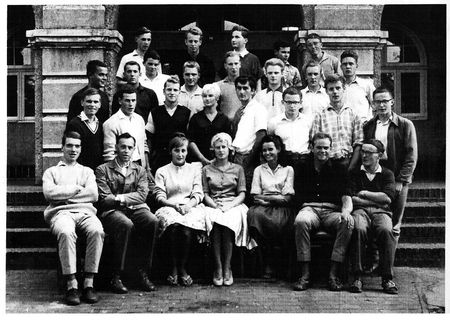
The A-level class, languages stream: in the second row, first from the right in the second row: Hilbert; third from the right: Meinert
2.4 Choice of career
As explained above, I come from a family of teachers. My maternal grandfather and my father were teachers. Four of my siblings became teachers. I have a wife and three sisters-in-law who are teachers. Together, we could have made up the teaching staff of a medium-sized primary school. 14 of the 28 pupils in my A-level class went on to become teachers. So the decision to become a teacher was an obvious one. I made it as early as Year 10. Before that, it was the usual story: first I wanted to be a forester, then a chemist. When chemistry lessons began at school, my interest in chemistry vanished abruptly. One factor that strengthened my motivation to become a teacher was probably the fact that, after my confirmation at the Evangelical Church in Westerstede, I’d become a so-called ‘children’s service assistant’ and had to keep twenty fidgety sixto twelve-year-old boys. I really enjoyed that. The lasting effects of this experience can be found in the ‘Storytelling’ section of my book *Teaching Methods*.
My career choice never wavered, but I remember having already decided, even before my Abitur, that I would continue my studies after completing my teacher training. The parallels between my career path and that of my father are therefore obvious.
3. First degree and teaching career
3.1 Bethel Church University
From the summer semester of 1961 until the winter semester of 1961/62, I studied at the Bethel Church University near Bielefeld – a very small institution with just 200 students – where I took the Graecum examination, which was assessed by a state commission. The opportunity to study at Bethel was offered by our father, and three of us children took it up. He justified these additional costs, given his meagre salary, as follows: “At the grammar school in Westerstede, you didn’t learn what hard work really is. But once you’ve completed the Graecum in Bethel under Professor Krämer, you’ll know for the first time what proper work is.” Our father was right, by the way! The professor put us through our paces – albeit in a kind manner – because he was determined to get us students to the same level of achievement in 11 months as the classical grammar school in Bielefeld took eight years to reach. That’s why, as our final preliminary written exam at university, we had to pass the grammar school’s Abitur written exam. My grade for the Graecum was ‘satisfactory’.
The year in Bethel broadened my horizons, partly because we students were expected to help out at the hospitals in Bethel at weekends to take some of the strain off the deacons working there. Since then, I have had no reservations whatsoever about interacting with people with epilepsy or those suffering from schizophrenia. And the language skills I acquired through the Graecum help me to deal with the many educational terms of Greek origin.
Bielefeld University of Education: At the same time, I was enrolled as an auditor at the Bielefeld University of Education. My fellow students in Bethel found it strange that I was learning Greek in order to become a primary school teacher. When I once let it slip and said I could imagine teaching at a university of education later on, they laughed at me. That’s how I learnt that ‘professor’ isn’t a career aspiration you can just blurt out, though I never gave up on the idea that it would be an attractive job.
3.2 Oldenburg College of Education
From the summer semester of 1962 to the summer semester of 1964, I studied for five terms at the University of Education in Oldenburg. In Oldenburg, I had two semesters of my minor subject at the Bielefeld University of Education recognised for credit, though I was not exempted from any examination components. Consequently, I only made use of one of the recognised semesters.
Main subject and minor subjects: I had chosen German as my main subject. My four minor subjects were History, Mathematics, Protestant Religious Education and English. I’d chosen German because I was a fan of Brecht. Unfortunately, for my lecturer, Prof. Hans Lüschen, serious literature – and that was the only kind covered – ended with Hugo von Hofmannsthal. I didn’t realise that Lüschen counted himself among the Stefan George Circle – I’d never even heard of this circle before. The four minor subjects each had to be covered by two credits, i.e. four hours per week over four semesters – better than nothing!

Teaching began in 1962 in the former ‘Teachers’ Training College’ on Peterstraße, built in 1846 – which, incidentally, had a very beautiful wood-panelled lecture theatre that has been preserved to this day. After two semesters, we all moved into the newly completed building on Ammerländer Heerstraße – today the oldest part of the university on Ammerländer Heerstraße.
Rural teaching placement: The so-called rural school placement, which I undertook during the summer semester holidays of 1962 with my fellow student Reinhard Riedel – who had only recently arrived in Oldenburg as a late repatriate from East Prussia – had a particularly significant influence on my professional development. We were assigned to the two-class primary school in Arle, East Frisia. Our mentor was Ellen Riggert. She was the head teacher.

The school building in Arle – behind the three windows in the attic was the workshop, where the two of us students were accommodated free of charge for six weeks.
We joined the upper class comprising classes 5 to 8, which was taught by Ellen. This meant that we had to attend form-based lessons every day and so learnt from the very beginning what ‘internal differentiation’ is.
In her lessons, Ellen championed and put into practice progressive educational ideas that she had learnt about during her studies at the University of Education in Hanover. I was impressed by the ‘country children’s’ methodological skills. For example, in religious education lessons, they were able to  identify different layers of meaning within a parable or a miracle story – and for the most part in East Frisian Low German (which I could only partially understand with my knowledge of Oldenburg Low German). Ellen drummed it into us: “As a teacher, you must learn to leave your weapons in your locker.” Unfortunately, she later abandoned this principle when she became a primary school headteacher in Oldenburg.
- Farewell to the rural teaching placement with Ellen Riggert
Every afternoon (!) during our teaching placement, we had to turn up at the teacher’s house and usually stayed there for three hours. First, we were served a cup of tea (in true East Frisian style, with sugar cubes and cream). Afterwards, every lesson taught that morning was thoroughly reviewed, then the lessons for the following day were discussed. Ellen would regularly write in her lesson logs: “Teacher disrupts the lesson!” And she was almost always right. We were simply still too clumsy and hadn’t yet realised just how independent these East Frisian country children already were and how many learning techniques they had already mastered.
City school placement: After the winter semester of 1962/63, it was my turn for the city school placement. So I plucked up all my courage and asked my fellow student Christa Konukiewitz if we wanted to do the placement together. I’d known her since the first week of the 1962 semester,  because we’d happened to be assigned to the same group for the so-called ‘Thursday placement’, during which we spent one morning a week at school. I wasn’t at all sure whether Christa would say yes – but she did.
- In the photo, Christa is teaching our pupils the hand signals for singing a scale.
The placement took place in Class 2b at Haarentor Primary School (Oldenburg), right next to the teacher training college. Our mentor, Gudrun Heise, was absolutely brilliant, just like Ellen Riggert had been during our rural school placement. She showed us just how challenging it is to design an appropriate curriculum for spelling and arithmetic in primary school. Ever since then, I’ve taken the view that teaching reading, writing and arithmetic is didactically more demanding than any advanced course in the upper secondary school.
At the same time as the placement, I had to sit my first subject examinations in my minor subjects, English and History, due to the semesters that had been credited to me. It was a struggle, but it worked out, partly because Christa was kind enough to take on some of the work that I was actually supposed to do myself. Our supervisor and examiner for the municipal school placement was the music education specialist Ulrich Günther. Christa was awarded a ‘good’ grade, whilst I received a ‘satisfactory’ grade.
Evangelical Student Community (ESG): Christa and I were active in the student community. Apart from the AStA and the SHB, there were no other student organisations at the time in which one could get involved. Getting involved in the ESG was a natural choice for us, as Christa is a pastor’s daughter and I, too, come from a Protestant family. We were both – though not at the same time – student representatives for the ESG – a role that didn’t involve too much work. The ESG organised retreats at the Ahlhorn log cabin, but also had close co-operation with the Reformed Evangelical Church of East Frisia and – of course – organised a ‘kohlfahrt’ in winter. The newly appointed first Oldenburg student chaplain, Peter Wagner from Detmold, made a strong impression on us; we have remained friends with him ever since. He was clearly on the left – both politically and theologically. He told us about Dorothee Sölle and explained why he was a pacifist.
Excursion to the FDJ in East Berlin: I vividly recall that in 1963 – shortly after the Berlin Wall was built – the then AStA of the Oldenburg University of Education accepted an invitation from the FDJ university group at Humboldt University in East Berlin/GDR.[17] My future wife and I were able to go along. Werner Loch and Hans-Jochen Gamm, who at the time held the two professorships in General Pedagogy at our university, were also there. Hans-Jochen Gamm gave a courageous lecture on education policy.[18] We visited the polytechnic training programme at an electrical engineering company and discussed matters with the teachers. At Humboldt University on Unter den Linden, we discussed educational issues with a relatively large group of professors of education. One professor went so far as to claim that, given the hostile attitude of the capitalist states towards the GDR, ‘education in hatred’ was necessary. One evening we went to the cabaret ‘Die Distel’ and witnessed Wolf Biermann’s last or penultimate public performance in the GDR. We spoke to important people and – what a coincidence – the then GDR Foreign Minister Bolz also dropped in to see us, apparently by chance.[19]
The teaching staff at the PH: In the 1960s in Oldenburg, we had committed and dynamic lecturers, many of whom had made a name for themselves nationwide just a few years later, for example Werner Loch (later at the University of Erlangen, then the University of Kiel), Hans-Jochen Gamm (later at the University of Darmstadt), Erwin Schwartz, founder of the nationwide Working Group on Primary Education (later at the University of Frankfurt), the art education specialist Reinhard Pfennig, the music education specialist Ulrich Günther, the craft education specialist Hartmut Sellin, the biology education specialist Ernst Kelle and the aforementioned Heinrich Besuden.
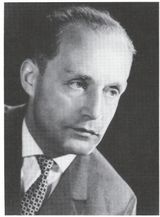 The principal of the Teacher Training College at the time was Hans-Jochen Gamm (pictured right), a student of Wilhelm Flitner from Hamburg. Every Saturday from 8 to 10 am, we attended his lecture on general pedagogy. This was followed, from 10 am to 12 noon, by Werner Loch with a lecture on the history of pedagogy. With his book *Führung und Verführung* (1964), Gamm was the first West German educationalist to present a comprehensive account of Nazi pedagogy. His book *Der Flüsterwitz im Dritten Reich* (1963) remained on the *SPIEGEL* bestseller list for months.
My landlady: I was subletting a room at 33 Von-Kobbe-Straße in Oldenburg from Mrs Hahn – a room without a toilet, but close to the teacher training college. She was a rather simple-minded woman and would repeatedly draw me into conversations, which I would write down straight afterwards.[20]
Mrs Hohn: Oh, Kennedy’s dead, Mr Meyer. That’s such a shame. He was so young and handsome, so straightforward. I thought he was much better than Hitler. – Is it all right to say that, Mr Meyer?
Hilbert: No, you can’t!
Some members of the ESG had visited me the evening before to discuss the programme for the next term. The following evening:
Mrs Hohn: Mr Meyer, the lodgers have complained. At half past eleven last night, three boys and three girls were still coming out of the house. They can’t be out that late. People will start talking about me. Some of them have taken nude photos before, and then the landlady had to go to the police afterwards!
Hilbert: But there was a pastor there, wasn’t there!
Mrs Hohn: All the worse for it!
Looking back, I rate the training I received at the Oldenburg Teacher Training College very highly. We really did acquire a great deal of the practical skills needed for the teaching profession and also learnt a great deal about the theory and history of education. ‘From practice – for practice’ didn’t apply to us.
3.3 First teaching qualification exam
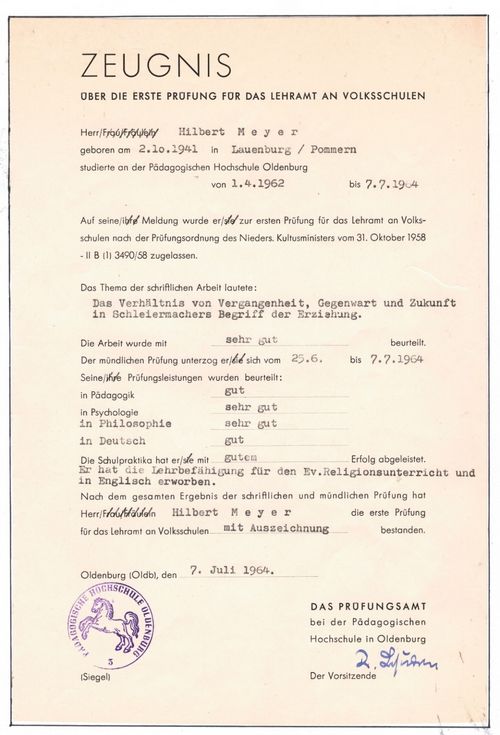
In the fifth semester, I registered for the exam and passed the ‘First Examination for Primary School Teaching’ on my mother’s birthday, 7 July 1964.
A curious grading system: my overall grade in the exam was ‘with distinction’ – a grade in which three ‘2s’ and three ‘1s’ were combined to give an overall ‘1’, even though the ‘2’ for the teaching placement had itself been calculated by adding a ‘satisfactory’ and a ‘good’. Nowadays, that would never have resulted in an overall grade of ‘very good’, let alone ‘with distinction’! I was therefore somewhat surprised by the result. My certificate is signed by the part-time head of the State Examinations Office, the mathematics education specialist Heinrich Besuden, who later became my colleague on the professorship for mathematics education.
My dissertation on ‘The Relationship between Past, Present and Future in Schleiermacher’s Concept of Education’ was supervised by Werner Loch. I had worked hard because my first written grade at the Teacher Training College had been a ‘poor’.[21]
The second examiner was Herwig Blankertz. The latter had been the philosophy lecturer at our teacher training college for four semesters at the time. Only a few students attended his lectures on Descartes, Kant and Rousseau. I was one of the few. That was a stroke of luck for me. For he offered me the opportunity to do my PhD under his supervision.[22] And he set the course for my academic career in every crucial respect.
Graduation ceremony: The second student in my class of 2018 to receive a ‘very good’ was Freerk Huisken, who later became a professor at the University of Bremen, where he remained a supporter of a Maoist splinter party for a frighteningly long time and, in one of his essays, accused me of having succumbed to the typical late-capitalist dreams of the system’s reformability. Be that as it may – but he was an excellent cellist and enriched the graduation ceremony with his playing.
At the time, there was a severe shortage of teachers. In a statement, the Ministry of Education and Cultural Affairs declared that it reserved the right to reclaim part of the training costs from those graduates who did not take up a post. That is why the GEW had set up a stand outside the assembly hall at the graduation ceremony, where we were assured that we need not worry about this.
3.4 Primary school teacher in Ammerland
From 1 August 1964 to 1 April 1967, I was a ‘teacher awaiting appointment’ at Ocholt Primary School in the Ammerland district, a small village with perhaps 1,000 inhabitants, situated 28 km west of Oldenburg. At that time, there was no teacher training programme at primary schools. From day one, I had to take charge of a full class and teach 30 hours a week.[23]
I was 23 years old and taught 30 hours a week across all year groups. However, the main focus of my work was on primary education. 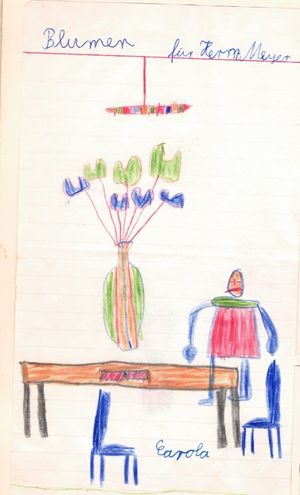 I became a class teacher straight away and taught a Year 2 class for just under three school years, meaning that ‘my’ class had reached Year 5 by the end of my time at the school. Actually, the school had been urgently looking for a teacher for Year 1, but my headteacher, Mr Grummer, told me: “Year 1 is too difficult for a beginner!”
First day of term: On the first day of term after the summer holidays, I walked into my Year 2 class feeling slightly nervous; the pupils had already learnt to read, write and do arithmetic quite well under their previous teacher, Irmtraud Berg. Standing at the door was a pupil, Carola Wöbken. She greeted me and said: “My name is Carola. I’ll help you.” And that’s exactly what she did.
Everything was new to me. I hadn’t studied primary school teaching methods at university and knew only a little from my teaching placement at the local school. During the first few weeks of my job, the parents were sceptical, no doubt partly because they were worried about all the things a complete beginner like me wouldn’t be able to do. But after a few weeks, most parents’ concerns had vanished, because they could see that I was very hard-working, kept a close eye on homework[24] and because the pupils clearly enjoyed being taught by me.
Headteacher: The headteacher, Mr Grummer, was a friendly elderly gentleman who had never heard the term ‘educational reform’, even though there was actually a great deal to be done due to the conversion of his school into a so-called ‘focal school’. During my first week at the school, he asked me to come and see him and said: “I’ll show you round the village!” Then we cycled through the village and he gave me all sorts of useful tips: “There are belladonnas in the hedge! Make sure the pupils don’t go near them.” Or: “There’s a bit of a loose woman living in that house over there. Don’t get involved with her!”
Mentor: My assigned – or self-appointed – mentor was Walter Spellig. Once again, this was a stroke of luck for me, because he took great care of me and offered advice, for example on disciplinary matters, but also with ideas for language and subject teaching. Mr Spellig had been an aircraft pilot in Rostrup (on the Zwischenahner Meer) during the Second World War; he’d fallen in love with the daughter of the Ficken distillery in the village of Lindern near Ocholt and married her. So he stayed in the north. Two years after my time in Ocholt, he was appointed the first training coordinator for primary school teachers in Ammerland.
Maintaining discipline: I had discipline problems for a good year and a half. The pupil Angret Hemmieoltmanns spoke up after 14 days— 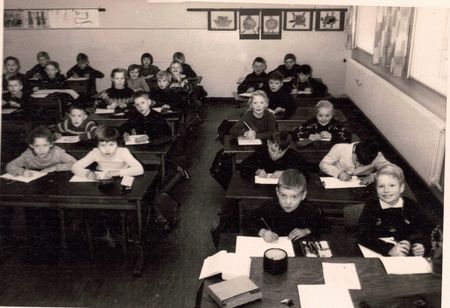 —when things had become quite restless again, and said: “You know what, Mr Meyer: Whenever you’re talking, we’re quiet, and when we’re talking, you’re quiet.” Irmtraud Berg, from whom I’d taken over the class, sat in on a lesson at my request and gave me a tip: “The restlessness in the class isn’t coming from the pupils; it’s coming from you.” And Walter Spellig said to me months later during the long break: “If Egon’s up to his old tricks again, send him over to my class. I’ll sit him next to his big sister. And he’ll be so mortified that she’ll give him a proper telling-off at home!”
Developing an experimental approach: I’ve always really enjoyed teaching. I often taught in small groups. I was constantly carrying out little experiments. I tried out the ‘programmed instruction’ that was all the rage at the time, using mini-programmes I’d put together myself. My favourite subject was general studies – a field that, following the end of ‘local history’, was still very under-represented in the curriculum. I was therefore able to experiment a great deal. My written seminar paper for my second teaching qualification was on the topic ‘The didactic problem of introducing topics too early in general studies’. In order to write the seminar paper, I systematically tried out all sorts of teaching content that was prohibited under the guidelines. For instance – rather absurdly – it was forbidden to cover the topic of the fire service before Year 4. So I did it in Year 3. At the time, arithmetic involving x and y was under no circumstances allowed to be introduced before Year 5, so I started teaching it in Year 3. This led to the distinction between a legitimate ‘anticipation’ within the structure of the curriculum and an incorrect ‘premature introduction’ that could be justified on the basis of learning theory.[25]
Action-oriented teaching: Looking back, I realised that in Ocholt I had, in certain areas, been practising what I had described in the 1980 guide to lesson preparation as ‘action-oriented teaching’. We had good facilities at the school for this. I was able to use an adjoining room at our school to build a large model of the village with the children. Incidentally, the adjoining room was a former Hitler Youth hall, where swastikas could still be seen on the ceiling beams. I often took my class out into the village to visit a farm, the large market garden and apple press in Hettenhausen, and the railway station. We had our ‘Moosstelle’ in the woods opposite the school, where we would occasionally tell stories and kick off the weekend. Once, as a voluntary homework assignment over the autumn half-term, I set the following task: ‘Build a sweet machine out of a shoebox, where you put a ten-pfennig coin in at the top and a sweet comes out at the bottom!’ That proved to be a real challenge, though. Only one pupil managed it – and even then, only with his father’s help.
Open Conference: Every 5 to 8 weeks, a group of between 12 and 20 colleagues from all primary schools in the municipality of Westerstede would meet for the Open Conference. We would observe a lesson taught by one of our colleagues and hold a thorough debrief (during which some harsh criticism was also levelled). Afterwards, there was coffee and cake. The school inspector had no place at these meetings – we were self-organised.[26]
Salary: The starting salary was 530 DM – a lot of money back then. I didn’t have a car yet and would cycle the seven kilometres to my parents’ house in Westerstede at the weekends. The rent (initially with the village policeman, then in the spare flat of the Ocholter nursery teacher) was 50 DM and later 75 DM. On top of that, I paid 75 DM a month for a set lunch at the village inn. I had at least 150 DM left over every month and bought the first radio of my life. I travelled to the Documenta in Kassel and bought an etching by the Tachist artist WOLS (Wolfgang Schulz) – and still had a bit left over.
 Physical Education: During my degree, I hadn’t attended a single seminar on physical education – and now I had to teach PE to Year 2 and Year 9 pupils. It was thirty metres from my Year 2 classroom to the little-used sports hall. So whenever the class got restless, I could quickly pop over and play dodgeball for ten minutes or lead a movement exercise. That almost always worked – afterwards, the pupils were ready to learn again. After a year, half the pupils could reach halfway up (photo on the left); after two school years, three-quarters of them were able to climb the climbing ropes in the gym right up to the ceiling. The boys in Year 9 always just wanted to play football – and I didn’t dare force them to do anything else. I didn’t even know the rules. So I let them get on with it.
“Hey, I’ve got an idea, Mr Meyer!” I enjoyed the directness and honesty of the primary school pupils. And whenever they came out with interesting, funny or sad remarks, I jotted them down straight away in a notebook. Here are three examples:
- Once a mother came in and said: “You need to give Rolf a proper thrashing. My husband’s a railwayman and is away most of the week. And I can’t do that!” (I slapped Rolf just once, when I happened to be standing right next to him as he punched his neighbour in the face without warning. He thought my reaction was perfectly fine, but for me it was an educational failure that still haunts me to this day.)
- German lesson: The pupils were set the task of writing down nouns that you can neither see nor touch. I’d set this task because some parents had confused their children with the incorrect rule: ‘Everything you can see is capitalised; everything else is lower case!’: After five minutes, Angret comes up to my desk: “Can I write this: murderer! – You hardly ever see one, do you!”
- Whilst walking down the corridor between lessons, a pupil called Elisabeth comes up to me, hesitates a bit and then asks: “Mr Meyer, do you actually have a wife?” Me: “No, but you know that, don’t you!?” Elisabeth: “I’ve actually got one for you: my cousin. She’s still at school and is 19 years old. You can have her. My mum told me not to tell you this, but I’m telling you anyway!”
3.5 Second teaching qualification
On 26 January 1967, I sat the exam in Year 4 with 44 pupils[27] the “Second Examination for Primary School Teaching”. I still remember that day well. I’d worked through all the lesson plans thoroughly. I’d already worn the grey suit and tie two days beforehand, so that the pupils, who only knew me in my studded trousers, wouldn’t be too surprised.
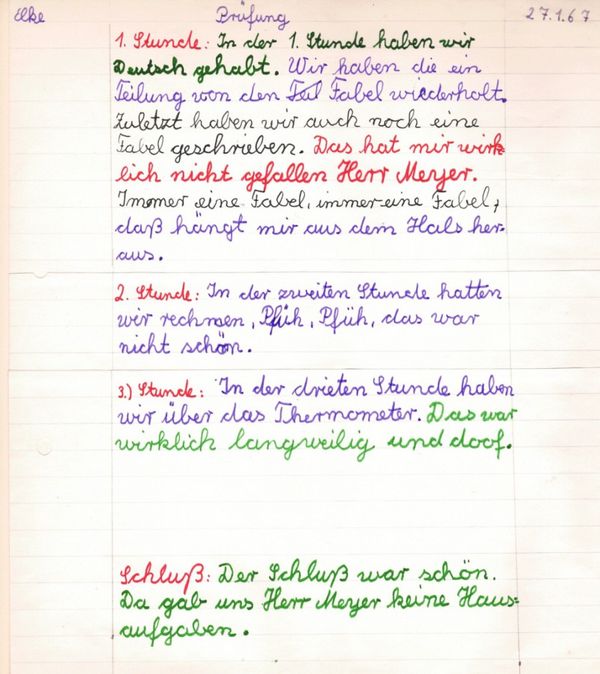
The examination committee consisted of the Ammerland school inspector, Mr Helmerichs, my mentor, Mr Spellig, and Hans-Jochen Gamm, a university lecturer from Oldenburg whom I had requested and who had been admitted on an optional basis. I had to teach three lessons, followed by a subject-specific discussion. The first lesson was German, the second maths. The third lesson, on general studies, lasted twenty minutes longer than planned because the pupils simply couldn’t work out what was happening physically when the thermometer was placed in boiling water and the mercury rose. Hans-Jochen Gamm then made the pointed remark: “Mr Meyer has brought us to the boil, quite unexpectedly.” Nevertheless, I was awarded a “very good” for my overall performance.
Next page: The day after the exam (and the boozy evening exam celebration, which left no time for lesson preparation), my pupils had to write an essay about the exam day.
- A sample from the bright pupil Elke, a mainstay of the whole class, on the next page!
Civil service appointment: Just five days later, on 1 February 1967, I was appointed a civil servant in the Lower Saxony school service, only to be dismissed again just two months later, on 31 March 1967, because I wanted to begin my second degree in Berlin.[28]
The pupil Angret knew that I would be leaving the school once I had passed my exam, and wrote in her essay: “Unfortunately, Mr Meyer has passed the exam.”
Conclusion: The three years in Ocholt certainly had a significant influence on my university teaching as well. I learnt that lessons must be prepared thoroughly, that without a clear structure (feature 1 from my book *What is Good Teaching?*), one misses many opportunities for productive learning, that teaching can bring a great deal of personal satisfaction, and that initial problems can be overcome. That is why I recommend that all Master’s graduates who wish to pursue a PhD with a view to becoming a university lecturer on teaching degree programmes should first undertake a teaching placement.
4. PhD studies and work on the secondary school pilot scheme
4.1 Just in time – Studies at the Free University of Berlin (West)
From the summer semester of 1967 to the winter semester of 1968/69, I studied at the Free University of Berlin and began my doctoral studies, with Educational Science as my main subject and with minors in Philosophy and History.[29] I had been invited by Herwig Blankertz to pursue my doctoral studies. It was a time when that antiquated rule – that one was not permitted to ask for a supervisor oneself – had just been abandoned: ‘… beneath the academic gowns, the mustiness of a thousand years.’[30]
- my first book: a collection of essays
Herwig (at that time still known as Mr Blankertz) gave me a post as a research assistant at the Institute for Business Education, which he headed. There I got to know the research assistants Frank Achtenhagen and Adolf Kell. Four years later (1971), I co-authored my first book with Frank on a topic that was highly topical at the time; the title was ‘Curriculum Revision – Possibilities and Limits’.
Student protests: When I began my studies in West Berlin in the summer semester of 1967, the student protests that would soon sweep across the whole of West Germany began on the campus of the Free University of Berlin. I came from the countryside and watched the students’ activities with wide-eyed wonder – from Rudi and Gretchen Dutschke to Gaston Salvatore, Rainer Langhans and Fritz Teufel. I enjoyed hearing important figures speak in person at events in the Audimax of the Henry Ford Building in Dahlem: Theodor Adorno, Herbert Marcuse and many others. I remember that we students used to fawn over a pensioner. He was known as ‘Red Rudi’, attended the teach-ins regularly and had, at some point, shaken Lenin’s hand. It was here that I learnt the hard way that there can be a world of difference between one’s own experience and what is reported in the newspapers.
I tried to read and understand Marx and Hegel, Adorno, Herbert Marcuse and Habermas. It was all rather heavy going for me.
I enjoyed combining my studies with student activism, though it caused my parents great concern. I never missed a major demonstration. On 2 June 1968, I was there when a demonstration against the Shah of Persia was organised, during which Benno Ohnesorg was shot that evening. I, too, had been standing outside Schöneberg Town Hall (then the seat of the Governing Mayor) holding a placard with Persian script that I couldn’t read, and saw how the Persian secret service, SAVAK, beat some of us with long poles.
At all the events – for example, the self-organised teach-ins in the Henry Ford Building at the Free University of Berlin and at the major anti-Vietnam War congress in 1968 at the Technical University of Berlin – I listened attentively.[31] Whenever there were demonstrations in the city centre, I often took part, but first checked where the police water cannons had been deployed. I would then position myself on the opposite side, so that my escape route was secure.
4.2 University of Münster – Master of Arts
From the summer semester of 1969 until the winter semester of 1971/72, I studied at the University of Münster because Herwig Blankertz had accepted a post there and had brought Frank Achtenhagen, Adolf Kell and me with him from Berlin. I continued my doctoral studies there. My subjects remained the same: educational science, philosophy and history. I was once again offered a post as a research assistant in Münster and was able to make a good living from it.
By then, the Berlin student revolt had also reached Münster – but the revolt did not take place – as it had in Berlin – on the streets, but at the systemic level: the aim was to democratise the structures of the Institutes and faculties. And Herwig played a decisive role in this.
Master’s degree: In February 1970, I sat my Master’s examination in Münster. The subject of my Master’s thesis was the topic set by Herwig: ‘The didactic concept of the École Polytechnique in Paris during the French Revolution’.[32] I completed my Magister course and examination at breakneck speed because I was due to take up a post as a research assistant, for which my teacher training college (PH) qualification was not accepted as a prerequisite. That is why Herwig had the idea of squeezing the Magister in between.[33]
From 1 April 1970 to 30 April 1973, I was a research assistant in the Department of Educational Science at the University of Münster.
4.3 My supervisor, Herwig Blankertz
Herwig Blankertz (1927–1983) played a decisive role in my academic career. He challenged and encouraged me like no one else. To this day, he remains my role model when it comes to fulfilling the role of a university lecturer, even though I cannot – and do not wish to – measure up to him in any way in terms of theoretical output, his critical acumen and his influence on education policy. One of his strengths lay in his ability to inspire a very diverse group of colleagues to work on joint projects, to delegate important tasks, and then to bring everything together and represent the project to the outside world.[34]

At the end of 1944, Blankertz was conscripted as a seventeen-year-old soldier and was wounded (see below). After the war, he worked first as a construction worker, then as a textile worker and an engineer. After studying at the College for Vocational Teachers in Wilhelmshaven, he passed his state examination there in 1955 to qualify as a vocational teacher (specialising in textiles and leather). He continued his studies and undertook doctoral research under the guidance of the Göttingen humanities scholar Erich Weniger (1893–1961), which he completed in 1959 with a thesis on the pedagogy of Neo-Kantianism.[35] After a spell in Hamburg, he became Professor of Philosophy at the University of Education in Oldenburg in 1963, where I met him and his wife Gisela. In 1964, he moved to the professorship for Business Education at the Free University of Berlin and, again in 1969, to the professorship for Philosophy and Education at the Westphalian Wilhelms University of Münster.
At that time, Herwig Blankertz was the key figure at our Institute of Educational Science in Münster. He also played an increasingly important role in the education policy of the state of North Rhine-Westphalia. In 1978, as chairman of the German Society for Educational Science, he organised the Tübingen Congress on ‘The Practical Relevance of Educational Research Findings’ and delivered a speech that attracted considerable attention at the time, in which he analysed the causes of the failure of the Brandt–Scheel education reform of 1972.[36]
Outwardly, he appeared strong, but he was not a cheerful sort; rather, he was a fragile man. He suffered when he could no longer steer contradictory developments in schools and higher education. He felt committed to Willy Brandt’s call to ‘dare to be democratic’. As Dean of the University of Münster, he introduced one-third student representation on the School Council and a 2:1 student-to-staff ratio on teaching committees, and ensured that a student became Vice-Dean of the School.
Herwig Blankertz championed a resilient democracy – not without a personal background to this: As a young recruit in 1944, he had listened to Goebbels’ infamous speech in Berlin’s Hasenheide and joined in the chanting when Goebbels asked: “Do you want total war?” As a 16-year-old, as his wife Gisela told me, he became an anti-aircraft gun assistant. At the age of 17, he was conscripted at the end of 1944. Two and a half weeks before the end of the war, near Dessau, he tried to defend the ruins of a house against the advancing US tanks using a Panzerfaust. The attempt failed. Instead, he was run over by one of the tanks and was left lying there, seriously injured. He received makeshift treatment at an American field hospital near Dessau and was then discharged. He made his way on foot to his mother’s home in the Rhineland. His father, a high-ranking Nazi official, went missing in the final days of the war.
The experience of the Nazi dictatorship left a deep mark on him. When Lutz van Dick, a Dutch special needs teacher and poet working in Hamburg, asked him in 1981 to sign the appeal issued by the (co-)founded nuclear disarmament initiative ‘Educators Against the Madness of Armament’, Herwig wrote him a long letter explaining why he could not do so.[37] He sent me a copy and asked me to withdraw my signature[38], because democracy could not survive without defence – a position that was not very popular amongst us left-wing students at the time, but which is viewed differently today. His last major lecture was on ‘Kant’s Idea of Perpetual Peace’. In 1983, Herwig Blankertz died far too young as a result of a road traffic accident.[39]
4.4 Doctorate
On 8 February 1972, my thesis defence took place at the School of Philosophy at the University of Münster, with Educational Science as my main subject and, shortly before that, Philosophy and History as my minor subjects. The thesis was entitled: “The Problem of Deduction in Curriculum Research”.[40] The first supervisor of the thesis was Herwig Blankertz; the second supervisor was Willi Oelmüller, a philosopher from Münster. The thesis was awarded the grade ‘summa cum laude’. It was published, at Herwig’s suggestion, under the general title ‘An Introduction to Curriculum Methodology’ (Munich 1972).[41]
The dissertation continues to shape my stance on the theory-practice problem in educational science to this day. I was determined to solve the problem of deduction, but after two years’ work I realised that it is unsolvable.
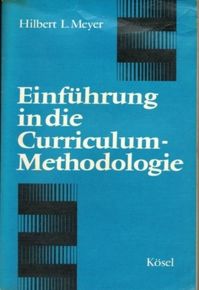
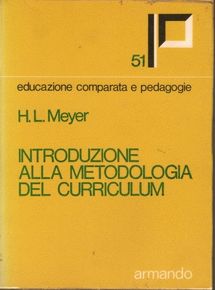 Since then, I have been aware that when working out the details of norms and principles, there is generally – and not just occasionally – greater scope for manoeuvre than many authors of normative concepts suggest. Every conceivable ‘derivation’ must be addressed communicatively, that is, using hermeneutic methods, and made plausible. This cannot be done without additional decisions relevant to teaching. That is why I remain sceptical to this day about didactic models that develop clever concepts at a theoretical level but fail to translate them into practical implementation. The concluding chapter of my doctoral thesis states that the unresolved
problem of deduction could also be utilised for a ‘partisan strategy’, which would then consist of the advocates of a new practice quite deliberately offering different (more conventional) normative justifications than the innovative content would suggest. This was taken up and sharply criticised by the CDU opposition in North Rhine-Westphalia at the time, and even carried over into a state parliamentary debate.
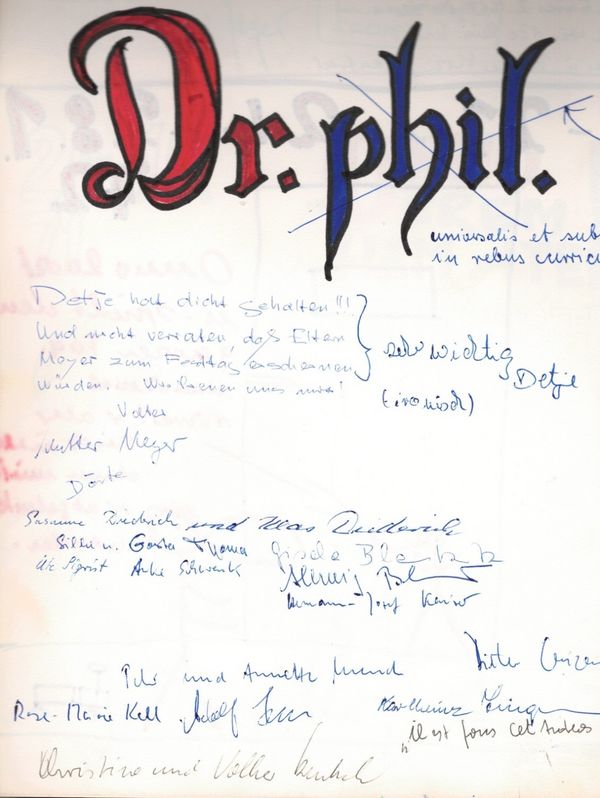
On the evening of the day of my thesis defence, 8 February 1972, we held a celebration at our flat. As the printed page from Meyer’s guest book shows, those who joined in the celebrations included my father and mother, my sisters Detje and Dörte, Herwig Blankertz and his wife Gisela, Gösta Thoma (later a headteacher in North Rhine-Westphalia), Hermann-Josef Kaiser (later at the University of Hamburg), Dieter Lenzen (University of Hamburg), Peter Menck (later at the University of Siegen) and Adolf Kell (also at the University of Siegen), Karl-Heinz Fingerle (later at the University of Kassel) and others.
4.5 Chaotic teaching arrangements
From the winter semester of 1969/70 onwards, I ran seminars at the Institute of Educational Science in Münster, covering topics such as curriculum theory, learning objective orientation and general didactics. The choice of topics was largely left to me. This meant I could select topics that I was already working on for my doctoral thesis anyway.
When Herwig Blankertz accepted his appointment in Münster, the University’s Institute of Educational Science was, to put it mildly, in a state of disarray. There were 11,000 teacher-training students aiming to teach at grammar schools[42], far too few staff, hopelessly overcrowded seminars, a course programme that did not comply with the current examination regulations, and an examination system in which any random topics could be tested. One of the first decisions Herwig Blankertz pushed through after his election as Dean was that, with immediate effect, only the grades ‘pass/fail’ would be awarded, because, given the overcrowding in the seminars, it was simply impossible to grade students on a differentiated basis. Furthermore, the principle applied: ‘Whoever teaches, sets the exams!’ As a result, as a research assistant, I became a member of the State Examination Board and sat 35 to 40 examinations each semester.
Teaching Committee: Together with Ulf Mühlhausen, then a student (later a school education lecturer at the University of Hanover), I chaired the Teaching Committee, which was composed of equal numbers of lecturers and students. We had to manage the staff shortage and organise a course programme as best we could, enabling the 11,000 students to obtain their two ‘certificates’, which would grant them admission to the secondary school teaching qualification examination – a ridiculously low entry requirement, given the demands placed on the teaching profession, which had already grown considerably even back then.
4.6 The Kollegschule pilot scheme in North Rhine-Westphalia
From April 1972 to April 1973, I was seconded to the ‘Wissenschaftliche Begleitung Kollegschule’ (Scientific Support for the Kolleg School ), headed by Herwig Blankertz and based in Münster. From 1 May 1973 to 31 January 1975, I then held the same position as a research assistant to the Minister of Education and Cultural Affairs of North Rhine-Westphalia.[43]
The aim of the pilot scheme was to merge the state’s upper secondary grammar schools with vocational schools to create an entirely new form of upper secondary school. My areas of responsibility included supervising several curriculum development teams, overseeing a school site (in my case: the town of Ahaus) and developing a practice-oriented evaluation concept. We were an active, young team (Adolf Kell, Günter Kutscha, Dieter Lenzen, Karl-Heinz Fingerle, Barbara Schenk, Andreas Gruschka and others) and, under Blankertz’s guidance, learnt that implementing a new type of school is far more difficult and demanding than devising the concept for it.
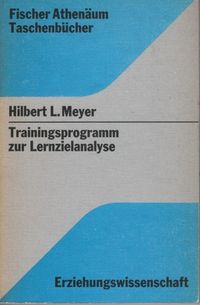
It was also here that my first book to be published in a large print run came into being: the “Training Programme for Learning Objective Analysis” (1974), a by-product of our support for the curriculum committees of the Kollegschule pilot scheme, all of which were tasked with producing learning-objective-oriented curricula and required a practical introduction. – In my view, this is a youthful indiscretion (see the explanations in section 8.2).
5th marriage - four children - golden wedding anniversary
The private sphere is public. - That was a principle of the 1968 generation, which I don't consider to be entirely correct, but in some respects. That's why, in the middle of this autobiographical report, I'll explain why you can't work full steam ahead for decades as a university lecturer if your family circumstances aren't right.
Christa Konukiewitz, a pastor's daughter from Delmenhorst, and I met in April 1962 in the first week of term at the Oldenburg University of Teacher Education because we happened to be in the same work placement group (see above). After a cautious process of getting to know each other, we were married on 27 December 1969 in Delmenhorst by my father-in-law Fritz Konukiewitz, pastor at the town church. I have never regretted it! Christa was and is the greatest stroke of luck in my life. And she patiently kept my back free and thus made a significant contribution to me being able to invest a lot of time in my professional work.
Unlike me, Christa had a decent salary at the time of our wedding and she owned a Citroen "duck". In October 1970, we moved to Roxeler Straße 13 (now Sebastianstraße) in Nienberge with our newborn first son Onno in the back seat - the first flat of our own just outside the city of Münster!
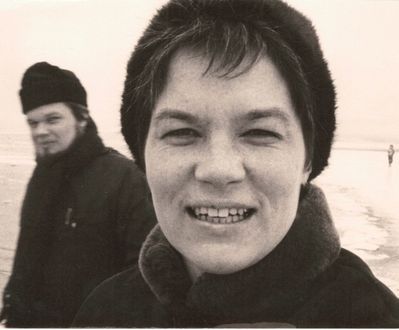

Photos: New Year's Eve 1972 on Langeoog
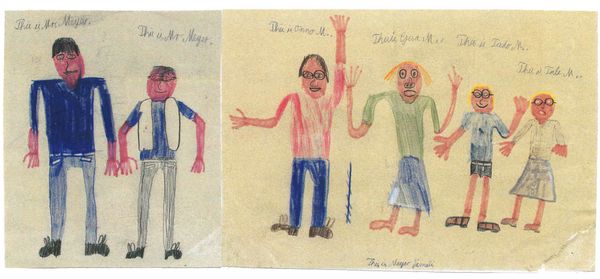
Four children: We have four children, none of whom have become teachers. My wife's ancestors come from East Frisia. So we thought that, in view of the boring surname Meyer, the children could have somewhat rarer first names. Hence the East Frisian names Onno, Gesa, Tiedo and Tale. When the eldest, Onno, was in the 5th grade in Oldenburg, he had to draw the family in English class: "This is Meyer fämeli":
Buying a house: in 1979, when it was clear that we wanted to stay in Oldenburg, we bought a semi-detached house in the Haarenesch neighbourhood. We paid off the loans for 38 years, but have never regretted the purchase. In the meantime, our son Tiedo and his family have moved into the upper flat. So we are a multi-generational house (including grandchildren, cat and sheepdog).
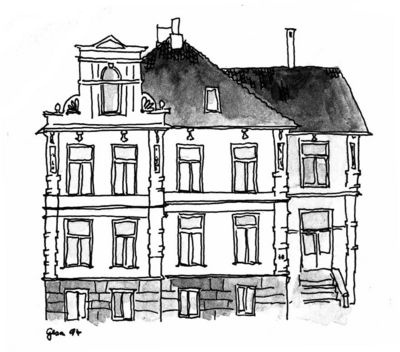
The drawing (1994) is by daughter Gesa
After the family phase, my wife wanted to return to teaching in 1985, but this was not possible because there was extreme teacher unemployment at the time. For 18 years, she therefore worked as an organist and choirmaster in the Bloherfelde/Oldenburg parish. She was involved in the ecumenical peace movement and founded the Oldenburg Ecumenical Centre, of which she was Chair for many years. She was a councillor for the SPD in the Oldenburg city parliament for 10 years. And she has a speciality: she bakes very tasty pizzas with the character of a mound. That's why we've invited an entire seminar to our house for pizza every semester for 30 years. I did the maths at the retirement party in 2009: It was a total of 2200 portions!
Denmark: Every year, we went to the village of Klitmöller in Jutland/Denmark with all our children, my parents-in-law, my twin brother's family, my mother, my sister Dörte and Waltraud and Friedhelm Zubke, who had already become our friends during our PH studies, and spent 4 weeks on holiday there - action-oriented, i.e. with big scavenger hunts.This included big scavenger hunts, Punch and Judy shows (in a children's hut hammered together out of flotsam and jetsam), mushroom picking, lots of swimming and long walks on the beach. Just lying on the beach and dozing off was not our thing. We always came with several families and often rented four or five holiday homes at the same time. We regularly met our Bielefeld colleague Theodor Schulze and his wife Dorothee there. This year (2022) will be the 46th time we have travelled to this village, now with our daughter, our son-in-law, daughter-in-law and two grandchildren, our second son, his partner and two grandchildren, and then my younger sister, my sister-in-law and my godchild. Together we have spent three and a half years of our lives in Klitmöller, and unfortunately we still don't speak Danish.

Meinert Meyer: "View of Denmark's blossom"
Brother Meinert always took oil paint and brushes with him and painted a lot. He once painted a paraphrase of Karl Friedrich Schinkel's famous painting "Blick in Griechenlands Blüthe" (1825), which hangs on our wall in Oldenburg: Schinkel's Greek temple in front, but with a Danish post box, an old brick church from Klitmöller's neighbouring village of Nors (near Klitmöller) on the left and our bathing lake Nors-Sö, also just "around the corner".
Building ship models: I developed a hobby in Klitmöller: I collected scraps of wood from the beach, which were still being thrown overboard in huge numbers off the coast in the 70s and 80s, and used them to build ships for the children, and later also for the grandchildren. Of course, that only worked if I took my toolbox with me on holiday: a rescue cruiser for my daughter Gesa in 1978 and a harbour tug for my grandson Lüko in 2020 - in each case big enough to use the Playmobil figures for playing. The ships float because they are made of wood. But their centre of gravity is so high that they usually tip over very quickly.

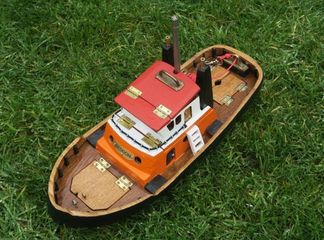
Golden wedding anniversary: On 27 December 2019, we celebrated our golden wedding anniversary in the "Krömerei" in Westerstede with 75 relatives and 15 friends in the "closest family circle".

Now we are getting old together, as the photo from 2020 (taken in our garden in Kastanienallee in Oldenburg) shows, and the first age-related ailments are making themselves felt.
6. University lecturer at Carl von Ossietzky University
6.1 A professorship in Oldenburg – what more could you want!?
The very first professorship I applied for was the one I got straight away. [44] It was a full[45] professorship in school pedagogy (at the time H4, then C4 and later W3) at the newly founded Carl von Ossietzky University, which was not yet allowed to be called that at the time, because the FDP had pushed through a clause in the coalition agreement with the SPD stipulating that the name of the Nobel Peace Prize laureate – who was not a communist but stood for a broad alliance with all left-wing forces – was not to be chosen. It was Gerhard Schröder who, immediately after taking office as Minister-President of Lower Saxony in 1981, enacted a law allowing universities to choose their own names.
The Oldenburg University of Education, where I had studied, was integrated into the new university. And so it came to pass that I ended up in my father’s former post (see above, point 1.3) and that I found myself working alongside a number of colleagues, some of whom I had attended seminars with 11 years earlier, and two of whom had even examined me.[46] Unlike at the University of Bremen, where there had been fierce disputes for decades between the staff of the old teacher training college and the newly appointed staff of the university, the integration of the teacher training college in Oldenburg went surprisingly smoothly. We lecturers did not organise ourselves into two blocs – ‘old teacher training college’ and ‘new university’ – but rather along the lines of shared higher education policy factions, ranging from SPD and DGB representatives (among whom I counted myself) through the undogmatic Left (in particular supporters of the Frankfurt School of Sociology, with whom I worked extensively and happily over the following years) to Marxists aligned with Stamokap. There was no CDU-affiliated group of university lecturers at the University of Oldenburg in 1975, though there were reportedly two lecturers in the natural sciences who were CDU members. Initially once a week, and later much less frequently, we met in these groups at 8.00 pm to discuss the situation.
Appointments Committee: As I received, on the quiet, a Leitz ring binder containing all the confidential documents relating to my appointment process from a member of the Appointments Committee twenty years later, I am well placed to reconstruct how the selection decision was reached and what the balance of power within the committee was. The Chair was my lovely colleague Ilse Mayer-Kulenkampff (1916–2008), a social education worker[47]who did not wish to cause anyone any harm and therefore regarded the fierce disputes between the university lecturers’ factions as something of a nuisance. Other committee members included: the philosopher Rudolf Lengert, the psychologist August Schick and the sociologist Gerd Vonderach, as well as the commission’s secret puppet-master, Hans-Dietrich Raapke, holder of the professorship for General Pedagogy, who, like my doctoral supervisor, had obtained his doctorate under Erich Weniger. Representatives of the mid-level academic staff were Gustav Denzer (who, like me, came from Lauenburg in Pomerania) and Friedhelm Zubke (with whom I had completed my teacher training college studies). The student representatives were Gudrun Patel (a member of the MSB – Marxist Student Union Spartakus) and Hans-Joachim Schwebe.
‘Audition’: I still remember my application presentation in the summer semester of 1974 very clearly. I was very nervous. I had chosen my field of work at the time as my topic (the establishment of an integrated upper secondary school as a continuation of the comprehensive lower secondary school) and had developed a proposal on how a ‘Kollegschule’ could be set up in Oldenburg. In the discussion that followed, Gerd Vonderach – who wanted to see another candidate, namely Johannes Beck, in first place rather than me – asked: “You mentioned Niklas Luhmann in your presentation. Could you explain again what you meant by that?” My reply: “You’ve caught me out on my weakest point. I haven’t yet delved thoroughly into Luhmann’s systems theory!” Half a year later, Herbert Hasler (a former assistant to Erwin Schwartz and at that time a university lecturer in Oldenburg) came up to me and said: “I was at your lecture. At the point where Gerd put you on the spot, I said to myself: ‘He’s exactly the right person for us, if he can admit so openly that there’s something he doesn’t know.’”
ELAB Commitment: At the time, every applicant for university teaching posts in Oldenburg was asked whether they were prepared to participate in setting up the ELAB project-based teacher training programme (see below). Naturally, everyone answered this question with ‘Yes’, because otherwise they would have had no chance of securing a place on the shortlist. My former fellow student and then assistant to the rector, Meinard Tebben, had already informed me of this beforehand, so I was able to prepare thoroughly for this question.
Competitors: Those who had applied for the post were Christine Möller (later at the University of Siegen), Johannes Beck (later at the University of Bremen), Hans-Dieter Haller (a colleague of Karl-Heinz Flechsig at the University of Göttingen), Karl Frey (Kiel), Hans Glück (later at the University of Cologne) and Kurt-Ingo Flessau (later at TU Dortmund).
My ‘most formidable’ rival was my Swiss colleague Karl Frey (1917–2011). At that time, in 1974, he was already Director of the Institute of Educational Sciences in Kiel (IPN). With his habilitation (which I lacked) and a highly remunerated post in Kiel, he was, on paper, far superior to all the other applicants. Had he been on the shortlist, the then SPD Minister for Education, Jost Grolle (previously a history didactics lecturer at the Oldenburg University of Education), would probably have had to give him preference, even if Johannes Beck or I had been in first and second place and he had only been in third. However, the committee decided not to include him on the list at all, as they were convinced that he merely wanted to ‘cash in’ on his reputation in Oldenburg – that is, use it to secure a higher salary in Kiel during retention negotiations.[48]
Thus Johannes Beck (1938–2013), who shortly afterwards was appointed to a professorship at the University of Bremen, became the second young academic considered for first place. He belonged to the ‘non-dogmatic Left’ and was therefore further to the left than I was. The two students voted against me because I was too close to the conservative camp. The mid-level academic staff and the majority of university lecturers voted for me because they considered my profile suitable and trusted the assessment of Herwig Blankertz, which had been obtained both verbally and in writing. He then went on to write one of the two expert reports, a copy of which he slipped to me in confidence, adding the phrase: “… with mixed feelings”.
Shortlist of three: Hans-Dietrich Raapke originally favoured someone else for first place. When he saw that a majority in the committee was emerging in my favour, he changed his mind. Thus, a shortlist of three was drawn up: first place: Meyer; second place: Beck; third place: Glück.
Appointment offered and accepted: In the autumn of 1974, I received an unassuming letter from the Minister for Education and Cultural Affairs, Joist Grolle. It consisted of just two sentences: “I am offering you the H4 professorship in School Pedagogy at the University of Oldenburg. Please establish contact with my adviser, Mr Kronshage.” Naturally, I accepted the appointment, even though it was hard for me to say goodbye to the Research Support Unit for Teacher Training Colleges in Münster. But returning to my home town of Oldenburg held an irresistible appeal for my wife and me.
No reason to get carried away: The fact that I was offered the very first post I applied for was largely due to the fact that, in the 1970s, as part of the Brandt–Scheel higher education and educational reform, a good 30 new universities and higher education institutions were established in the Federal Republic of Germany in one fell swoop. Most of them – as in Oldenburg – had evolved from teacher training colleges (PHs). Almost all of these new universities offered teacher training degree programmes. Consequently, young researchers in the field of education who were eligible to apply in the early 1970s had very good prospects, even if they had not yet obtained their habilitation. By 1978, the situation had already become significantly more difficult, and from 1980 onwards, almost all posts becoming vacant in schools of educational science were abolished without replacement.
6.2 Taking up the post and chair endowment
On 1 February 1975, I took up my new post at Carl von Ossietzky University and held it until my retirement on 1 October 2009. Even after that, I continued to work on the basis of my retirement rights.
At first, I had nowhere to work at all. The large AVZ building on Uhlhornsweg was still under construction. Consequently, for the first 12 months I was given temporary accommodation in Faculty 2, specifically in the office shared by Meinhard Tebben (art education specialist and, at the time, assistant to the Vice-Chancellor) and Prince Rudolf zur Lippe (Professor of Aesthetics in the Subject of Visual Communication).
After a year, I then moved into my first office on the 5th floor of the AVZ (now A 4) – rather modest in size at 3 by 5 metres, but with a lovely view of the city. 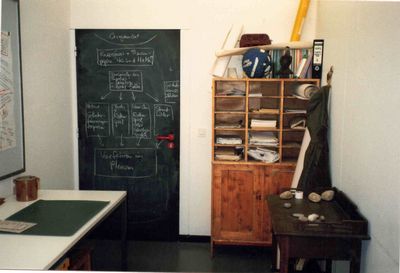 The administration had failed to order the furniture for the newly occupied building. As the photo shows, I made the room a little more homely with furniture I’d bought myself. The door, which could be used as a chalkboard for planning meetings, proved very helpful. When, during a chat in the corridor, I complained to my colleague Hans-Dietrich Raapke that I had no furniture, he remarked laconically: “That’s just how it is here. They’ll throw a chair at you, but you’ll have to wait for a proper chair!” It wasn’t until 1989 that I finally moved from the fifth floor to the first floor of the same building, into a significantly larger office (see section 6.4).
Myown assistants? Not a chance! I’ve never had my own assistant in my entire professional life. Back then, we wanted to establish grassroots democratic university structures, promote flat hierarchies and do away with the old dependencies of research assistants on professors. That wasn’t necessarily a disadvantage. It forced me to seek out collaborators on a voluntary basis. And for the most part, I succeeded in doing so.
Student assistants and research assistants – a real pleasure! There were no teaching assistants, but I was able to regularly employ student assistants and research assistants (see point 9). The assistants didn’t actually carry out assistant work in the traditional sense; rather, they were heavily involved in my teaching activities. This is illustrated by the photo of the lecture session with the assistant Manfred Schewe (point 6.4). Research assistant Eva Pilz, who remains a friend of mine to this day, told me years later: “You really did exploit us – but we learnt a great deal.”
A whole number of these teaching assistants went on to contribute to publications: for example, Karsten Friedrichs and Eva Pilz to the book *Unterrichtsmethoden* (Teaching Methods), Andreas Feindt in a collection of essays on action research, and Werner Jank – with whom I co-taught the lecture ‘Introduction to Didactics’ in 1991/92 – as a co-author of the book by Jank & Meyer, *Didactic Models* (see section 8).
Overwhelmed? I was 34 years old when I received the appointment. Even back then, that was still a young age – only my later president, Michael Daxner, had already been appointed to a professorship at the University of Osnabrück at the tender age of 28. I remember being a little daunted by my own courage and resolving to take up the professorship ‘on a trial basis’ for three years, before deciding whether or not I was up to the job in the long term. After three years, the decision was clear to me.
6.3 Pilot scheme for single-phase teacher training (ELAB)
From the very first semester following the university’s foundation (summer semester 1974), the Oldenburg pilot scheme for single-phase teacher training (ELAB), which attracted nationwide attention, was carried out.[49] By the time I arrived in Oldenburg, the planning was largely complete. However, from February 1975 until the summer semester of 1985, I was closely involved in putting the plans into practice. These first ten years of involvement in inclusive teacher training had a profound influence on my teaching style.
Contact teachers: An important element of the ELAB pilot scheme was the ‘contact teachers’ – teachers from the region who were given ten teaching hours’ leave to take part in the practical training of the Oldenburg students. They were always exceptionally committed individuals from the university’s catchment area, whose contribution to the success of the pilot scheme cannot be overestimated. Many of them went on to become headteachers and/or heads of department.
Participating teachers: Following the discontinuation of the pilot scheme, the successor model for participating teachers was introduced. They were now only granted a two-hour exemption from teaching duties. I worked closely with both groups. I remain friends with Liane Paradies and Johannes Greving to this day. Dorothea Vogt, for example, officially co-designed my lecture ‘Introduction to School Pedagogy’. This subsequently became books Nos. 15 and 16, published by the ZpB (see the ‘Publications: Books’ file on the homepage). A particularly large number of participating teachers – sometimes as many as twelve – took part as team members in the BLK pilot project on team research (see section 7.4). Without them, we would never have been able to carry out this wide-ranging practical research.
Lack of examination regulations: For the first three years, we did not even have examination regulations for the single-phase degree programme – the Ministry of Education and Cultural Affairs had simply not managed to draw them up any sooner. However, this was not a disadvantage, as we had considerable leeway and, in terms of subject areas and working methods, were effectively free to do as we pleased.
Termination: In 1976, following the change of government in Hanover from the SPD to the CDU, it was decided to terminate the Oldenburg pilot scheme, even though it was cost-neutral and had been positively evaluated in the final report commissioned by the Lower Saxony Ministry of Education and Cultural Affairs and authored by Kurt Ewert, Carl-Ludwig Furck and Werner Ohaus (1981). The pilot scheme did, however, continue for a number of years afterwards, as the students who had enrolled had a legal right to complete their studies.
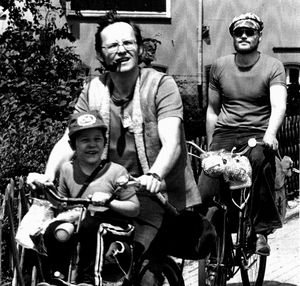 Bicycle protest: In 1976, when the new state government had decided on drastic cuts to the expansion plans for the University of Oldenburg that threatened its very existence, we organised a bicycle protest involving the entire university (1,000 students, 100 professors). We cycled across the flat countryside from village to village and from region to region all the way to Hanover, camped on campsites or on the grounds of shooting clubs, and then demonstrated outside the state parliament. The media coverage was enormous. The cycle demonstration is extensively documented in the university’s annals. So I’ll just mention in passing: as I had taken my six-year-old son Onno with me on my bike (see photo), I only cycled as far as Wildeshausen.
Conclusion: To this day, single-phase teacher training remains, in my view, a forward-looking model for 21st-century teacher training – by no means utopian, but one that can be realised with certain modifications. Unfortunately, the opportunity presented in 1990 – following the reunification of the (former) Federal Republic of Germany and the GDR – to extend the single-phase model practised in the GDR to the whole of Germany was not taken.
6.4 Project-based study
In the early years of the pilot scheme, project-based study was at the heart of the entire teacher training programme. To this end, large project groups were formed, comprising up to 120 students, up to 15 lecturers and 15 contact teachers.
SPASC: My first project, which ran for over two years with 12 lecturers and 120 students, was entitled ‘SPASC – Pupil-oriented project work as school-based curriculum development’. It was there that I met my colleague Ingo Scheller, amongst others. I learnt a great deal from his concept of dramatic play and adopted several working methods, which were subsequently included in the book *Teaching Methods* (1987). In the SPASC project, I quickly became responsible for lesson preparation and evaluation. A precursor to the book *Leitfaden zur Unterrichtsvorbereitung* (*Guide to Lesson Preparation*), co-authored with Ingo Scheller and entitled *Rezeptbuch für die schriftliche Unterrichtsvorbereitung* (*Recipe Book for Written Lesson Preparation*), was produced as part of this project.
BASEK ( Basic Skills for Secondary Education): Rüdiger Semmerling and I set up a second, significantly smaller project in 1980/81 with other lecturers and just under 40 students. We analysed school structures, but also travelled twice to universities in the Netherlands: once to Groningen to the Rijksuniversiteit to visit John Peters, and then to Amsterdam to the Vrije Universiteit to visit Jacques Carpay.
September 1980: BASEK students held an information session at the ATEE (Association for Teacher Education in Europe) conference in Oldenburg, where they outlined the core elements of the ELAB programme and lamented its discontinuation:
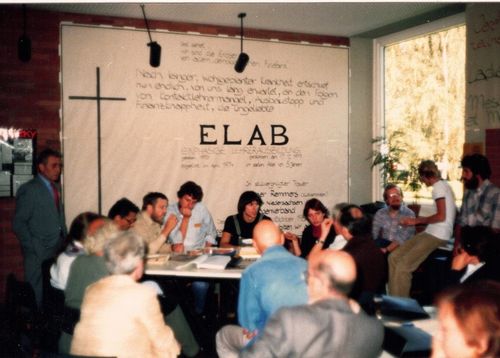
Practical teaching half-year for single-phase students: In the third stage of their studies, which roughly corresponded to the teaching placement, the single-phase students completed their practical teaching half-year at one of the schools participating in the pilot scheme. This culminated in the practical examination. All lecturers were involved in supervising students during this phase.
Exam preparation: The thorough training in general and subject-specific teaching methodology received by the single-phase students was vital to the survival of the ELABpilot scheme, as students often encountered hostile heads of secondary education departments during their practical teaching examinations; these officials regarded the single-phase training programme as a Marxist-inspired misconstruction and generally marked the students very harshly. They were concerned that the high proportion of educational and social science content in the curriculum might jeopardise a thorough specialised education. Furthermore, they considered it inappropriate that, in Oldenburg, large sections of the teaching staff were on first-name terms with the students. They feared a culture of cronyism.[50]
Alumni study? Unfortunately, there is still no reputable alumni study on ELAB students to this day. Thanks to the many contacts I still maintain with these former students, I am certain that those who secured permanent teaching posts despite high unemployment among teachers in the 1980s have performed their duties very well – contrary to the fears of a whole host of department heads. Hundreds of them went on to become headteachers years later, whilst others found success in the private sector.
6.5 Areas of focus in my academic work and teaching
Over the course of 47 years of university teaching, I have specialised in five subject areas and represented them in both research and teaching:
- General didactics (since 1975)
- Teaching methodology (since 1981)
- School pedagogy (since 1988)
- Action research (since 1994)
- School and teaching development (since 2000).
These areas of focus are also reflected in my published books.
Interpreter – not an empiricist: I am not an empirical teaching researcher, but rather a didactician trained in the tradition of educational theory. I have not conducted any empirical research of my own whatsoever, apart from the team-based research (point 7.4), which is yet to be outlined. A significant part of my academic work has consisted, and continues to consist, of acting as an interpreter of key research findings and of writing textbooks for students, trainee teachers and practising teachers, in which standard tasks of the teaching profession and issues relating to school development are described. I stand by the importance of this interpretative work. Whilst it does little to advance theoretical developments in educational science, it does make the material more accessible to those who matter most: the practitioners in schools.
Lectures: From the very beginning, as is expected of a professor, I have given lectures – and have always done so with great pleasure.[51] When we still had morning lectures from 9 am to 11 am and 11 am to 1 pm, I would read aloud from 8 am to 9 am. This did not hinder student attendance in any way. Later, the sessions became two-hour sessions, often with practical elements – as in the photograph, in which Manfred Schewe, my research assistant at the time (now at the University of Cork, Ireland), was leading a hands-on activity in the lecture on Johann Heinrich Pestalozzi in the university’s main lecture theatre:
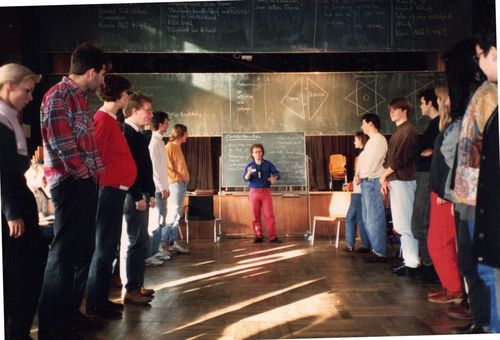
Lecture, Winter Semester 1992/93: ‘Pestalozzi’ with Manfred Schewe
Lecture notes: For every lecture session, right up until my retirement, I wrote a set of lecture notes 10 to 20 pages long, had them printed at the university’s print centre, stapled them together at home with my wife’s help, and then distributed them to the students at the start of each session. When, in 1980, a more detailed check was carried out for the first time to see who was distributing how many print jobs, I stood alone at the top of the list for the whole university. There were two advantages to this way of working: the students did not need to buy expensive textbooks, and I was able to compile the thick collection of lecture notes that accumulated each semester into a textbook, which was then printed by the Centre for Pedagogical Professional Practice. This is how the ‘Guide’, the ‘Teaching Methods’ and the ‘Didactic Models’ came into being (see Section 8).
Courses taught: Here are a few extracts (from the course catalogues from 1975 to 2006) regarding the courses I taught, which at that time were still published as printed books every semester. My compulsory teaching load consisted of 8 hours per week over the semester. It often amounted to 10 hours, but never more than 11!
Summer semester 1975:
- Lecture: Introduction to Curriculum Research
- SPASC project plenary session (= Pupil-oriented project-based teaching as school-based curriculum development)
- Project-based course (for SPASC members only): Preparation for project-based teaching
- Seminar: Teaching approaches for public holidays and day-to-day lesson preparation[52]
Additionally from 1977:
- Supervision of first-year students ‘on site’ at their schools, where they complete their half-year of teaching practice and sit their examinations.
Winter semester 1989/90:
- Lecture: Introduction to General Pedagogy
- Seminar: Preparation for the General Teaching Placement
- Seminar: Supervision and evaluation of the general school placement in Leipzig[53]
- Seminar: Body language in the classroom
Summer semester 1994:
- Lecture: Teaching Methods
- Seminar: Preparation for the General Teaching Placement
- Seminar: Supervision and evaluation of the general teaching placement
- Intensive seminar: Future Workshop on Teacher Training
- PhD colloquium
Summer Semester 2000:
- Seminar: Preparation for the General Teaching Placement
- Seminar: Supervision and evaluation of the general school placement
- Seminar: Introduction to Team Research
- Seminar: Bilingualism and action-oriented approaches in foreign language teaching (jointly with Heike Rautenhaus, Department 11)
- PhD colloquium
Winter semester 2003/2004:
- Lecture for Module 1.01.02 of the Master’s degree programme: Introduction to School Pedagogy (in collaboration with Hanna Kiper, Wilhelm Topsch and tutors)
- Seminar: Practical exercises in teaching methodology
- Seminar on team research
- Preparation for the general school placement
- PhD colloquium
Winter semester 2005/2006:
- Lecture with seminars: Characteristics of good teaching (with participating teachers)
- Seminar on team research
- Preparation for the general school placement
- Seminar: Teaching and learning in lower secondary education
- Seminar: Preparation for the oral pedagogy examination
- PhD colloquium
Practical seminar work! I have always found great satisfaction in preparing seminars together with the students. There were virtually never any ‘standard’ presentations in my seminars. I would assign the seminar topics to teams of between three and five students and arrange one or two preliminary meetings with them. The students then had to plan the seminar session with me, chair it themselves, provide the theoretical input and organise the regular small-group work.
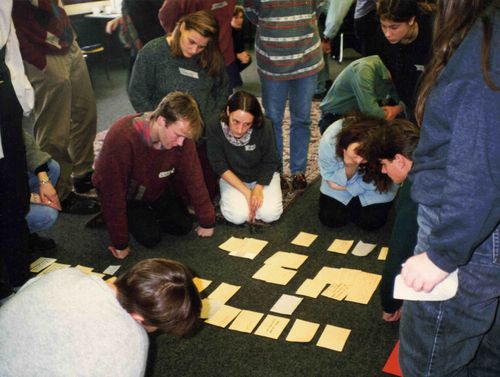
June 1993: Intensive seminar on action-oriented teaching
A feedback session took place immediately after the seminar session. The student team then received a collectively marked course certificate for all their individual contributions taken together. Andreas Feindt (now at the University of Münster), with whom I still collaborate extensively, told me 15 years ago: “Hilbert: I didn’t find your lectures all that exciting! What really stuck with me were the joint planning sessions!”
New study: In my new, much more comfortable lecturer’s office on the first floor of Building A 4, which I moved into in 1989, there was a large table for the planning meetings, as shown in the photo below, and to the left an old chalkboard which the caretakers had organised for me and screwed to the wall.[54]
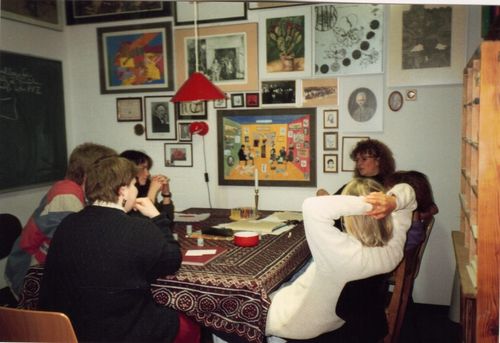
my lecturers’ room from 1989 to 2009
Off to Berlin to join Humboldt University? In 1991, on the initiative of my colleague Dietrich Benner, I was asked to apply for the professorship in School Pedagogy at Humboldt University in Berlin. The head of the relevant department under the Senator for Science indicated that I had a good chance of success. I hesitated briefly as to whether I should accept this interesting offer, but in the end I decided to stay in Oldenburg. In Berlin, I would presumably have ended up in charge of practical school studies again sooner or later, and would then have had to invest a great deal of energy in organising the Institute, which, following reunification, was to undergo radical staff cuts and a restructuring of its working methods. I told myself that, given my area of expertise, it would be wiser to stay in Oldenburg, to teach and write books. The deciding factor, however, was my wife Christa, who declared: “You’re welcome to go to Berlin – but I and the children are staying here!” That settled the matter, even though I still wonder to this day whether it was a somewhat selfish decision.
Workload: I enjoyed working hard right up until my retirement. And even since then, that hasn’t fundamentally changed. To this day (2022), I simply carry on as if I hadn’t retired yet. But I do enjoy the freedom to decide for myself what I do and where I turn down any of the requests that are still trickling in (lectures, visiting professorships, doctoral supervision). Until my retirement, ‘a lot’ meant that I worked right through the week until Sunday evening and started afresh early on Monday mornings. However, from 1990 onwards , once the children had left home, I took a midday nap practically every day – 30 minutes, never longer.
Workaholic? Some of my acquaintances claim I’m a workaholic. I disagree, because I don’t feel addicted, because my work benefits others, and because I don’t hide my ‘illness’. As Karl Marx has already analysed, self-determined work serves the purpose of self-realisation. And Theodor Adorno once remarked somewhere that professors do not need holidays because they can organise their work autonomously.[55] I tend to agree with that. Work can be very satisfying. There is also plenty of scope for manoeuvre in the profession of university lecturer, but if one abuses it, this very quickly leads to social isolation within the School.
6.6 Supervision of work placements
From the very start of my teaching career, that is, from 1975 to 2009, I offered a preparatory seminar for internships every semester, initially for the practical phases of the ELAB, then for the first General School Placement (ASP) under the old teacher training regulations, and subsequently within the Bachelor’s degree programme. This involved supervising the students during the semester breaks and then holding a joint evaluation seminar afterwards. Initially, four hours of my teaching load were set aside for this; following the switch to the BA/MA degree system, this was reduced to just two hours per week – in my view, a mistake and a major source of frustration. It is hardly surprising, then, that – purely due to time constraints – on-site supervision and the evaluation of the internships are carried out in a slapdash manner.
- Practical Teaching Half-Year at the ELAB: From 1975 to 1985, supervision as part of the ELAB pilot scheme primarily involved supporting the so-called ‘Practical Teaching Half-Year’, which culminated in the combined First and Second Examinations. There, we lecturers had roles similar to those held today by subject leaders at teacher training colleges. We travelled far and wide, as the students’ locations ranged from Emden and Leer via Oldenburg and Nordenham to Delmenhorst, and from Verden to Cuxhaven. I would then set off in the morning, often at 6 am, to arrive at the schools in time for lessons to begin. These numerous classroom visits had a significant influence on my ‘Guide to Lesson Preparation’ (see below, section 8), which was drawn up at that time.
- General school placement in the two-phase teacher training programme and in the BA/MA degree programmes: From 1973 onwards – in parallel with the phasing out of the ELAB pilot scheme – the ‘normal’ degree programme, culminating in the state First Teacher Qualification Examination, was reintroduced. I was responsible within our department for organising the General School Placement (ASP) included in this programme, and I always enjoyed doing so. However, there was a chronic shortage of teaching hours, which only came to an end with the introduction of the Bachelor’s-Master’s degree programme, because from that point onwards, capacity at our university was calculated down to the last detail for the first time, so that, even whilst the semester was still in progress, additional staff were recruited at our Institute when enrolment figures were too high – albeit in exploitatively low-paid posts.[56]
A highlight – the teaching placement in Leipzig: During the summer term holidays in 1991, with the active support of Edgar Rausch from the Leipzig University of Education (see below, point 7.6), we moved our general teaching placement to Leipzig to study the working conditions of teachers during this period of radical upheaval and, at the same time, to take our first steps in teaching. It was a profound experience for everyone. We were accommodated on a vacant floor of a hall of residence in Leipzig-Grünau. And Detlef Spindler from the ZpB (see section 7.1) covered the travel expenses.
6.7 Dean's Office
Out of a sense of duty, and not because I was particularly keen to do so, I stood as a candidate for the office of Dean; I was subsequently elected and held the post for two years initially (from 1989 to 1991) and then, due to the illness of my successor, Erich Westphal, for a further semester in 1993.
The university’s press office took a photograph (left) of every newly appointed dean for the UNI-INFO. The heart and soul of the faculty office was Ingrid Wiese, who was a pleasure to work with


(centre of the photo). She was joined by the equally friendly and competent Edith Suhrkamp (right). The two of them repeatedly steered us deans through difficult times.
Co-operation with the GDR: The reunification of the GDR and the FRG took place right in the middle of my term as dean. I still remember clearly how, in the autumn of 1989, Professor Regine Pauls from the Mendelssohn-Bartholdy University of Music in Leipzig suddenly turned up at the door unannounced and said: “I am Regine Pauls. I come from revolutionary Leipzig. I would like to establish contact with you!” And that is exactly what she did. More on this in section 7.6.
Demonstrations against the Iraq War ( Second Gulf War): In Oldenburg, too, there had been fierce demonstrations against the US war in Iraq in January 1991. On 19 January, students in Oldenburg occupied the Pferdemarkt and brought all traffic to a standstill for half a day. The police had their hands full, but things remained peaceful. I then invited the then Chief of Police, Police Director Achim Borne, to the university to our department to discuss the police operation and the right to demonstrate at a panel discussion organised by me in collaboration with the AStA. This was reported in detail in the NORDWEST-Zeitung on 25 January 1991.
University rankings – first place for our department: A highlight of my time as Dean came at the end of 1989, when the Centre for Higher Education Development (then based in Hanover) carried out the first nationwide ranking of the teaching and research quality of (West German) Schools of Educational Science. To the surprise of many other universities, my department found itself in top spot, ahead of Bielefeld, Tübingen and the Free University of Berlin. The media response was huge. A Chinese visitor and two Japanese visitors dropped by to inspect our department. We were rather proud of this, even though it later emerged that the data on which this first ranking was based was still very limited. But in subsequent rankings, we still featured among the top performers!
6.8 Supervision of doctoral theses by doctoral supervisors
Since 1975, I have supervised PhD students in Oldenburg and written reports for PhD and habilitation applications. A list can be found on this website. The reason for compiling this list was a question from the Chinese doctoral candidate Lin Ling: ‘How many PhD theses have you supervised?’ – I didn’t know, but then I set to work.
From 1977 to 2022, I supervised a total of 45 PhD theses and acted as the primary examiner. In addition, there were 32 second-review assessments and 26 habilitation reports. That’s quite a lot! But Wolfgang Klafki from Marburg, who sets the benchmark for us all, had twice as many first-review assessments. At the other end of the scale is Hartmut von Hentig. He paid hardly any attention to his doctoral candidates and ultimately supervised only four or five people to their PhDs. After every thesis defence (lasting up to two hours, with five professors), a group photo was taken. Below is the photo from Andreas Feindt’s thesis defence (now at the University of Münster).

2006: Conclusion of Andreas Feindt’s thesis defence[57]
I am currently running the doctoral colloquium together with Barbara Moschner and my second chair, Till-Sebastian Idel.[58] It’s still great fun, even though there was one dramatic incident.[59]
On the next page is a scan from Meyer’s guest book. We celebrated Ye Xuping’s PhD graduation on 13 February 2017 at Kastanienallee 40. Like many Chinese women, Xuping is a little superstitious. That’s why she was worried about the date being Friday the 13th. But it all went very well.
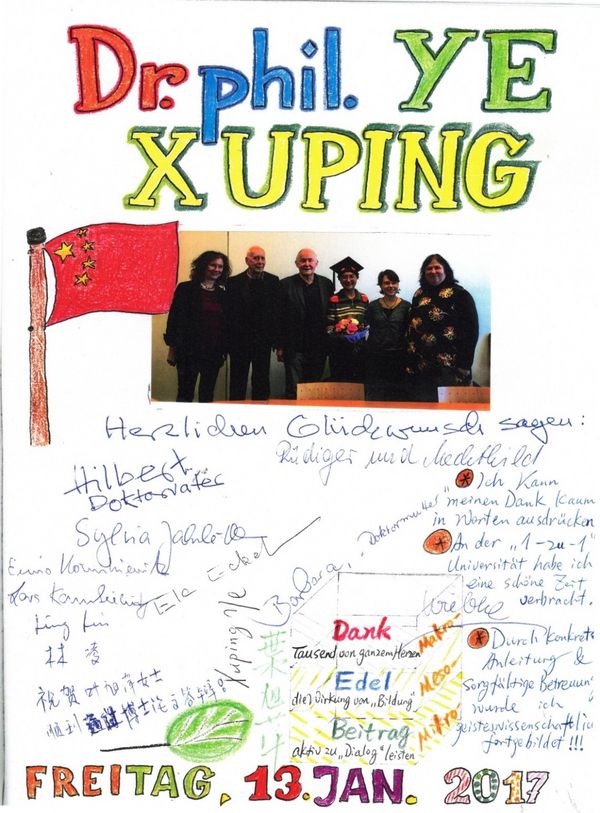
From left to right: Sylvia Jahnke-Klein (examiner of choice), Wolfgang Fichten (examiner of the related subject), HM (first examiner),
Ye Xuping, Ulrike Krause (Chair), Barbara Moschner; second examiner
Professorships held by ‘my’ doctoral candidates: A whole host of doctoral candidates (first and second assessors) have since been appointed to a chair or promoted to associate professor, Professor, e.g. Falk Rieß, Ingo Scheller, Irmhild Wragge-Lange, Klaus Klattenhoff, Wolfgang Fichten (all at the University of Oldenburg), Rainer Bromme[60] at the University of Münster, Werner Fölling at the University of Dresden, Christian Wopp in Osnabrück, Ulf Gebken in Essen, Simone Seitz in Bremen, Frank Hellmich in Paderborn. Many of my former doctoral candidates from Oldenburg also hold chairs abroad: Haimo Fensterseifer (University of Santa Maria, Brazil), Manfred Schewe (University of Cork, Ireland), Manfred Pfiffner (University of Teacher Education, Zurich), Catherine Walter-Laager (University of Graz: she is now Vice-Rector there), Ye Xuping (Hefei University in Anhui Province, PR China).
6.9 Doctoral Travel Programme
For sixteen years, I collaborated with Volker Wendt, one of my former doctoral candidates, who was responsible for the organisational running of the PhD colloquium – which he ran jointly with Barbara Moschner  – and who also coached a number of doctoral candidates.[61] He had the idea of visiting some of the doctoral candidates abroad. As a result, we both undertook lecture and training trips (at our own expense) to Japan, Bolivia, China and Greenland.
Japan: In 1999, we visited Nobuyuki Harada in Japan, who was planning to do his PhD in Germany (Hildesheim or Oldenburg). At the time, he was a lecturer in educational science at Kumamoto University. He subsequently moved to Gifu University and is now a professor at Nagoya Municipal University. We observed some classes and I gave a lecture.

Kumamoto (Japan) 1999
Bolivia: In February/March 2001, Volker Wendt and I were in Bolivia – first at the German School in Santa Cruz, then at the German School in La Paz, at the Goethe-Institut in La Paz and with our doctoral candidate Barbara Heiß, who was working on the topic of ‘Teacher training in inclusive education in Bolivia’. Together with her, we visited the Mariscal Braun primary school in El Alto (above La Paz at an altitude of 4,100 metres), which is supported by UNESCO (photo).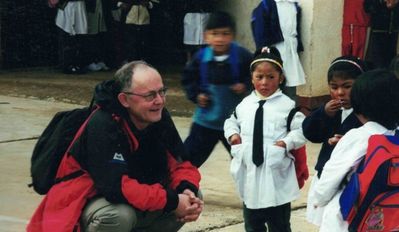
China: In March/April 2006, Volker and I were invited to China for the first time to give lectures and deliver training courses, namely at East China Normal University in Shanghai (to meet Xu Binjan), to the Department of German Studies at Nanjing University (to Ni Jenfu) and to the School of Education at Anhui Normal University in Wuhu (Anhui Province). In Shanghai, Volker and I visited Huang Xueyuan, a doctoral candidate in German Studies based in Oldenburg. In Wuhu, we gave lectures at the university and discussed the dissertation project of Ye Xuping, who is completing her PhD under my supervision.
I have now been to China eight times to visit universities and schools. Observing lessons at Chinese schools has always been both highly interesting and unsettling for me: as their top rankings in the PISA studies since 2009 demonstrate, the Chinese manage, through a strongly teacher-centred approach to teaching, but also through a strong willingness to learn – indeed, an enthusiasm for learning – to achieve high levels of cognitive learning success in competence-based tests, something we in Germany are still a long way from. However, simply imitating this approach is out of the question for me. The question remains as to whether, and if so how, we could do things better here than we have done so far.
The photograph on page 62 dates from 2016. It shows the speakers at the 12th Curriculum Conference at East China Normal University in Shanghai: front row, second from the left: Manfred Pfiffner; third: Catherine Walter-Laager; fourth: HM; third from the right: Andrew Porter (USA).
You can find out more about the ‘travel team’ on my HOMEPAGE in the file ‘School and classroom visits across five continents’!
6.10 Examination activities
I have been involved in marking to a considerable extent throughout my entire professional life. My marking began whilst I was a research assistant at the University of Münster (see section 4.5). I found it difficult to award a ‘four’, whilst I took great pleasure in awarding a ‘one’ and would often reflect on the profound sense of fulfilment my first ‘one’ had brought at the end of my teacher training programme. I have roughly calculated the total number of examinations I have set:
(1) Eight semesters of oral examinations at the University of Münster: approximately 30 examinations per semester = 240 examinations
(2) Theses supervised in Münster: a total of around 20
(3) Practical teaching examinations at the ELAB over 12 semesters (from 1979 to 1985): approximately 60 examinations
(4) EG examinations: integrated oral examinations in educational science and social sciences (from 1979 to 1985): approximately 200 examinations
(5) Conventional oral examinations in pedagogy within the two-phase degree programme from 1982 to 2009 (27 semesters): approximately 25 cases per semester = 675 examinations
(6) Theses for teacher training programmes from 1982 to 2000: approximately 5 per semester = 90 theses
(7) Master’s theses at the University of Oldenburg from 1997 to 2009: approximately 5 per semester = 60 theses
(8) Master’s theses in the School Management degree programme at the University of Kiel from 2007 to 2017: 5 per semester = 55 theses.
In total, there were round about 1,400 examination cases. One consequence of this scale of examination work was that, from the 1990s onwards, in practically every school I visited in north-west Germany for work placement supervision or professional development, I came across several – sometimes as many as a dozen – teachers who had sat an examination with me.
6.11 University Representative for Examination Matters
From 1990 to 2009, with a brief interruption, I served as the university’s representative for the Oldenburg branch of the Lower Saxony State Examination Office.
- Even before my appointment, I had worked closely and with great pleasure with Hans Krull , formerly a school inspector in Delmenhorst – a schoolmate of Walter Kempowski from Rostock and a courageous man who would intervene resolutely, particularly when grammar school heads of department had awarded unfair grades in the single-phase teacher training programme, or who would make extensive use of his right to appoint examination committees well in advance.[62]
- Hans Krull was succeeded by Mr Rikowski – my relationship with him was somewhat more distant.
- Until the State Examinations Office closed in 2009, I then worked alongside Konrad Barth, the former headteacher of Edewecht Grammar School. That, in turn, was a very constructive collaboration.
My role was to act as an ‘ombudsman’ for the students, to mediate in conflicts and to deal with overarching issues in collaboration with the head of the branch office and the president of the Examinations Office in Hanover.
Every term, I held information sessions for all teacher-training students in the ever-packed lecture theatre. The topic: ‘How do I prepare for the oral pedagogy examination?’ – There was always a simulation of a pedagogy examination with ‘real examiners’ and a ‘real candidate’; in this case, it was my student Ilka Parchmann (not in the photo), who is now a chemistry education specialist at the IPN in Kiel:
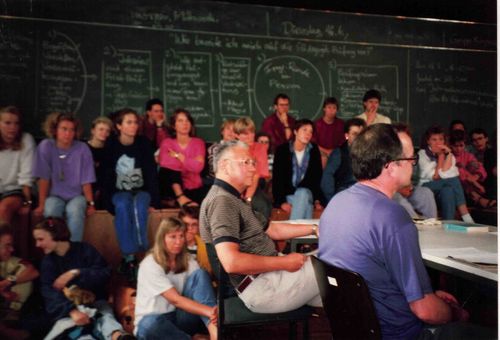
1992: Information session in the packed lecture theatre with a mock exam (Mr Rikowski in the centre, HM on the right)
I was allowed to sit in on all the teacher training examinations at the University of Oldenburg and did so repeatedly – particularly in the subjects of mathematics and natural sciences – at the start of my career. These were, at times, frustrating experiences, as by no means all my colleagues were truly attuned to their examination candidates.[63] However, I had excellent experiences in the subject examinations set by the mathematics education specialist Michael Neubrand. His examinations were competence-based. He wanted to know whether, and to what extent, a student was already able to put themselves in the shoes of a lower secondary school pupil, and devised clever reflective tasks for this purpose.
The role was – particularly since the invention of the internet and the ability to send emails – a labour-intensive affair. Every day I received enquiries about all manner of problems. From time to time, I would then speak to colleagues about their examination practices, which was not always received with enthusiasm. That’s why, in 2009, I wrote on the homepage of my website: “I’m delighted about every email that doesn’t reach me.” That’s all in the past now. And I’m delighted to receive enquiries, comments, criticism or whatever else you might have.
7. Co-operations
A professorship in school pedagogy offers a wide range of opportunities for co-operation with other university departments, with schools in the region and with organisations beyond the region. I have done this from the very beginning with great pleasure and to my personal benefit.
7.1 Centre for Pedagogical Professional Practice
Working with the Centre for Pedagogical Professional Practice and its director, Detlef Spindler, has always been particularly important and rewarding for me.  He possesses excellent social and communication skills and has consistently demonstrated an ability to bring together colleagues from a wide variety of backgrounds to work productively together.
Another member of the ZpB was the geography education specialist Wolfgang Schranke, who organised the PÄDAGOGISCHE WOCHE (PW) every autumn at the university, which offered a wide range of professional development opportunities in school pedagogy and was attended by several thousand lecturers each year. I took part on several occasions, giving lectures and running workshops.
Hansjürgen Otto also worked at the ZpB; I already knew him casually from my time studying at the Free University of Berlin. He was a reliable ally to the students and advised them on conflicts that arose at their teaching practice schools.
The next photo on the page shows the teacher Sabine Nolte (currently Chair of the Osnabrück District Staff Council) on the podium at the PW event with pupils: “School ’88 – totally rubbish?”
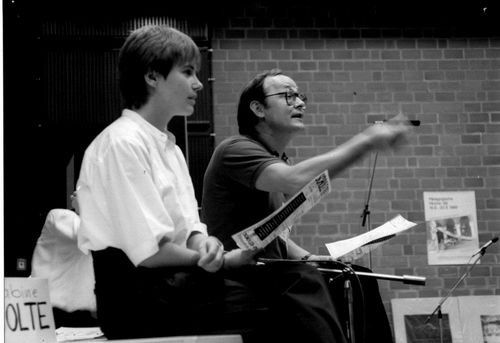
Pädagogische Woche 1998: “School – totally rubbish?” (left: Sabine Nolte)
7.2 School Reform Unit
From 1992 to 2006, I held the position of Academic Director of the Centre for School Reform (AS) at the Centre for Pedagogical Professional Practice at the University of Oldenburg – an institution of the Ministry of Education and Cultural Affairs, established to support school development in the region and to test evaluation models. To this end, the then SPD Minister for Education, Rolf Wernstedt, allocated teaching hours to the ZpB – initially equivalent to four teaching posts, and later two. There was an advisory board, initially chaired by Otto Menzel, the Osnabrück department head, and later by RSD Ernst Wille (Oldenburg) and RSD Klaus Kapell (Wildeshausen). We organised regular closed-door meetings together with the advisory board, at which we not only prepared the work plan for the coming year but also discussed a topical issue relating to teaching development.
Schortens: The AS’s activities included, amongst other things, the establishment of learning workshops, participation in in-school teacher training (SchiLF) and the Schortens headteachers’ conferences, which often attracted more than 350 participants and for which we invited experts renowned both nationally and internationally: Heinz Rosenbusch and Stephan Huber, Annemarie von der Groeben and Susanne Thurn from the Laborschule, Jürgen Baumert, Klaus-Jürgen Tillman, Hans-Günter Rolff, Peter Posch from Klagenfurt and Michael Schratz from Innsbruck, Pertti Kansanen from Helsinki and Mats Ekholm from Sweden, and the neuroscientist Gerhard Roth from Bremen. Comment from Ha-Gü Rolff, Dortmund: “We envy you for what you have built up in SCHORTENS!”
I have enjoyed working with Ina Ulrich, Christel Wopp, Wilm Renneberg, Alida Baumann, Franz Wester and many other seconded lecturers. In doing so, I never saw my role as head of the AS as one of dictating the guidelines. What was more important was that the seconded teachers were able to contribute their strengths and develop them further:
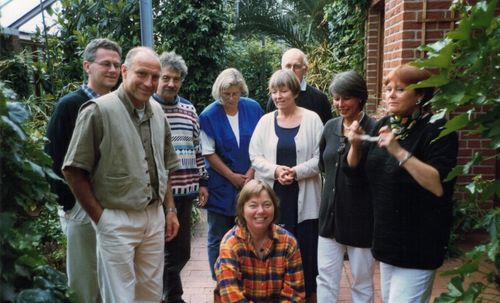
Closed-door meeting with the AS at the Historical and Ecological Education Centre in Papenburg
7.3 Research workshop on ‘Teacher Training’
In 1994, I ran a short seminar entitled ‘Future Workshop: School’. The outcome was that the students (including Carola Junghans, Andreas Feindt, Bettina Kappelhoff and Anne Eckermann) proposed the establishment of a university school[64] and a research workshop on teacher training. Wolfgang Fichten, Alexandra Obolenski and I, as lecturers, joined forces with this initiative and founded the Research Workshop on Schools and Teacher Training – a joint venture between Department 1 and the Centre for Didactics (formerly ZpB) at the university.
The driving force and head of the research workshop was Wolfgang Fichten (pictured here at a closed-door meeting of the Northern Network for School-Based Research). The main task of the Research Workshop was to serve as the ‘base station’ for the trials launched at the same time to establish our model of team-based research.
Northern Network for School-Based Research: From the Research Workshop, we also organised the Northern Network , which still exists today under the name Northern Network for Practice-Based Research.

This brought together several universities and teacher training institutions in northern Germany. The initial initiative for this came from Ingrid Kemnade from Bremen.
7.4 Oldenburg Team Research and the BLK Pilot Project
We refer to Oldenburg team research as a further development of the model of self-organised action research (collaborative action research) developed by Herbert Altrichter and Peter Posch for the German-speaking world. Herbert visited Oldenburg on several occasions and patiently showed us how it’s done.
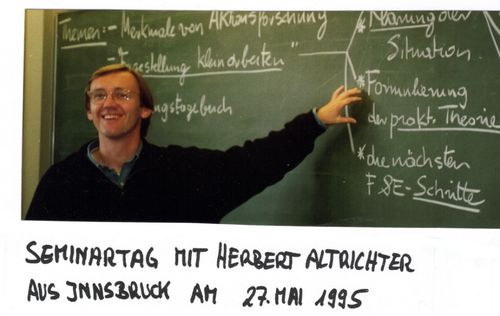
1994: Herbert explains the principles of action research
Whilst the Austrians had individual teachers investigate their own teaching practices, in Oldenburg we formed teams from the outset, in which 3 to 7 students, each working with a participating teacher, (see above) to investigate a key teaching issue or a school development task.
We had developed a process model which the individual teams – each consisting of one lecturer and four, five or six students – could follow.

We began each session with a intensive day (on Saturday and Sunday morning), during which we introduced four research methods suitable for our objectives: questionnaires, interviews, the structure-laying technique and group discussions. This was followed by an extended period of work within the individual teams – both on-site at the lecturer’s school and at the university. We concluded with a presentation day, during which the 6 to 12 teams in each cohort were able to present their research findings and then all received a certificate as ‘team researchers’.
Certification of the KGS Wittmund team
BLK pilot project: From 2000 to 2005, we received – partly thanks to the commitment of Alexandra Obolenski and her good contacts with Green politicians in the Lower Saxony Ministry of Education and Cultural Affairs – received funding totalling 250,000 euros as a pilot project of the Federal-State Commission (BLK) of the Conference of Ministers of Education.
Photo on this page: Members of our BLK facilitation team: Ute Warm (supervisor), Carola Junghans (seconded teacher),
Ulf Gebken (in a coordination role) and his successors Ela Eckert and Uta Wagener.
We tested our team research concept in the undergraduate programme (which continued to go very well), but also – in collaboration with the teacher training colleges in Aurich and Leer – in the second phase of teacher training (which was laborious given the tightly scheduled training stages at the teacher training colleges).
We all thoroughly enjoyed the work. Unfortunately, the monograph on the Oldenburg team research project, which Wolfgang Fichten and I had intended to write after 2005 (and for which we had already received a commitment to publication from Cornelsen Verlag), never came to fruition. However, there are many articles and also three collections of articles in which the model is described.[65]
7.5 Contacts with the GDR and Reunification
I had no relatives in the GDR and so, until 1989, my only experience of the GDR had been the trip to Berlin organised by the FDJ at Humboldt University (see point 3.2 above). From 1984 onwards, however, I had close contact with Lothar Klingberg (1926–1999). I had sent him my book *Leitfaden zur Unterrichtsvortbereitung*. In his first reply, he wrote that he was pleasantly surprised that I had refrained in my book from the malice towards GDR educators that was common amongst West Germans.
Lothar Klingberg: Following traumatic experiences as a 17-year-old soldier [66], he became a ‘new teacher’ (without, or without having completed, any formal training) at the primary school in Otterwisch near Leipzig immediately after the end of the Second World War.[67] He then went on to study again at the University of Leipzig, under the philosopher Ernst Bloch amongst others; he obtained his doctorate there and subsequently gained his habilitation with a thesis heavily influenced by Herbart on ‘Pedagogical Guidance and Self-Direction in the Socialist School’ (1962).[68] He moved to the ‘Karl Liebknecht’ University of Education in Potsdam and became the leading and internationally renowned general didactician in the GDR.[69]
In 1986, Lothar visited Oldenburg for the first time at the invitation of Otto Lange (School 1) and myself to give a lecture at the university. One sentence from his lecture has stayed with me: ‘Pupils are responsible for their teachers’ sense of achievement!’
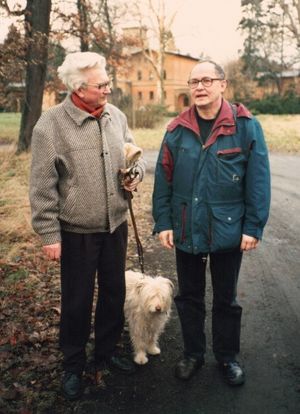 In 1989, my wife and I visited Lothar and his wife Renate for the first time. At the time, they were living with their two sons in Sanssouci Palace Park, specifically in the former pheasantry, where two staff flats had been fitted out for staff of the University of Education housed in the New Palace within the park. The flat had previously been occupied by the conductor and composer Wilhelm Furtwängler. In the attic bedroom where I was put up, the aluminium strips that Furtwängler had used to protect himself against evil earth rays were still hanging on the walls.
A walk in Sanssouci Palace Park with my dog Tonka;
with the Pheasantry in the background.
In 1990, I tried to persuade my School and the University Senate of Carl von Ossietzky University to award Lothar Klingberg an honorary doctorate from our School – as a small contribution to shaping the substance of German reunification. This failed because the three-quarters majority required in the University Senate – partly due to a very unprofessional information policy on the part of the then Chancellor – was not achieved.
In 1990, Dorothea Vogt (then at KGS Wittmund) and I had organised a training course for lecturers at the IG Metall training centres in Berlin. We took the opportunity to visit Lothar at his flat in the Schlosspark with the whole IG Metall group:

1991: left: Dorothea Vogt, centre: Lothar Klingberg, right: HM
Leipzig: I also had further contacts – arranged by Lothar – with Edgar Rausch (1928–2016) in Leipzig.  In 1986, he had recommended to a fellow student from his days in Leipzig that he invite me to Leipzig to give a lecture at the Clara Zetkin University of Education. However, it took another three years for this to happen, because the Stasi – acting through the director of international affairs at his university – forced him on several occasions to withdraw the invitation he had already extended.
- left: Edgar Rausch, school teacher from Leipzig (1989)
In February 1989, I was finally allowed to enter the country and thus became the first West German guest speaker at the Clara Zetkin University of Education (in the beautiful buildings on Karl-Heine-Straße, designed in the Bauhaus style).
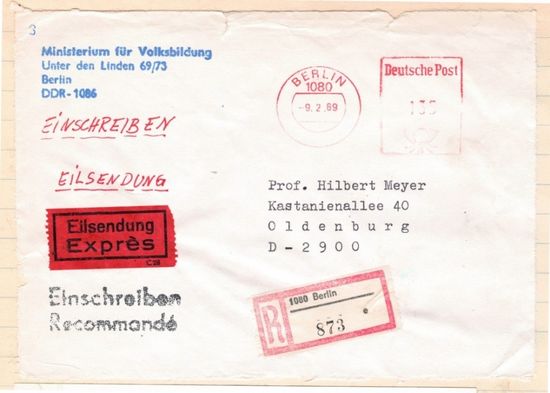
My visa: issued directly by
Margot Honecker’s
Ministry of Public Education
The lecture topic proposed by Edgar Rausch was: ‘Teaching methodology’. This allowed me to draw heavily on the preparatory work of Lothar Klingberg. Three-quarters of a year later, I found it baffling that, back in February ’89, I had not sensed at any point just how close the end of the GDR was, nor what a significant role the courageous people of Leipzig would play in bringing it about. Afterwards, Renate Klingberg and Elisabeth Fuhrmann told me that they had already sensed the imminent end a year or two earlier from the social behaviour of ordinary people. These people had shown ever less respect for state authority.
Academy of Pedagogical Sciences – Elisabeth Fuhrmann: In 1987, at the suggestion of 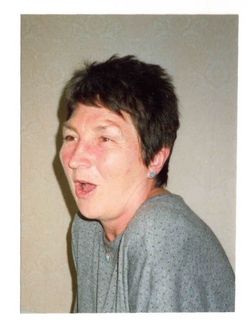 Lothar Klingberg, I had made contact with Elisabeth Fuhrmann from the Academy of Pedagogical Sciences (APW) in Berlin.[70] There, she headed an Institute established at the Heinrich Heine School, right next to the Berlin Wall.
 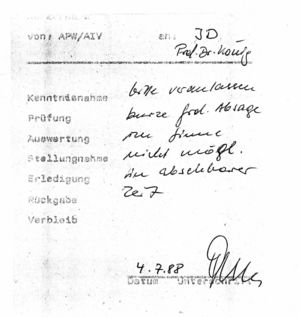 Her career had been held back because she refused to leave the Catholic Church and join the SED.
Otto Lange and I invited her to Oldenburg in 1987. Here, too, the Stasi intervened and instructed Elisabeth’s boss, Professor König of the APW, to ensure that Elisabeth turned down the invitation on spurious grounds (see the instruction on the right).[71]
DGfE Conference: In June 1990, Elisabeth Fuhrmann organised the first all-German conference for the Didactics Commission of the German Society for Educational Science (DGfE). We met at the Heinrich Heine Secondary School, where we were also able to sit in on lessons. For everyone involved, it was a striking experience of a school system undergoing radical change.[72]
Reunification: On Reunification Day, 3 October 1990, the PÄDAGOGISCHE WOCHE was just getting underway at the University of Oldenburg. I had arranged for Elisabeth Fuhrmann to deliver the opening address. Elisabeth Fuhrmann gave an impressive speech in the auditorium on the prospects for a new beginning. However, we had also invited many other colleagues from the GDR to speak.
The evening before, my wife and I invited all our colleagues from the GDR (Elisabeth Fuhrmann, Regine Pauls, Johanna Faust, Ralf Hickethier,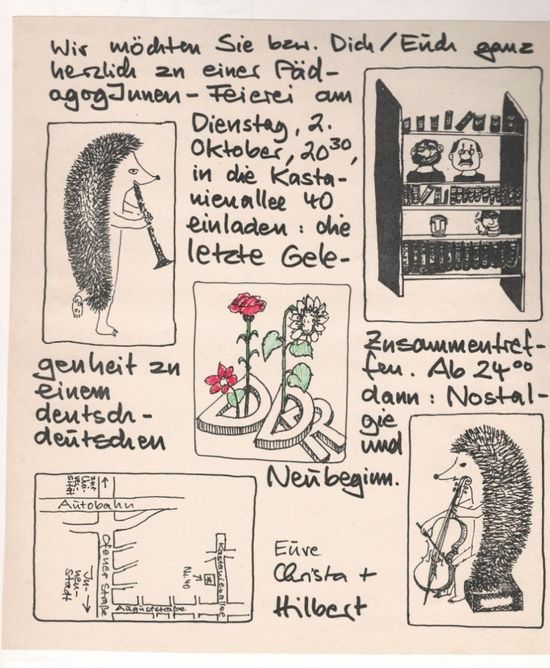 , Uwe Wyschkon and Edgar Rausch from Leipzig, Esther Migge from Saßnitz and others) to our home to celebrate my birthday (2 October). That evening, we built a ‘New Year’s Eve rocket’ (see above, section 1.2) together using matches, sparklers, wax and spray fountains, and lit it at 11 pm. The Warsaw Pact flag was emblazoned on the left of the rocket, and the NATO flag on the right. Both burned away. But at 11.45 pm, three-quarters of our guests suddenly took their leave. The sense of melancholy was probably too strong for them to want to celebrate the end of the GDR with us with loud cheers and a glass of sparkling wine.
Interim Professorship: During the winter semester of 1996/97, Elisabeth Fuhrmann took over as interim professor in Oldenburg whilst I was on a research leave. (During this time, I wrote the book *Schulpädagogik*.)
A conclusion: In the early years of reunification, contacts with the new Federal States were close and cordial. I visited Leipzig and Dresden, Potsdam and Stralsund on several occasions. These contacts gradually became less frequent, largely due to the fact that two of my closest partner institutions had been ‘wound up’ and all their staff made redundant: the APW in Berlin and the PH in Leipzig. However, new cooperation partners emerged, who repeatedly invited me to take part in teacher training courses:
- Parey Secondary School in Saxony-Anhalt, invited on several occasions by Anita and Klaus Krüger
- the ThILLM State Institute in Thuringia, at the invitation of my former master’s student from Kiel, Marion Tröster
- the LISA State Institute in Halle, as part of the headteacher training programme in Saxony-Anhalt
- the Association of Protestant Schools in Saxony, where one of my student assistants, Uwe Schmidt, had since become headteacher
- the Kreuzgymnasium in Dresden, invited by its headteacher, Gabriele Füllkrug
- the Eichsfeld Gymnasium, at the invitation of Marina Parlitz.
In the state of Brandenburg, where many things were different from the other new Federal States, the ‘Karl Liebknecht’ Teacher Training College was not wound up but integrated into the newly founded University of Potsdam. This provided the opportunity to maintain closer contact with the primary school teacher Ursula Drews from Potsdam.
I had also worked closely and productively with Witlof Vollstädt (formerly of the University of Karl-Marx-Stadt) for more than ten years on the jury for the Cornelsen foundation’s ‘Teaching and Learning’ award (see below, point 7.10).
7.6 Research Training Group ‘Didactic Reconstruction’
From 2001 to 2006, I was a member of the Oldenburg Research Training Group “Didactic Reconstruction” – a highly interesting initiative  led by my Oldenburg colleague and biology educator Ulrich Kattmann. Together with Ulrich Kattmann, Michael Neubrandt, Dietmar von Reeken, Astrid Kaiser and others, we ran a programme of courses specifically designed for PhD students across two cohorts. The final symposia, organised largely by Barbara Moschner and featuring an international line-up, were outstanding. This is how I came to meet, for example, Richard Ryan, whom many know for his theory of self-determination in motivation, co-authored with Edward Deci. On the initiative of Michael Neubrandt and myself, Xu Binjan from East China Normal University in Shanghai also attended the first symposium.
I was thrilled by this form of doctoral funding. As a doctoral candidate myself 30 years earlier, I would have loved to have had something like this! In my view, the interdisciplinary collaboration between the many different subject-specific and general education didacticians is exemplary.  We lecturers, too, learnt a great deal from one another.
7.7 Lecturer training for IG Metall
From 1986 to 2016, I worked for IG Metall every year – with brief interruptions – to run a one-week or three-day training course for the lecturers at the five IG Metall training centres – mostly in Sprockhövel, sometimes also in Berlin-Pichelsee, Bad Lohr or Bad Beverungen.
This is how it came about: in 1986, the IG Metall Executive Board, under its then chairman Franz Steinkühler, had decided to reform the union’s entire training programme.[73] The aim was to move away from the rigid course system (Labour I, Labour II, Capital 1, Capital 2) and adopt a more learner-centred approach. To this end, Steinkühler’s advisor was sent out to recruit new training tutors.  Among others, he approached Ingo Scheller (also from Oldenburg) and me. Ingo had other priorities at the time, but I agreed straight away and have built up a solid co-operation over the years.
The colleagues at the training centres worked with a high degree of professionalism. The seminars were a challenge for me every single time. I also used them to trial new training topics and methods. One outcome of this collaboration is the work carried out jointly with trade unionists Martin Allesbach and Lothar Wentzel[74] in 2009.
7.8 Master’s programme in School Management at the University of Kiel
From the summer semester of 2007, I was an external member of the teaching staff for the Master’s degree programme in School Management at Christian-Albrechts-University, Kiel, which had developed this degree programme in collaboration with the Institute for Quality Development in Schleswig-Holstein (IQSH). The driving force behind this was the then Director of the IQSH, Thomas Riecke-Baulecke (President of the Centre for School Quality and Teacher Training in Baden-Württemberg since 2020), who kept pestering me until I finally agreed to take on the role.
This is an accredited Master’s programme, which culminates in a written Master’s thesis. Participants are expected to have several years’ prior professional experience in the school sector. Many of the students intended to qualify for a headteacher role, whilst others were already headteachers. A significant number of the students worked at German schools abroad. Just as many came from abroad. For example, through the Kiel student Ernst Eitzen, I established what have since become close contacts with the German-speaking Mennonites in the Gran Chaco region of Paraguay (see ‘School and classroom visits worldwide’ on this website).
 MODULE V: Together with the chemistry education specialist Reinhard Demuth and the IPN research assistant Claudia Fischer, I was responsible for MODULE V , ‘Improving and Assessing Teaching’. Each semester featured a two-day face-to-face session and several online seminars. Part of the work involved writing a module handbook of the same title. It has been published in two volumes by Oldenbourg Verlag in Munich (see publications nos. 38 and 39 on this website). Each semester, I supervised five to seven Master’s theses and set 25 to 40 written exams, which I marked together with Claudia Fischer. The work was very varied and instructive. Two graduates went on to complete their doctorates under my supervision in Oldenburg and at the University of Osnabrück respectively, following their studies in Kiel: Christian Geldermann, now a school inspector for the dioceses of Münster and Aachen; and Christina Peters, a seminar leader for vocational schools in Schleswig-Holstein.
In 2017, I retired from active teaching in Kiel. However, I retain my examination entitlement and still make use of it from time to time.
7.9 LABORSCHUL Advisory Board
The work of a university lecturer entails various advisory board roles (see the list in the appendix to the file ‘Professional and Academic Career’). Particularly important, though also labour-intensive, was my membership of the Advisory Board of the LABORSCHULE Bielefeld from 1992 to 2017.
Our task: After Klaus-Jürgen Tillmann had taken over the academic directorship of the Laborschule from Will Lütgert, the ‘teacher-researcher’ model of the Laborschule, developed by Hartmut von Hentig, was modified. There was no longer a blanket exemption for teachers to carry out research tasks— 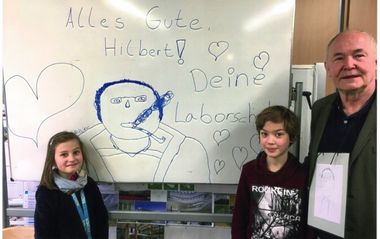 —but only time-limited exemptions for research and development projects (FEP). Project proposals had to be written for this purpose. The Advisory Board’s main task was to discuss these proposals with the applicants and suggest improvements. This task was carried out at the annual two-and-a-half-day Advisory Board meetings.
In 2017, I was then formally relieved of my duties on the Advisory Board during a small ceremony attended by the pupils and colleagues of the Laborschule.
7.10 CORNELSEN Foundation for Teaching and Learning
For 20 years, I served on the Advisory Board of the CORNELSEN foundation ‘Teaching and Learning’. The photograph, taken on the balcony of the Cornelsen publishing house in Berlin, shows us with the Chair of the Advisory Board, Ruth Cornelsen.
Our task was to assess funding applications submitted to the Cornelsen Foundation and to make recommendations. Franz Cornelsen had entrusted the management of the foundation’s funds to the Stifterverband für die Deutsche Wissenschaft. As Chair, Ms Cornelsen gave us a free hand and was pleased when we thoroughly examined the pros and cons of individual proposals.
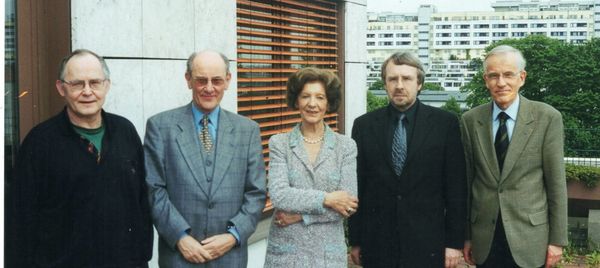
The members of the Advisory Board in 2002: HM, Helmut Schwarz, Ruth Cornelsen, Elmar Tenorth and the representative of the Stifterverband
Cornelsen Promotion Prize: In my capacity as a member of the Advisory Board, I subsequently became the spokesperson for the jury of the Cornelsen Promotion Prize. Individual lecturers or teams of lecturers with interesting school projects could apply for the three prizes, worth 6,000, 4,000 and 2,000 euros respectively. The only eligibility criterion, as stipulated by the foundation’s remit, was that the project had to involve academic supervision.
As with the Laborschule, the work on the jury was very instructive, as it allowed one to ‘hear the didactic grass growing’. Many developments that later found their way into mainstream schools had already been thought through and tested by the prize-winners at an early stage.
Every year or every two years, the prize-winners we had selected from the many applications were invited to DIDACTA in Stuttgart, Cologne or Hanover. On the stage of the School Forum, they had to present their award-winning project. Afterwards, a member of the jury delivered a laudatory speech. In addition, each of the three prize-winners received a cash prize from the foundation’s funds. Beaming with pride, the winners would then head home and usually ensure that a report appeared in the local media.
8. Publications
8.1 Collaboration with Cornelsen Publishers
University lecturers have the right to combine their academic work at the university with the publication of research findings. I have made full use of this right. In purely quantitative terms, however, my list of publications is significantly shorter than that of several of my colleagues in Oldenburg. I have concentrated on textbooks and study guides, each of which had – and continues to have – a broad readership. A complete list of my publications, updated to 2022, can be found on this website. The total print run of the monographs published in particular by Cornelsen Verlag Berlin now (in 2022) stands at just under 1.4 million copies. Given the current total of 880,000 lecturers in the Federal Republic of Germany, that is quite a substantial figure, which occasionally causes some surprise.[75] These high figures are also thanks to Horst Linder, the director of Cornelsen-Scriptor Verlag Berlin, who has worked tirelessly to promote the distribution of my books.

Horst Linder at the Frankfurt Book Fair in 1991 during the launch of the newly published book by Jank & Meyer, *Didaktische Modelle*
Almost all my books have emerged from specific teaching and learning contexts. This goes some way towards explaining why readers occasionally praise the books for being so easy to understand. A former student, who is now headteacher of the Eichen Gymnasium in Scheeßel (Lower Saxony), invited me to give a lecture and said: “Hilbert, I often disagreed with you completely – but at least you were easy to understand!” Gerhard Müller, the managing director and former student at the University of Oldenburg, made very similar points when inviting me to give lectures in 2016 and 2022 at the Regional Vocational Training Centre for Business (in Kiel).
Of course, there has been and continues to be some criticism – sometimes of the often relaxed and occasionally flippant tone, and the occasionally ironic imagery (e.g. by my colleague Klaus Prange), but also of what is considered insufficient theoretical underpinning of my teaching concepts. Wolfgang Klafki, with whom I had the opportunity to work on the advisory board of the LABORSCHULE in Bielefeld, told me on the sidelines of a meeting that he had repeatedly defended my books against attacks from colleagues.
When Franz Cornelsen, the founder of the publishing house, was awarded an honorary professorship by the City of Berlin in November 1987, he invited many of his authors to the award ceremony at Schöneberg Town Hall. There were solemn speeches about the honouree’s truly impressive entrepreneurial achievements, until Michael Klett, owner of Klett Verlag and Cornelsen’s main competitor, and yet a friend of Franz’s, gave a light-hearted speech and explained that he, too, held such a title; that it was actually of little practical use, but that it came in handy when booking a hotel room somewhere. After the award ceremony, a banquet was held in the high-rise building next to Berlin’s Gedächtniskirche – and all the invited guests were photographed there:

November 1987: HM, Mr Thiele (head of Hirschgraben Verlag), Franz and Ruth Cornelsen
8.2 Long-sellers
Bestsellers are all well and good – but long-sellers, which remain available in bookshops for a long time and subsequently achieve high total print runs, are more important for publishers, as well as for practical university work and teacher training in the second phase. In this section, I outline a few long-sellers I have written and the stories behind their creation. Whether, and if so to what extent, such books influence teacher training has not yet been empirically documented. I would be very interested in such a study. However, I myself can no longer, nor do I wish to, undertake such painstaking work.
(1) ‘Training Programme for the Analysis of Learning Objectives (1974): It is a youthful indiscretion from the time of my involvement in the North Rhine-Westphalian pilot project on the Kollegschule, which has, after all, made it to its 14th edition (see above, point 4.6). The book came about because, at the time, the Standing Conference of the Ministers of Education and Cultural Affairs (KMK) had stipulated that all new curricula should be designed with learning objectives in mind. Consequently, the question was how learning objectives should be appropriately defined and then ‘operationalised’[76] became a key issue for practitioners on the curriculum committees and for trainers in the second phase. I refer to this as a ‘youthful indiscretion’ because the subject matter and aim of this book involve a systematic narrowing of focus on the question of learning objectives, even though the book does point out this shortcoming here and there, for example with the assertion that ‘emancipation cannot be operationalised’.
(2) ‘Guide to Lesson Preparation’ (1980): From 1978 onwards, I had delivered a lecture every other semester entitled ‘Introduction to Lesson Preparation’ and produced a set of lecture notes for each session (see above). This subsequently became the preliminary draft of the guide, published internally by the then Centre for Pedagogical Professional Practice (image on the left). It had been passed on by colleagues (not by me!) to four publishers: Klett-Verlag, Westermann, Urban & Schwarzenberg and Scriptor Athenäum (at the time an independent publisher in Königstein/Ts.). All four publishers wanted to print the manuscript. I then wrote a joint letter to the editors explaining that I would grant the rights to whichever publisher offered the lowest retail price.[77] Scriptor won the race by a clear margin.[78]


Since then, I have been friends with Horst Linder of CORNELSEN SCRIPTOR, who was the editor in charge at Athenäum Scriptor at the time and is now the publishing director. In 2007, I carried out a thorough revision of the book. There is now also a Chinese edition.
To Horst Linder’s delight, the guide sold well and gradually found its way into second-phase seminars. At the time, compared with the didactic works by Klafki, Derbolav, Geisler, Heimann and others—written in a highly academic and sophisticated style—the book was almost unrivalled in terms of its practical relevance. In the foreword to the eighth edition, however, I wrote, as a precaution: ‘High print runs are no guarantee of quality. I do not infer the quality of the BILD newspaper from its circulation figures, but I do conclude that it satisfies a need.’
‘Holiday didactics’? In the ‘Guide’, Wolfgang Klafki, Gunter Otto and Wolfgang Schulz, as well as Christine Möller – in other words, the leading figures in general didactics at the time – are mocked as ‘holiday didacticians’. Wolfgang Klafki had no trouble dealing with this judgement from a young upstart. Wolfgang Schulz, as he later told me, was genuinely annoyed and wrote an entire essay to set the record straight regarding my attacks. That did not, however, prevent him from addressing me informally when we became co-editors of the Encyclopaedia of Educational Science (see below). Today, I would not repeat such a critique of ‘holiday didactics’, because in my most recent publications (and those by Carola Junghans), a significantly higher level of self-reflection is demanded of students and trainee teachers – not exactly light reading for beginners. We stand by this, however, because the expectations regarding reflective teaching practice have risen sharply over the last 40 years. Thirty-five years ago, I set to work with great enthusiasm. In the introduction to the guide, I had written: “You can learn to teach well. And one can certainly learn to prepare one’s lessons well.” That remains my position today – but, as I said, the expectations regarding the reflective abilities of students and trainee teachers have risen.
Criticism: The most scathing criticism of the guide – and indeed of my other publications – came, and continues to come, from my fellow PhD student and fellow graduate with a Diplom in educational science, Andreas Gruschka (now a professor emeritus in Frankfurt am Main). I’d met him during the teacher training college pilot scheme in Münster. Andreas wrote that I was a “gravedigger of didactics” and almost as bad as Heinz Klippert. His reasoning is that I relieve readers of the need to think for themselves and merely rephrase, in bite-sized chunks, what they would have stored in their store of experience anyway. I do not see it that way, although I readily concede that an academic debate on quality criteria for self-help literature is long overdue. Such a debate, however, should be underpinned by empirical evidence as far as possible, rather than merely serving to reproduce the core tenets of Andreas’s Adorno-inspired ‘Negative Pedagogy’ (Gruschka 1988).
Much enmity, much honour: the Lower Saxony Minister for Education’s attempt to ban the book! The internal university advance copy of this book was leaked to Werner Remmers, the then CDU Minister for Education – whom I otherwise held in high regard – by secondary school officials from the Osnabrück district government (all members of the same party), and was sharply criticised.[79] Consequently, the then Vice-Chancellor of the University of Oldenburg, Rainer Krüger, received an instruction – unusual even in those heated times – in which he was asked to ensure that my text was not used in teacher training at the University of Oldenburg. The Vice-Chancellor rejected this, citing the freedom of research and teaching guaranteed by the Basic Law.
The guide was also debated in the state parliament. Werner Remmers criticised it; Rolf Wernstedt, who later became SPD Minister for Education and Cultural Affairs but was at that time still serving as the SPD parliamentary group’s education spokesperson in the opposition, defended it. I then attended a lecture by Remmers in 1980 at the congress of the German Society for Educational Science in Göttingen. He made a passionate plea for his concept of the ‘decree-free school’. After the lecture, I plucked up the courage to approach him and asked him why he had sent this directive to my headteacher. His reply: “Don’t take it too personally! I was at the mercy of powerful groups.”
A dispute over the name – even on the guide! In 1974,the university wanted to name itself Carl von Ossietzky University, because this Nobel Peace Prize laureate had been imprisoned and tortured at the Esterwegen concentration camp nearby. However, the state government banned the use of this name. I had deliberately disregarded this, in consultation with the publisher, and had the following printed on the back cover of the guide : ‘Hilbert Meyer, Professor of School Pedagogy at Carl von Ossietzky University’. I then received a letter from Ansgar Holzknecht, who was at the time the personal adviser to the Minister for Education and Cultural Affairs; the tone was polite, but the content was stern, in which he wrote that I had no right to do this. However, I made no changes to the book’s spine in subsequent editions!
(3) ‘Teaching Methods’ (1987): During my studies and also whilst working on my doctoral thesis, I had no interest in questions of methodology. That changed in 1975 in Oldenburg, when I realised just how important a component of professional teaching practice this is. Since then, teaching methodology has been my passion and my speciality.
The two volumes published by Cornelsen Scriptor were based on lectures on the subject of ‘Teaching Methods’, which I first delivered in the winter semester of 1981/82 and then published in book form in May 1982, together with my two research assistants Eva Pilz and Karsten Friedrichs, at the Centre for Pedagogical Professional Practice at CvO University.
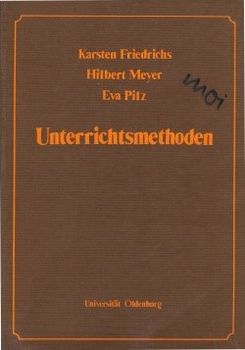
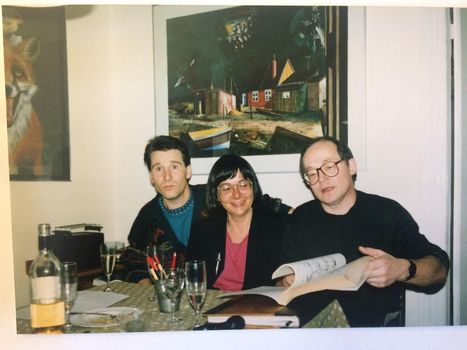
1982: Karsten Friedrichs, Eva Pilz and I celebrate the publication of the methodology book
After several rounds of lectures, the lecture notes grew ever more extensive, resulting in the two-volume published edition of 1987:
- The theory volume provides a systematic reconstruction of the concept of methodology.
- The practical volume describes the methodological tools of teachers.
At that time, as analysed in the 2022 revised edition (2022, p. 199 ff.), there was a veritable effervescence of theoretical discussion surrounding the phenomenon of ‘teaching methodology’. This debate came to an abrupt end in the early 1990s. Since then, not a single monograph on the theory of method has been published. Yet the topic remains highly relevant to teacher training practice.



The book covers in order: 1st ed. 1987, 10th–16th eds. 2002 to 2021; Japanese edition 1998; Chinese edition 2011
 In 1982, as I was familiarising myself with the subject area, I noticed that West German educational theorists such as Wolfgang Klafki, Wolfgang Schulz and Rainer Winkel were imprecise and incomplete in their terminology relating to teaching methodology. Herwig Blankertz then gave me the West German licensed edition of Lothar Klingberg’s *Introduction to General Didactics*, published by Fischer Athenäum, and I was surprised: no other author was more precise when it came to the conceptualisation and systematisation of teaching methodology. I therefore turned to him for advice and was very grateful that he guided the development of this book and provided meticulous commentary and criticism on many chapters. This led to a friendship that lasted until his death in 1999, for which I remain grateful to this day.
Since then, more than 300,000 copies of the practical volume and more than 200,000 copies of the theoretical volume have been printed. The Japanese edition had two print runs, whilst the Chinese edition has had several reprints. Now, 35 years on, however, a new edition was long overdue, which I have produced together with my former student assistant and current seminar leader, Carola Junghans (Meyer & Junghans 2021; 2022).
(4) ‘Didactic Models’ (1991/2002): Werner Jank, a music educator from Frankfurt who has since retired, studied music in Oldenburg from 1991 to 1994. His partner and now wife, Gaby Schröter-Jank, was a student of mine and said to him: “Why don’t you go and see Hilbert?” He did just that, and we immediately agreed that he would take up a post as a research assistant and co-teach the lecture ‘Introduction to General Didactics’ with me. We sought to provide students and trainee teachers with an overview of the current state of didactics at that time. The front covers in order: the university edition from 1990; the first Cornelsen-Scriptor edition from 1991; the 5th revised and abridged edition from 2001; and the Danish translation from 2003:


In designing the book, we drew heavily on Herwig Blankertz’s *Theories and Models of Didactics* (1969), but then sought to enhance clarity through the use of new text types, graphics and other elements, whilst also significantly expanding the range of topics covered. There are thus new chapters on the acquisition of competences, the concept of learning, constructivist didactics and action-oriented teaching. The first three chapters have been translated into Swedish by Michael Uljens (Vaasa, Finland).
(5) ‘What Constitutes Good Teaching?’ (2004): This is the only book I actually had no intention of writing. Here’s how it came about: I had recommended to Horst Linder that, following the German PISA debacle of 2000, he should publish a book on the subject of ‘teaching quality’. And I immediately suggested two authors to him. The first suggestion was Andreas Helmke, who was working at the University of Landau at the time. However, Andreas Helmke had just signed a contract with Klett-Kallmeyer for the book *Unterrichtsqualität und Lehrerprofessionalität* (Teaching Quality and Teacher Professionalism); it was published by them in 2003.  The other author I suggested drew up a synopsis for the publisher, according to which two-thirds of the book was to consist of historical analyses of the development of the concept of quality, from progressive education to the present day. The publisher didn’t want that. So Horst Linder came to me and said: “Then you’ll have to write the book!” – And that’s exactly what happened.
I wanted to call the book “Characteristics of Good Teaching”. Horst Linder thought that was too defensive and said: “At your age, you can certainly be a bit more bold. I suggest: ‘What is good teaching?’”
The precursor to the book was, once again, a seminar in which I had formed ten teams. Each team had to work on one of the ten characteristics. In this book, I attempted for the first time to engage more deeply with empirical research into teaching. This had not yet been the case with the guide and the teaching methods, because at that time such empirical research was still in its infancy and because I had not yet familiarised myself with the few existing approaches.
This is the book that has been translated into the most foreign languages:



Denmark (2005) Croatia (2005) China (2011) Korea (2011) Egypt (2015)
I was, and still am, surprised by the response to this book. Clearly, many teachers are tired of constantly being told about PISA shortcomings. They want to be told in no uncertain terms which criteria are important to the author. And they are grateful to note that the book is not a collection of ready-made solutions, but rather a catalogue of criteria that can – and must – be implemented in different ways. Next year (2023), I intend to start revising this book.
(6) Two books relating to vocational education and training: Together with my former doctoral candidate Catherine Walter-Laager, I published a guide in 2012 with Cornelsen Verlag entitled *  * (Teaching Methods for Early Years Educators) for the training of early years educators, in which the expertise in early years education was contributed by the former early years educator and current lecturer in early years education at the University of Graz (Austria), whilst I contributed a compilation drawn from my books *Unterrichtsmethoden*, *Didaktische Modelle * and *Guter Unterricht *. Incidentally, I find the photo on the book cover less than ideal: it shows five nursery teachers,
 , looking devotedly at the male lecturer – which reinforces, albeit certainly unintentionally, gender stereotypes.
The book *Didactics and Methodology in Nursing and Healthcare Professions * (now in its fifth reprint), published in 2013 in collaboration with the Hanover-based nursing didactician Uta Oelke , is similarly structured: Here, too, the sections on nursing didactics were written entirely by Uta, whilst I contributed my expertise in general didactics.
8.3 By-catch
Not all publications were published by Cornelsen-Verlag. As the fishermen on the North Sea coast say, there was the occasional by-catch: books that I published with other publishers, but which had a significantly narrower target audience than the Cornelsen books.
(1) My first book, *Curriculum Revision: Possibilities and Limits* (co-authored with Frank Achtenhagen; see section 4.1), was published by Kösel-Verlag in Munich in 1971; a year later, the same publisher released my doctoral thesis, *  * (see section 4.4).
(2) In 1983, Klett-Cotta published Volume 3 of the *Enzyklopädie Erziehungswissenschaft* (Encyclopaedia of Educational Science ), entitled *Ziele und Inhalte von Erziehung und Unterricht* (Goals and Content of Education and Teaching) (co-edited with Hans-Dieter Haller). – This was a time-consuming project, published by Klett-Cotta between 1983 and 1987 under the overall supervision of my then fellow research assistant in Münster, Dieter Lenzen.
 (3) In 2007, the FRIEDRICH Annual XXV was published: Good Teaching, Standards and Characteristics – Approaches and Tools. Edited by Andreas Feindt, Hilbert Meyer, Martin Rothland and others. The Friedrich Yearbooks are presented as an annual gift to all subscribers to a journal published by Friedrich-Verlag. Consequently, the yearbooks have a large print run and presumably also a correspondingly wide readership.
(4) In the same year, 2007, the book co-authored with my twin brother Meinert Meyer (  ) was published: *Wolfgang Klafki – A Didactics for the 21st Century?* The impetus for this book was the fact that we were both asked to write one of the two required expert reports for Wolfgang Klafki’s honorary doctorate, awarded in 2004 at the University of Kassel.
(5) In 2021, the book *Education Against Division* was published. We wanted to send a signal—  —that radical steps towards school reform must finally be taken. Unfortunately, the co-authors Annemarie von der Groeben and Susanne Thurn, both teachers at the Laborschule, passed away shortly after publication. This polemic is now their legacy. In this volume, we argue for greater individualisation, call for the development of the necessary ‘didactics of diversity’, and adopt the idea of ‘educational step-by-step kits’ from the Laborschule’s teaching methodology.
Conclusion: At first glance,it might seem as though I have been writing books non-stop. But that impression is misleading. I always spent at least five years working on a new textbook before it was finished.
8.4 Illustrations
I do not wish to take credit for other people’s work. The vast majority of the many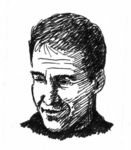 drawings in my books are by Karsten Friedrichs, who, in 1982 as a student assistant, helped produce the first version of the lecture notes for my course on teaching methods (see above). Karsten went on to become a teacher of Art and German at the Liebfrauenschule in Oldenburg. He lives ‘just round the corner’ from me. For me, this was and remains an ideal situation: whenever a new book is in the making, I keep popping round to him with very rough sketches and say: ‘Can you draw this teaching situation?’ ‘Can you draw a staff meeting where a third of the teachers are on the verge of falling asleep?’ Or I simply mention a topic to him. And then, sooner or later, a drawing arrives that fulfils the brief. For example, the cartoon commissioned with the request: ‘Why don’t you draw something on the dialectic of teaching methodology!’ – These became the two small drawings on the cover of the first edition of *Teaching Methods* (see above, p. 86)
Karsten’s speciality was, and still is, producing head sketches (portraits). He also produced head sketches for the forewords to my books. The following four drawings show how I have changed visually over the course of 40 years:
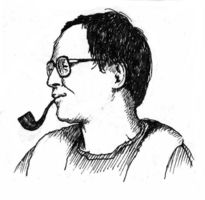
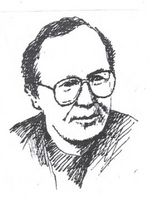


HM 1982 HM 1989 HM 1991 HM 2019
I can’t draw faces like Karsten! My speciality is the far less demanding art of drawing hedgehogs, suns, shells and similar creatures:

The many illustrations in my books and the DIDACTIC MAPS are also my work.
9 Sixtieth birthday (2001) and retirement (2009)
Detlef Spindler, then head of the Centre for Professional Practice, is a week younger than me. We therefore decided to celebrate our 120th birthday together on 19 October 2001. Karsten Friedrichs drew the appropriate cartoon for the invitation:
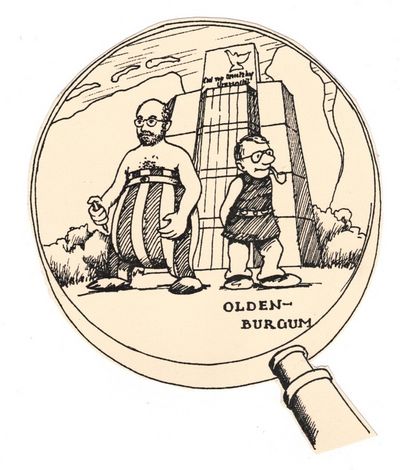
Alexandra Obolenski, Andreas Feindt, Ulrike Heinrichs, Ulf Gebken and Carola Junghans were responsible for the superb organisation of the event:
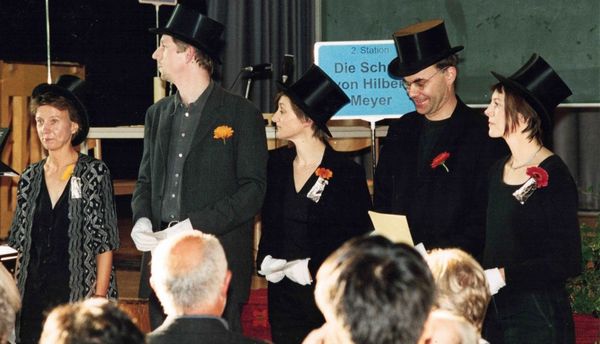
Retirement ceremony 2009: On 20 June 2009, my retirement ceremony took place in the old auditorium of the university, where I had heard lectures as a student in 1963/64, organised and designed by Sylvia Jahnke-Klein, Carola Junghans, Andreas Feindt, Volker Wendt, Ulrike Heinrichs and many other nice people.
The university's AStA had politely asked me beforehand if they could drop a banner denouncing the dean's faculty policy from the balcony of the auditorium during the celebration. I happily agreed and said: "Great! This will take me back to the turbulent beginnings of my doctoral studies at the FU Berlin on the day of my retirement!"
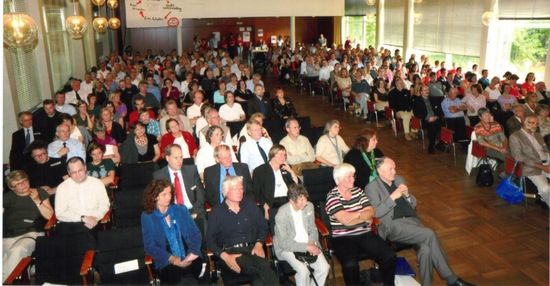
I still meet colleagues today who tell me how brilliantly these five organised the ceremony: They wanted to transfer my principle of action-orientation of teaching to a university celebration - and they really succeeded! As in every one of my lectures, there was a large FAHRPLAN, this time on the topic of "Teacher training in 6 acts":

The FAHRPLAN of the retirement ceremony set up on the stage of the auditorium
The individual stages:
- Astrid Kaiser, then the Institute Director, opened the event; and the Vice President, Mrs Ahrens, gave a welcoming address.
- The Dean of our School, sociologist Bernhard Kittel, gave a short speech in which he explained that I had had a good time between 1975 and 2009. Today the work has become much more demanding! Klaus-Jürgen Tillmann, who led a discussion about teaching quality on the podium after this opening, strongly disagreed with this - which made me happy!
- Assistants' choir: A production of the 35 student assistants and research assistants who currently work for me or have done so in the past, who commented lovingly and ironically on the conditions in my office (especially the midday nap on the rubber mat under the desk).
- Carola's husband Michael Greiner staged a stomp with all 300 guests, during which the following sounds were intoned by all guests in four-four time: tapping on the desk top at the seat - loudly folding up the claddings they had brought with them (as Hilbert always used them) - banging two stones together (as each examinee received as a gift) - hitting honey jars with spoons (they were under the seat; the reason: Hilbert kept giving away his brother-in-law Wolfgang's honey) - and an ostinato, struck by Luise with Hilbert's singing bowl.
- After the speeches and presentations, my wife Christa made the necessary comments on such a male academic career from a feminist point of view.
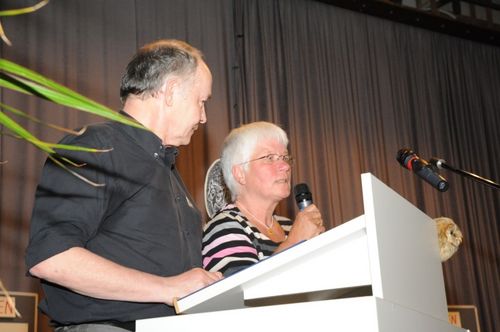
- At the end, the auxiliary choir sang a rewritten version of Peter Fox's "Haus am See", which all the guests were asked to sing along to. The chorus after each verse:
"And at the end of your labour in to the hedgehog house/
Chestnut avenue, Christa and pipe smoke/
You have shown us so much appreciation/
oh Hilbert, your trust has made us strong/
We have learnt from your person/
a biographical curriculum!"
Singing along was a success, as the photo from the university press office shows:

Front row from left: Andreas Feindt, Carola Junghans, Sylvia Jahnke Klein, Wolfgang Konukiewitz (my brother-in-law), Gisela Blankertz (my doctoral mother), Christa and Hilbert Meyer
I was particularly pleased with the choir of assistants because I have enjoyed working with them all my professional life:

Choir of assistants - in the front row: Rabia Schadel, Friederike Güffens, Reina Freese, Gesche Willerich and Ines Hartog
Conclusion:
I have been very lucky in my professional and academic career, despite the aforementioned Einstürzende Neubauten. I am wholeheartedly grateful to all those who have allowed me to do so and who have supported me in my professional and academic development. Some things did not work out. From today's perspective, I lack a stable empirical research practice of my own. On the other hand, I suspect that I would never have written my textbooks if I had first had to establish their empirical basis myself.
When writing this report for the first time in 2006 and even more so when revising it in 2022, I realised three points about my professional and academic career:
(1) I realised how strongly the esteem in which I was held by my doctoral supervisor Herwig shaped my university teaching behaviour. He demanded a lot, but gave me confidence and made it clear that I would succeed.
(2) I realised how much influence my twin status had on my personal development and later also on my academic work.
(3) I realised that German fascism and the misery of the Second World War had a greater influence on my academic career than I was aware of at the age of 20 or 30.
Carola Junghans, with whom I co-authored the new edition of the two volumes "Teaching Methods", writes in the theory volume (on p. 82) that challenging learning processes consist of the constructive processing of crises in the personal development process. I said to her: "I can't remember any such crises in my own career." Carola replied: "You just didn't notice them!"
Addendum:
On 20 May 2020, I was appointed Dr. honoris causa at Abo Academi University in Turku (Finland) for my contribution to the Scandinavian didactics discourse, triggered by many years of collaboration with Michael Uljens, Faculty of Education and Health Science at the external location in Vaasa.
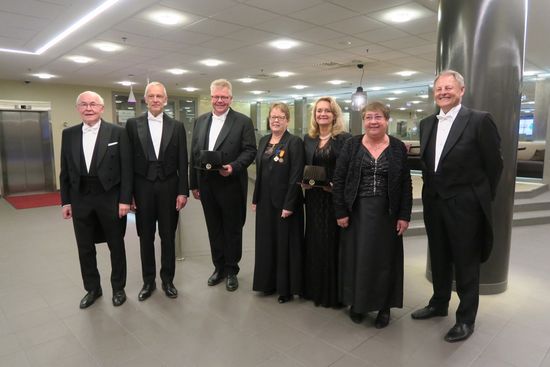
From left to right: Dr h.c. HM, Dr h.c. Jan Masschelein from the University of Leuven (Belgium); Michael Uljens (host of Hilbert), Siv Björklund (host of Jim), the Rector of the Vaasa branch Lisbeth Fagerström, Ms Ann-Katrin Svensson and Dr h.c. Jim Cummins from the University of Toronto. Jim Cummins from the University of Toronto (Canada).
The ceremony was still conducted according to medieval rites: a good 90 doctoral candidates and 13 honorary doctorates 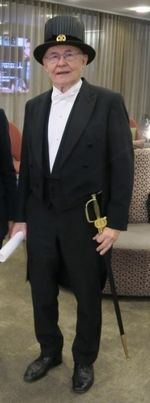 from five Schools were assembled, which were combined from two years ago due to the corona pandemic. We had to come forward one by one, receive our doctoral hat, sword and degree certificate from the dean and then make a deep bow to the rector - it took two and a half hours, during which only Latin was spoken. Afterwards, the newly graduated students processed together through the city to Turku Cathedral, the oldest church in Finland. An ecumenical service was held there in Swedish, in which the city's rabbi gave the sermon and the Protestant pastor as well as the Catholic and Russian Orthodox priests performed the liturgy. The university choir provided the music. Incidentally, the word "doctorate" comes from this rite: in the Middle Ages, all those who had passed the viva voce went from their School to the Rector once a year to receive their doctoral degree and hat. By the way: the School of Theology in Turku does not hand out swords! That's a good thing! I had to hand in my sword straight away: My nine-year-old grandson Theo Kasper begged me so hard that I couldn't resist giving him the sword.
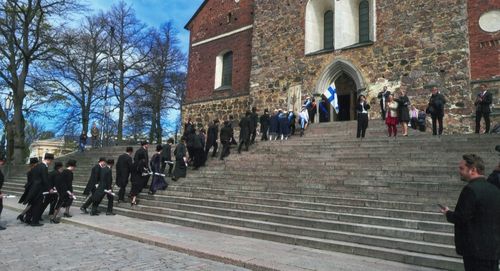
Graduation of all doctoral candidates and doctores honoris causa at Turku Cathedral on 20 May 2022
[1] For those who are not familiar with the rock scene, this phrase is a reference to an experimental band that was popular in the 1980s.
[2] I have no fundamental objections to the switch to the BA/MA system. It strengthens university autonomy. What I do think is disastrous, however, is the hunt for points that begins in the first semester on the basis of the course certificates that conclude the exams. The 450 written exams that the three of us had to look through within a week were sheer nonsense from a didactic point of view! The current examination system hinders self-determined study and, as has long been empirically proven, leads to bulimic learning in many students.
[3] This is no. 97 from the list of publications "Essays" on my UNI homepage.
[4] Currently, for example, in the theory volume Unterrichtsmethoden (together with Carola Junghans, Berlin: Cornelsen 2022).
[5] The photo on the first page was taken by Michael Miethe (Berlin) for Cornelsen Verlag in 2009.
[6] He was murdered there by the Germans together with his orphanage children and his co-worker Stefania Wilcynska.
[7] Rolf Hornig (ed.) (1998). Three women in the 20th century. A biographical trilogy from Westerstede. Westerstede: Pleis Druckerei, pp. 108 to 156
[8] Through this great-grandfather I was very closely related to the brothers Gerhard and Ricklef Orth (later headmaster of my first practical school in Oldenburg). When I told them this, they were astonished.
[9] He never concealed this. He was therefore also tolerant when I had the report card remark "transfer jeopardised" or when one of my siblings was left behind. I found that very relieving.
[10] Friedrich Wissmann's habilitation thesis contains a chapter about this seminar and its pre-fascist director.
[11] In the work by Alexander Hesse ("Die Professoren und Dozenten der Preußischen Pädagogischen Akademien und Hochschulen für Lehrerbildung", Weinheim 1995, p. 309), a lot is said about the academic appointments of these lecturers and professors and also about my father based on the surviving personnel files (see the appendix in the script "Unsere Fluchtgeschichte" on this HOMEPAGE).
[12] His boss wrote in his statement on the proposal: "Meyer is suitable for the appointment because he has pedagogical talent."
[13] detailed in the text "Our escape story" on this HOMEPAGE.
[14] Only our grandmother enquired anxiously after our birth whether it was true that twins only get half of everything.
[15] When I went to my then Oldenburg university lecturer Werner Loch in 1964 and told him I would like to write a dissertation with him on the pedagogy of hitchhiking, he simply refused and suggested I write my dissertation on Schleiermacher's pedagogy - wise advice that I took to heart!
[16] I only had one teacher at grammar school, the biology and chemistry teacher Harder Stukenberg.
[17] The local Junge Union came to the PH and asked us to decline the invitation. Reason: "You must not stab Adenauer in the back!"
[18] On this occasion, he met the leading representative of polytechnic education in the GDR, Prof Hans Joachim Klein, and developed a long-standing friendship with him.
[19] The counter-invitation we extended to the FDJ members to Oldenburg was accepted, but never realised. In 1968, I met one of the former East Berlin students again at the Free University of West Berlin. She confessed that she - like several others - had only joined the FDJ's travelling cadre in the hope of escaping the republic. The Stasi obviously saw it the same way and did not approve of the trip.
[20] In July 1964, I summarised the notes in a small brochure.
[21] The first written grade at the PH at that time was the so-called "Vorexamensarbeit", which had to be written in the main subject. My lecturer, Professor Lüschen, didn't say a word about the grade during office hours, but remarked: "You're not crying. The female students always cry like that!"
[22] At that time, it was not yet possible to actively apply for a doctorate. You had to wait until you received an offer from a university lecturer.
[23] After a year, the teaching load was reduced to 25 hours. However, I had to attend a fortnightly seminar session organised by the school council and led by my Ocholt mentor Walter Spellig.
[24] All the pupils had to buy the German and maths exercise books twice so that I could check all the homework every day.
[25] Abridged version published in the journal "Bildung und Erziehung" (1968); reprinted in my volume "Türklinkendidaktik" (2001).
[26] I never learnt the history of this Free Conference. I suspect that it was founded at the end of the 19th century, when elementary school teachers were forming and saw themselves as a political movement.
[27] I started in 1964 with 28 pupils, but because very small schools in the neighbouring villages were closed, my class became fuller and fuller.
[28] I was made a civil servant three times and dismissed twice. Given the shortage of teachers at the time, there was no risk involved.
[29] At that time in Berlin, as in Münster in 1969, there was only the so-called undergraduate programme in the School of Philosophy and not a doctoral programme based on a first examination. Two minor subjects were required for the undergraduate programme, which were also examined in the viva voce.
[30] Alongside Herwig Blankertz, Werner Loch (then at the University of Erlangen) had also made me this offer. I wavered as to which would make more sense for me, but then clearly decided in favour of Herwig Blankertz because I had the - certainly correct - impression that I could learn more about the theory of science and criticism of scientific work from him.
[31] It was only 30 years later that Andreas Helmke and I discovered that we had both attended this congress.
[32] Traces of this work can be found in Blankertz's book "Bildung im Zeitalter der großen Industrie" (1969). At that time I did real archive work for the first and only time in my life and studied the documents available in the FU library on the National Convention during the Revolution (cf. J. Guillaume (Ed.) (1891-1907). Procès-verbaux du Comité d'Instruction publique de la Convention nationale. 6 volumes: Paris.
[33] I did not accept the formal reasons for this discrimination against the PH programme at the time, nor do I accept them today. The PH degree programme only lasted 6 semesters and was and still is not considered a scientific degree!
[34] A more detailed analysis of Blankertz's personnel, curricular and educational policy activities can be found in the Münster dissertation by Martin Rothland (first reviewer: Ewald Terhart).
[35] Wolfgang Klafki, Klaus Mollenhauer, Theodor Schulze, Ilse Dahmer and Hans-Dieterich Raapke from Oldenburg are also doctoral candidates of Weniger.
[36] Blankertz, Herwig (1978). The relevance of pedagogical theory for action. Self-criticism and perspective of educational science at the end of educational reform. In: Zeitschrift für Pädagogik, 24th vol. p. 171-182.
[37] In a reply letter to van Dick dated 21 May 1981, Blankertz wrote: "At a young age, when I would not even have been of age according to today's law, I had to be a soldier in Hitler's Wehrmacht and had to make decisions that almost broke me. (...) Nevertheless, I do not see this as pacifism, but as a right and duty to fight against injustice and barbarism."
[38] Which I did not do.
[39] Cf. Hilbert Meyer (1993) In memoriam Herwig Blankertz. In: Herwig Blankertz Foundation of the City of Recklinghausen in cooperation with the Academy for Youth and Academic Appointments, Hattingen p. 13-28
[40] Herwig Blankertz had initially suggested that I clarify the deduction problem in a historical analysis of 18th century pedagogues. I found that boring. He immediately accepted my suggestion to relate this question to the US curriculum discussion, which had just become highly topical at the time, and supported it to the best of his ability.
[41] This generalisation of the title then brought me clear criticism from Hartmut von Hentig: on the occasion of the 500th anniversary of the University of Tübingen, he gave a lecture on the question of the practical relevance of educational research (published in HvH (1982). Recognising through action. Stuttgart: Klett), in which he criticised my dissertation as a prime example of practical irrelevance (op. cit., p. 35).
[42] Even today (2022), this is the number of students. In terms of enrolment figures, the University of Münster was and is primarily a teacher training institution
[43] In 1973, I was offered a well-paid salaried position (BAT I A) at the Düsseldorf Ministry because in November 1972 I had been asked by the Dean of the School of Education at the University of Trier-Kaiserslautern to apply for an H 4 position for which the application deadline had already expired. I didn't respond, but Herwig Blankertz pushed through the Ministry of Education and Cultural Affairs so that I was given a higher BAT classification.
[44] This was also due to the very favourable application situation for young academics (see below).
[45] I still haven't found out why these professorships are called "full". What is clear is that the H3 professorships and the associate professorships are not disorganised.
[46] They were the religious education teacher Lenchen Ramsauer, the maths didactician Heinrich Besuden, the political scientist Helmut Freiwald, who examined me in philosophy in 1964, and Ulrich Günther, who gave me the internship grade.
[47] Daughter of Lina Mayer-Kulenkampff, a leading social pedagogue in the Weimar Republic
[48] It is fitting that in Zurich, where he later moved, he got into trouble at the ETH for unauthorised secondary employment.
[49] A comprehensive overview of the concept is provided by the six-volume "Dokumentation zur Einphasigen Lehrerbildung" (Documentation on single-phase teacher training), edited by Wolfgang Fichten, Detlef Spindler and Ulrich Steinbrink and published by the Centre for Pedagogical Professional Practice Oldenburg (1981).
[50] I held the same view and until my retirement I introduced the "Werkstatt-Du" in the first lecture, but then immediately remarked: "The more socially powerful person determines the rules of the road. And at the moment, that's me. When you do your internships at schools, please stick to the rules that apply there!"
[51] That's why I still have an inner aversion to teaching concepts that want to completely abolish direct instruction.
[52] The seminar took place on Fridays from 6 to 8 pm. It was well and regularly attended.
[53] So there were two sessions each for supervising a practical training group - twice as much teaching load as today!
[54] Klaus Zierer, my successor in 2011, took this plaque with him when he left the University of Oldenburg. It now hangs in his office at the University of Augsburg.
[55] Taking so many holidays is a very recent invention and should not be taken for granted. My parents, my grandparents and their ancestors never went on holiday at all! And I always took work with me on holiday too.
[56] When I became dean of our department in 1989, I introduced a bill that showed that "actually" only 20 per cent of our teaching capacity should have been included in the degree programme in education, but that in fact it was 40 per cent. This meant that the many teacher training students were clearly at a disadvantage. The bill triggered heated discussions. Friedel Busch, who was in favour of the diploma course, said to me at the faculty council meeting: "You don't want the diploma course to be closed, do you?" - I didn't want that, but I wanted a fair and equal distribution of the shortage - and not the preference for students majoring in a subject, which is also common at many universities.
[57] From left to right: Wolfgang Fichten (the member elected by the doctoral candidate), Una Dirks (second assessor from Hildesheim), Hanna Kiper (Chair), Andreas Feindt (who has just been presented with a talking stone and a singing bowl by HM) and Matthias Schierz (sports didactics expert and examiner of the neighbouring subject).
[58] Barbara Moschner and I are competing a little to see which of us has or will have helped more people to gain a doctorate by the time we retire.
[59] One of my doctoral candidates, whom I had proposed for the Research Training Group "Didactic Reconstruction" (see point 7.5) and who was well on the way to writing an excellent dissertation on primary school didactics, had already teamed up with a partner who was initially very supportive, but then turned out to be a porn producer. He had a tendency towards violence. He owned a gun. He was banned from the university. He was constantly spending huge amounts of money that he didn't even have. The doctoral student stepped in, got more and more into debt and then, to everyone's horror, committed suicide. I keep thinking about this doctoral student and ask myself whether and how her death could have been prevented.
[60] Rainer should actually have done his doctorate at the Institute of Mathematics Education at Bielefeld University - but the doctoral degree regulations there did not allow it. He "only" had a Diplom in psychology.
[61] Volker had already been discharged as a Bundeswehr pilot at the age of 42, but didn't want to retire and asked if he could do his doctorate with me on the subject of "Personal initiative in further academic education". Which he did.
[62] Hans Krull actually wanted to write a dissertation with me after his retirement on the subject of examination didactics and had already diligently collected empirical material (tape recordings of examinations), but then had to abandon the project for health reasons.
[63] In a maths exam for a grammar school teaching degree, the professor suddenly said: "Oh no, I withdraw this question. That's only for Diplom exams!" He was signalling his teacher training prejudice with this question and did not know that this student already had a maths diploma.
[64] Nothing came of the university school. I asked the Minister of Education, Rolf Wernstedt, about it. He said: "Yes, do that!" To the follow-up question: "What funding will we get for this?" he had to answer: "None!" So the idea was buried for the time being. But perhaps it will succeed in the new century.
[65] Hilbert Meyer & Wolfgang Fichten (2009). Introduction to action research in schools. Aims, procedures and results of a BLK pilot project. Oldenburger VORDRUCKE No. 581. Oldenburg: Didactic Centre of the University. (93 pages).
[66] Renate Klingberg once told me what experiences were involved. And Lothar confirmed the statement by nodding his head: Lothar had been drafted as a 17-year-old into a pioneer unit that had been captured by a partisan group in the Czech Republic in the final months of the war. The 18 or 19 soldiers had to line up according to age. Then they were shot one by one. Lothar, the youngest, was told to run away. He was sure that he would be shot as he ran away. But they let him be the only one to run - perhaps because they wanted word of the fate of the others to spread around the war zone. Since this event, Lothar has had a massive heart condition.
[67] New teachers were deployed in the Soviet occupation zone, sometimes without any training, to replace active Nazi party members. Lothar had close contact with his first class throughout his life. A third of this first school class from Otterwisch attended Lothar's funeral 45 years later (which I was also able to attend and gave a short speech at).
[68] It was only after reunification that Lothar was able to inspect the files of his habilitation procedure at the University of Leipzig and then saw that a colleague had objected to his procedure because, in his opinion, he had received the bourgeois pedagogue Johann Friedrich Herbart too uncritically.
[69] Klingberg's biographical data can be found on the homepage of the University of Leipzig. It outlines his first studies at teacher training colleges in Silesia, which he cancelled due to the war, his deployment in a battalion of the Waffen SS in the last months of the war in 1945, his time as a new teacher, his studies at the University of Leipzig and his positions as a professor in Leipzig and Potsdam.
[70] Because of this contact, I was also present as a reviewer at the last extended doctoral examination (habilitation) of the APW; the successful candidate: Petra Stephan.
[71] After reunification, Elisabeth sent me copies of the various file notes and instructions.
[72] Only the West German Rainer Winkel attracted unpleasant attention because he asked the pupils in the primary school class he was observing to sing an FDJ song. The class teacher came crying to Elisabeth afterwards. She felt that her serious desire for reform had been duplicated.
[73] When we first made contact in Oldenburg, the Chair's advisor said that they wanted to "de-Stalinise" IG Metall's educational work - a pithy formulation that challenged me.
[74] I am still friends with Lothar Wentzel, who is responsible for educational work on the IG Metall executive board in Frankfurt/M. and comes from Oldenburg.
[75] From time to time I am asked whether I have become a millionaire thanks to the book royalties. I then reply: "Not at all! I have a very nice extra income, but it's still significantly less than what a married couple of teachers or university lecturers earning twice as much have at their disposal every year!" I have used the extra income to send four children to university and to pay off the house in Kastanienallee in Oldenburg step by step. However, the sales success does not apply to all books: the two volumes on "Schulpädagogik" (1997) and the book "Unterrichtsentwicklung" (2015) had or have very modest sales figures.
[76] A Greek-Latin teacher once came to me in a curriculum committee of the Kollegschulversuch and asked: "Does the word operationalisation come from opus and ratio?" (A classical philologist could have worked out for himself that this is not the case!)
[77] That sounds very selfless, but it wasn't at all. I had already calculated that an inexpensive book would sell better and for longer.
[78] The first edition cost DM 12.80, a price that was only possible because the publisher was prepared to take the risk of printing 20,000 copies in the first edition. Urban & Schwarzenberg wanted to offer the book for 18 or 19 DM; Klett for double the Scriptor offer.
[79] There had been a pirate printing of parts of my "Leitfaden" at the Centre for Teacher Training at the University of Osnabrück, which the Osnabrück department heads had read. Among other things, they criticised the statement that only alienated learning was possible at school. They rightly surmised that such a term had a meaning derived from Karl Marx.