
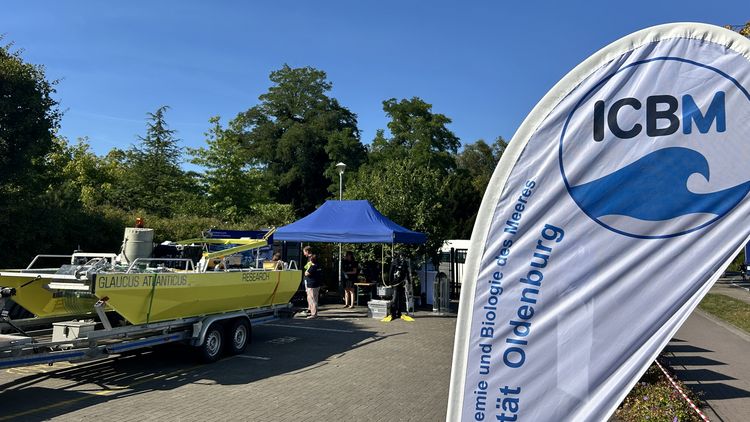
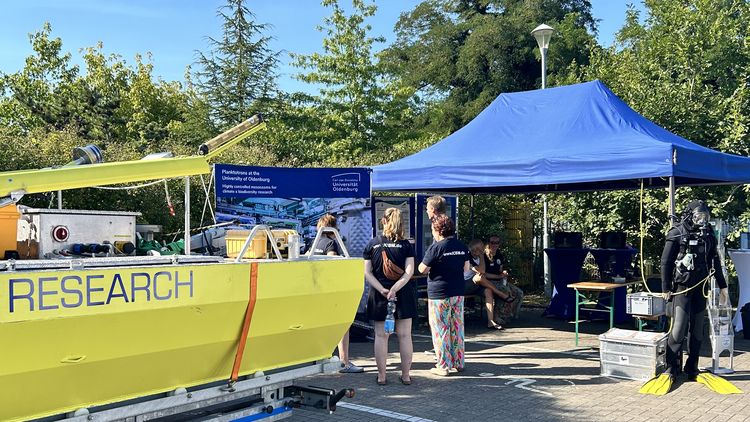
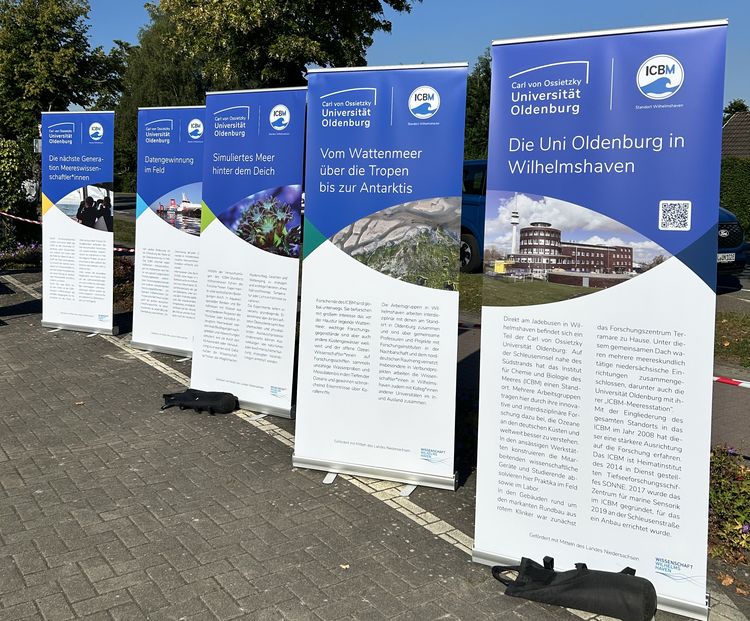


On August 14, scientific institutions, initiatives, and educational institutions from Wilhelmshaven presented their work as part of the Long Night of Science, an event hosted by the Northwest German University Association (NWDUG) at the Botanical Garden. The ICBM was also represented at a booth with all five of its Wilhelmshaven research groups.
Even before reaching the entrance to the Botanical Garden, Glaucus Atlanticus caught the eye at the ICBM booth: one of two homemade catamarans used to study the ocean’s surface. Dr. Mariana Ribas Ribas explained to visitors how rotating glass plates are used to collect samples from the water’s surface and what function the installed sensors serve.
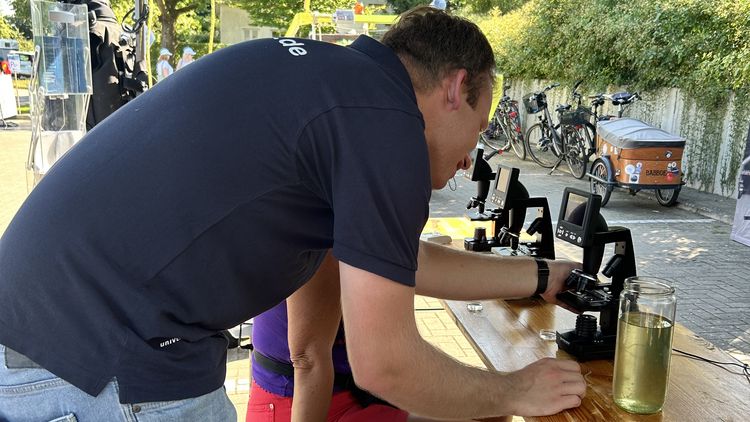
Visitors could only make out the details of daphnia with the aid of microscopes. Under the guidance of Dr. Linda Rehder and Sebastian Neun, children built plankton out of modeling clay and toothpicks. The goal was to find a shape that would remain near the water’s surface for as long as possible in downwells, giving it more time to perform photosynthesis.
Deeper in the water, research divers trained at the ICBM carry out their work. Dr. Sven Rhode explained their training using the diving dummy “Uschi” and various videos. The unique challenges of research diving could be experienced firsthand through an activity involving tying knots while wearing diving gloves.
Dr. Julia Oelker and Dr. Thomas Badewien demonstrated the use of a radiometer to measure water color. They also showcased a drifter built in the ICBM workshops that uses GPS tracking to provide important data on ocean currents.
In addition to the information booths set up by the participating institutions, numerous talks offered insights into current topics. Two staff members from the ICBM in Wilhelmshaven also shared interesting presentations in this format:
Dr. Maren Striebel provided insights into the unique characteristics of plankton and its importance for climate and biodiversity. The audience eagerly awaited to learn what role rainbows, unicorns, and flower vases play in experimental planktonology at the ICBM.
The second presentation from the ICBM was given by Annika Traue on the topic of climate adaptation among coastal residents. As part of her doctoral research, the early-career scientist is studying the perception and acceptance of measures to adapt to climate change, and she successfully recruited the first coastal residents right at the ICBM booth to participate in her newly launched survey.