
Parliamentary evening
"Amazement at the premiere in blue", NWZonline, 19.02.2015
Parliamentary evening
Marine research - indispensable for our future
ICBM hosted a parliamentary evening in Hanover
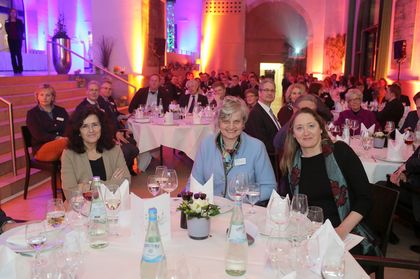
Hanover/Oldenburg. Around 80 guests accepted the ICBM's invitation to the Parliamentary Evening in the Garden Hall of the New Town Hall in Hanover on 17 February.
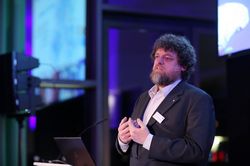
In her welcoming address, Gabriele Andretta, Vice President of the Lower Saxony State Parliament, expressed her enthusiasm for the "Premiere in Blue". Science Minister Gabriele Heinen-Kljajic emphasised the strong interest in marine research in the coastal state of Lower Saxony. After all, almost 50 per cent of humanity now lives in coastal regions, as University President Katharina Al-Shamery added in her welcoming address. In his introductory speech, ICBM Director Helmut Hillebrand pointed out that around half of global oxygen production takes place in the oceans and that we therefore owe "every second breath ... to the sea". The greatest evolutionary diversity in the sea is offset by a "dramatic decline in marine organisms", not least due to the fact that humans remove 100 million tonnes of marine products from the sea every year.
After Hillebrandt, Thorsten Dittmar, Head of the ICBM-MPI Marine Geochemistry Bridge Group, explained further facets of ICBM science to the astonished audience. For example, the water obtained in the Antarctic from the half-litre bottle in his hand contains around "30 million single-celled organisms", and the seawater, which often appears blue, is more yellow than colourless or even blue when concentrated.
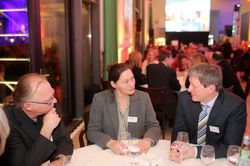
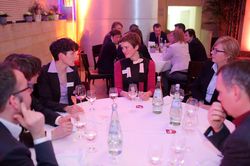
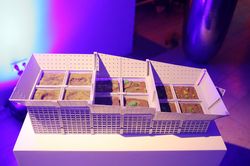
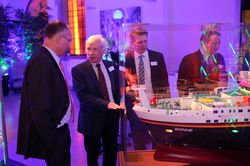
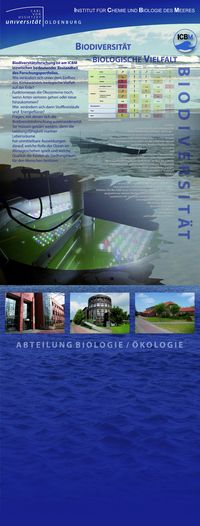
This was followed by a lively exchange on current topics in marine research at the tables and in front of the Institute's exhibits. Using a model of the ultra-modern research vessel SONNE, which was handed over to science at the end of 2014 and whose home institute is the ICBM, the institution showed that it is now also active in many ecosystems of the open ocean. The evening exhibition was complemented by models of the Institute's permanent measuring station and one of 12 artificial islands in the Wadden Sea near Spiekeroog. The latter is part of a joint project between the University of Oldenburg, the University of Göttingen, Senckenberg am Meer and the Lower Saxony National Park Administration to provide an insight into how the colonisation of newly emerging Wadden Islands takes place in the coexistence and interaction of bacteria, plants and animals. The evening was rounded off with display boards on current scientific topics, the promotion of young scientists, education and public information.