
Village miller
Village miller
Short biography
Kjell Mørk Karlsen is one of the most important contemporary composers in Scandinavia and Norway in particular. Born in Oslo in 1947, he initially studied with his father, the Oslo cathedral organist and composer Rolf Karlsen, before going on to study church music at the Oslo Academy of Music, specialising in composition with John Lammetun. In addition to the cantor's examination, he also passed artistic maturity examinations in recorder and oboe. He perfected his composition studies with Copland and Dallapiccola student Egil Hovland in Oslo and with Joonas Kokkonen in Helsinki, who introduced him to the practice of unorthodox dodecaphony.
In 1973 he became cathedral organist, first in Tønsberg and then in Stavanger, before deciding to work as a freelance composer in 1981. For several years he worked as a part-time organist in Asker, but since 2011 he has lived in Tomter, south of Oslo, where he devotes himself entirely to composing, free from all academic appointments. Norsk Musikkforlag Oslo is now the organisation with the most publications of his extensive oeuvre, which encompasses almost all genres and instrumentations. Karlsen has been honoured several times with composition prizes and was made a Knight 1st Class of the Royal Norwegian Order of Merit by King Harald V.
Selection of works
Symphonies: No. 1 op. 70 (1984), No. 2 op. 73 (1985), No. 3 op. 78 (1986), No. 4 op. 87 (1989), No. 5 op. 99 (1997), No. 6 op. 118 (1996), No. 7 op. 130 (2001), No. 8 op. 105 (2003), No. 9 op. 145 (2004), No. 10 op. 155 (2014), No. 11 op. 157 (2014), No. 12 op.186 (2015).
Piano concertos no. 1 op. 90 (1988) and no. 2 op. 192 (2018); violin concertos no. 1 op. 135 (2001) and no. 2 op.141 (2003).
Oratorios: Jule (=Christmas) oratorio op. 57 (1981); symphonic oratorio "Lilja" op. 82 (1987); chamber oratorio "Milska" op. 103 (1993); Passion oratorio "O crux ave" op. 134 (2013); church play "Engelbretsdatter" op. 150 (2005).
Passions: After St John op. 100 (1991), after St Mark op. 166 (2010), after St Matthew op. 181 (2015).
Mass for choir and winds op. 51 (1982); Requiem for women's choir and strings op. 32 (1986); Requiem grande op. 162 (2008/2009); 12 motets op. 49 (1979); Jubilate Deo. 100 motets for the church year with and without organ op. 56 (1969-1999).
For organ: Symphonies No. 1 op. 99 (1991), No. 2 op. 105 (1993), No. 3 op. 116 (1996), No. 4 op. 157 (2007), No. 5 op. 171 (2013), No. 6 op. 193 (2018); Te Deum op. 33 (1975); Mass op. 51 (1979); Introduction and Passacaglia on B-A-C-H op. 202 (2020); Partitas, chorale arrangements and meditations.
String quartets: No. 1 op. 66 (1993), No. 2 op. 117 b (1996), No. 3 op. 121 (1998).
For piano: Sonatas op. 183 (2018) and op. 200 (2019), with trumpet op. 40 (1976) and with tuba op. 74 (1985); Fra folketone til tolvtone (24 Minipräludien) op. 133 (1982-2001); Griegfragmenter op. 163 for piano solo, for piano four-hands and for two pianos (2010; compulsory pieces at the 11th International Grieg Competition Bergen 2010); various piano song cycles.
To the colloquium
After the introductory performance of Kjell Mørk Karlsen's Partita brevis 2 on Norwegian folk songs op. 110, 2 (1994) by Institute lecturers Ulla Levens (viola) and Christoph Rode (cello), the speaker outlined the life and work of the composer, who has been on friendly terms with him for over three decades and dedicated two of his larger organ compositions to him: the 3rd Organ Symphony op.116 in 1994 and "Introduction and Passacaglia on B-A-C-H" op. 202 in 2020.
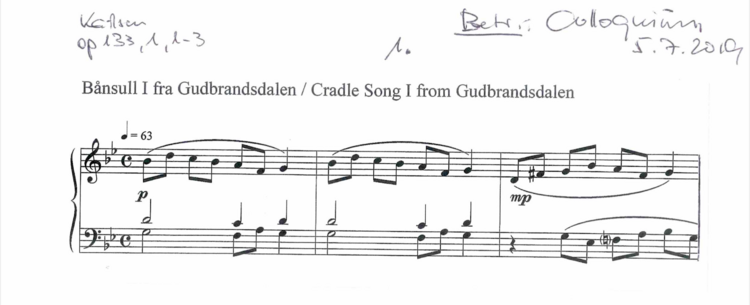
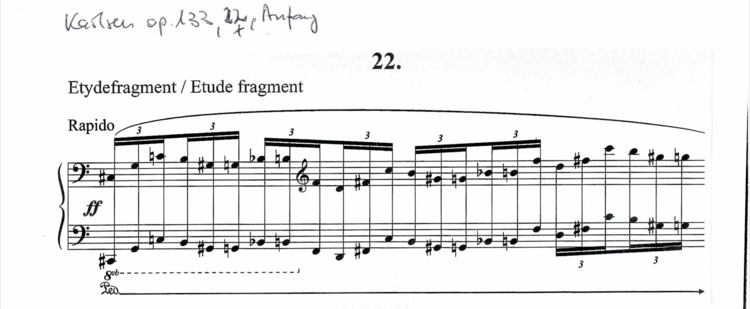
The analytical focus was on the piano cycle "Fra folketone til tolvtone / Vom Volkston zum Zwölfton" op. 133, which is quite exemplary for Karlsen's oeuvre. As the title states, the cycle, composed in 2001 from 24 mini-preludes, moves historically and chronologically from tonally orientated Norwegian folklore via whole-tone scales in a quasi-impressionistic sense to unorthodoxly practised dodecaphony, summarised in the epilogue in the direct confrontation of row and major-minor chords. In this way, the cycle consciously sets itself apart from the genre format of "24 piano preludes" composed after Johann Sebastian Bach by Chopin, Debussy, Scriabin, Rachmaninoff and Shostakovich, among others. The cycle is also characterised by the fact that more traditional concepts such as strophic song, canon, invention, toccata and waltz contrast with freer ones such as fantasia, ostinato, sound study and fragment in the second part of the cycle. A development also shows the momentum of progressive pianism from the first rather simple mini-preludes to the later ones, which take the course towards concertante virtuosity.
The event was concluded with a complete interpretation of the cycle by the speaker.