
Count
Count
Statement
"A composition should reflect the knowledge and mastery of the most important cultural techniques and at the same time produce something new and individual."
Curriculum vitae in tabular form
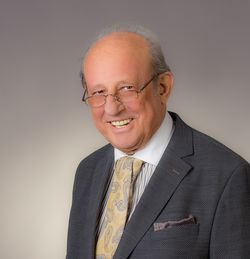
Dr phil. Dietmar Gräf M.A.
Composer, conductor, pianist, church musician, musicologist
| 1943 | Born on 1 June in Marienbad |
| 1945 | Expulsion, then family residence in Bayreuth |
| 1963-1966 | Studied music at the Regensburg Church Music School |
| 1966-1968 | Teacher of the Regensburger Domspatzen |
| 1968-1969 | Cathedral conductor in Eichstätt |
| 1969-1973 | Studied church music (A), school music and the concert subjects piano and organ at the music academies in Munich and Würzburg |
| 1972 | Conducting diploma with Prof. Swarowsky (Vienna) |
| 1969-2008 | School musician in Mindelheim, Bamberg and Munich and A-level church musician in Bad Wörishofen |
| 1973 | Foundation and management (until today) of the Förderkreis für Symphonie- und Kammerkonzerte e.V. |
| 1976-1980 | Studied musicology, music education and pedagogy at the Ludwig Maximilian University of Munich, graduating in 1981 with a Magister Artium and in 1985 with a doctorate from the School of History and Art 1978-2014 Founded and directed the musica sacra chores e.V. |
| 1981-2003 | Lecturer for piano, organ and methodology at the chair of music education at the LMU Munich |
| 2009 | Founded a masterclass for piano (with masterclass diploma) |
| 2009-2013 | Director and musical director of the Kneipp Music Festival, Bad Wörishofen |
| from 2013 | Head of the music section of the KünstlerGilde e. V. (based in Esslingen) and jury chairman of the Johann Wenzel-Stamitz Prize |
| from 2015 | Juror in international music competitions Second Federal Chairman of the KünsterGilde e. V. (based in Esslingen) |
Over the past 55 years, he has given over 2,000 concerts as a conductor, pianist and organist and played in numerous ensembles; conducted renowned symphony orchestras in Germany and abroad. Numerous tours have taken him to England, France, Italy, Hungary, Russia, Canada, Chile, Austria, Poland, Romania, the Czech Republic and Switzerland. Many film, radio, television and sound recordings as well as world premieres. His compositional oeuvre now comprises over 500 works, several of which have been premiered in recent years.
Awards, prizes and memberships
| 1986 | County badge of honour of the county |
| 1988 | Silver Medal of Merit Bad Wörishofen |
| 1999 | Academic appointment as a member of the Esslingen Artists' Guild |
| 2001 | Sudeten German Culture Prize for Music |
| 2003 | Golden Medal of Merit Bad Wörishofen Admission as a composer to GEMA |
| 2004 | Federal Cross of Merit on Ribbon Academic appointment as a full member of the Sudeten German Academy of Sciences and Arts |
| 2009 | Papal Gold Medal on the occasion of the musica sacra choir's third trip to Rome |
| 2010 | Johann Wenzel Stamitz Prize for Music from the Artists' Guild |
Book publications:
Die Veränderung der Einstellung zur Musik und zum Musikunterricht durch Werkanalyse, dissertation, Frankfurt am Main 1985; Der Choral Gregors des Großen. Ein Beitrag zur Didaktik des Gregorianischen Chorals, Frankfurt am Main 1994; collaboration on the textbook series "Spielpläne Musik" for grammar schools (Vol. 5-10, 1996-2002)
Dietmar Gräf: Polytonality, my method of composition.
By chance, on 1 August 1992, while improvising on the piano, I had the idea for what I later called polymodality. I improvised with one hand on the black keys and the other on the white. It's clear that this was nothing new. Nevertheless, I listened very intensively to the existing pentatonicism of using all the black keys and at a certain point I thought to myself that I could also add a pentatonicism on the white keys in order to combine both pentatonicisms. There are already a few different possibilities, for example by specifying a root note for the "black-key pentatonic", let's say F sharp (or G sharp), and also a root note for the selected "white-key pentatonic", let's say for the row "f-g-a-c-d-f". Both pentatonics would then have the same sequence of intervals, namely "root major second major second minor third major second minor third". This sequence of intervals is known as the "Chinese pentatonic" and is of course nothing special. Back then I simply called it bi-pentatonic, just as there is the bitonality of combining F major and F sharp major, for example. F sharp major and C major are also interesting (see Stravinsky's Petrushka, for example, where the tritone relationship between the two major keys is particularly attractive).
It makes a difference whether - to stay with the first example mentioned - the same sequence of intervals is used in both pentatonic scales. For example, if we don't use f as the root note in one hand, but c instead, we get several possibilities (only a few are mentioned here): a) c-d-e-g-a-c. This still has the same interval structure, but not b) c-d-f-g-a-c! Derived from the so-called church modes, we could call this a) authentic and b) plagal. An excursion into the so-called church modes would be possible or appropriate here. Let us restrict ourselves to a single example. Dorian (or 1st mode) without accidentals uses this tone sequence: d-e-f-g-a-h-c-d; this is authentic Dorian, with the final tone (or finalis) d and the so-called tenor (pronunciation accent on the second syllable; there are also other designations such as recitative tone, repercussa or tuba) - a kind of precursor of the later dominant - on the fifth a. This is the tone around which the dominant is pronounced. This is the note around which the main melodic action takes place. However, the melody will always return to the finalis at the end. It is not - as in the major-minor system - identical to the root note (explaining this in more detail here is definitely going too far). Hypodoric, on the other hand, takes this tone sequence: a-h-c-d-e-f-g-a. (This is thought to be Aeolian or natural minor.) However, this is the plagal Dorian mode. The final note remains the d, but the ambitus is lower and the tenor is on the third of the finalis, namely the f!
In Gregorian editions (e.g. in the so-called "Graduale Romanum") you will find hundreds of examples for both Dorian modes and for all others as well. It is even made easy by indicating the respective mode, e.g. a Roman one for Dorian and a Roman two for Hypodoric.
I have already referred to bitonality above. Every musician has certainly heard of polytonality. In bitonality, two different keys (with or without accidentals) are combined; it is not even necessary to combine a major and a minor key. Even two major keys produce very attractive sound results. Let's simply take C major and A major. Anyone can try this out for themselves. For a brief explanation of polytonality, refer to the subject section of the Riemann lexicon (or the relevant article in "Das Große Lexikon der Musik" by Honegger-Massenkeil). The "Groupe des Six" around Milhaud favoured the use of polytonality. Three or more major and minor keys are played simultaneously (vertically and horizontally), e.g. D major, A flat major, B flat minor and F sharp minor. The reader is invited to experiment, combine and compose. Please come up with the most possible and impossible combinations. Even today, it is still possible to compose very amusingly, but certainly also seriously, depending on the occasion, theme, mood and so on. But that was just a preliminary skirmish to introduce my polymodality.
It will probably be known to (almost) everyone that the modes not only exist without accidentals, but that they are transposable, just like major and minor. For the time being, let's take only the best known, namely the so-called church modes Dorian, Phrygian, Lydian and Mixolydian, and imagine possible combinations with these; whereby you can stick with one mode at the beginning, which you then take at different pitches, i.e. with different accidentals. I'll take an arbitrary combination here: c-dorian (c-d-es-f-g-a-b-c) and e-dorian (e-f-sharp-g-a-h-c-sharp-d-e). Dorian has the semitone steps, which of course play a major role (which can be studied well in Kodály's choral school, which is an incredibly good aural training, by the way), from the 2nd to the 3rd tone and from the 7th to the 8th tone. In terms of music education, I would really like to point out here that it makes sense to take these modes at an early age (I practised this with 3 to 5-year-old children), to play, sing and improvise with them. It is not difficult for children if you "tackle" it correctly and early on. There are "popular" examples of all modes, ecclesiastical, secular, classical and also from rock music. (Let's limit ourselves here to an example for Doric: What shall we do with a drunken sailor). If, as is usual, only major and minor songs are used in kindergarten, a kind of tunnel hearing develops that is difficult to correct or treat later. Why don't you try writing d-e-f on a music board (e.g. really also on note names) and have the children sing it, they will usually sing the pitch f sharp instead of f. Why? Because their hearing is primarily focussed on the major third (major).
Let's now continue with a few - ultimately almost endless - possible combinations.
So far we've been at bimodal (another example: bi-lydian; d-lydian if you like, namely d-e-f-sharp-g-sharp-a-h-c-sharp-d, combined with b-lydian, b-c-d-e-f-g-a-b). So as I said, the previous two examples were monomodal, just like when you combine two major keys, which is also mono-tone-gendered in relation to the major key, but with different transpositions and therefore also bitonal, in relation to the different root note and the different Bb and sharps. It is more interesting to combine major and minor keys. Example: G major and B flat minor or B flat major and F sharp minor.
Of course, this is all still bitonal. Continued in polytonal, for example, three or four major and minor keys at the same time: A flat major, B flat minor, C sharp major and F minor. I have not speculated here, but chosen arbitrary combinations. There are also well-considered combinations, depending on the intended sound result or experience. If you want the starting point (and possibly also the final sound) to be a little more consonant, you could use c, e flat, g and b as the fundamental notes. (In chords, for example, C minor, E flat major, G minor, B major; or with the same root notes: C major, E flat minor, G major, B minor). This harmony with C, E flat, G, B sounds by no means unusual to today's ears (e.g. in jazz). It's not exactly consonant, but it's not terribly dissonant either.
So far we have mainly been dealing with bitonal and polytonal. Now applied to bimodal and then to polymodal, there are an incredible number of tonal possibilities and results.
Above we already had bimodal with only one mode but two different fundamental tones. Let's build on that again. Let's take a simple example for bimodal (first with the same mode, but at different pitches, i.e. with accidentals): E flat Dorian combined with F sharp Dorian. (Pay strict attention to semitone steps.) Now with two different modes: E flat Dorian with F sharp mixolydian (unsigned mixolydian starts from g, i.e. g-a-h-c-d-e-f-g, and therefore has the semitone steps from the 3rd to the 4th tone and from the 6th to the 7th tone; applied to F sharp mixolydian you get: F sharp-g sharp-ais-h-c sharp-d sharp-e-f sharp. Let's add the notes from E-flat-Dorian: E-flat-f-B-flat-B-C-E-flat-E-flat. Now let's add a triphrygian, i.e. the same mode, but on three different pitches and therefore also different accidentals: c-sharp-phrygian (c-sharp-d-e-f-sharp-g-sharp-a-h-sharp), f-phrygian (f-sharp-as-b-c-sharp-e-flat-f), b-phrygian (b-c-d-e-f-sharp-g-a-h).
You wouldn't think that there would be anything strange about transposing the modes in the same way as we know it from major and minor. Anyone who is a little familiar with this material will get to grips with it relatively easily and quickly. However, it adds a great deal, if not considerably, to your previous listening habits, playing habits and compositional possibilities. Although I consider myself to be the inventor of polymodality (as of autumn 1992), I don't think it's impossible that colleagues have also experimented with it. However, I have never heard of this. I once read the term in a Bartók analysis, but thought at the time that it wasn't the same as mine, but unfortunately I can't remember where I found it. You go searching. I realised early on that Bartók goes as far as bimodality, see for example in Mikrokosmos, volume 4, page 9.
In "Gekreuzte Hände", Bartók writes an e flat in the upper voice, resulting in the following unusual five-note row: c, d, e flat, f, b (g and a are missing in this row). In the lower voice there is also a five-note row with c, b, a, g sharp, f sharp. There are five-note rows in several pieces in this volume, i.e. no complete scales or keys. In this context, one could certainly also speak of "modes" (analogous to keys) in relation to modes. At this point, I suggest examining volumes 5 and 6 of Mikrokosmos for possible bimodality. Bartók's "44 Duos for Two Violins" would also be very productive in this respect. The extent to which Bartók advanced towards polymodality in his works would be absolutely worth investigating.
In general, I would like to emphasise that there is hardly a better aural, rhythmic, improvisational and compositional training than Béla Bartók (precursor: Kodály); ultimately also an introduction to the art music of the 20th century. In addition, the training of modern piano playing. I find statements from musicians who say: yes, yes, I once heard something about these church modes during my studies, but I've forgotten all about it, it doesn't appear in my orchestral playing; or: you can't teach it in school music lessons. None of this is true! By the way, how could we get people to listen to the unfamiliar Phrygian? Let's take the "original Phrygian", i.e. the original Phrygian without accidentals, namely e-f-g-a-h-c-d-e.
Here the semitone steps are from the 1st to the 2nd tone and from the 5th to the 6th tone. You could again write the first three notes on the music board and have them sung, say in the 5th grade of a grammar school. As a rule, the sound is again e-f sharp-g sharp. Shouldn't it actually be quite normal for pupils to be able to sing e-f-g in, say, the third year of primary school? The training of hearing and reproducing the semitone steps is part of elementary music lessons, i.e. actually even in pre-school education!!! (See Hungarian music education according to the "Kodály/Bartók method".) So if children are only fed major (and even rarely minor) in kindergarten, "tunnel hearing" is no wonder. But with the musical training of kindergarten teachers, this is actually logical. And sadly, many Federal States (including Bavaria) employ music teachers (including lateral entrants) who can only sing a few nursery rhymes, folk songs or pop songs!
Back to the introduction to the extremely unfamiliar Phrygian. Play the first four notes (without accidentals, i.e. e-f-g-a) and play them downwards rather than upwards. In addition, place them in the lower voice or in a lower register: A-G-F-E. And lo and behold, a miracle happens: (almost) everyone can sing it! It would be very impressive to accompany it on the guitar with the following chords: A minor, G major, F major, E minor or better E major. The latter sounds more beautiful, more Andalusian or Moorish, so to speak. This sequence of notes a-g-f-e is the so-called Malageña fourth. You can improvise wonderfully on this descending figure. Then play and sing the notes upwards and it suddenly goes "like clockwork"! In other words: the difficulty of singing a semitone step from the 1st to the 2nd note is no longer there. (Who still knows the hymn "O Haupt voll Blut und Wunden", or the text "Wenn ich einmal soll scheiden"? It appears several times in Bach (St Matthew Passion) and other composers. Incidentally, the melody is not by Bach, but by Hans Leo Hassler and was originally in a lively 6 metre, even a dance song! It sounds good and is very suitable for trying out. (An eighth-note upbeat, then a quarter-note on beat 1, followed by an eighth-note; in frequent alternation between quarter-note and eighth-note: it bounces perfectly!) It can be harmonised in a church tonal or also according to major-minor harmony (see Bach).
Let's return to polymodality. The tonal results in terms of chord combinations, i.e. harmonies, are novel, but by no means abnormal.
In contrast to 12-tone music and serial music, there is nothing manic about polymodality. In 12-tone music, the 12 tones must always be used in a melody. In polymodality, however, the modes used (and transposed) can be changed at any time. New (transposed) modes can also be introduced. Of course it is possible to change from one mode to another, even in the middle, in the sense of a modulation, but with fewer rules. One simply cancels any accidentals or introduces others etc. However, the pure use of the (transposed) modes is always very interesting at the beginning. It can be used in any kind of instrumentation, from choir to winds and string quartet to orchestral music. For example, I have also composed polytonal music for (church) organ. The pedal in particular comes in very handy as an independent voice.
I would like to briefly mention the ancient Greek tonal families of the same name. Due to an error, the early medieval philosopher Boëthius (born around 480 in Rome, died 524 in Milan) incorrectly transmitted the Greek keys of the same name (Dorian, Phrygian...) to the Roman Empire and thus also to Central Europe. This happened because he apparently did not realise that the Greeks primarily thought, heard, sang, played and taught their tonal genres downwards. For example, Dorian in ancient Greek music went from e to e downwards, i.e.: e-d-c-h-a-g-f-e, so it had the semitone steps from the 3rd to the 4th tone and from the 7th to the 8th tone downwards. Ancient Greek Dorian (downwards) sounds related to the ecclesiastical key of Phrygian (upwards).
Ancient Greek Phrygian, on the other hand, goes from d to d downwards, has the semitone steps (from top to bottom) from the 2nd to the 3rd tone and from the 6th to the 7th tone. This sounds related to the ecclesiastical Dorian (upwards).
If one adopts this way of thinking, one realises that different melodies and compositions are created both stylistically and tonally. (By thinking primarily downwards.)
With the polymodal composition technique, it should not be forgotten that international modes, Japanese, African, Indian, Islamic etc. can be used and combined. Everyone will easily recognise that thousands and hundreds of thousands of possible combinations exist and can be used. Clearly, non-European modes (Arabia, India, Israel, etc.) can also be combined with European ones, which I have tried out. Many of the non-European modes cause problems because they contain quarter-tone steps that are difficult for our ears to understand and therefore difficult to reproduce.
Some tribes came to Europe and brought their music with them, including other types of intervals than we are familiar with. These include the Sinti and Roma, who mainly came to Romania and Hungary. One should also think of the Indonesian oversized whole tone steps (in gamelan music), which were first heard at the 1889 World Exhibition in Europe (Paris) and which inspired many composers, according to Debussy. At the time, however, he had no other option than to transform them into whole-tone steps. This led to the whole-tone scale (c-d-e-f-sharp-g-sharp-ais-c), which is also unfamiliar for Europeans to hear and reproduce. An improvisation or composition with two whole-tone scales is beautiful. (However, there are only two types. The second would be from c sharp (c sharp-d sharp-e sharp/f-g-a-h-c sharp or also d sharp-f-g-a-h/ces-d sharp). Enharmonic confusion plays (virtually) no role here.
However, polymodality is only one part of my compositional approach. I also like to compose "barless". According to the general conception and theory of music, the bar lines always entail an emphasis after the bar lines. In my opinion, this greatly interrupts the melodic flow. Neither in air nor in water etc. are there such radical interruptions or jolts or whatever. Prose doesn't know it either. Language does recognise stresses in words, but not in this regular sequence. What I have said about the disruption of the melodic flow ultimately also applies to rhythm! Now you could conclude that you only have to ignore the stresses after the bar lines. This is (unfortunately) not possible, as they belong stylistically to several musical epochs where they are normal, customary, even necessary, prescribed. From the Baroque period onwards, this was called accentual metre. (In any case, this is a misnomer, as it should be called an accentuated bar! Accents are something completely different). Not to forget the other accents that follow the main accentuation. (For example, the secondary accent on beat 3 in four-four time.) Some composers have tried it with constantly changing time signatures, e.g. in polymetrics (including Boris Blacher with his variable metres). However, this does not mean that they can escape the stresses that still exist. (Ligeti tried it by writing: the bar lines in this composition do not entail any stresses). You can take any movement, listen to yourself (or others) once, then transfer the language into changing rhythms, but not into changing metres! The result is quavers (admittedly in a figurative sense), crotchets, often triplets, etc. The more syllables a word has, the shorter the note values. Let's take a funny text: There stands the Heinerle in the forest. This can be translated as follows: there=quarter, that=two quavers, Heinerle=triole (or two 1/16 and one 1/8), in that=two quavers, forest=quarter.
These considerations do not detract from the genius of composers from Baroque to Classical to Romantic (etc.). Accentual time is simply a fact of music history. I am convinced that one can hardly surpass Bach's counterpoint, Schubert's use of language and melody, Bruckner's harmony, Stravinsky's rhythm, Beethoven's treatment of motifs, the tone colours of the Impressionists, etc. to any great extent. But one will always continue to search and find. Cage, for example, invented the "prepared piano" and thereby created new sound colour effects for the piano. (For example, you only have to place a few sheets of paper on the sides of a grand piano to get an interesting new harpsichord-like sound).
Once again to Ligeti. He said that you shouldn't change all the parameters at the same time, you would only create incomprehensibility. How true. I studied with him.
I am looking forward to the compositional attempts of the readers of this little study with the polymodal compositional technique. Happy composing and success!
Here are a few (simple) examples of my bimodal and polymodal compositions, which I will briefly explain in terms of the modes used. (Of course, I have also written larger works in this technique, including a violin, cello and clarinet sonata).
- Bidoric (combination of c-doric and e-doric)
- Bimodal (combination of b-dorian and f-phrygian)
- Meditation (combination of c-eolian/c-minor natural and e-dorian)
- First three-part invention (G-sharp Phrygian, C-lydian and E-flat Mixolydian. A notation with only two systems would also be conceivable here. The three-part notation merely demonstrates the three different modes well).
