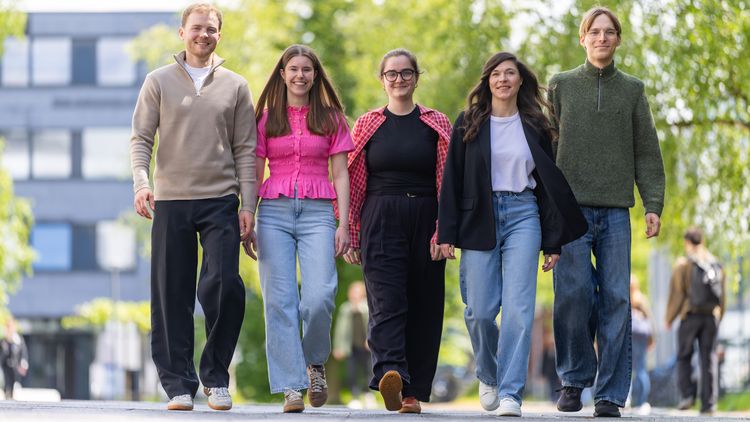

AI, wind turbines, nanochemistry: five students from Oldenburg present socially relevant research to MPs as part of the "Posters in the Bundestag" project. An opportunity to make their own approaches visible to the public.
Writing a Bachelor's thesis or participating in a research project is one thing. Developing a scientific and at the same time generally understandable poster for the general public from the results is something completely different. This was the experience of five Oldenburg students whose projects were selected by an independent jury for the "Posters in the Bundestag" exhibition in Berlin. Members of parliament, staff and interested guests can find out about their research projects - as well as those of numerous other Bachelor students from various German universities and colleges - in parliament from 26 June to 17 July. The posters highlight research work on current social, political, technological and ecological topics.
"Posters in the Bundestag" is part of the Erasmus+ project "Posters in Brussels", which brings students from European countries together with political decision-makers. Universities from Germany, Ireland, Lithuania, Luxembourg and Austria are involved. "'Posters in the Bundestag' makes student research visible," says Susanne Haberstroh, Head of the overall project and Head of the Department for Study Affairs at the University of Oldenburg. "The exhibition brings political decision-makers and the interested public closer to the research areas in which young people are involved - and at the same time promotes students' ability to communicate complex research in an understandable way."
Presenting research in an appealing way
Because that was the task: to reduce the students' own research to easily understandable key messages - on a DIN A0 poster and in a one-minute video. Education student Eva Verena Keding, for example, focussed on artificial intelligence in an academic context. In her Bachelor's degree programme, she investigated the conditions under which students make it transparent in their research work that they are using AI. Lots of statistics, surveys, various hypotheses: "It was really challenging to reduce myself to the essentials for the poster," reports Keding. "It helped me to tell various people I didn't know about my subject." What was incomprehensible quickly became clear to her.
Repeated presentations to non-specialists also helped Torben Schaefer. "My research is very data- and diagram-based - for the exhibition in the Bundestag, it was important to provide context without losing the scientific core." In his Bachelor's degree, the Engineering Physics student worked on how wind turbine rotor blades can be optimised so that they deliver enough energy in both weak and strong winds. Carlotta Steimke's topic: the political representation of women and stereotypes of female politicians based on their visual representation. "For equal participation and democratic structures, there needs to be significantly more women in general and diverse images of women in politics," says the social sciences student. "For the poster, I thought a lot about whether and how I could use my findings to formulate concrete demands for MPs."
Exchange with MPs in Berlin
Three online workshops supported the students with the implementation. They expanded their skills with an experienced science communicator: They learned how to present their theses attractively on a poster with headlines, graphics, choice of colours and text, how to give each other constructive feedback and how to design a pitch in front of a large audience. This was also the case for Joshua Stolle, who analysed how scientific and non-scientific argumentation patterns are used in Spotify podcasts and which forms of scientific scepticism become visible in the process. "It was very valuable to talk to students from different disciplines during the workshops," says the student, who studied Social Sciences and German Studies in his Bachelor's degree. "This gave me interdisciplinary insights into research topics that I would otherwise hardly have had any contact with."
At the end of June, the students will finally go to Berlin. At the exhibition, the students will see their posters in full size for the first time. At an opening ceremony, they will present their research live to members of the German Bundestag and want to engage in dialogue about their ideas and approaches. Prof Dr Ralph Bruder, President of the University of Oldenburg, and Andrea Lindholz, Vice-President of the Bundestag, will also be speaking there.
"It's great to help raise public awareness of student research topics," says Pia Wolken, a student teacher of biology and chemistry, who has focussed on cancer research as a learning field in chemistry lessons for her project. "Nanochemistry topics in particular are often perceived as abstract and less interesting. I'm delighted to be able to provide real-life insights." Torben Schaefer says: "Engaging in dialogue with politicians about your own research - that's a step out of the usual specialist bubble."