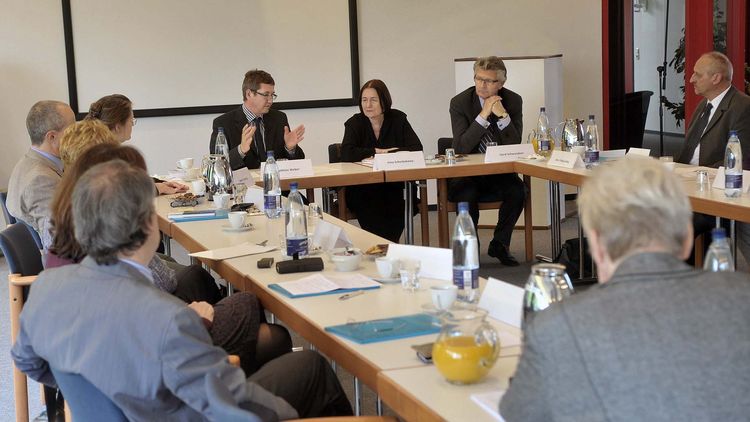

Irina Scherbakowa has been awarded the Carl von Ossietzky Prize by the city of Oldenburg. The Russian historian and human rights activist has now been invited to the Federal Institute for Culture and History of Germans in Eastern Europe (BKGE) for an expert discussion.
The exchange of ideas on the topic of "Germany and Russia. Perspectives on the 20th Century" with Dr Irina Scherbakowa was attended by Lord Mayor Prof. Dr Gerd Schwandner and academics from the Universities of Oldenburg and Bremen as well as the BKGE. Prof Dr Sabine Doering - a German scholar at the University of Oldenburg, member of the BKGE's Scientific Advisory Board and spokesperson for the jury of the Carl von Ossietzky Prize - once again pointed out the great consensus within the jury when selecting the prizewinner.
Irina Scherbakowa, who says of herself that she is "a historian at heart", has worked intensively with Kurt Tucholsky as a Germanist and translated his works into Russian. The committed publicist and oral history expert emphasised her proximity to the award's namesake, Carl von Ossietzky, who succeeded Tucholsky as director of the weekly magazine "Die Weltbühne" in 1927. The Weimar Republic is an interesting phase of the 20th century, which is a much-discussed era in Russia today, especially because of its experiences with democracy and parliamentarianism.
Irina Scherbakowa covered a wide range of topics, from the Tsarist era to the post-Soviet years and the current situation in Russia, from long-term historical perspectives to ruptures and turning points to topical issues. She repeatedly illustrated her analyses with impressive examples from student essays from the "All-Russian Student Competition", which she supervised. The examples illustrated the great tension between the various images, traditions and myths about the country's history and the concrete family stories experienced.
She also used the activities of the human rights organisation "Memorial" - Irina Scherbakowa is a founding member - to show new ways of dealing with the past and memory in Russia, for example the "Poslednij adres" ("The last address", similar to the "Stolpersteine" project known in Germany) for the memory of the victims of the Stalin era.
The current situation in Ukraine was also present at all times during the discussion. Scherbakowa pointed out distorted representations of Ukraine and the misuse of terms, but above all the great responsibility of journalists and historians for the preservation of the European peace order. The co-operation and expressions of solidarity that have been initiated, such as the Carl von Ossietzky Prize, are an important support for her and her colleagues from "Memorial".