
Contact

Press & Communication

+49 (0) 441 798-5446

More

Institute of Chemistry and Biology of the Marine Environment (ICBM)

Contact

Lennart Book

0441 99873398

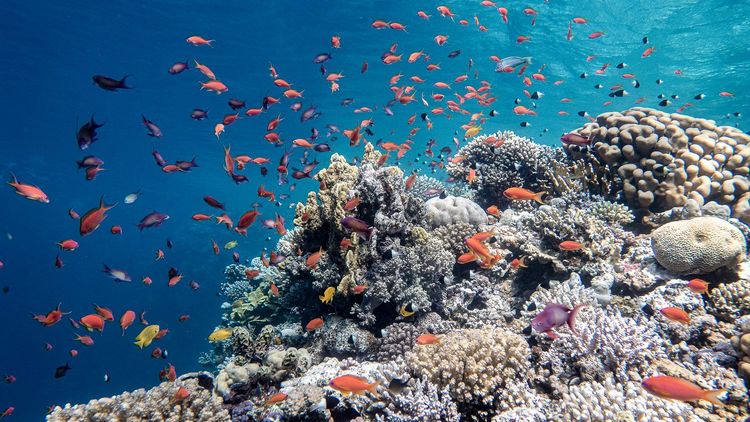
  • The picture shows an aquatic landscape with corals and fish

    The beauty of coral reefs never ceases to enchant people. Unfortunately, the underwater world of corals is in serious danger. Photo: Stephanie Helber

Discover the colourful diversity of the oceans

Immerse yourself in the underwater world - from the local North Sea to tropical coral reefs: three Oldenburg marine biologists make this possible with their colourful exhibition "Discover the colourful diversity of the oceans".

Immerse yourself in the underwater world - from the local North Sea to tropical coral reefs: three Oldenburg marine biologists make this possible with their colourful exhibition "Discover the colourful diversity of the oceans".

Showing the diversity of the oceans and arousing fascination for the often endangered habitats there - that is what drives the three marine biologists Dr Anna Roik, Dr Julia Strahl and Dr Stephanie Helber. They normally conduct research at the Helmholtz Institute for Functional Marine Biodiversity (HIFMB) and the Institute of Chemistry and Biology of the Marine Environment (ICBM) at the University of Oldenburg. With their exhibition "Discover the colourful diversity of the oceans", they are now also acting as curators for the first time.

"Many people are unaware of the biodiversity of our native North Sea, for example, and what the organisms living there actually do for us," says Helber. Reason enough to develop and realise an exhibition about this together with her two colleagues and more than 25 other researchers. They will be presenting the exhibits in the Smart House from tomorrow until 24 May.

The exhibition also looks at threats to marine life and their natural refuges and breeding grounds. They are primarily a consequence of climate change, says Anna Roik: "Climate change is leading to such rapid changes in living conditions that the individual organisms have little opportunity to adapt." There are also other threats such as mass tourism, marine pollution and overfishing. The exhibition draws attention to these risks and shows how marine scientists are investigating them. Short portraits also present concrete research and field work by researchers who are investigating the effects of environmental changes on the biodiversity of our oceans worldwide.

The exhibition is sponsored by the Universitätsgesellschaft Oldenburg (UGO) and the Barthel Foundation. Following the premiere at The Smart House Oldenburg, the show can be booked free of charge as a travelling exhibition.
This might also be of interest to you:

A smartphone displays the home page of the ‘Wohnen Oldenburg’ portal
Target group: students Campus Life

New portal helps students find accommodation

Limited funds, plenty of competition, tight deadlines and no experience with tenancy agreements: once they’ve been admitted to a degree course, many…

more: New portal helps students find accommodation
Vocational training Campus Life People

University welcomes 17 new apprentices

This week, 17 young people have started their apprenticeships at the university. The range of apprenticeship roles is wide – spanning everything from…

more: University welcomes 17 new apprentices
A man wearing a life jacket, an orange high-visibility jacket and a peaked cap is at the helm of a large inflatable boat. The water is relatively calm; in the background on the right is the research vessel Heincke, on the left a few wind turbines a little further away, and the setting sun, which bathes the scene in a golden light.
Thomas Badewien
Research Energy Top News Marine Sciences

Amidst the waves and wind turbines

A special research expedition recently took a team from Oldenburg to a stretch of sea north of Heligoland. The researchers had to overcome some…

more: Amidst the waves and wind turbines
(Changed: 18 Aug 2026)  Kurz-URL:Shortlink: https://uol.de/p82n7656en
Zum Seitananfang scrollen Scroll to the top of the page

This page contains automatically translated content.