
Contact

Press & Communication

+49 (0) 441 798-5446

More on the topic

Wittbülten National Park House Institute of Chemistry and Biology of the Marine Environment (ICBM)

Contact

Dr Birte Junge
ICBM Management
Tel: 0441/798-5344

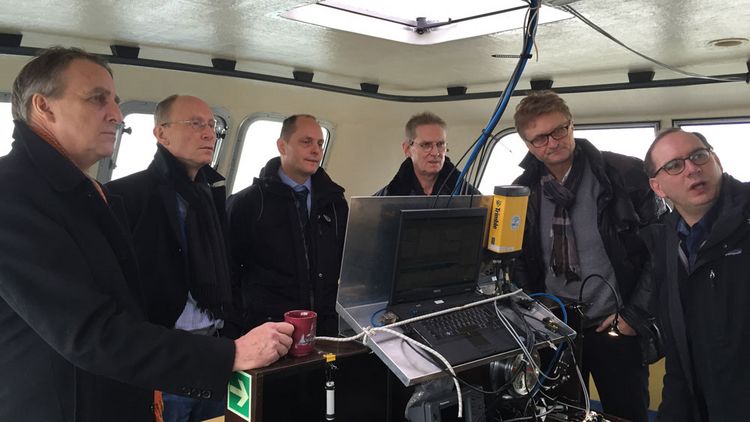
  • Setting course for Spiekeroog together (from left): Environment Minister Stefan Wenzel, University President Hans Michael Piper, ICBM researchers Bernd Blasius and Jörg-Olaf Wolff, Hubertus Hebbelmann (Ministry of the Environment) and Thomas Badewien (ICBM). Photo: Oliver Zielinski

Focus on the environment

The first step in the formation of dunes and thus an island is what are known as primary dunes - in Platt: "Wittbülten". The national park house of the same name on Spiekeroog, which has been operating a research centre in co-operation with the university since 2011, is now celebrating its tenth anniversary.

The first step in the formation of dunes and thus an island is the so-called primary dunes, known as "Wittbülten" in the local dialect. The national park house of the same name on Spiekeroog, which has been operating a research centre in co-operation with the university since 2011, is now celebrating its tenth anniversary.

220,000 visitors in ten years and a wide range of research activities - the environmental centre at Spiekeroog's Hermann Lietz School can look back on a success story. "The ensemble of school facility, national park house and research institution is unique," praised Lower Saxony's Environment Minister Stefan Wenzel at the ceremony at the weekend. "Standards are being set here," said Wenzel with regard to the joint commitment of the school, the National Park House and the University of Oldenburg.

University President Prof. Dr Dr Hans Michael Piper pointed out the "unique working conditions" offered by the Wittbülten research centre with its laboratories and the integration with environmental education. In addition to the Institute of Chemistry and Biology of the Marine Environment (ICBM), which is in charge of the centre, didactics specialists at the university also benefit from this.

Under the motto "Marine research for all", researchers from the ICBM and other participating universities in Augsburg and Göttingen presented their projects based on Spiekeroog in lectures and posters. In addition to soil science and Spiekeroog's freshwater resources, the topics also included the artificial islands that an Oldenburg research group has created in the mudflats for interdisciplinary biodiversity research.
This might also be of interest to you:

Campus Life International affairs

Researchers from around the world

The University of Oldenburg is international. Here we introduce people from all over the world who have chosen to come to Oldenburg. The following…

more: Researchers from around the world
A woman wearing a black T-shirt and with shoulder-length brown hair is smiling at the camera. Blurred green hedges can be seen in the background.
University of Oldenburg / Daniel Schmidt
Vocational training Campus Life

Supporting and guiding volunteers

Marina Bartels from the Study and Career Counselling Service coordinates the Voluntary Academic Year (FWJ) at the University of Oldenburg. She is…

more: Supporting and guiding volunteers
eine große Menschenmasse steht bei bewöktem Himmel draußen. Eine bunte Wimpelkette hängt über ihnen. Sie feiern, unterhalten sich und stehen herum.
Markus Hibbeler
Campus Life Landingpage [Discover] Personal International affairs

From cloudburst to summer bliss

The rain didn't put off this year's participants at the International Summer Fest. They enjoyed delicacies such as poffertjes and dorayaki, and a…

more: From cloudburst to summer bliss
(Changed: 21 Jul 2026)  Kurz-URL:Shortlink: https://uol.de/p82n1433en
Zum Seitananfang scrollen Scroll to the top of the page

This page contains automatically translated content.