
The Bible as a historical text, a critical examination of Christianity and interesting excursions: A look at studying theology and one graduate's special journey.
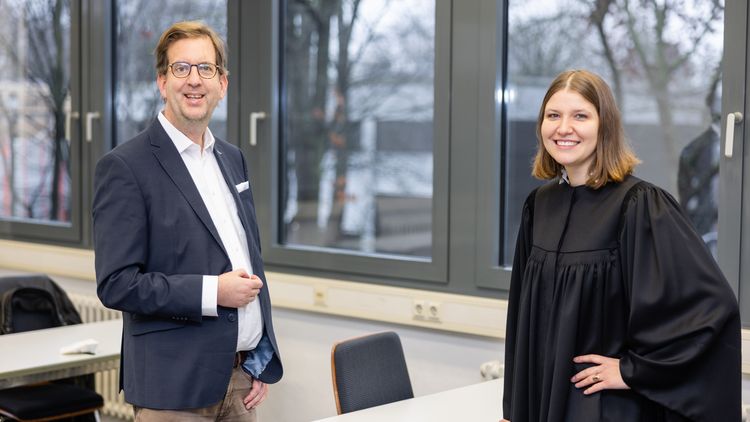
"I think the academic appointment is great because I meet so many people and have different points of contact with them from birth to death," says Lina Kohring. The 33-year-old is an alumna of the University of Oldenburg and was recently ordained as a pastor. The Oldenburg native, who studied Protestant theology and German as a teacher, remembers realising during her bachelor's degree that teaching would not completely fulfil her. Kohring therefore completed the master's degree programme "Ecumenism and Religions" in addition to her teaching degree. This is a speciality at the Institute of Theology in Oldenburg and enables students to broaden their horizons. Graduates can, for example, work in publishing houses and, in exceptional cases, become pastors.
Kohring had a challenging time ahead of her until her ordination, i.e. the ceremonial investiture. While writing her Master's thesis, she took summer courses in Greek and Hebrew. She also attended some missing study modules at the University of Münster: within a semester, the theologian learnt how to write and deliver sermons, attended worship teaching and pastoral care seminars. After taking various exams, she started her vicariate, the practical part of her pastor training, in Wiefelstede north of Oldenburg in 2019.
Wide range of courses and special excursions
The path Kohring has chosen is special. "At the Institute of Theology and Religious Education, students usually aim to become teachers," explains Dr Christian Wetz. The research assistant has been teaching in Oldenburg since 2013 and is responsible for the introductory courses on the New Testament, among other things.
With just under 1,000 students, the Institute is the largest of its kind in Germany. "There are five theological disciplines: the Old and New Testaments, church history, systematic theology and religious education as part of practical theology. All disciplines are represented at our Institute with one professorship each," explains Wetz. It is not only the wide range of courses on offer that attracts students to Oldenburg, but also the special research perspectives. Such as that of Wetz, who approaches the New Testament via both evolutionary psychology and cognitive science. "This approach via evolutionary psychology is still relatively unknown in German-speaking exegesis and is more common in Scandinavia," explains Wetz. "However, an important focus of our Institute is also ecumenism, i.e. the totality of the different denominations," continues Wetz. This is evidenced not least by partnerships with universities all over the world.
The theology programme in Oldenburg also has a lot to offer in other respects. This includes excursions to very different places. "I was in India for a fortnight back then. There we exchanged ideas with other students and visited Hindu and Buddhist temples," enthuses Kohring. There have also been trips to excavations in Israel and, of course, visits to places of worship in Germany. "We enable the students to look at things outside of theory and think outside the box," says Wetz. Students are therefore also given the opportunity to spend a semester outside of Oldenburg. For example, at the University of Vechta, where they can gain an insight into Catholic theology. Religious studies in Bremen, Jewish studies in Berlin or a semester abroad are also possible. "We don't dictate dogmatically what people have to believe, but rather take a critical look at Christianity and other religions," says Wetz. It should not be forgotten that theology is a science in which everyone is always involved. "Of course, atheists can also study theology here, but you're basically taking a critical look at a system that you yourself are part of," summarises Wetz.
In the summer, Kohring will finally take up her first pastorate after a maternity leave, at the Evangelical Lutheran Church in Oldenburg: "It is important to me to give people a good image of the church and to show them that it is valuable to have faith in your life." And maybe teaching at school at some point? That's not an issue at the moment - but the university has also prepared her well for it.