
How do early language experiences, especially bilingualism, affect the processing of language in the brain? This is the topic of a new Oldenburg project in the "Research Cooperation Lower Saxony - Israel" programme.
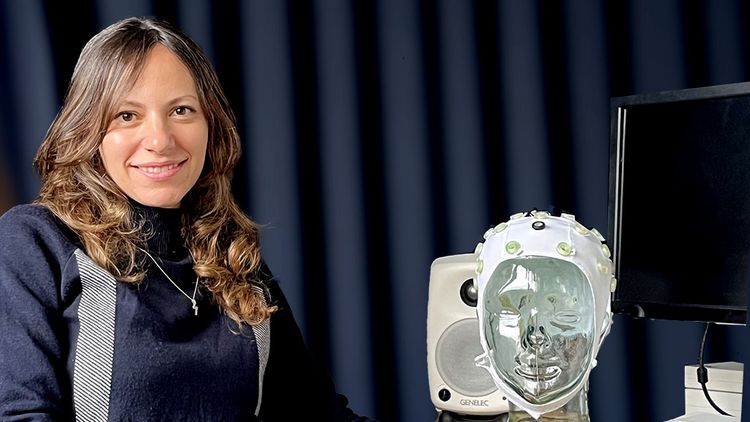
People who are at home in two languages find it particularly difficult to understand conversations in a noisy environment. Linguists Prof Dr Esther Ruigendijk from the University of Oldenburg and Dr Hanin Karawani from the University of Haifa want to find out why this is the case in a joint project. The Lower Saxony Ministry of Science has approved up to 500,000 euros for the project over the next four years as part of the "Research Cooperation Lower Saxony - Israel" programme.
Ruigendijk and Karawani want to find out in their project "Bilingualism in challenging listening conditions: Is it language specific or a general mechanism?" to jointly explore how early language experiences, particularly bilingualism, influence the processing of language in the brain and how this affects the ability to understand language. "Most people in the world use more than one language in everyday life - a fact that has hardly been taken into account by hearing research to date," explains Ruigendijk. The aim is to find out why a noisy environment poses particular challenges for bilingual people.
Are both languages always activated in bilingual people?
The team wants to understand whether there is a fundamental neuronal mechanism behind this effect - namely that both languages are generally activated in the brain of bilinguals, even if they are only speaking in one of them. The researchers and their teams are conducting a series of experiments with test subjects. Using a combination of language tasks and brain wave measurements, they want to find out whether the relationship between languages influences listening comprehension in a noisy environment.
For the experiments, they are looking for bilingual people with the language combinations Arabic - Hebrew, Arabic - German and German - Dutch, as well as people who use Hebrew and German as their only language. Karawani spent several months at the University of Oldenburg last year as a Humboldt Foundation scholarship holder and worked with Ruigendijk in the Hearing4all cluster of excellence to develop the basis for the joint research project.
As part of the "Research Cooperation Lower Saxony - Israel" programme, the state of Lower Saxony is funding a total of eight projects in the humanities and social sciences that are being carried out jointly by researchers from universities and research institutions in Lower Saxony and Israel. Two of the projects are based in Oldenburg. The funding comes from zukunft.niedersachsen, the joint funding programme of the Lower Saxony Ministry of Science and Culture and the Volkswagen Foundation.