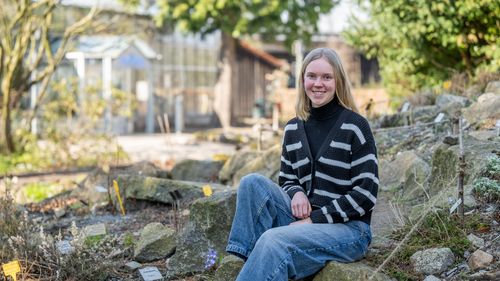
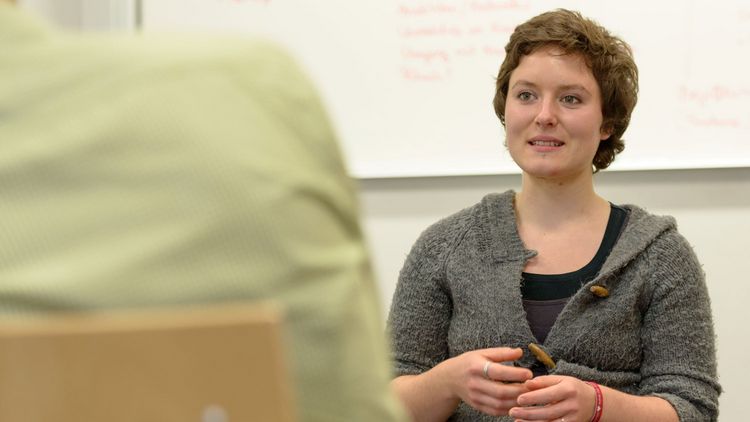

Solving fictitious patient cases and discussing cranial nerves in the anatomy room: Lucia Christians is the first prospective doctor at the European Medical School currently studying in Groningen - in Dutch.
"It's never lupus." Dr House, who tries to get to the bottom of mysterious patient ailments in the TV series of the same name, has his problems with the diagnosis of lupus. However, the disastrous dysregulation of the immune system is also particularly difficult to track down. Lucia Christians knows the series a little, but she knows lupus inside out. She is sitting in the cafeteria of the University of Groningen's School of Medicine, drinking the tea she has brought with her and talking about how her studies in Groningen are going.
In two days, the 24-year-old has to decipher a fictitious condition and make a diagnosis. Three possibilities remain: Lupus, neuroborreliosis or multiple sclerosis. "The tricky thing about lupus is that basically any symptom can point to it." Lucia Christians is studying medicine at the University of Oldenburg and belongs to the first EMS generation. She is in her third year of study. She and a fellow student are the first Oldenburg students to study in Groningen. The European Medical School's curriculum provides for a two-semester stay at the partner university.
Born in Munich, she has not regretted the move to Oldenburg. "I really wanted to do the model degree programme because it was important to me to learn practically first and not just spend two years reading books." Unlike her fellow students, she is not studying in English in Groningen, but in Dutch. She has already given her first presentation and the feedback was good. "I was very nervous, but the moment I gave the presentation, it went well." She will give another presentation in two days' time. The fictitious patient case she has to solve is tricky. She enters questions into the Groningen computer programme. She requests laboratory tests and CT scans, and the software delivers them.
She analyses the data in order to write a referral letter, the actual exercise, to the relevant specialist. Whether it really is never lupus, Dr House's credo, is something she doesn't want to commit to just yet. "But for me, it points more towards neuroborreliosis." Now she has to make progress with her diagnosis, she doesn't have much time left. She doesn't make a nervous impression. Not even when she goes down to the anatomy department at Groningen University Hospital after tea. In Groningen, Lucia is not one of 40 medical students per cohort as in Oldenburg, but one of 400. 50 students are now gathered in the anatomy room. The same event will take place eight times this week.
The students have split into groups. Today's topic is cranial nerves. There are five stations that the groups go through, led by an anatomy lecturer and his assistants, medical students from higher semesters. Lucia is in the group where a student is explaining. He repeatedly interrupts his digressions about models and dissected body parts with questions.
"Are there cranial nerves that are directly related to the eye?" "There is the abducens nerve and the oculomotor nerve." "And what does the abducens nerve have to do with the eye?" "The name stands for pull away, it pulls the eye to the side." "And which muscle does the nerve innervate so that the eye is pulled to the side?" "The rectus lateralis muscle." "And which other cranial nerves have something to do with the eye?" "For example, the optic nerve." "And what does this nerve do?" "It picks up signals from the retina and transmits them to the brain."
It's a question-and-answer flow that you don't know who enjoys more: the older students or the younger students. Lucia says afterwards, back in the cafeteria, that the assistant was very good. She has three more lectures today: On the brain inflammations meningoencephalitis and meningitis and on the socio-medical question "Can this patient work?" The first two lectures are given by neurologist Jan Kuks. It was he who brought the idea of computer-aided training from the USA and had learning software developed; he is an advisor to the curriculum in Oldenburg and director of the Master's curriculum in Groningen.
The Groningen medical curriculum, with its strong practical orientation, is the blueprint for the Oldenburg model degree programme. But there are also things that Kuks would like to take with him from Oldenburg to Groningen. His conclusion after three years on the EMS is extremely positive. "Things are going better in Oldenburg than I would ever have dared to hope."
He is full of praise for the first two Oldenburg medical students. "They are getting on very well in Groningen and are taking part in the discussions. Lucia speaks very good Dutch." It comes as no surprise when you hear from Lucia a few days later that her second lecture also went well. And that Dr House was right again: it wasn't lupus, but neuroborreliosis.
More on the topic
<link medicine/>School V - School of Medicine and Health Sciences</link>
Universitair Medisch Centrum Groningen (UMCG)
More articles from UNI-INFO
Contact
School V - School of Medicine and Health Sciences
Office of the Dean of Studies
Tel: 0441/798-2510
medizin@uni-oldenburg.de