
How do you make the lifestyle of a bygone era resound, especially with students who were all born two decades later? With the 70s Revue, the Institute of Music has found an answer that delights the audience.
Grand finale: almost 50 students take to the stage in the university auditorium. They sing "Stairway To Heaven" by Led Zeppelin. Sophisticated choreography - beaming faces: after more than two hours of the programme, "The 70s Revue" comes to an end. There were hits and evergreens from the decade in which the University of Oldenburg was founded - from ABBA's "Waterloo" to Elton John's "Your Song" and "Macht kaputt, was euch kaputt macht" by Ton, Steine, Scherben. The audience is enthusiastic. On three - completely sold out - evenings, the students brought the lifestyle of the 70s back to life.
The students Silja Mansholt (Music and Mathematics), Fabian Schulz (Music and Art), Nina Bolte (Sport, English, German as a Foreign Language) and Anne Bandemer (Music, English, German as a Foreign Language) sit together with one of the musical directors of the revue, Peter Janßen, in the university's Chamber Music Hall. They are discussing how the project came about and how they realised it. The students are united by the fact that they all wanted to take part in a major musical production at some point, including Anne: "I thought it was good that the project wasn't limited to a certain number of participants. Everyone could take part and contribute their own strengths. There was no casting in advance: Who can sing the best, who looks the best and who dances the best?"
Peter Janßen, together with Peter Vollhardt, has already realised major music projects with students at the Institute of Music in recent years. Every year, they offer the "Music Scene Theatre" module, which is unique in northern Germany in its orientation and, compared to music colleges, is less about the participants achieving musical perfection; rather, the focus is on the practical aspect. "Of course we want our students to be artistically fit and achieve a certain musical standard. But our primary aim is for them to be able to manage a theatre and music project when they teach in schools later on," explains Janßen. And Fabian adds: "When I stand in front of a class, I'm also a kind of conductor: the skills we have acquired during the seminar can also be used directly in the classroom - heck, you can use them anywhere."
To mark the university's 40th birthday, a revue was to be created with hits from the founding decade. Janßen and Vollhardt, both musically socialised in the 1970s, came up with a concept: "It was immediately clear to us that there had to be contemporary references in the show - the most important political developments. Otherwise it wouldn't be a revue," says Janßen. And it was clear from the outset that certain musical styles had to be reflected in the programme: pop, beat, disco, flower power.
The 1970s were socially and politically exciting: the education reform, Willy Brandt's policies, the end of the Vietnam War, the oil crisis, the RAF, the sexual revolution and women's movement, the anti-nuclear movement. The students, who were all born in the late 1980s or early 1990s, were given short keynote speeches to get them in the mood for the decade. "I have to admit that I hadn't studied the 1970s before the project," laughs Silja. Of course she was familiar with the music, maybe even saw a recording of the ZDF hit parade from back then, heard a strange pop song from the era in her parents' car - but she - like many others - only realised what the students of the 1970s achieved during the rehearsals for the revue. And a discussion immediately ensues about the legacy of the students of the 1970s:
Anne: "In the 1970s, much more was done by students than is the case today. That's quite impressive. They didn't like something, they were against it, then there was a demonstration."
Silja: "That's true. When you see how they took to the streets back then to push through the education reform, I can only say: hats off."
Nina: "We've only been on the streets once before, when it was against tuition fees. We already had the feeling: I'm against it now. But otherwise..."
Fabian: "But what do you want to demonstrate against today? It's actually all very well. I don't really feel the need to demonstrate."
Janßen: "Maybe you're still benefiting from what was achieved back in the 1970s. For us back then, it was like this: it stinks
us, there's something wrong - we're taking action against it. Perhaps you no longer need that today? For example, you could take to the streets now against the Bachelor's and Master's structures because you think it's too school-based."
Fabian: "Why, we don't know any different!"
Janßen: "We often didn't have anything to compare it to, but we took to the streets anyway."
Nina: "There are still things that annoy us - but I think nowadays you discuss them with your boyfriend or girlfriend in a small circle..."
Silja: "...and put a post on Facebook."
Working on the revue brought the whole group together. The rehearsals for "Die 70er Revue" lasted two semesters and took up more time than normal university seminars. Rehearsals took place every Monday evening, and the rhythm and string sections, choirs and dance group also met. Rehearsals were intensified on several weekends, tasks were allocated, arrangements were worked out and rehearsed. Everything was created in-house - including the elaborate costumes. "Of course we raided our parents' - or rather our grandparents' - wardrobes," laughs Nina. Shortly before the premiere, there was even a group that sewed flared trousers "A very special dynamic developed: The rehearsal weekends, the group work - nobody was excluded, everyone got involved. There was a real euphoria. And then the highlights, the performances themselves, the three evenings - that was a unique experience," says Silja.
"The 70s Revue" will be performed again on Wednesday, 29 October and Friday, 31 October, both at 8 p.m. in the university auditorium.
-
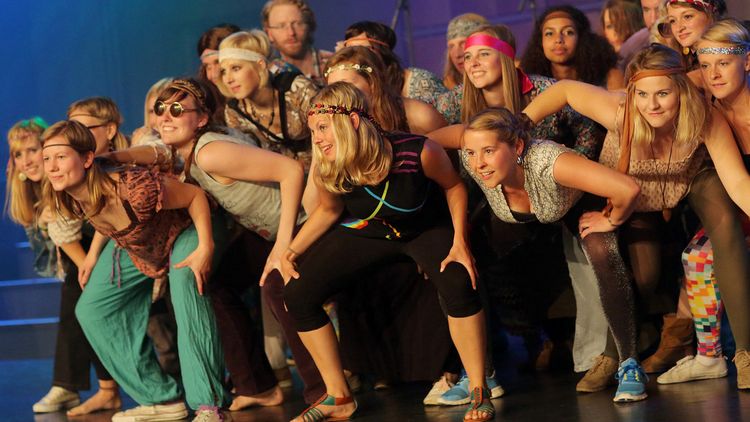
Presenting world hits from the founding decade of the university in "The 70s Revue": students from the Institute of Music.
Clay, stones, heirs


Topics
- Astronomy
- Biology
- Botanical garden
- Chemistry
- Computing Science
- Cooperations
- Covid
- Culture
- Dutch Studies
- Early Career
- Economics
- Educational Sciences
- Energy
- Energy Research
- Environmental Sciences
- Equal opportunities
- German Studies
- Graduate academy
- Health Services Research
- Higher Education Policy
- History
- Human Medicine
- International affairs
- Marine Sciences
- Material Culture
- Medical ethics
- Medical Physics and Acoustics
- Music
- Neuroscience
- People
- Philosophy
- Physics
- Presidential Board
- Psychology
- Research
- Slavic Studies
- Social Sciences
- Special Needs Education
- Sport Science
- Study Affairs
- Sustainability
- Teacher Education
- Theology
- Transfer
- University Medicine
- Ukraine
- Wind Physics