The University of Oldenburg is training several thousand future teachers. Some Master's students have now taken a very practical look at teaching in Dutch schools - and discovered some interesting differences.
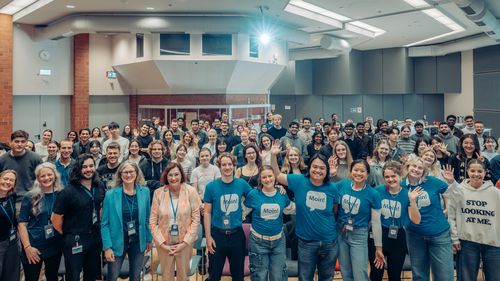
Mobile phone use in class? Tolerated in moderation. Interaction between teachers and pupils? Otherwise also quite relaxed. Technical equipment in the school? Very good. This and more was noticed by 23 Oldenburg students when they recently spent two days in the Netherlands as part of a block seminar and observed lessons at a secondary school in Groningen and a college in Haren.
"Exposure to other school systems, including in practice, broadens the students' personal and professional horizons," says Dr Sylvia Jahnke-Klein from the Institute of Educational Sciences, who organised the block seminar together with her colleague Sandra Loevenich. This was also the experience of the 23 participants.
The two-day excursion was preceded by two days of theory. The German and Dutch school systems are not easy to compare, says Jahnke-Klein: for example, due to the federal structures in this country and the different degrees of autonomy on both sides of the border. This also means that concepts are not easily transferable.
The start of school careers is also different. In the Netherlands, for example, children only move on to secondary school at the age of twelve. The common primary school period there comprises eight grades, with compulsory schooling starting at the age of five and many children attending (pre-)school at the age of four.
The intercultural insights into actual teaching practice were provided by Sandra Loevenich, who is not only a lecturer at the University of Oldenburg, but also maintains intensive contact with Dutch schools as a lecturer for the German Academic Exchange Service (DAAD) at the Noordelijke Hogeschool in Groningen and whose dissertation project deals with precisely these differences in teaching practice between the two countries.
In addition to the relaxed atmosphere in the classroom and the very good technical equipment in the schools, the Oldenburg students were particularly struck by the longer and more frequent independent work of the pupils. The impressions were deepened in discussions with student teachers from Groningen. Differences in teacher training and professional understanding also became clear. Many of the Dutch students have already been working in schools for years and are studying for their Master's degree while working - in just one subject and with more intensive practical phases than in Germany.
The two lecturers agree that different assessments on both sides - for example with regard to the ideal of the "perfect teacher" - offer interesting starting points for further excursions and research work. They would like to offer such a block seminar more often.
Further information on this topic
: Working Group on School and Classroom Researchand pre-school socialisation
Contact
: Institute of Educational Sciences
Dr Sylvia Jahnke-Klein
Tel.: 0441/798-2738
sylvia.jahnke.klein@uni-oldenburg.de
Sandra Loevenich
Tel.: 0441/798-2784