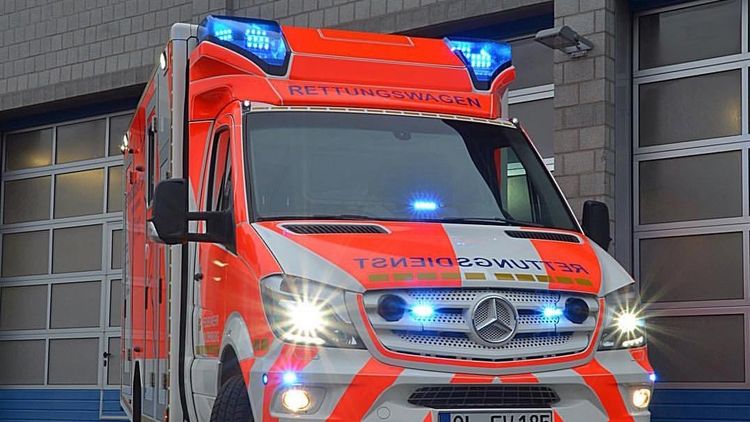


The start of the coronavirus crisis in mid-March suddenly presented the Oldenburg fire service with numerous challenges. The university helped out - with an IT system, the necessary equipment and personnel.
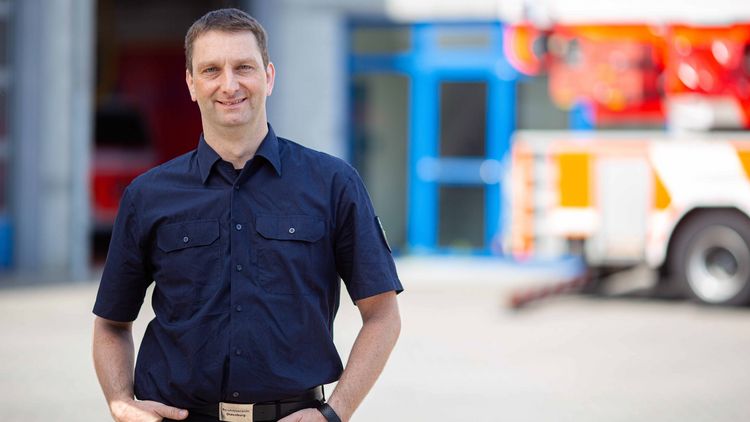
Stefan Thate, head of the rescue service at Oldenburg's professional fire brigade, described the situation in mid-March as a "serious situation with no empirical values". The number of people infected with the new coronavirus suddenly rose sharply in Germany too. "The images and background reports from Bergamo and Strasbourg made us realise that the situation could also become difficult for us," reports Thate. At this point, the aim was to prepare Oldenburg and the surrounding area as quickly as possible to be able to care for larger numbers of patients.
It quickly became clear that the normal capacities of the rescue service were not sufficient for this task. "We immediately needed a special organisational structure and additional resources, such as support to procure protective clothing and other medical products or to better forecast the number of hospital beds required," says Thate. As a co-founder of the Oldenburg Research Network for Emergency and Intensive Care Medicine (OFNI), an association of research institutions and partners from the field, the head of operations knew where he could get additional help for these tasks: at the university.
"Many people worked together in an uncomplicated way"
The university provided support with protective clothing and laboratory materials, while the Innovation(s)campus of the Innovative University of Applied Sciences Jade Oldenburg! (IHJO) used 3D printers to produce adapters for respiratory masks. Robert Hentschke from the university's occupational safety department and Manuel Karczmarzyk from the Centre for Lifelong Learning (C3L) were always available. "Many people worked with us in an uncomplicated manner and supported us in a variety of ways. I would like to say a big thank you to everyone involved," says a delighted Thate.
The fire brigade received special assistance from the Centre for Lifelong Learning and the School V - School of Medicine and Health Sciences. Matthias Hemmelgarn from the fire service's vocational college used existing contacts from joint training courses with the C3L for a special request and immediately received a positive response: the C3L made the online platform C3llo (pronounced cello) available within four days in mid-March. The learning management system offered the rescue service employees the opportunity to organise projects, edit and manage content together, share information and prepare specific e-learning formats, such as short courses on infection protection.
Making the situation manageable
"C3llo is the learning environment for our in-service programmes and was programmed in-house. We are therefore very flexible with it," reports Annabelle Jandrich, Head of IT/Media/Learning Design. "We wanted to help quickly, so we customised the system to the needs of the fire service and got it up and running in no time at all," continues Jandrich. The fire service also uses C3llo for the training of emergency paramedics, which can currently only take place digitally, and for further training. "All of this has really helped us to make the situation manageable," says Thate.
Dr Insa Seeger and Andrea Klausen from the Department of Health Services Research and Volker Thiemann, Head of the Research Data Management Service Centre at the School of Medicine, witnessed first-hand how the coronavirus situation in Oldenburg developed from the beginning of April: the three university employees were seconded to the city from 1 April to 31 May and directly supported Stefan Thate and his large team.
Online training and protective material
Seeger, a health scientist and scientific coordinator of the OFNI research network, was involved, for example, in the planning for a makeshift hospital that would have been set up if the capacity of Oldenburg's hospitals had not been sufficient at the height of the pandemic. Nursing expert Klausen and medical IT specialist Thiemann also worked in a multi-professional project group at the Oldenburger Land large-scale control centre to develop forecasting tools, for example to calculate and visualise scenarios for the occupancy of hospital beds.
Together with the team from the professional fire brigade, Klausen, a qualified nurse with many years of experience in the field of nursing training, also organised a 40-hour online training course for nursing assistants. The three university employees also worked with the fire service's experienced logistics team to find new sources of urgently needed protective equipment such as masks and gloves.
Maintaining and expanding co-operation
"Working for the rescue service was a lot of fun," summarises Seeger. "The collaboration was very pleasant on a personal level and it was great to see results quickly." Even if the temporary hospital did not ultimately have to be set up, the plans for it are now in the drawer and could be implemented if there is a second wave of illness.
Head of Operations Thate is certain that some of the experiences from the coronavirus period will continue to play a role in the future: "We should definitely maintain the co-operation with the university and the exchange of experts - and expand it!"