
The way in which teachers manage to spark curiosity and a spirit of inquiry in their pupils during General Studies is to be more firmly embedded in teacher training in Oldenburg. To this end, the University will in future be collaborating with the association Forscherbambini e.V., which acts as the local network in Oldenburg for the nationwide educational initiative ‘Haus der kleinen Forscher’.
Prof. Dr. Yvonne Gabriele Ehrenspeck-Kolasa and Dr Ines Oldenburg, a private lecturer at the Institute of Educational Sciences, will henceforth work closely with the non-profit educational initiative, which is half-funded by the Federal Ministry of Education and Research and operates under the patronage of Minister Prof. Dr Johanna Wanka.
The co-operation between the university and the “Haus der kleinen Forscher” initiative has one main objective: to ease children’s transition from nursery to primary school by ensuring that General Studies at school build on the spirit of discovery fostered in nurseries. For this to work, nursery staff and teachers must agree on a common approach. “In future, joint workshops with nursery staff from Oldenburg are to be facilitated as a pilot project within the primary school teacher training programme,” explains Ines Oldenburg. In the ‘Lernwerkstatt’, the educators will, amongst other things, work together to consider how nursery and primary school children can conduct age-appropriate research, and also develop specific ideas, such as experiments on the topics of acoustics and water.
As primary school teachers are permitted to teach all subjects, the workshops are open to all trainee primary school teachers – regardless of the combination of subjects they are studying. “In this way, we want to help our trainee teachers overcome their apprehension about scientific or technical topics,” says Oldenburg. The co-operation with the ‘Haus der kleinen Forscher’ also offers trainee teachers a very practical benefit: they gain direct access to its supporting materials. In addition, the Forscherbambini association has acquired special technology kits with the help of the North-West Metal Industry Foundation. Using these, children can, for example, explore the topic of energy and build wind turbines and solar-powered vehicles.
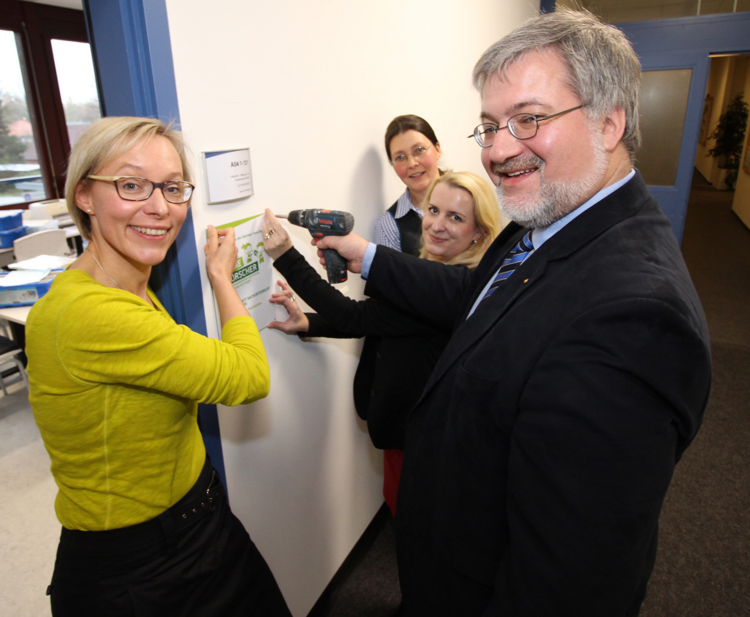
The co-operation between the university and Forscherbambini e.V. was officially sealed today by the association’s patron, Stephan Albani. The Member of the Bundestag, who is also, amongst other things, managing director of The Haus des Hörens in Oldenburg, presented representatives of the university with a partnership plaque. Together with the association’s chairpersons, Dr Beate Grünberg and Isabell Sproß, he expressed his conviction that this would provide children in the region with better educational opportunities. This is because research and experimentation not only foster an interest in science, mathematics and technology, but also strengthen other core skills, such as language and social skills, solution-oriented thinking and confidence in one’s own abilities.
The charitable foundation “Haus der kleinen Forscher” has been committed since 2006 to improving the education of children of nursery and primary school age in science, mathematics and technology. Through a nationwide training programme, ‘Haus der kleinen Forscher’ supports educational specialists and teachers in fostering a spirit of discovery among girls and boys and in providing them with expert guidance during their research. The educational initiative thus makes an important contribution to promoting educational opportunities, professionalising teaching staff and securing the next generation of specialists in the STEM fields. In the Oldenburg area, almost one in two nurseries takes advantage of the services offered by the “Haus der kleinen Forscher” educational initiative.