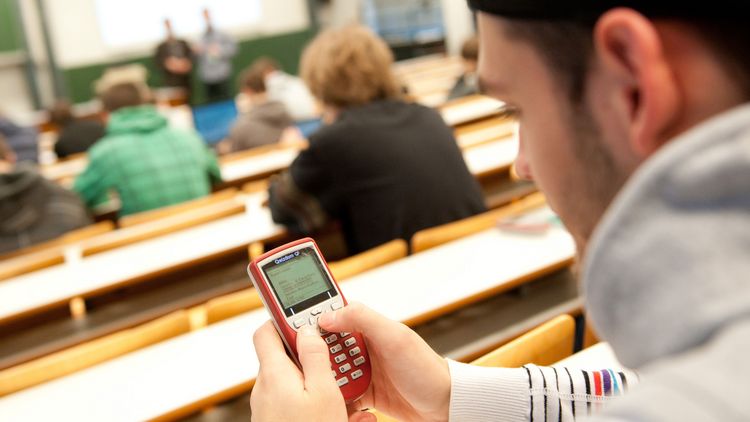
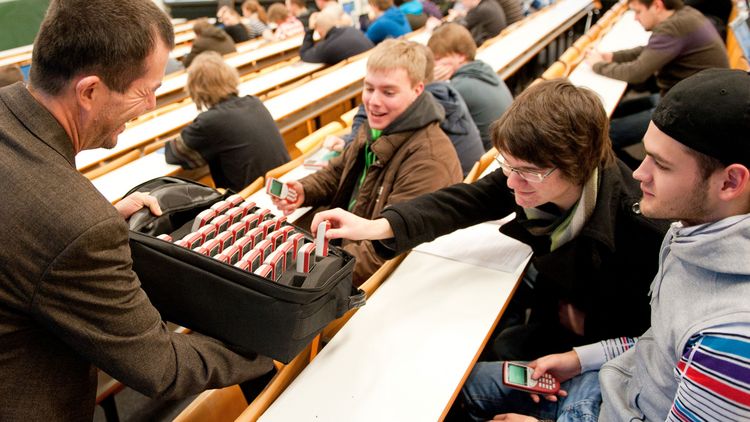
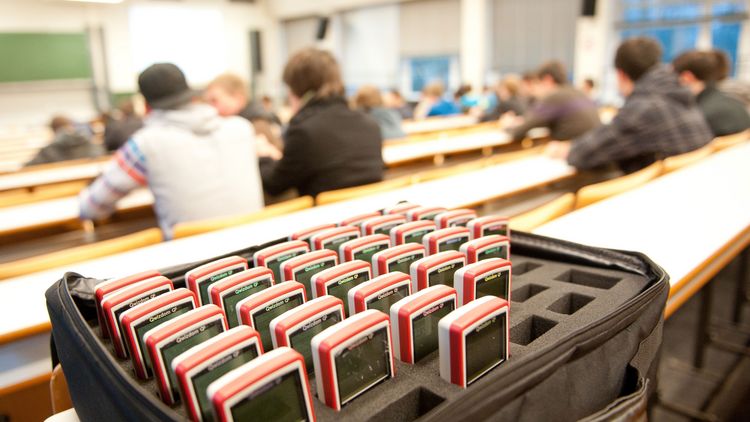


It’s a lecture, and nobody’s listening. Professors at the University of Oldenburg have come up with a solution to this problem. Since the winter semester, they have been using ‘audience response systems’. Students simply call them ‘clickers’. These devices are familiar from quiz shows.
“Who has read Jeff Jarvis’s new book?” Questions like this kick off the discussion in many seminars. In a packed lecture theatre, however, this approach doesn’t work very well: to establish contact with the audience and capture their attention, the lecturer has to resort to other methods. For example, audience response systems (ARS): small, handy devices that television viewers know all too well – from Günther Jauch’s quiz show “Who Wants to Be a Millionaire?”
These remote controls are known as “clickers”, and their use in universities is still the exception rather than the rule. Prof. Dr Axel Hahn, a business informatics expert, has now introduced them at the University of Oldenburg. The advantages: students answer questions anonymously using clickers. The technology presents the ‘survey results’ graphically so that the lecturer can use them immediately. However, the devices can be used for more than just a simple question-and-answer game. For example, students can help decide whether a point should be explained using a further example, or whether the pace of the lecture is too fast or too slow.
“Whilst e-learning often used to create a distance between lecturers and students, clickers are a good example of how communication in traditional lectures can be improved,” says Prof. Dr Gunilla Budde, Vice-President for Studies and Teaching.
“Teaching can be better tailored to the students through the use of clickers. And any lecturer can use the devices,” Hahn is also convinced. He introduced the devices as part of the Lower Saxony Network for E-Assessments & E-Exams (N2E2) project, which is funded by the State of Lower Saxony and the University of Oldenburg, partly from tuition fees. “The project team was surprised by the enthusiastic response from lecturers. The initial experiences were so positive that the Schools are now purchasing further devices. The existing ones are in constant use.” According to Hahn, further application scenarios are now being developed within the N2E2 project. “The ideas range from educational games to electronic examinations.”