Hybridisation from two sides


Hybridisation from two sides
Hybridisation from two sides: Ukrainian-Russian and Russian-Ukrainian codemics in the context of the (socio)linguistic situation in southern Ukraine along the Black Sea coast
(English version below)
PROJECT LEADER:
Prof Dr Gerd Hentschel (Oldenburg, Germany)
Prof. Dr Tilmann Reuther (Klagenfurt, Austria)
COLLABORATORS:
Dr Olesya Palinska
CO-OPERATION PARTNER:
Prof. Dr Tilmann Reuther, Institute for Slavic Studies, University of Klagenfurt
Prof. Dr Oleksandr Taranenko, Institute of Linguistics of the National Ukrainian Academy of Sciences
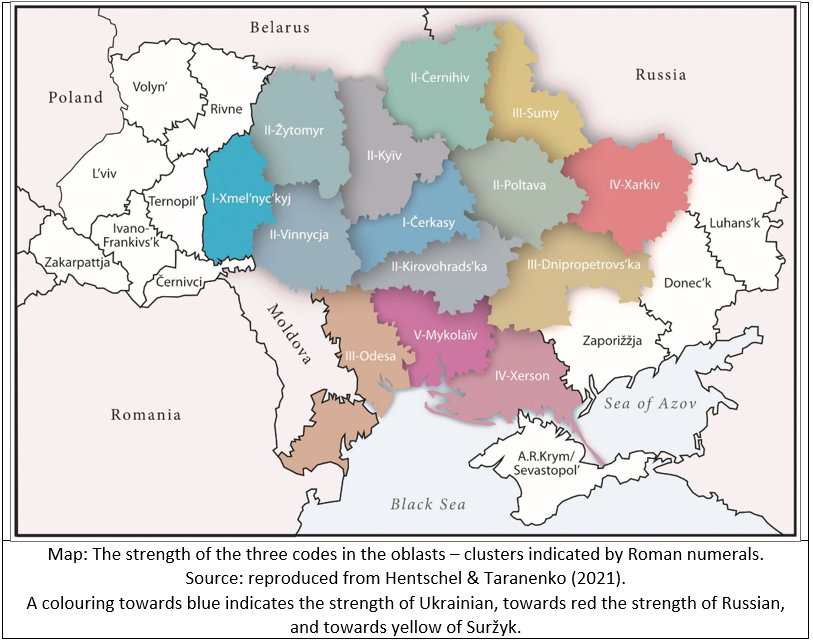
Ukraine is a multilingual country. The bilingual constellation of Ukrainian and Russian is dominant. Ukrainian is strong in the west, Russian in the east and south. Central Ukraine represents a transitional area. The two structurally closely related languages function as donor languages for a mixed code, the "Suržyk". The specific point about Suržyk is that it exists (as is assumed) in two variants.
The "prototypical Suržyk" dates back to the period of political and social dominance of Russian in Ukraine. From the 1860s of the Tsarist era and from the 1930s of the Soviet era, people adapted to the Russian-speaking environment. The development of the "old" Suržyk is similar to the so-called "dialect levelling". Although there is still some variability, a certain stabilisation of this code can be observed, as adults began to speak in "old Suržyk" among themselves and with their children in informal communication situations over several generations. The second variant of the mixed code, called "New Suržyk" here, is of more recent origin. It developed among speakers who mainly used Russian before turning at least partially to Ukrainian due to language policy from 1990 onwards. The New Suržyk thus has a Russian base and is most likely to be found - alongside the Old Suržyk - in the south of Ukraine (and in the east, which is currently not accessible for systematic research).
The central research question with an innovative contact linguistic dimension is: Is a clear differentiation between two mixed codes based on the same two closely related donor languages possible? Or is there a gradual transition between speaker groups with different socio-demographic backgrounds?
The hypotheses of our project are:
- Grammatically, a distinction can be made between Old Suržyk and New Suržyk mainly on a quantitative basis, with cluster differences between speakers (e.g. in the range of inflectional endings).
- Lexically, there are clear differences - predominantly Ukrainian vs. predominantly Russian-influenced lexis.
- In terms of phonology, Old Suržyk and New Suržyk are structurally different.
- The New Suržyk is more variable than the Old Suržyk.
The alternative to these hypotheses is that no two different Suržyks are recognisable, but rather a continuum between a strongly Ukrainian and a strongly Russian Suržyk, combined with socio-demographic differences at various levels.
The methodological approach of the project consists of an innovative corpus linguistic description, combined with analytical methods of quantitative variation linguistics, which are correlated with socio-demographic data. In addition, in-depth interviews on individual "language biographies" will be conducted and qualitatively analysed in order to compare quantitative and qualitative findings.
Hybridisation from two sides: Ukrainian-Russian and Russian-Ukrainian Code Mixing
in the context of the (socio) linguistic situation in southern Ukraine along the Black Sea coast
The Ukraine is a multilingual state, with a predominantly bilingual constellation - Ukrainian and Russian. These two structurally closely related languages function as donor languages for a mixed code called Surzhyk. The specific point with the Ukrainian-Russian mixed code is that it may exist in two variants, reflecting the history of the country.
"Prototype Surzhyk" stems from the times of Russian political and social dominance in the Ukraine: From the 1860-ies in Tsarist times and from the 1930-ies in Soviet times people adapted themselves to a Russian-speaking environment. Though quite variable, a certain stabilisation of this mixed code is observed, since adults started to speak Old Surzhyk between themselves and with their children in informal communication over several generations. The second variant of mixed code, here called "Neo-Surzhyk", is of younger origin. It evolved with people who used to practise mainly Russian, but - due to the Ukrainian language politics after 1990 - had at least partially to turn to Ukrainian. Neo-Surzhyk thus has a Russian base and is expected to occur - most probably along with Old Surzhyk - in the South of the Ukraine (and in the East, now inaccessible for systematic research).
The central research question of our project with a general contact-linguistic dimension is the following: Is there a clear differentiation between two mixed codes based on the same two closely related donor languages? Or is there a gradual transition between groups of speakers with different sociodemographic backgrounds?
The methodological approach of the project consists in a corpus linguistic description, combined with analytical methods of quantitative variationist sociolinguistics, correlated with sociodemographic data. In addition to that, in-depth interviews on individual "Sprachbiographien" (linguistic biographies) will be conducted and analysed qualitatively, in order to correlate quantitative contact-linguistic findings with qualitative data.
Publications on the topic: Publications on "Hybridisation from two sides"