Variability and stability in the mixed substandard: Suržyk

Variability and stability in the mixed substandard: Suržyk
Variability and stability in the mixed substandard in extensive and time-stable language contact: Ukrainian Suržyk between Ukrainian and Russian (in comparison with Belarusian Trasjanka)
SUPPORTERS
Fritz Thyssen Foundation
DURATION
2014-2019
PROJECT LEADER:
Prof Dr Gerd Hentschel
EMPLOYEES:
2014-2016: Anastasia Reis
from 2017: Olesya Palinska
CO-OPERATION PARTNER:
Prof Dr Oleksandr Taranenko, Institute of Linguistics of the National Ukrainian Academy of Sciences
Brief description 2014
The terms "Suržyk" (in Ukraine) and "Trasjanka" (in Belarus) refer in particular to those forms of "mixed" speech in which autochthonous (Ukrainian or Belarusian) and Russian elements and structures alternate in short, rapid succession, even within individual sentences. Millions of speakers in both countries use this form of speech. While Belarusian and Russian are state languages in Belarus, but Russian clearly dominates politically and socially as in Soviet times, Ukrainian is the sole state language in post-Soviet Ukraine. Nevertheless, Russian is still very much present today. "Suržyk" and "Trasjanka" became a modern mass phenomenon, particularly as a result of industrialisation and urbanisation and the associated linguistic adaptation of Ukrainian and Belarusian rural-urban migrants to Russian, which dominated in the cities. The "prototypes" of "Suržyk" and "Trasjanka" are thus speech phenomena on an autochthonous (Ukrainian and Belarusian) basis. (A more recent "suržyk" on a Russian basis is not the subject of this project). Today, normative linguists and cultural scientists in both countries regard mixed speech as a sign of a lack of education or lack of culture. Due to this stigmatisation, the neutral terms "Ukrainian-Russian mixed speech" (URGR) and "Belarusian-Russian mixed speech" (WRGR) will be used in the following.
The proposed project pursues four core objectives, three of which are linguistic: Firstly, there is the goal of a comprehensive linguistic description of URGR in its phonetic, grammatical (morphological and syntactic) and lexical structures. (For the WRGR, this was largely achieved by the Slavic applicant as part of an earlier project funded by the Volkswagen Foundation). The second aim of the proposed project is a systematic comparison of URGR and WRGR. Thirdly, a linguistic-theoretical goal is being pursued: Linguistics in the target countries (Ukraine, Belarus) generally report irregular, unsystematic, even chaotic mixtures of autochthonous (Ukr./Wr.) and "foreign" (Russian) components in the mixed speech of individual speakers. In the studies on WRGR, on the other hand (with the approach of a quantitatively orientated sociolinguistic analysis of comprehensive text corpora), stable qualitative-quantitative patterns with hierarchical characteristics could be established, according to which Russian and Wr. elements, constructions and features vary. These results will now be tested on Ukrainian-Russian data with the aim of identifying constants of variation in the language mixture. Linked to this is the discussion of the theoretical question of qualitative, quantitative and/or linguistic-sociological criteria for the emergence of "independent" mixed languages, in this case from two closely related languages. So far, this question has mainly been discussed with regard to contact between structurally and typologically very different source varieties. At the same time, it needs to be clarified in this context what is generally understood by a "usage" in highly variable social sub-varieties. In this case, "usage" is certainly something different than in a standard language stabilised by codification and also something different than in "old" autochthonous dialects of a socially less mobile local population.
Finally, the fourth objective is to evaluate the URGR from a linguistic-sociological point of view. (The applicants have already carried out the linguistic-sociological investigation of the URGR in the aforementioned "VW project"). The most important question here is whether URGR has an identification potential for certain sections of the population and to what extent its use is an expression of a social, national or ethnic (or also "sub-national" / "sub-ethnic") identity.
Due to the linguistic and sociological research aspects envisaged, the proposed project has an interdisciplinary character with a focus on socio-linguistic and variationist questions, both descriptive and theoretical. The study of the URGR and, as a comparative object, the WRGR breaks away from the largely persistent focus of "native" (Ukrainian and Belarusian) linguistics on the "maintenance" of the respective literary languages and a traditionally understood dialectology. It thus takes account of the plurality of linguistic forms of expression in an area whose sociolinguistic and linguistic-sociological research was only possible to a limited extent for a long time for political reasons.
Short report 2015
Mixed speech | "Variability and stability in the mixed substandard in extensive and time-stable language contact: Ukrainian-Russian mixed speech in Ukraine in comparison with Belarusian-Russian mixed speech in Belarus" is at the centre of a project by Prof. Gerd Hentschel, Institute of Slavic Studies, University of Oldenburg, and Prof. Bernhard Kittel, Institute of Economic Sociology, University of Vienna.
Ukrainian-Russian mixed speech" (URGR) and "Belarusian-Russian mixed speech" (WRGR) are widely practised oral "mixed varieties" in which Ukrainian or Belarusian and Russian elements alternate. While WRGR is a relatively widespread phenomenon in Belarus, in Ukraine URGR was considered more of a phenomenon in the centre, especially in the east. Here, in the centre, language sociological surveys and sociolinguistic recordings of language data will be carried out for the project. The latter will be processed into annotated corpora (analogous to the existing Belarusian corpora: uol.de/ok-wrgr).
The linguistic-sociological part of the project focuses on the connection between national or social orientation and the use of the three relevant codes in Ukraine (Ukrainian, Russian, URGR). Initial results are available on the distribution of the codes. The following diagram illustrates this, with five sub-areas emerging (cf. Hentschel & Taranenko 2015):
(please click on the image to enlarge)
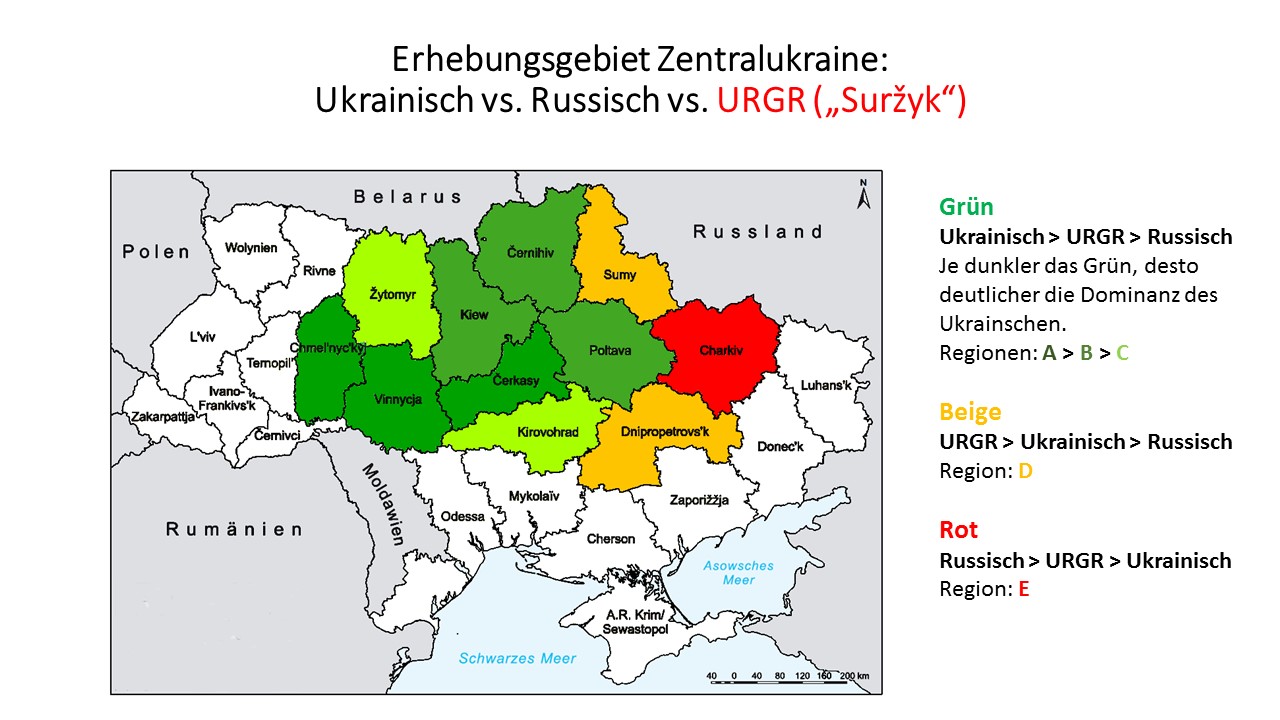
The vast majority of respondents do not use just one code. Between 40% of respondents in area (A) and over 80% in area (D) use the URGR frequently in everyday life. In general, not only a west-east, but also a centre-periphery dimension of gradual differentiation was found. Largely independent of linguistic orientation, respondents (90% and more in the individual districts) see Ukrainians and Russians as two separate "nations". Similarly, a majority of respondents see a clear difference between Ukrainian and Russian culture, although the differences that can be identified in the districts are not related to linguistic orientation.
The language materials are currently being transcribed for the comprehensive description of the phonological, morphological, syntactic and lexical structures of the URGR planned for the linguistic part of the project. Each individual word form is being classified according to relevant grammatical criteria. By comparing the corpora of URGR and WRGR, a contribution to the theory of contact linguistics is to be achieved: Do WRGR and URGR show comparable hierarchical patterns according to which elements of their "donor languages" vary? Is there a "usus" in such highly variable mixed social subvarieties, i.e. are relatively stable patterns of distribution of Ukrainian or Belarusian elements on the one hand and Russian on the other?
Publications on the topic: